






















Nikon 14-30mm F/4 S vs Tamron 16-30mm F/2.8 G2: Which Lens Is Right for You?
Aug 26, 2025
Anzalna Siddiqui
A psychology major in her third year of Bachelor’s, Anzalna Siddiqui has endless curiosity for the human mind and a deep love for storytelling – both through words and visuals. Though she hasn’t taken up photography as a profession, her Instagram is where her passion finds its home. In addition to this, she’s a travel enthusiast who never travels without her camera because every place has a story waiting to be captured.
Share:
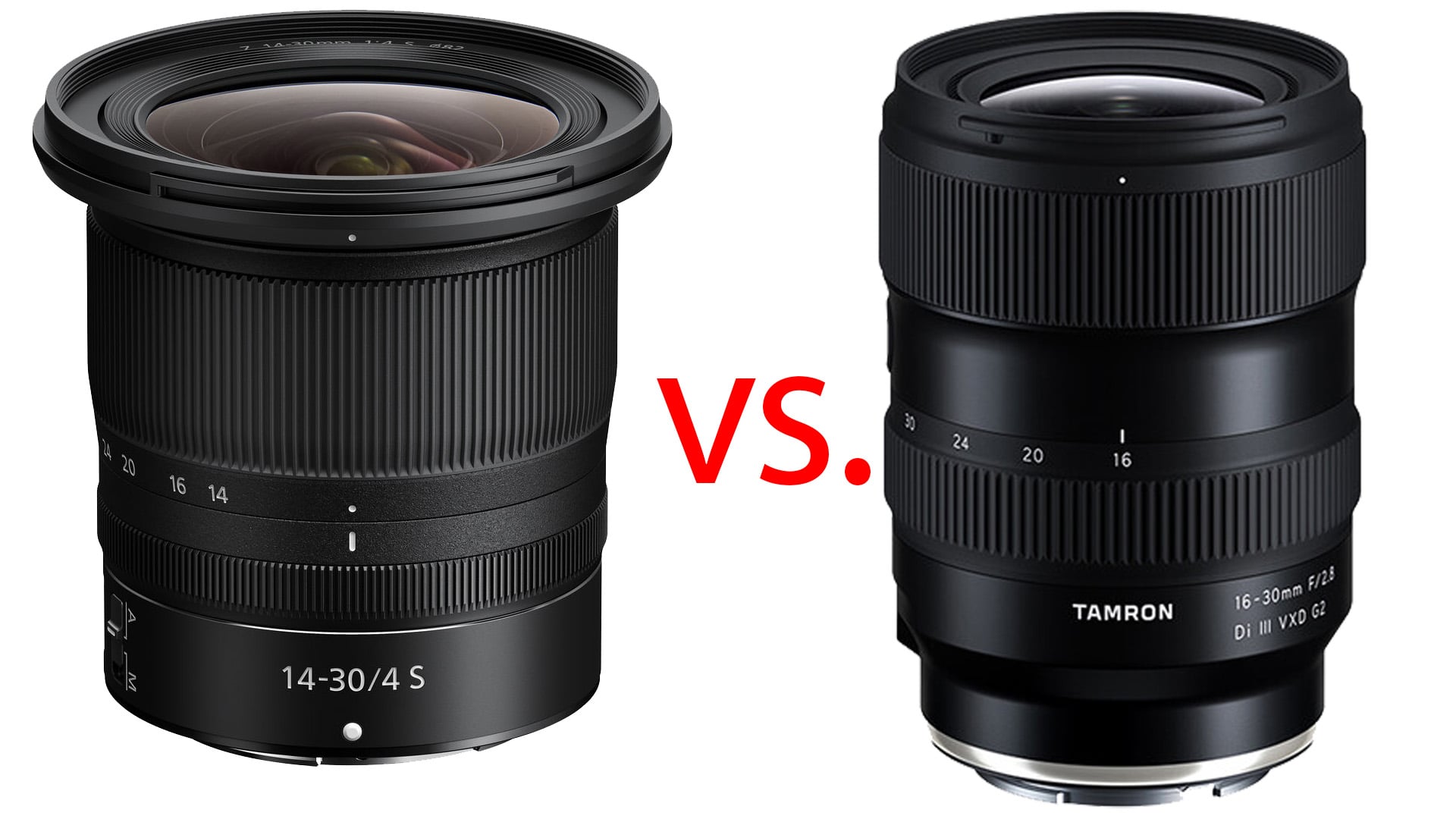
Picking out a new lens can be quite challenging, don’t you think? It’s a significant purchase, and you want to ensure you’re getting great value for your money. If you use a Nikon Z-mount camera, you might be considering two popular wide-angle zoom options: the Nikon 14-30mm f/4S and the newer Tamron 16-30mm f/2.8 G2. But how do you choose between them? One is a well-known Nikon lens that offers exceptional quality, while the other is a third-party option that has a faster aperture and is more affordable. So, Nikon 14-30mm vs Tamron 16-30mm: which lens is right for you?
In a recent video, photographer Adrian Alford summarizes the main differences, helping you decide which lens should go into your camera bag.
Size and Handling: It’s All in the Zoom
When you first look at these lenses, you might notice that the Nikon 14-30mm f/4S is shorter when it’s closed up. However, there’s an interesting feature: to start using it, you need to pull the lens out. At the widest setting of 14mm, the lens actually becomes longer, extending quite a bit and making it longer than the Tamron.
On the other hand, the Tamron 16-30mm f/2.8 G2 has an internal zoom mechanism. This means that no matter which focal length you choose, the size of the lens remains the same. This is important because when a lens extends, it can let in dust and moisture, which you definitely want to avoid during a shoot. Tamron’s design likely provides better weather protection.
Moreover, Adrian discusses weight. The Tamron weighs 450 grams, while the Nikon is slightly heavier at 485 grams. While this isn’t a huge difference, every gram matters if you’re carrying your gear all day. If you’re traveling and want to keep your backpack light, the Tamron might be the better choice for you.
Specifications and Performance: The Technical Nitty-Gritty
Adrian says the main difference between these two lenses is their aperture. The Nikon lens has an f/4 aperture, which works well in many situations, particularly for landscape photography where smaller apertures are often used. On the other hand, the Tamron lens has a wider f/2.8 aperture, giving you more options. A wider aperture allows you to shoot in lower light without raising your ISO too much, and it also helps create that nice, soft background blur known as “bokeh.”
When it comes to bokeh, he notes that the Tamron can focus closer to your subject at its widest focal length (19cm at 16mm versus the Nikon’s 28cm). This feature lets you capture some interesting close-up shots and really take advantage of shallow depth of field. It’s neat how you can use a wide-angle lens for close-ups to achieve a different viewpoint.
Adrian also mentions that both lenses are quite similar in terms of sharpness. He suggests that the Nikon might be “a little sharper or crisper,” but the difference is minimal and likely won’t be noticeable in most everyday photos. Overall, both lenses offer excellent image quality.
The Great Filter Debate and Price Tag
One aspect that might not come to mind immediately is the size of the filter thread. The Nikon lens has an 82mm filter size, which can be quite pricey. In contrast, the Tamron lens features a more common 67mm filter thread. If you already own some filters, you may find that the Tamron’s size works better with your current equipment. Adrian points out that Tamron often uses a 67mm thread for its f/2.8 G2 lenses, making it easier for photographers who prefer this brand. This means you can use the same filters on multiple lenses without needing to buy new ones for each.
When you decide to purchase, the cost is a significant consideration, and there is a noticeable difference in price. The Nikon 14-30mm f/4S usually costs around $2,300 AUD, while the Tamron 16-30mm f/2.8 G2 is priced at about $1,799 AUD. That’s a difference of roughly $500, which could go towards other equipment.
Making a Choice
After all the comparisons, what’s the conclusion? Adrian owns the Nikon lens and is quite fond of it for his work. He mentions he wouldn’t trade his Nikon for the Tamron, as its f/4 aperture meets his requirements and he values its overall performance.
He states that if he were to purchase his first ultra-wide zoom lens for a Nikon Z camera now, he would choose the Tamron. Why? The wider f/2.8 aperture offers greater versatility. He believes it can serve well for various subjects, such as astrophotography, real estate, and travel, beyond just landscapes. It’s a lens that can do a lot and might be the only wide-angle lens you need.
It appears that the Tamron is tailored for photographers looking for an all-in-one solution, which helps reduce space and weight in their camera bags. It’s like having a multi-tool for your photography needs. On the flip side, the Nikon lens excels at its specific role, particularly in landscape photography.
Ultimately, the decision is up to you and what you need from a lens. Do you prefer the added flexibility of an f/2.8 aperture for capturing night skies and low-light shots? Or is it important for you to save on weight and cost? Adrian points out that both lenses are excellent choices, and you can’t go wrong with either. It simply depends on which lens aligns better with your creative needs.
[Nikon 14-30mm F4S VS Tamron 16-30mm F2.8 G2 | Which ONE Should You BUY? I Adrian Alford Photography]
See more from DIYPhotography.net on Google
Add DIYPhotography.net as a trusted source. This makes
our stories more likely to appear in your Google Search results.
 Add as a preferred source on Google

Anzalna Siddiqui
A psychology major in her third year of Bachelor’s, Anzalna Siddiqui has endless curiosity for the human mind and a deep love for storytelling – both through words and visuals. Though she hasn’t taken up photography as a profession, her Instagram is where her passion finds its home. In addition to this, she’s a travel enthusiast who never travels without her camera because every place has a story waiting to be captured.
Related Posts
 Tamron Introduces 16-30mm f/2.8 Di III VXD G2 for Nikon Z: Wide, Fast, and Surprisingly Light
 Tamron’s upgraded 15-30mm f/2.8 lens promises better image quality, improved AF and vibration compensation
 The Irix 30mm lens makes Irix a serious competitor in the cine market
 Nikon releases the “new” 17-28mm f/2.8 Z mount lens but it looks an awful lot like a rehoused Tamron
Join the Discussion
DIYP Comment Policy
Be nice, be on-topic, no personal information or flames.