






















A Simple Explanation On How Aperture Impacts Depth Of Field (And Why Pinholes Are Always Sharp)
Nov 13, 2014
Udi Tirosh
Udi Tirosh is an entrepreneur, photography inventor, journalist, educator, and writer based in Israel. With over 25 years of experience in the photo-video industry, Udi has built and sold several photography-related brands. Udi has a double degree in mass media communications and computer science.
Share:
There is a Seinfeld episode where George loses his glasses, yet he is able to spot a coin on the floor by squinting. Without knowing the team at Seinfeld made a very elegant scientific experiment comparing lenses to pin holes.
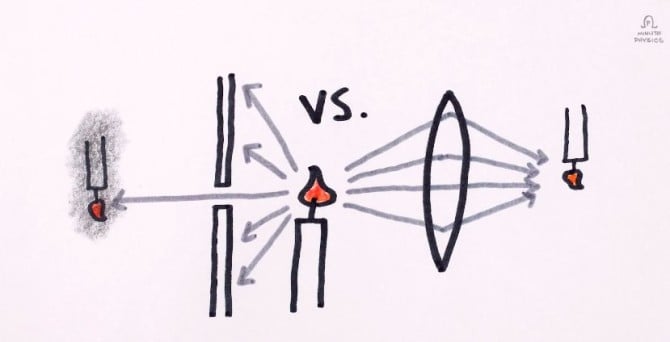
A Lens makes things sharp by focusing rays of light coming from a source so the rays converge on a single sport.
A pinhole, on the other hand, only allows light to enter from a single direction thus not letting it blur.
Both aspects are very clearly explained in this video by MinutePhysics.
Indecently, this video also explains how aperture works and why the Bokeh Masters Kit makes star shaped bokeh.
So why most applications prefer a lens over a pinhole (which is obliviously cheaper to manufacture?) Because pinholes work by blocking light the resulting image is significantly darker.
[How to See Without Glasses via reddit]
See more from DIYPhotography.net on Google
Add DIYPhotography.net as a trusted source. This makes
our stories more likely to appear in your Google Search results.
 Add as a preferred source on Google

Udi Tirosh
Udi Tirosh is an entrepreneur, photography inventor, journalist, educator, and writer based in Israel. With over 25 years of experience in the photo-video industry, Udi has built and sold several photography-related brands. Udi has a double degree in mass media communications and computer science.
Related Posts
 Depth of Field: the ultimate beginner’s guide to controlling depth of field using lens aperture in nature photography
 Understanding Full-Frame vs Crop-Sensor Impacts on Depth-Of-Field And Perspective
 A simple technique for faking subtle shallow depth of field in Photoshop
 Field curvature – Or why not everything that should be in focus is sharp
Join the Discussion
DIYP Comment Policy
Be nice, be on-topic, no personal information or flames.
5 responses to “A Simple Explanation On How Aperture Impacts Depth Of Field (And Why Pinholes Are Always Sharp)”
You seriously need to rethink this sentence: “Because pinholes work by blocking light the resulting image is significantly darker.”
Really? That’s exactly what a mechanical iris does. Compensate for a smaller aperture by using a longer exposure time, whether it’s a pinhole or a precise diaphragm.
yup! a “stopped down” mechanical iris is just like a small pinhole. On that section though, I am comparing pinholes optics to lens optics.
Nope. It doesn’t matter what you’re comparing it to. Exposure is exposure. A pinhole does not make an image darker. Underexposure makers an image darker.
it does reduce the light, but as we all know, you’ll just need to extend the exposure time to collect the same amount of light as a wider aperture, since the stuff actually accumulates, like all matter (electrons, ya know?).
If you’ve ever tried focusing a big view camera with a small maximum aperture lens (like f11 or smaller), you’ll understand what I think Udi means when he says it’s darker… it’s like looking into a cave as compared to that 85mm 1.2 on your Nikon/Canon.
My (different) observation about this post is that while pin holes (and smaller apertures in general) *do* increase depth of field, making more stuff *in focus*, that doesn’t mean they are “sharper”. It just means more of the scene is in focus.
Sharpness is a function of lens optics and construction. Depth of field (what’s “in focus”) is a function of aperture size. Another thing about small apertures is that in extreme cases, they actually degrade the sharpness, an aberration known as diffraction.
Pinholes are not always sharp. It depends on what is capturing the image. e.g. try a pinhole on a D800 and you will be very disappointed with the sharpness because of refraction issues.