





















Pixinsight 1.9 Lockhart released: Major upgrades and improvements
Feb 4, 2025
Soumyadeep Mukherjee
Soumyadeep Mukherjee is an award-winning astrophotographer from India. He has a doctorate degree in Linguistics. His work extends to the sub-genres of nightscape, deep sky, solar, lunar and optical phenomenon photography. He is also a photography educator and has conducted numerous workshops. His works have appeared in over 40 books & magazines including Astronomy, BBC Sky at Night, Sky & Telescope among others, and in various websites including National Geographic, NASA, Forbes. He was the first Indian to win “Astronomy Photographer of the Year” award in a major category.
Share:

Pixinsight is considered one of the best and one of the most popular image-processing software for astrophotography. First released in 2024, Pixinsight has seen many updates since. On 20th December 2024, Pixinsight released its latest major update of version 1.9.0 “Lockhart”. The name is inspired by one of the main characters of the video game Final Fantasy VII. According to Juan Conejaro, a member of the development team:
“This release is a crucial landmark in the history of the PixInsight project… PixInsight 1.9.0 signals the starting point of a new generation of image analysis and processing tools that will change the way we understand critical areas of astronomical image processing.”
Let us take a look at some of the major upgrades and improvements introduced in this update.
Table of contents
New tool: MultiscaleGradientCorrection
The MultiscaleGradientCorrection process (MGC) is a greatly improved, high-performance, and very accurate implementation of Vicent Peris’s MGC method. By comparing large-scale, statistically consistent structures between its target image and a reference image that is gradient-free, MGC creates a gradient model. Either a user-supplied image or data extracted from a MARS database can be used as the MGC reference.
One of the core issues of astronomical image processing that relies solely on observational data is resolved by MGC, which stands for gradient modeling and correction. MGC is one of the most notable achievements in terms of impartiality and dependability in the interpretation of astronomical images because of its observational character, the strength of its underlying algorithm, and its implementation. In addition to its accuracy and power, MGC is user-friendly. It frequently performs admirably with its default settings, which we carefully selected to tailor the tool to the features of the majority of deep-sky photos taken with amateur equipment.

New feature: Image Synchronization
It is now possible to synchronize image views either astrometrically or at the pixel level. When two or more images are synchronized, if you pan, zoom, or scroll on one of them, the other images will automatically replicate the same navigation activities, with coordinates adjusted to fit the various image sizes and scales. In order to synchronize images, the following options are available:
- By pixel coordinates: use the Ctrl (or Cmd on macOS) key to move a view selector.
- Drag a view selector while holding down the Ctrl and Meta keys (or Cmd and Ctrl keys on macOS) to use astrometry (by celestial coordinates). The ‘Windows key’ found on the majority of PC keyboards is the Meta key.
- Additionally, there are new entries in the context menu and main menu under IMAGE > Synchronize/Desynchronize.
Introduced in version 1.9.0 Lockhart, this exciting new feature of the PixInsight core application will be expanded upon in future iterations to provide additional capability and adaptability.
New feature: Fast Drizzle
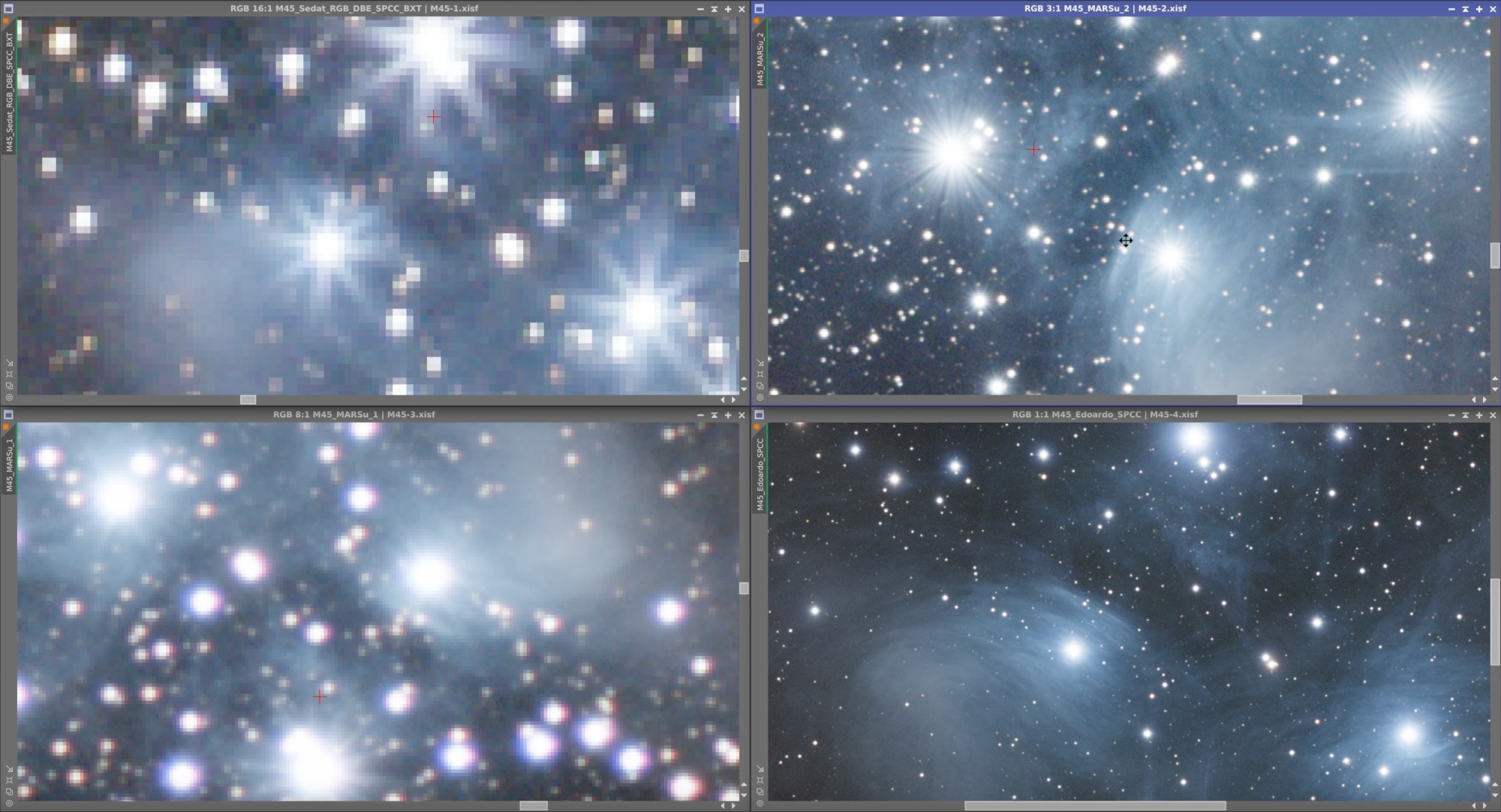
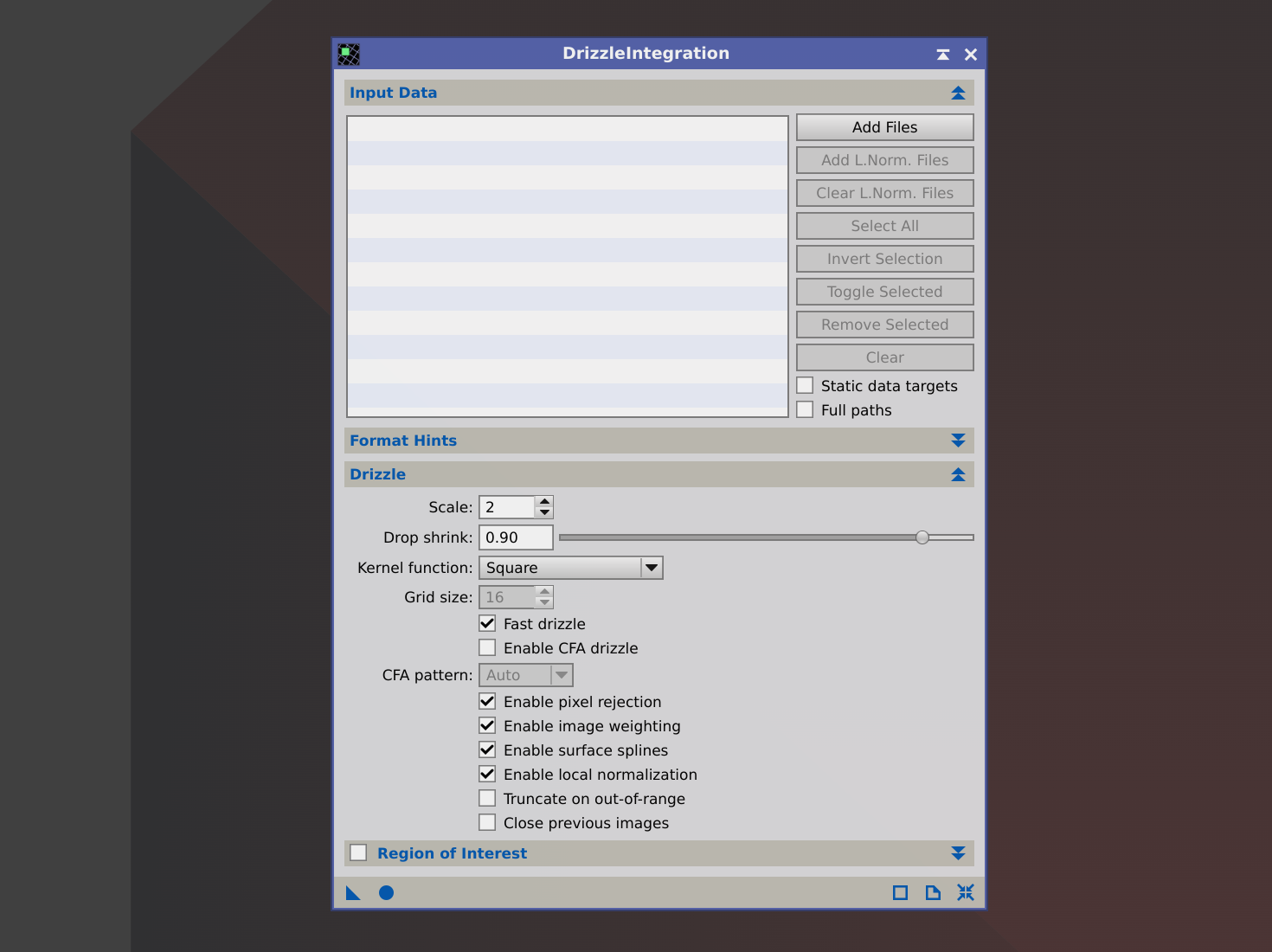
The DrizzleIntegration process now uses the newly built Fast Drizzle algorithm, which was designed and developed by Roberto Sartori. In comparison to the standard square kernel using the classical drizzle method, fast drizzle significantly speeds up the execution of drizzle integration and enables us to employ alternative drizzle kernel functions (circular, Gaussian, and variable-shape kernels) at higher speeds. The DrizzleIntegration tool and the WBPP and FBPP scripts both have this algorithm activated by default.
With fast drizzle, you may employ circular, Gaussian, and variable-shape kernels without sacrificing speed to get optimal resolution in your drizzle integrations, allowing you to experiment freely with various possibilities. The image below indicates that drizzle integration with a Gaussian kernel (right) preserves the original noise distribution and small-scale structures significantly better than drizzle integration with a square kernel (left). Doing this without the rapid drizzle technique takes a long time to process, which is a significant barrier to testing.
MARS data release 1
With PixInsight 1.9.0 Lockhart and the new MultiscaleGradientCorrection tool, the Multiscale All-Sky Reference Survey (MARS)’s first official data was also released. This initial file covers roughly half of the northern hemisphere, with data collected at 22 arcseconds per pixel. This is MARS’ basic layer, upon which the rest of the survey will be built at bigger scales.
High-performance astrometry engine
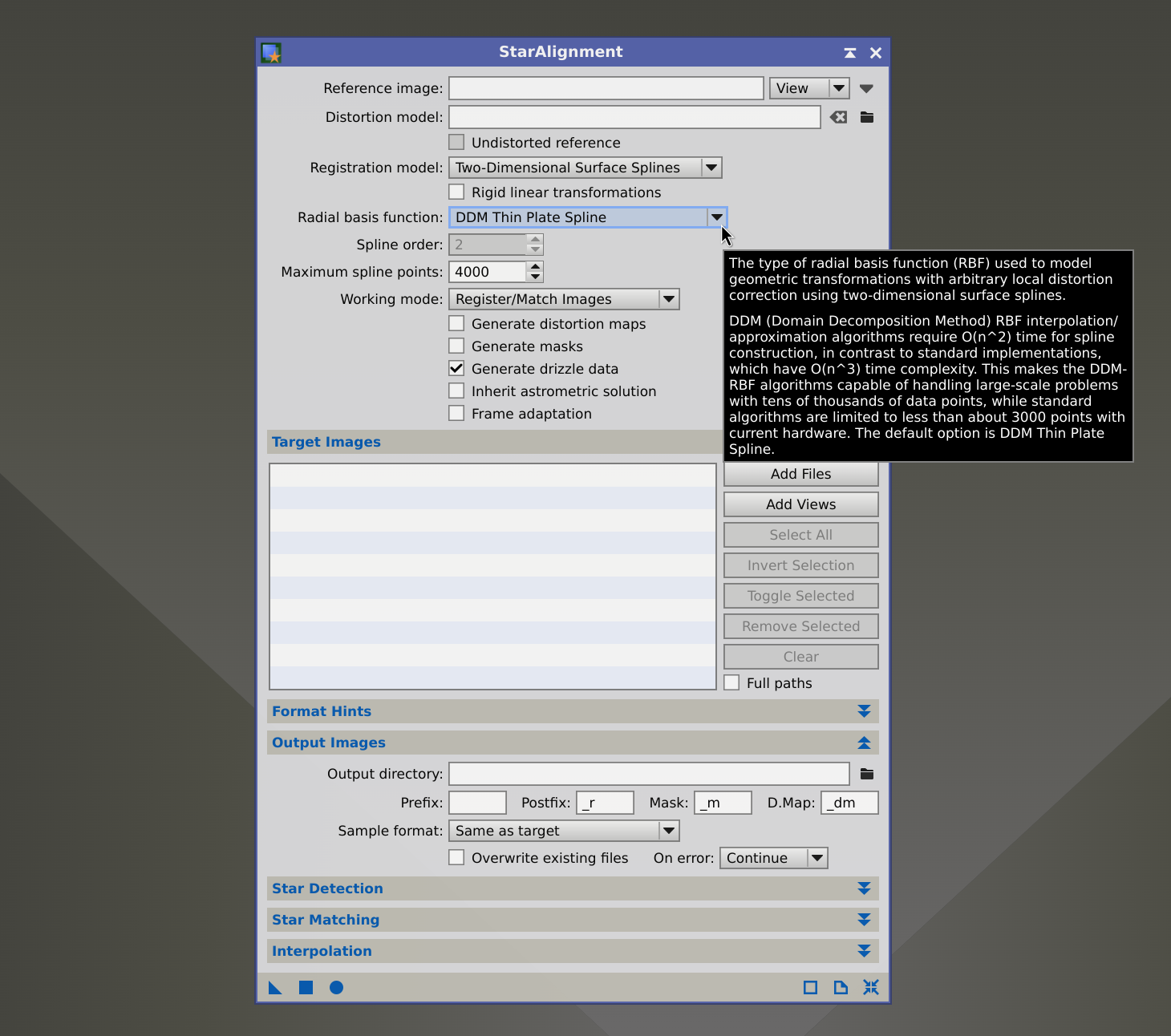
PixInsight 1.9.0 Lockhart features a revamped and reimplemented spline-based astrometry engine that employs DDM radial basis functions and surface splines. The Domain Decomposition Method (DDM) allows us to simulate arbitrary local distortions with up to 25,000 control points (reference stars), representing a significant improvement in accuracy and robustness. The ImageSolver script now uses 4000 points by default with DDM thin plate splines, which results in substantially faster execution and higher accuracy than prior versions. The same DDM thin plate spline implementation is used in the StarAlignment tool, resulting in a significant improvement in its ability to model arbitrary distortions during image registration.
Other improvements and updates
Along with the above-mentioned updates, Pixinsight 1.9.0 also released two new features: “Property Inspector” and “Drag and Drop Copy of Astrometric Solutions”. The new update also released updates to multiple scripts and tools including ImageSolver Script Version 6.3, WeightedBatchPreprocessing Script Version 2.8.0, FastBatchPreprocessing Script Version 1.1.3, MakefileGenerator Script Version 1.142, and FastIntegration Module Version 1.2.1. The details of these updates were explained in the official release note.
To manage some of the bugs, Pixinsight subsequently released versions 1.9.1 and 1.9.2 on December 23 and December 28, 2024, respectively. The latest version can be downloaded from the official Pixinsight website.
Clear skies!
See more from DIYPhotography.net on Google
Add DIYPhotography.net as a trusted source. This makes
our stories more likely to appear in your Google Search results.
 Add as a preferred source on Google

Soumyadeep Mukherjee
Soumyadeep Mukherjee is an award-winning astrophotographer from India. He has a doctorate degree in Linguistics. His work extends to the sub-genres of nightscape, deep sky, solar, lunar and optical phenomenon photography. He is also a photography educator and has conducted numerous workshops. His works have appeared in over 40 books & magazines including Astronomy, BBC Sky at Night, Sky & Telescope among others, and in various websites including National Geographic, NASA, Forbes. He was the first Indian to win “Astronomy Photographer of the Year” award in a major category.




Join the Discussion
DIYP Comment Policy
Be nice, be on-topic, no personal information or flames.