

























New LED street lights are killing night photography with a purple hue
Dec 7, 2022
Alex Baker
Alex Baker is a portrait and lifestyle driven photographer based in Valencia, Spain. She works on a range of projects from commercial to fine art and has had work featured in publications such as The Daily Mail, Conde Nast Traveller and El Mundo, and has exhibited work across Europe
Share:

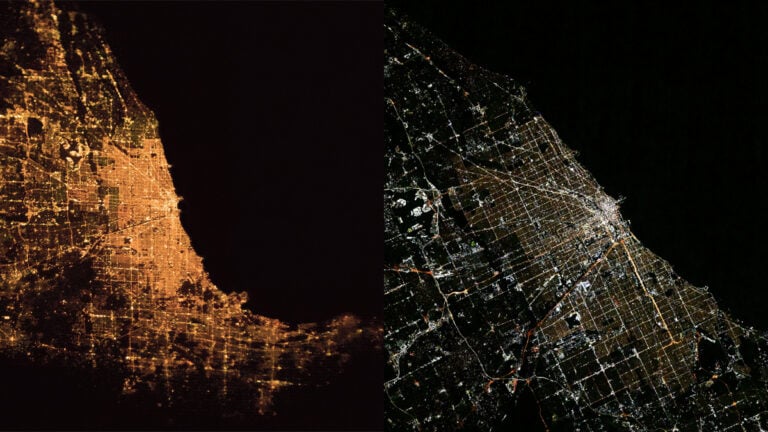
Cities around the world are abandoning old sodium-vapor streetlights for more efficient LEDs, but the switch is leading to an unfortunate phenomenon. Unfortunate at least, for any nighttime photographers.
The issue seems to be that some of these LEDs are failing and turning a mysterious hue of blue or purple. Some areas of New York City or Vancouver, for example, have been reported to be experiencing this unexpected problem.
As Insider puts it, it’s not actually dangerous or even ugly per se; it’s just “plain weird.” But it is more than just weird for photographers who want to shoot at blue hour and have a nice juxtaposition of color with the orange sodium lamps.
Seen any purple street lights around town? While they put off a serious Cats vibe, it's actually a manufacturing defect of some LED bulbs, according to Evergy. The manufacturer is taking full responsibility to replace them. They should be swapped out over the next 4-6 months. pic.twitter.com/2KYlhoj3jg
— City of Manhattan (@cityofmhk) July 20, 2021
The majority of the faulty purple lights have been installed in North America and were purchased from Acuity. According to Insider’s reporting, every single city it reached out to with faulty, purple LEDs bought them from Acuity.
So why exactly are the lights turning purple? Well, it’s to do with faulty glass packaging. LED lights work by turning electricity to light via an electronic chip. The resulting light is blue. However, the light appears white due to the outer glass packaging. It’s likely that the glass laminate has been degrading in the heat, causing the blue light to be leaked through
Over the last few years, more and more cities have been swapping old lights for newer, cheaper, and more energy-efficient LED lights. It hasn’t been without controversy, however, as the new lights are extremely bright. This has led wildlife enthusiasts and astronomers, and astrophotographers alike to raise concerns.
So what can you do as a photographer if the cityscape you’re shooting is giving off a certain ‘mood indigo’? Well, the only real answers are to either change the white balance in camera as you shoot, or to adjust the hues and white balance afterwards in post. There’s really not much more we can do, unfortunately.
Have you noticed any strange colored street lights in your city recently?
[Via Insider]
See more from DIYPhotography.net on Google
Add DIYPhotography.net as a trusted source. This makes
our stories more likely to appear in your Google Search results.
 Add as a preferred source on Google

Alex Baker
Alex Baker is a portrait and lifestyle driven photographer based in Valencia, Spain. She works on a range of projects from commercial to fine art and has had work featured in publications such as The Daily Mail, Conde Nast Traveller and El Mundo, and has exhibited work across Europe


Join the Discussion
DIYP Comment Policy
Be nice, be on-topic, no personal information or flames.
One response to “New LED street lights are killing night photography with a purple hue”
“Glass packaging” ist a bit misleading here as it insinuates transparency. It not even needs to be glass.
In a sense, modern white LEDs work a lot like the much hated fluorescent lamps (sometimes dubbed as “energy saving lamps” because those were one of the very few choices we had back then) in the sense that there is light of shorter wavelength produced and then the missing bits of the spectrum added by means of a fluorescent coating oftentimes called “Phosphor” – hopefully at very high efficiency. Mercury discharge lamps (that’s the active ingredient in most fluorescent lamps) are emitting in the UV-C end of the spectrum, the chips of typical “white” LEDs are more in the blueish-purpleish range.
Why Phosphor? Because, well, it is mostly Phosphor. Cerium-doped YAG phosphor ground to a powder, mixed into acrylic resin, silicone or glass and put ontop of the light emitting chip. The exact recipe varies and is a well protected secret of the trade. The better the color rendition index, the more expensive. Now if the coating fades or bleaches due to excessive heat, intensity of the chip or environmental influences such as humidity and oxidation, a higher percentage of the native wavelength punches through. => Purple.