


















Get ready for the partial lunar eclipse tonight. Tips from an expert astrophotographer
Sep 17, 2024
Soumyadeep Mukherjee
Soumyadeep Mukherjee is an award-winning astrophotographer from India. He has a doctorate degree in Linguistics. His work extends to the sub-genres of nightscape, deep sky, solar, lunar and optical phenomenon photography. He is also a photography educator and has conducted numerous workshops. His works have appeared in over 40 books & magazines including Astronomy, BBC Sky at Night, Sky & Telescope among others, and in various websites including National Geographic, NASA, Forbes. He was the first Indian to win “Astronomy Photographer of the Year” award in a major category.
Share:

A partial lunar eclipse will be visible from parts of the world tonight. The moon will be partially covered by Earth’s umbra during this phase. It is a wonderful opportunity for sky lovers to watch it with their naked eyes or to photograph it. Also, remember, it is going to be an eclipse of a supermoon.
Table of contents
What is a partial lunar eclipse?
Tonight’s eclipse will be a partial lunar eclipse. Here is how NASA defines it:
Lunar eclipses occur at the full moon phase. When Earth is positioned precisely between the Moon and Sun, Earth’s shadow falls upon the surface of the Moon, dimming it and sometimes turning the lunar surface a striking red over the course of a few hours. Each lunar eclipse is visible from half of Earth…[In case of a partial lunar eclipse] an imperfect alignment of Sun, Earth and Moon results in the Moon passing through only part of Earth’s umbra. The shadow grows and then recedes without ever entirely covering the Moon.
NASA Science
Check out this animation to see how lunar eclipses take place.
Will the lunar eclipse be visible from your location?
The partial lunar eclipse of 18th September will be visible from almost entire Europe, Africa, North America and South America. From some parts of Asia, a penumbral eclipse will be visible. Unfortunately, for the rest of the world, the eclipse won’t be visible at all.
Check out the eclipse map and the interactive globe map here to see if it will be visible from your location.

Phases of a partial lunar eclipse and timings
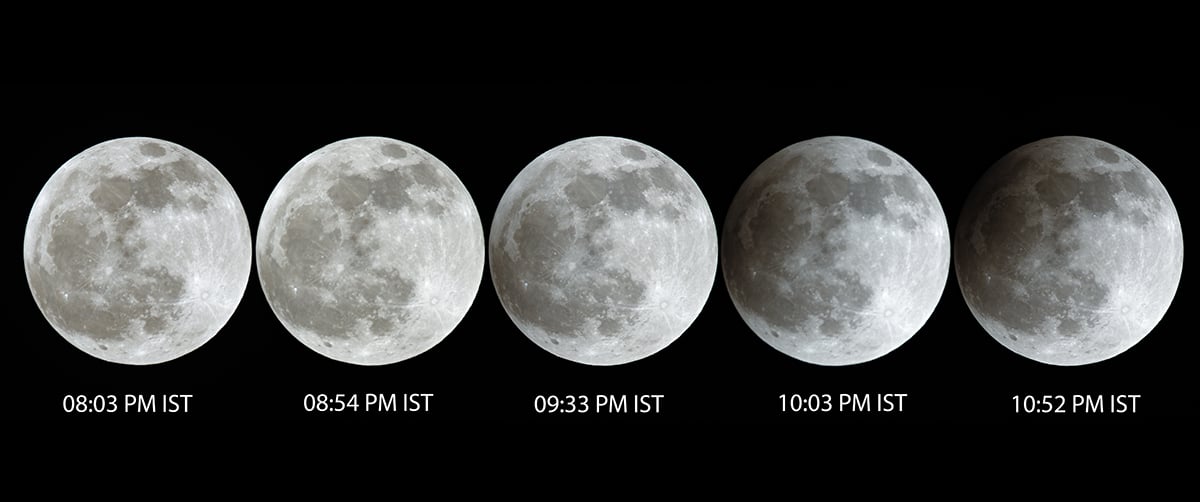
The partial lunar eclipse can be divided into five phases. Here are the timings of each of these phases:
- Penumbral Eclipse Begins: 00: 41: 07 UTC (18th September 2024)
- Partial Eclipse Begins: 02: 12: 58 UTC (18th September 2024)
- Maximum Eclipse: 02: 44: 18 UTC (18th September 2024)
- Partial Eclipse Ends: 03: 15: 38 UTC (18th September 2024)
- Penumbral Eclipse Ends: 04: 47: 27 UTC (18th September 2024)
The penumbral phase will last for little more than 4 hours and the umbral phase will be visible for more than 1 hour.
How to photograph the partial lunar eclipse
Photographing the moon is always fun. A partial lunar eclipse is even more. You can capture the dark umbra of the moon along with the bright parts of the rest of the moon.
Equipment required
- A DSLR or mirrorless camera
- A telephoto lens (at least 200-300mm, more is better) or a telescope
- A sturdy tripod
- An external intervalometer or shutter release (this is optional, and if your camera has an internal option, then it is not required) A star tracker (again, this is not mandatory, but if you have one, it will make things easier)
Camera settings
- Aperture: Choose the sharpest aperture of your lens. If you are not aware of your lens’ sharpest aperture, use anything between f/8 – f/11.
- Shutter speed: The partial phase is a high dynamic scene, you will need to bracket your shots. You can create a bracket of 2, 3 or 5 shots. The fastest shutter speed will be for the bright non-eclipsed surface of the moon and the slowest one should reveal the dark umbral part.
- ISO: To get the best results, keep an ISO between 100 and 800. Most cameras perform the best within this range.

Tips to get the perfect Lunar Eclipse shot
Here are a few tips that will help you get the best out of the partial lunar eclipse.
- Start with checking the timings of the eclipse above. Set up your gear well before the eclipse begins.
- You need to decide how you are going the approach the eclipse. It can either be an image of the maximum partial phase, or a timelapse or you could record the change in phases for 4 hours.
- If you want to compose the moon with a landscape element, reach the location at least an hour before the eclipse begins. You will have enough time to set up your gear and make necessary changes
- Focus on the moon manually before the eclipse begins. Remember that you won’t have much time once the maximum phase begins.
- Bracket your maximum phase shot. It could be as minimum as 2 shots, but you can definitely increase that to get a smoother blend across the lunar disk.
- If you are confident and comfortable, you can take multiple shots of the bracketed exposures. For example, you can take 5 exposures of 1/200s, 5 exposures of 1/100s and so on. You need to stack each of them first and then blend them.
- Keep checking your histogram to adjust for the exposure. The moon will become dimmer as the penumbral phase starts and progresses. Parts of the moon will become even dimmer when the umbral phase starts.
- When taking multiple shots of the maximum phase, do not move your camera or tripod. The moon (and every other object in the sky) undergoes field rotation. Moving your camera or lens will introduce it and it might get somewhat difficult to align the layers.

Even if you are not planning to photograph the lunar eclipse, go out and enjoy it with your naked eyes or with a binocular. Clear skies
See more from DIYPhotography.net on Google
Add DIYPhotography.net as a trusted source. This makes
our stories more likely to appear in your Google Search results.
 Add as a preferred source on Google

Soumyadeep Mukherjee
Soumyadeep Mukherjee is an award-winning astrophotographer from India. He has a doctorate degree in Linguistics. His work extends to the sub-genres of nightscape, deep sky, solar, lunar and optical phenomenon photography. He is also a photography educator and has conducted numerous workshops. His works have appeared in over 40 books & magazines including Astronomy, BBC Sky at Night, Sky & Telescope among others, and in various websites including National Geographic, NASA, Forbes. He was the first Indian to win “Astronomy Photographer of the Year” award in a major category.


Join the Discussion
DIYP Comment Policy
Be nice, be on-topic, no personal information or flames.
One response to “Get ready for the partial lunar eclipse tonight. Tips from an expert astrophotographer”
very informative and useful.