
















Don’t miss the Supermoon coming up this week: here are our top tips for a successful photo
Sep 15, 2024
Soumyadeep Mukherjee
Soumyadeep Mukherjee is an award-winning astrophotographer from India. He has a doctorate degree in Linguistics. His work extends to the sub-genres of nightscape, deep sky, solar, lunar and optical phenomenon photography. He is also a photography educator and has conducted numerous workshops. His works have appeared in over 40 books & magazines including Astronomy, BBC Sky at Night, Sky & Telescope among others, and in various websites including National Geographic, NASA, Forbes. He was the first Indian to win “Astronomy Photographer of the Year” award in a major category.
Share:

A supermoon is coming up on 17th September. A great opportunity to photograph the larger moon.
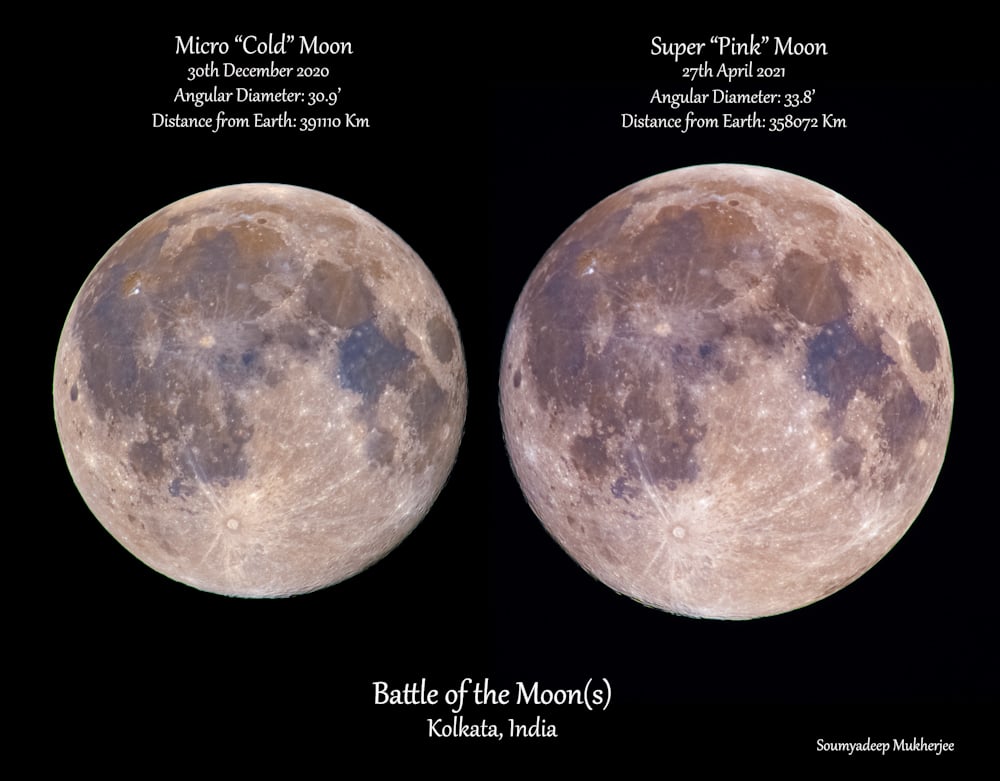
When the moon’s closest orbital approach to Earth coincides with the full moon, this is known as a supermoon. As a result, the moon appears marginally closer and brighter. However it is hard to see the difference with the unaided eye. Supermoons appear almost 14% larger and about 30% brighter than micromoons, when the moon is farthest from Earth. Even though the size difference may not be apparent to the naked eyes, you can definitely see the change in brightness.
Definition of Supermoon
Here is how NASA defines supermoon:
A “supermoon” occurs when a full moon coincides with the Moon’s closest approach to Earth in its elliptical orbit, a point known as perigee. During every 27-day orbit around Earth, the Moon reaches both its perigee, about 226,000 miles (363,300 km) from Earth, and its farthest point, or apogee, about 251,000 miles (405,500 km) from Earth. Because the Moon’s orbit wobbles and differs depending on where the Sun and Earth are in their orbits, the exact distance of these closest and furthest points varies, and some supermoons are closer or farther than others.
NASA
You can watch this animation from NASA/JPL for a better understanding of how supermoons appear in the sky.
What is a Supermoon
The term supermoon, however, is not an official astronomical term. The term, as it is currently used, was first used in 1979 by astrologer Richard Nolle. Furthermore, when a full moon or new moon is within 90% of its closest point to Earth, it qualifies as a supermoon per Nolle’s criteria. On the other hand, supermoon calculations vary throughout websites.

Upcoming Supermoons
We will be seeing a supermoon in the night sky this week. However, we will also get a chance to enjoy the same in October and November 2024. Here are the 3 upcoming supermoons this year and their distance from Earth:
- September 17th: 222,131 miles (357,485 kilometers)
- October 17th: 222,055 miles (357,363 kilometers)
- November 15th: 224,853 miles (361,866 kilometers)
The October supermoon will be the closest to Earth, hence the largest full moon of the year.

How to photograph the Supermoon
Photographing supermoons are identical to photographing other full moons. You will need a DSLR or a mirrorless camera along with a telephoto lens or a telescope to capture it. The focal length of your lens may vary, but as a general rule, if it is more than 200mm, you will be getting some details of the lunar surface. Use the maximum focal length you have. The longer, the better. You can follow these settings to achieve a wonderful image.
Aperture: Use the sharpest aperture of your lens. Normally, that is 1 or 2 stops lower than the highest aperture of your lens. Try to keep the aperture between f/8 and f/11.
Shutter Speed: Like any other object in the sky, the moon moves. Keeping a higher shutter speed will render a sharper image. As a general rule, your shutter speed should be double your focal length. For example, if you are using a 500mm lens, your shutter speed should be 1/1000s. However, if you are using a tripod, you can lower it to 1/800s or 1/640s.
ISO: There are no set rules for ISO. Since the moon will be very bright, you won’t require a high ISO. Once you set the desired aperture and shutter speed, adjust the ISO accordingly. Remember to check your histogram and look out for highlight clipping.
Tips to achieve a better image
Here are some additional tips for a better and sharper image:
- Use a tripod. This will allow you to take sharper images. You can also reduce your shutter speed and keep the ISO lower.
- Take multiple images of moon. Although there are no general numbers, taking 100 or 200 images should suffice. Stack these images to get noise-free image along with more details of the moon.
- Use an external intervalometer or an internal intervalometer (if your camera has one). This will prevent your set up from any kind of shake caused by touching the camera.
- Use manual focus to achieve the best focus. Autofocus may or may not work.
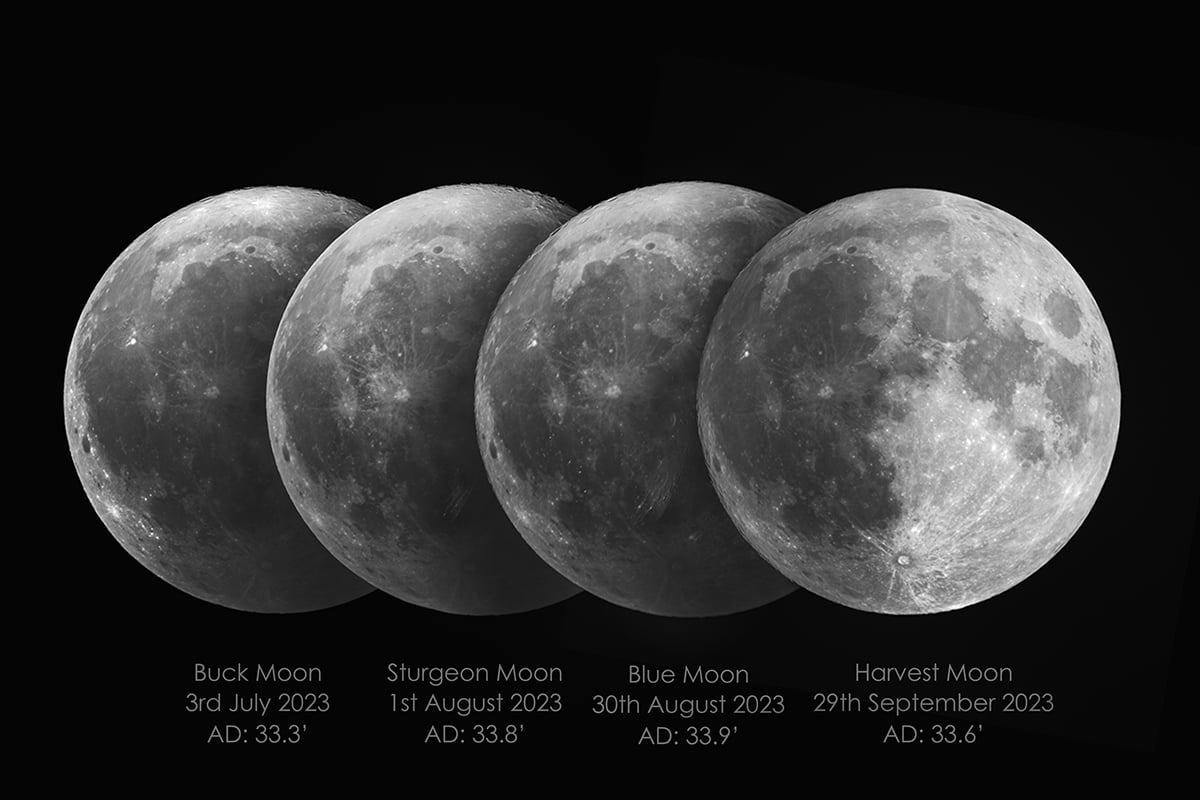
If you happen to have an earlier picture of the moon, place it side with the image of this supermoon and see the difference in their size. Remember that the equipment has to be similar (same focal length and sensor size) to achieve a true comparison.
Hope you are able to capture the mighty supermoon. Clear skies.
See more from DIYPhotography.net on Google
Add DIYPhotography.net as a trusted source. This makes
our stories more likely to appear in your Google Search results.
 Add as a preferred source on Google

Soumyadeep Mukherjee
Soumyadeep Mukherjee is an award-winning astrophotographer from India. He has a doctorate degree in Linguistics. His work extends to the sub-genres of nightscape, deep sky, solar, lunar and optical phenomenon photography. He is also a photography educator and has conducted numerous workshops. His works have appeared in over 40 books & magazines including Astronomy, BBC Sky at Night, Sky & Telescope among others, and in various websites including National Geographic, NASA, Forbes. He was the first Indian to win “Astronomy Photographer of the Year” award in a major category.



Join the Discussion
DIYP Comment Policy
Be nice, be on-topic, no personal information or flames.