












Rubin Observatory Captures a 144-Megapixel Image of the Seagull Nebula
Oct 24, 2026
Soumyadeep Mukherjee
Soumyadeep Mukherjee is an award-winning astrophotographer from India. He has a doctorate degree in Linguistics. His work extends to the sub-genres of nightscape, deep sky, solar, lunar and optical phenomenon photography. He is also a photography educator and has conducted numerous workshops. His works have appeared in over 40 books & magazines including Astronomy, BBC Sky at Night, Sky & Telescope among others, and in various websites including National Geographic, NASA, Forbes. He was the first Indian to win “Astronomy Photographer of the Year” award in a major category.
Share:
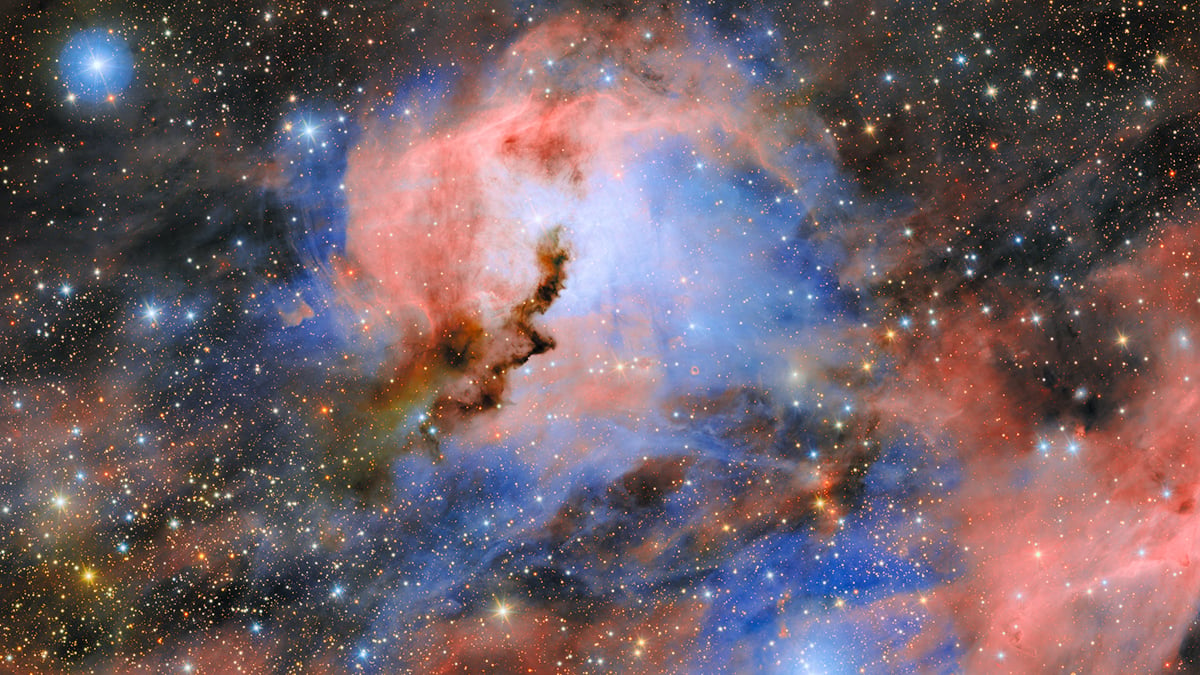
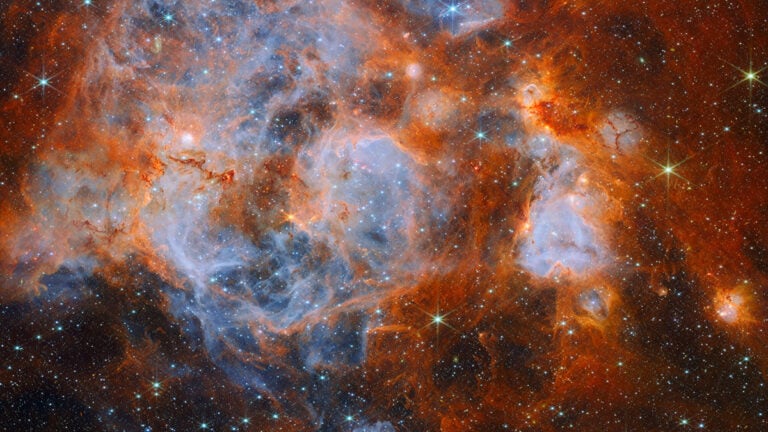
The Seagull Nebula lies about 3,700 light-years from Earth, in a region where young stars illuminate vast clouds of gas and dust. A new image from the Vera C. Rubin Observatory brings the nebula’s head into view, showing glowing hydrogen, blue reflection nebulosity, and dark ridges around a young star system.
The observatory released the 144-megapixel image earlier this week, almost two years after capturing it. Rubin used the photograph to test its engineering camera and the software that processes its observations. The camera, called ComCam, recorded thousands of exposures before the observatory switched to its much larger main camera.
A closer look at the Seagull’s head
Rubin’s image captures Sharpless 2-292, the cloud that forms the Seagull Nebula’s head. The larger complex includes three extensive clouds of gas, catalogued as Sharpless 2-292, Sharpless 2-296, and Sharpless 2-297. They resemble a bird in flight between the constellations Monoceros and Canis Major.
The photograph concentrates on the head, where the gas takes on several distinct forms. Pink emission regions surround darker lanes, while blue haze spreads across parts of the cloud. These features reveal how young stars affect the material around them.
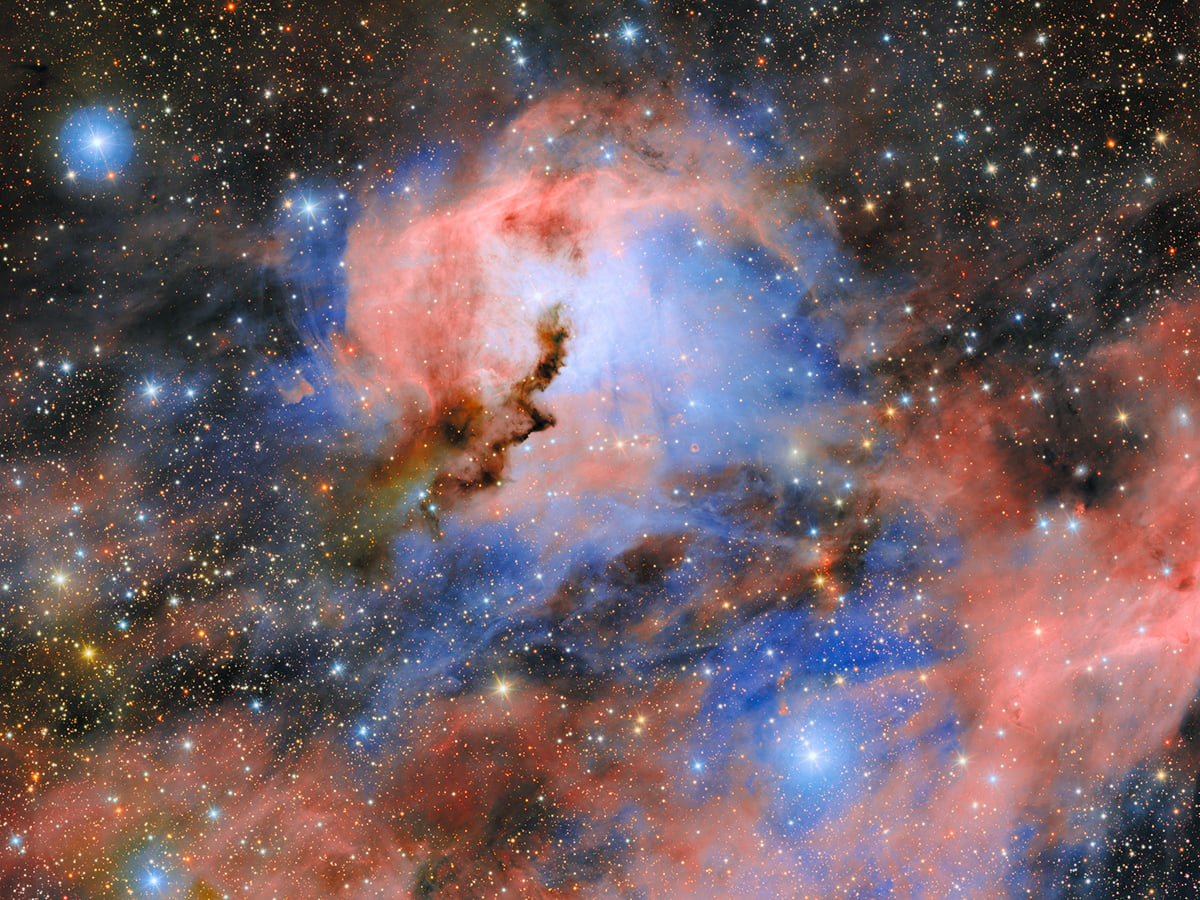
A dark, jagged ridge stands out near the center of the image. The massive young triple-star system HD 53367 sits near the top of this ridge, marking what looks like the Seagull’s blue eye. The stars illuminate the surrounding cloud and contribute to the region’s complex appearance.
Rubin Observatory describes the photograph as the deepest and sharpest view of this region to date, until further observations from its main camera become available. The team captured the image in autumn 2024, during ComCam’s engineering campaign.
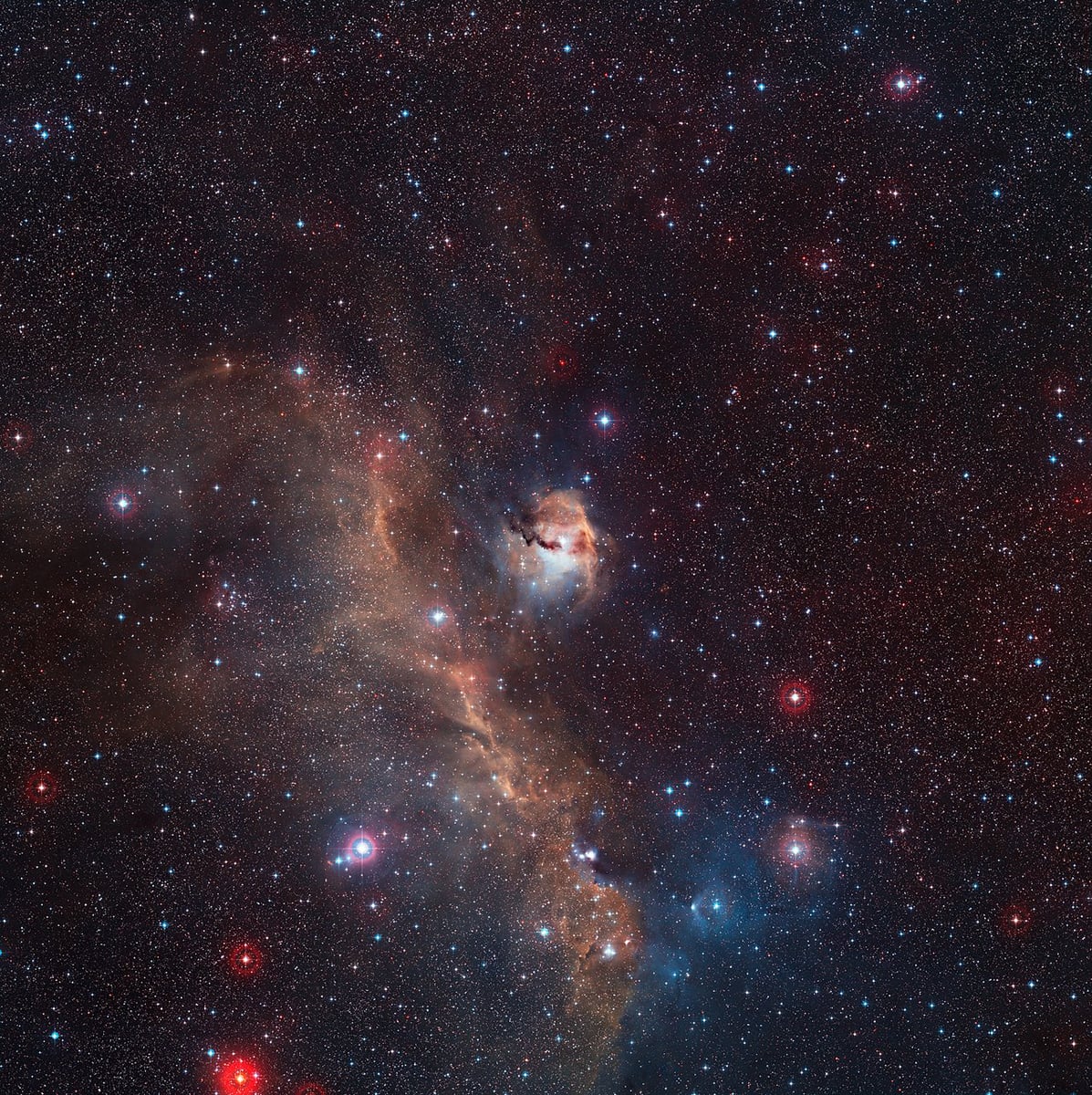
What makes the nebula pink and blue?
The pink regions trace hydrogen gas that glows under intense ultraviolet radiation from young stars. These stars form inside molecular clouds, where gas and dust gather under gravity. Massive young stars emit enough ultraviolet energy to strip electrons from nearby hydrogen atoms, ionizing the gas.
The ionized hydrogen then emits light. In Rubin’s processed image, those regions appear pink. Radiation from the young stars also heats the surrounding material and pushes away some of the dust that blocks visible light. As the cloud changes, previously obscured structures become easier to see.
The blue haze has a different source. Dust particles scatter and reflect light from nearby stars, creating what astronomers call reflection nebulosity. The scattered starlight gives parts of the cloud their blue color.
The camera behind the image
Rubin captured the photograph with its LSST Commissioning Camera, known as ComCam. The instrument combines nine charge-coupled device sensors, or CCDs, to produce images with a total resolution of 144 megapixels. Its field of view covers an area of sky roughly twice the apparent size of the full Moon.
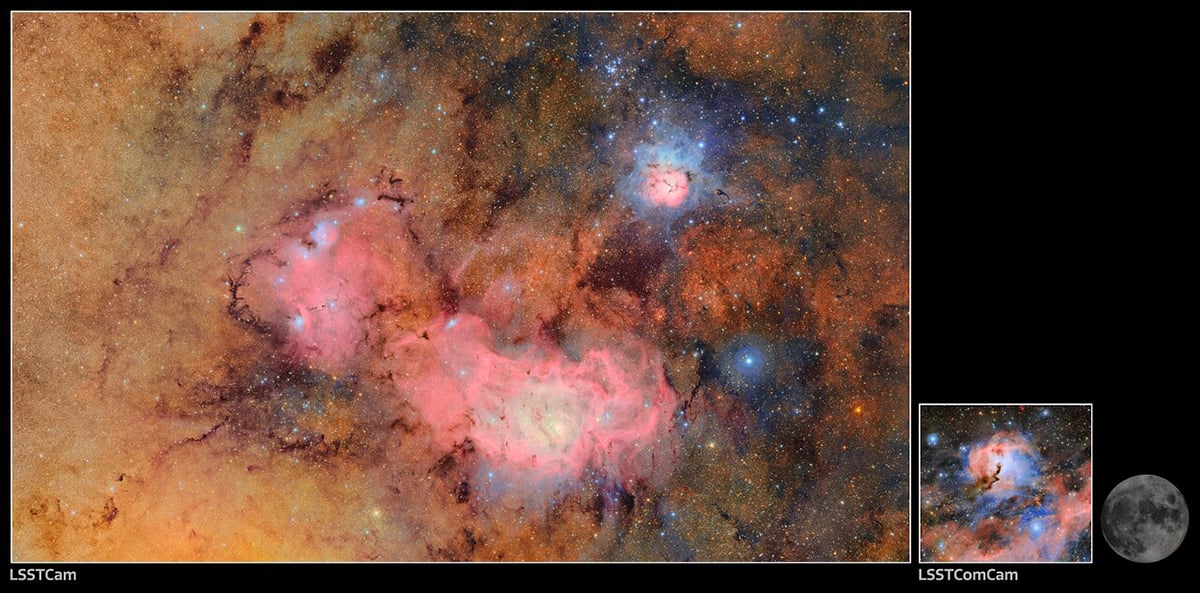
ComCam began its engineering campaign on October 24, 2024. The testing period ran until December 11, and the team collected approximately 16,000 exposures. Each observation helped engineers check the telescope’s hardware, software, and image-processing systems.
The camera’s job went beyond recording sharp images. Rubin needed to check how its systems handled observations across multiple sensors and how the software combined the data. Engineers also needed to identify processing problems before the observatory began working with much larger images.

Clear skies!
See more from DIYPhotography.net on Google
Add DIYPhotography.net as a trusted source. This makes
our stories more likely to appear in your Google Search results.
 Add as a preferred source on Google

Soumyadeep Mukherjee
Soumyadeep Mukherjee is an award-winning astrophotographer from India. He has a doctorate degree in Linguistics. His work extends to the sub-genres of nightscape, deep sky, solar, lunar and optical phenomenon photography. He is also a photography educator and has conducted numerous workshops. His works have appeared in over 40 books & magazines including Astronomy, BBC Sky at Night, Sky & Telescope among others, and in various websites including National Geographic, NASA, Forbes. He was the first Indian to win “Astronomy Photographer of the Year” award in a major category.

Join the Discussion
DIYP Comment Policy
Be nice, be on-topic, no personal information or flames.