





















NASA Captures Earth’s Changing Seasons From a Million Miles Away
Sep 26, 2026
Soumyadeep Mukherjee
Soumyadeep Mukherjee is an award-winning astrophotographer from India. He has a doctorate degree in Linguistics. His work extends to the sub-genres of nightscape, deep sky, solar, lunar and optical phenomenon photography. He is also a photography educator and has conducted numerous workshops. His works have appeared in over 40 books & magazines including Astronomy, BBC Sky at Night, Sky & Telescope among others, and in various websites including National Geographic, NASA, Forbes. He was the first Indian to win “Astronomy Photographer of the Year” award in a major category.
Share:
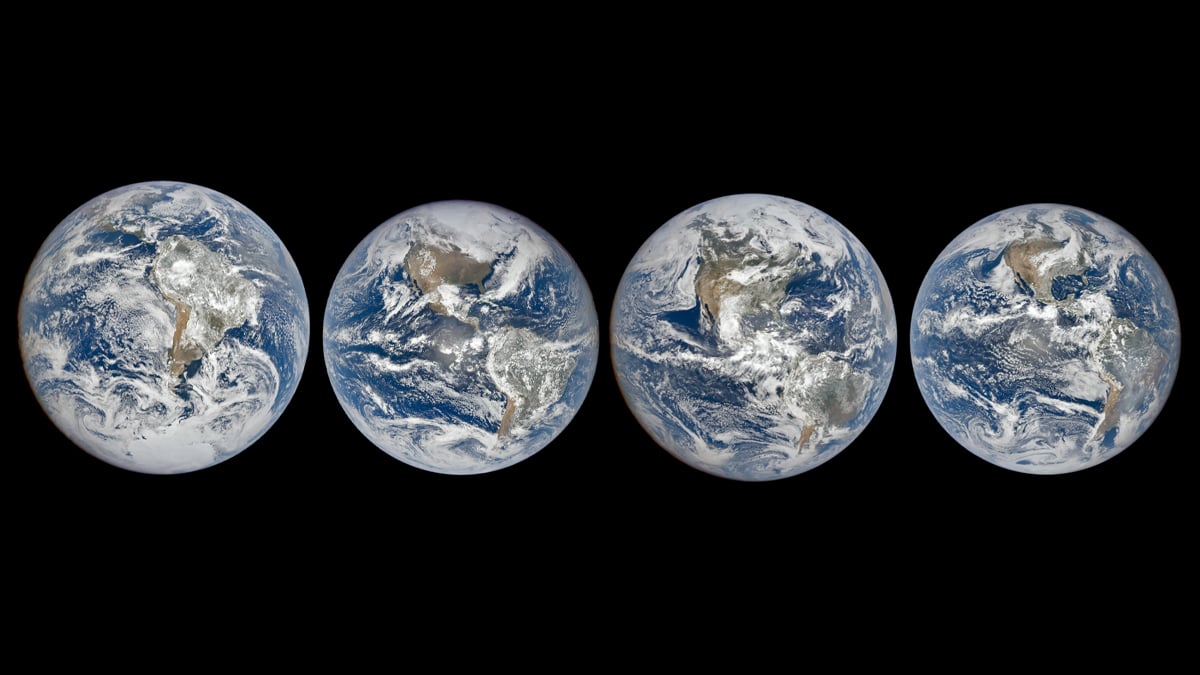
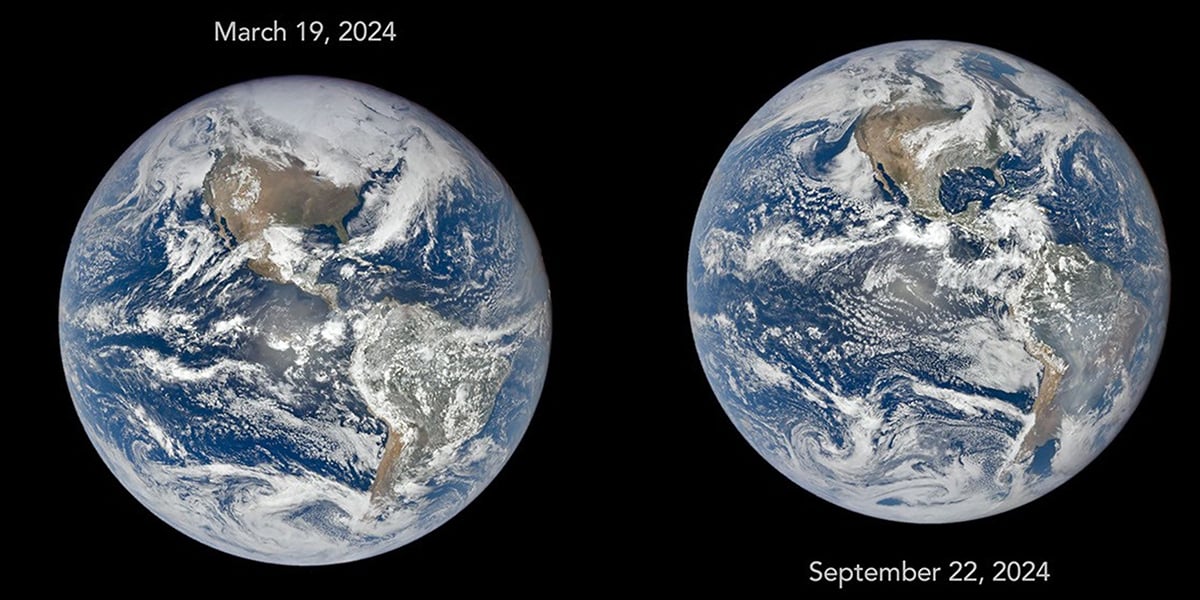
Four photographs from NASA’s EPIC camera capture how Earth’s tilt and seasons change throughout the year, as seen from more than a million miles away. NASA’s Earth Polychromatic Imaging Camera (EPIC) has photographed our planet at the December and June solstices and the March and September equinoxes. The camera sits aboard the Deep Space Climate Observatory (DSCOVR), about 1.6 million kilometers from Earth.
Each photograph shows the full sunlit side of Earth. Yet the four views look noticeably different. South America sits near the middle of one frame. Several months later, North America occupies a similar position. Antarctica appears in one image and vanishes from another.
A camera with a very unusual view of Earth
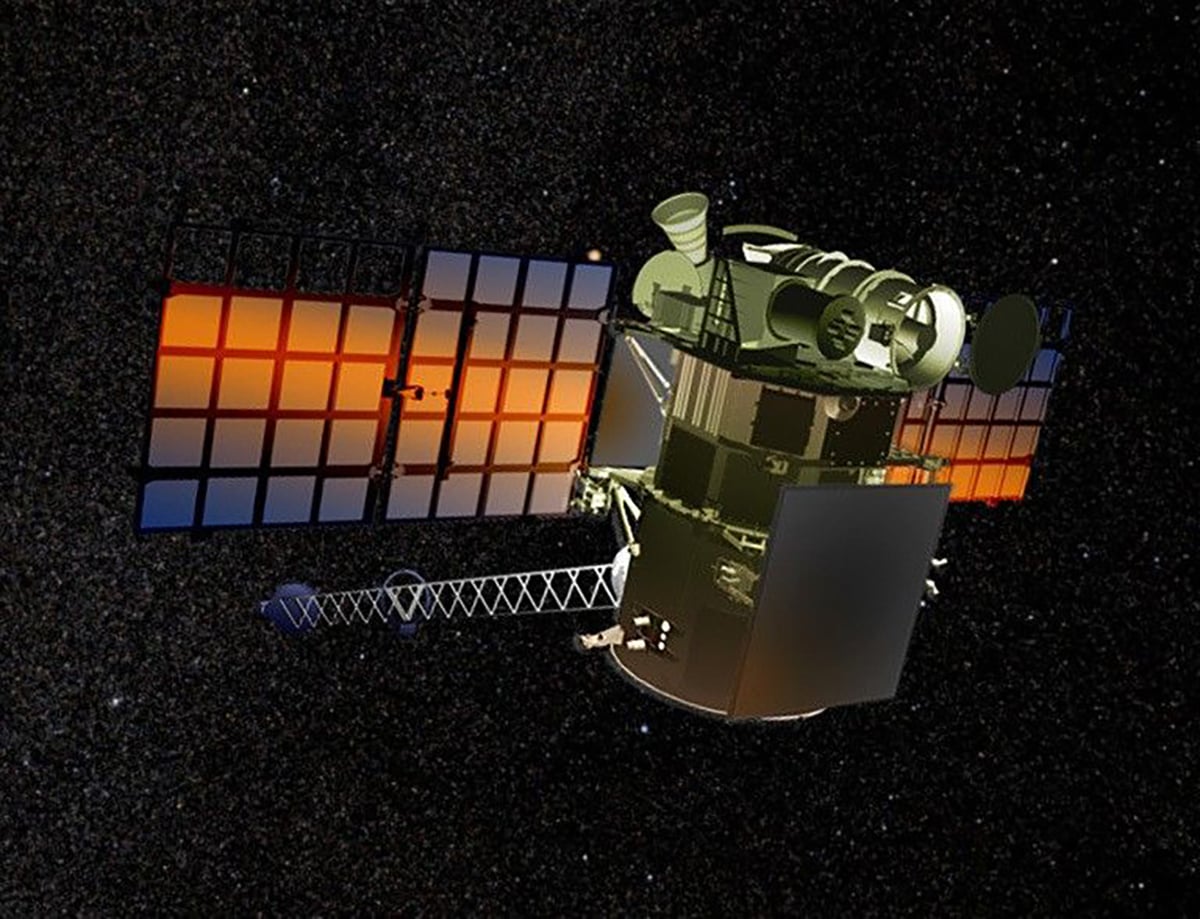
Most spacecraft that photograph Earth stay relatively close to the planet. DSCOVR, on the other hand, operates near the Sun-Earth L1 Lagrange point, roughly one million miles from Earth. That location gives EPIC a view that few other Earth-imaging instruments can match. The spacecraft sits between Earth and the Sun, so EPIC can keep looking at the planet’s illuminated hemisphere as Earth rotates.
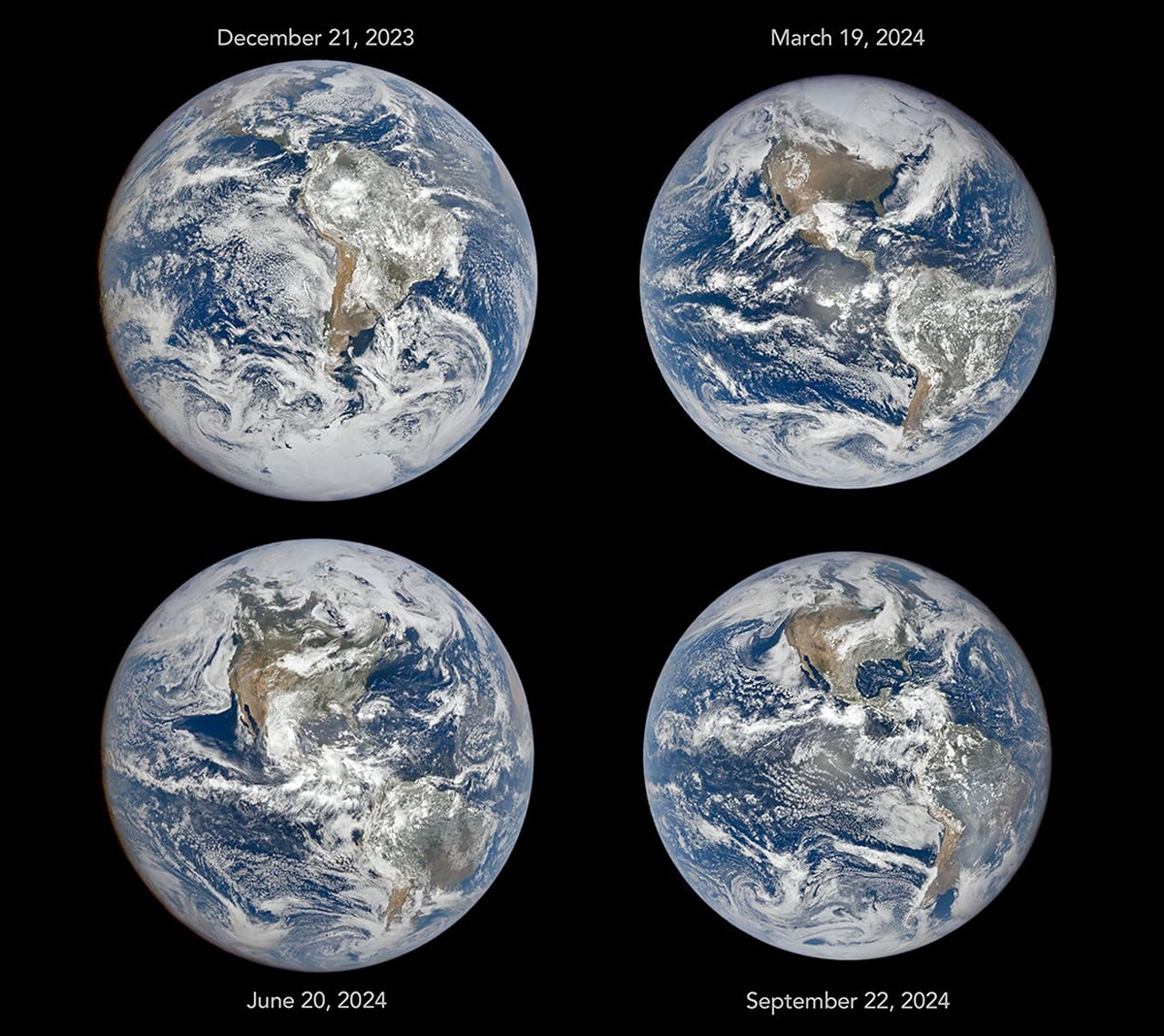
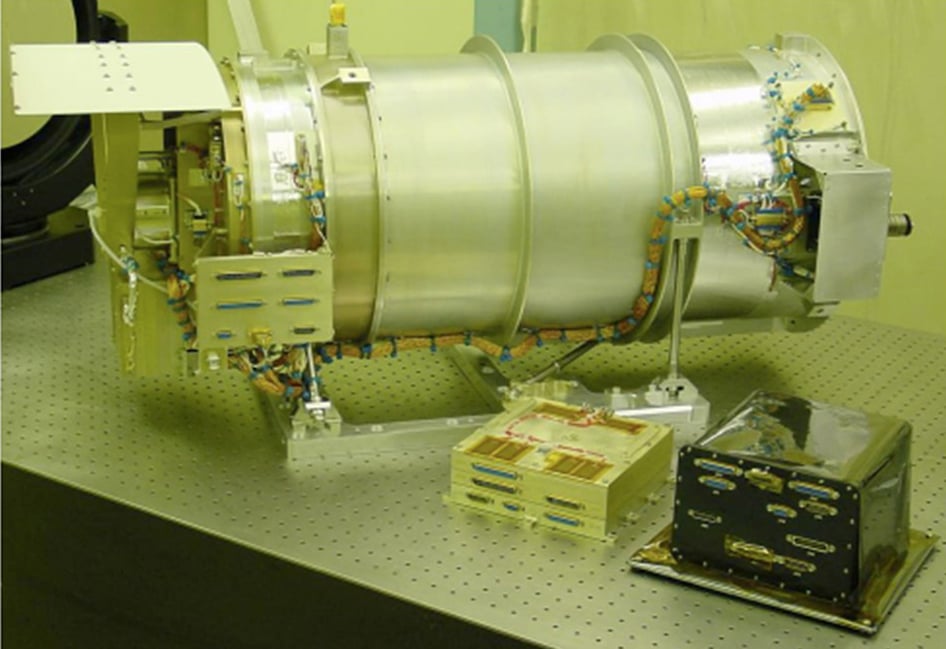
EPIC captures a full-disk image of Earth about every two hours. The instrument’s own specifications give a faster observation cycle of roughly 60 to 100 minutes across the sunlit hemisphere. EPIC also differs from an ordinary camera. The instrument has 10 spectral channels, covering wavelengths from 317 to 780 nanometers.
A 30-centimetre Cassegrain telescope feeds light to a 2048 × 2048-pixel CCD. Scientists use the different wavelengths to study ozone, aerosols, clouds, vegetation, ultraviolet radiation, and other features across the planet.
Earth’s tilt changes the view through the year
Earth does not rotate upright as it travels around the Sun. Its axis remains tilted, and that tilt changes the amount of sunlight reaching each hemisphere during the year.
Around the June solstice, the Northern Hemisphere tilts toward the Sun. Around the December solstice, the Southern Hemisphere takes that position. The March and September equinoxes fall between those two points in Earth’s orbit.
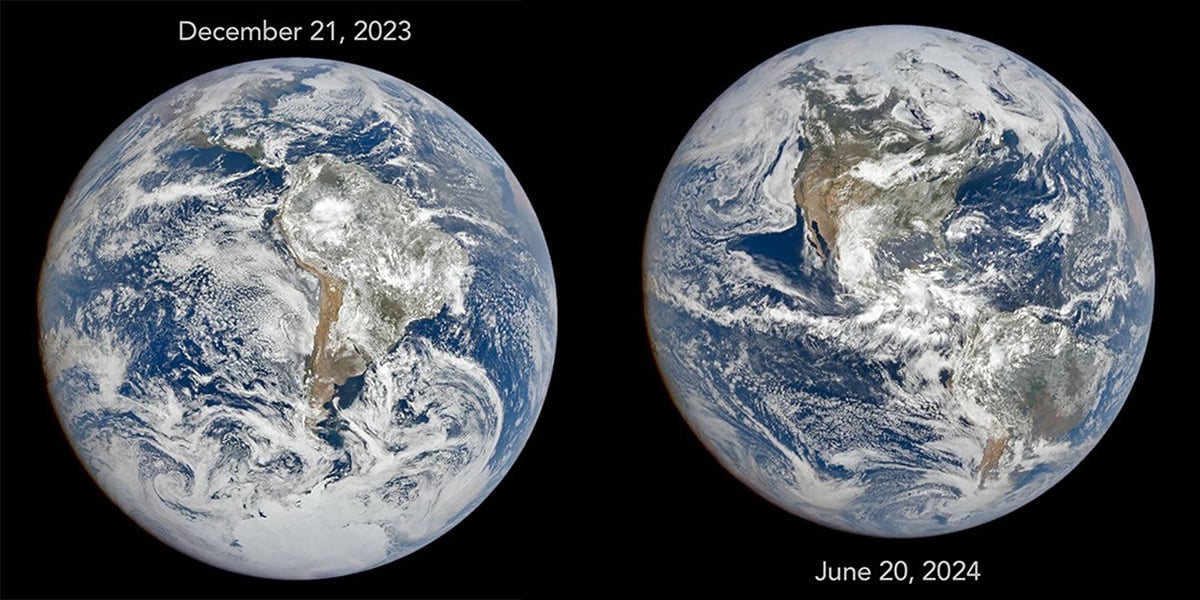
EPIC gives us a view of the changing geometry. The December 21, 2023 photograph shows South America close to the center of Earth’s disk. Much of Antarctica is also visible. North America sits farther toward the edge.
Six months later, the June 20, 2024 photograph looks quite different. North America has moved closer to the center of the disk. The Arctic and its sea ice become visible, while South America shifts away from the center. Antarctica drops completely out of view. The March 19 and September 22 images show positions between those two extremes.
The equinoxes fill in the gap between the solstices
During an equinox, the Sun sits over Earth’s equatorial region. The boundary between the illuminated and dark sides of the planet, known as the terminator, runs through both poles.
The Northern and Southern Hemispheres then receive nearly equal amounts of sunlight. Day and night also approach equal lengths across much of the planet. The March and September EPIC images capture Earth between the two solstice views. The positions of the continents reflect the intermediate orientation.
The camera sees the Western Hemisphere from far beyond the Moon‘s orbit. As the year progresses, the same continents move across the center of the frame because the planet presents a different orientation to the spacecraft.
Clear skies!
See more from DIYPhotography.net on Google
Add DIYPhotography.net as a trusted source. This makes
our stories more likely to appear in your Google Search results.
 Add as a preferred source on Google

Soumyadeep Mukherjee
Soumyadeep Mukherjee is an award-winning astrophotographer from India. He has a doctorate degree in Linguistics. His work extends to the sub-genres of nightscape, deep sky, solar, lunar and optical phenomenon photography. He is also a photography educator and has conducted numerous workshops. His works have appeared in over 40 books & magazines including Astronomy, BBC Sky at Night, Sky & Telescope among others, and in various websites including National Geographic, NASA, Forbes. He was the first Indian to win “Astronomy Photographer of the Year” award in a major category.
Related Posts
 NASA asteroid probe OSIRIS-REx photographed the Earth & Moon from 71 million miles away
 The Long-Distance Fix: How NASA Saved JunoCam from 370 Million Miles Away
 Seasonal Beauties Is A Wonderful Double Exposure About The Changing Seasons
 NASA’s Perseverance rover captures video of 1.2 miles tall dust devil on Mars
Join the Discussion
DIYP Comment Policy
Be nice, be on-topic, no personal information or flames.