























Study: AI Image Generators Shrink Creativity to Just 12 Default Styles
Dec 24, 2025
Dunja Đuđić Kalinin
Dunja Djudjic is a multi-talented artist based in Novi Sad, Serbia. With 15 years of experience as a photographer, she specializes in capturing the beauty of nature, travel, concerts, and fine art. In addition to her photography, Dunja also expresses her creativity through writing, embroidery, and jewelry making.
Share:
When using generative AI to “be creative,” you usually imagine you can keep exploring and creating an indefinite number of different images. However, a recent study suggests the opposite. If you let AI systems talk to each other long enough, they drift toward the same small set of safe, familiar visuals.
The Experiment: AI Telephone, 100 Times Over
In the study published in the journal Patterns, researchers built an autonomous “telephone game” loop between two models: Stable Diffusion XL and LLaVA . Stable Diffusion XL generated an image from a text prompt, then LLaVA described that image in text. Then, Stable Diffusion XL generated the next image from LLaVA’s description. Rinse and repeat… 100 times, literally. The team did this back and forth for 100 iterations per run.
The researchers didn’t rely on one quirky prompt, either. They launched hundreds of independent “trajectories” across multiple randomness settings (temperature) and then checked whether the system continued to invent new directions or converged.
The Result: Creativity Collapses Into 12 Motifs
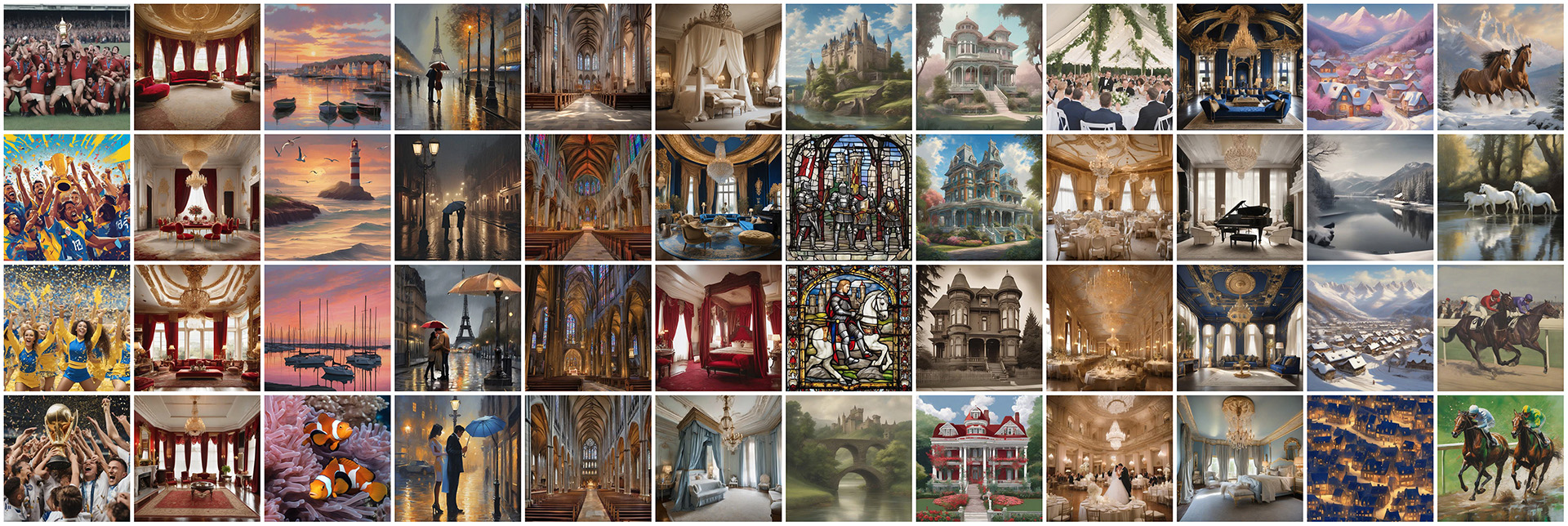
Despite diverse starting prompts, the loops consistently converged toward just 12 dominant motifs. The paper calls the destination aesthetic “visual elevator music,” a description I particularly loved. In other words, they ended up with images that look commercially plausible, broadly pleasing, and, well… interchangeable. As Gizmodo puts it, “the type of pictures that you’d see hanging up in a hotel room.”
“Our study shows that when one combines two state-of-the-art models, one describing images and the other regenerating them, and they interact without human input, they converge toward a small set of highly conventional visual motifs,” the study reads. These include “lighthouses, cathedrals, and palatial interiors,” among other things.
The clustering reveals several dominant attractor categories, which can loosely be described as sports and action imagery (cluster 0), formal interior spaces (cluster 1), maritime lighthouse scenes (cluster 2), urban night scenes with atmospheric lighting (cluster 3), gothic cathedral interiors (cluster 4), pompous interior design (cluster 5), industrial and vintage themes (cluster 6), rustic architectural spaces (cluster 7), domestic scenes and food imagery (cluster 8), palatial interiors with ornate architecture (cluster 9), pastoral and village scenes (cluster 10), and natural landscapes and animals with dramatic lighting (cluster 11).
In other words: you can start with surreal narrative prompts, but the loop “forgets” the original idea and slides toward the same subjects over and over again.
A Concrete Drift Example
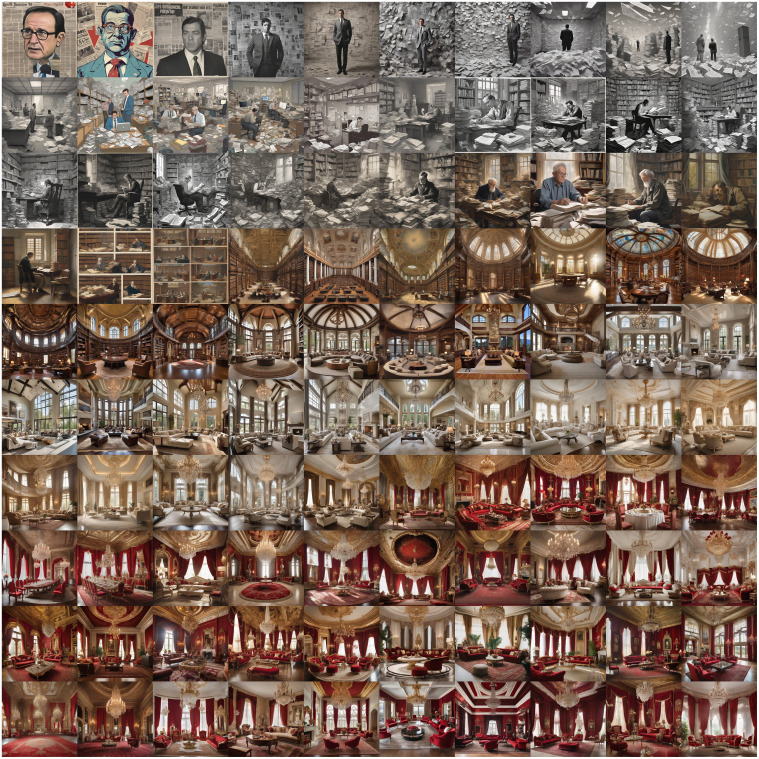
Here’s an interesting example from the study to illustrate how the scenes drift into something totally unrelated. It starts “with an image of what might be a politician in front of a newspaper,” the study reads. Eventually, it leads to “one or multiple people reading in a library, over an architectural elaboration of the library transforming it into a luxurious room, which ends with a red color scheme.”
Why It Happens (and Why It Matters)
There is a close parallel to humans in this generative AI’s behavior. I personally found this part the most interesting.
“Bartlett’s foundational serial reproduction experiments demonstrated that when humans reconstruct stories or images from memory in chains, content systematically drifts toward participants’ cognitive biases,” the study reads.
“Subsequent controlled studies have confirmed that human iterated learning consistently converges toward learners’ inductive biases—for instance, regardless of the initial mathematical functions presented to the first person in a chain, human learners converge toward preferred forms, such as positive linear relationships.”
You can see the pattern outside the lab. The study mentions the example of many cultures arriving at near-identical story shapes on their own. Think of the recurring flood myth, or the Little Red Riding Hood family of tales that pops up across regions.
“In the visual domain, geometric patterns in paleolithic art—spirals, zigzags, and grids—appear independently across cultures separated by millennia, indicating that cognitive constraints channel human visual creativity toward particular forms, much like our AI systems converge on lighthouses and cathedrals.”
This study reminded me remotely of an experiment we covered in 2020. Austrian photographer Janick Entremont uploaded his selfie to Instagram, downloaded it, reuploaded it, and repeated the process over 300 times. It’s not the same, of course. But in both experiments, we end up with something of a digital mess.
But, in this case, interaction is the key that makes all the difference. When people can ask questions, correct each other, and adapt in real time, variety survives. When information travels in a one-way chain with little feedback, it simplifies. That is what happens in autonomous AI loops with no human input, intervention, and correction. If that’s missing, all we can get is steady slide toward generic output. And a very limited one.
Still, the takeaway is not that creativity is doomed. It is that both human minds and computer models tend to settle unless something keeps them exploring. Humans need dialogue, constraints, and critique. AI needs human steering or explicit anti-convergence checks. Otherwise, you get the same generic, pleasant to the eye… And incredibly forgettable results.
[via Gizmodo]
See more from DIYPhotography.net on Google
Add DIYPhotography.net as a trusted source. This makes
our stories more likely to appear in your Google Search results.
 Add as a preferred source on Google

Dunja Đuđić Kalinin
Dunja Djudjic is a multi-talented artist based in Novi Sad, Serbia. With 15 years of experience as a photographer, she specializes in capturing the beauty of nature, travel, concerts, and fine art. In addition to her photography, Dunja also expresses her creativity through writing, embroidery, and jewelry making.
Related Posts
 Have your photos been used to train AI image generators? This website lets you check
 I asked A.I. if humans should fear text-to-image A.I. generators. Here is what it said.
 Research shows that AI image generators can replicate existing photos
 Death of creativity: AI-generated image wins a fine arts competition
Join the Discussion
DIYP Comment Policy
Be nice, be on-topic, no personal information or flames.