






















First look: Full-frame Canon EOS C80 sees some C400 features in a C70 shell
Sep 25, 2024
John Aldred
John Aldred is a photographer with over 25 years of experience in the portrait and commercial worlds. He is based in Scotland and has been an early adopter – and occasional beta tester – of almost every digital imaging technology in that time. As well as his creative visual work, John uses 3D printing, electronics and programming to create his own photography and filmmaking tools and consults for a number of brands across the industry.
Share:

Canon has announced its newest EOS Cinema camera. It’s the Canon EOS C80 ($5,499), and some of the specs read a lot like the EOS C400 ($7,999). The body, on the other hand, looks more like a slightly taller EOS C70 ($4,999).
The Canon EOS C80 features a full-frame 6K stacked BSI CMOS sensor with a triple base ISO (I told you it was like the C400). It also features Canon’s latest Dual Pixel AF II, with fast readout speed and oversampled 4K footage, with 4K recording up to 120fps.
Update: We stopped by the Canon booth at IBC 2024 in Amsterdam this month to check out the new Canon EOS C80 for ourselves. It’s a powerful little camera!
Canon EOS C80 – Triple base ISO
Dual base ISO was revolutionary for many filmmakers when it started arriving on mirrorless and cinema cameras. Well, Canon’s gone one better again with the EOS C80. Like the EOS C400, it offers triple base ISOs of 800, 3200 and 12,800. This means an increased dynamic range and better low-light performance.
It has Canon’s latest Dual Pixel CMOS Autofocus system, Dual Pixel AF II, with a 6K Stacked backside-illuminated sensor. It records up to 6K 30P in Cinema RAW Light, as well as the standard XF-AVC 10-bit 4:2:2. It also records in the XF-AVC S and XF-HEVC S codecs introduced with the Canon EOS C400.

When it comes to 4K, it shoots up to 120 frames per second for some nice slow motion, with autofocus available the entire time you’re shooting.
Wide range of connectivity options
The Canon EOS C80 sports a wide range of connectivity, including 12G-SDI output for an uncompressed video feed, HDMI, mini-XLR audio inputs, Ethernet jack and built-in WiFi, as well as timecode. The camera has been designed for a compact size and light weight.
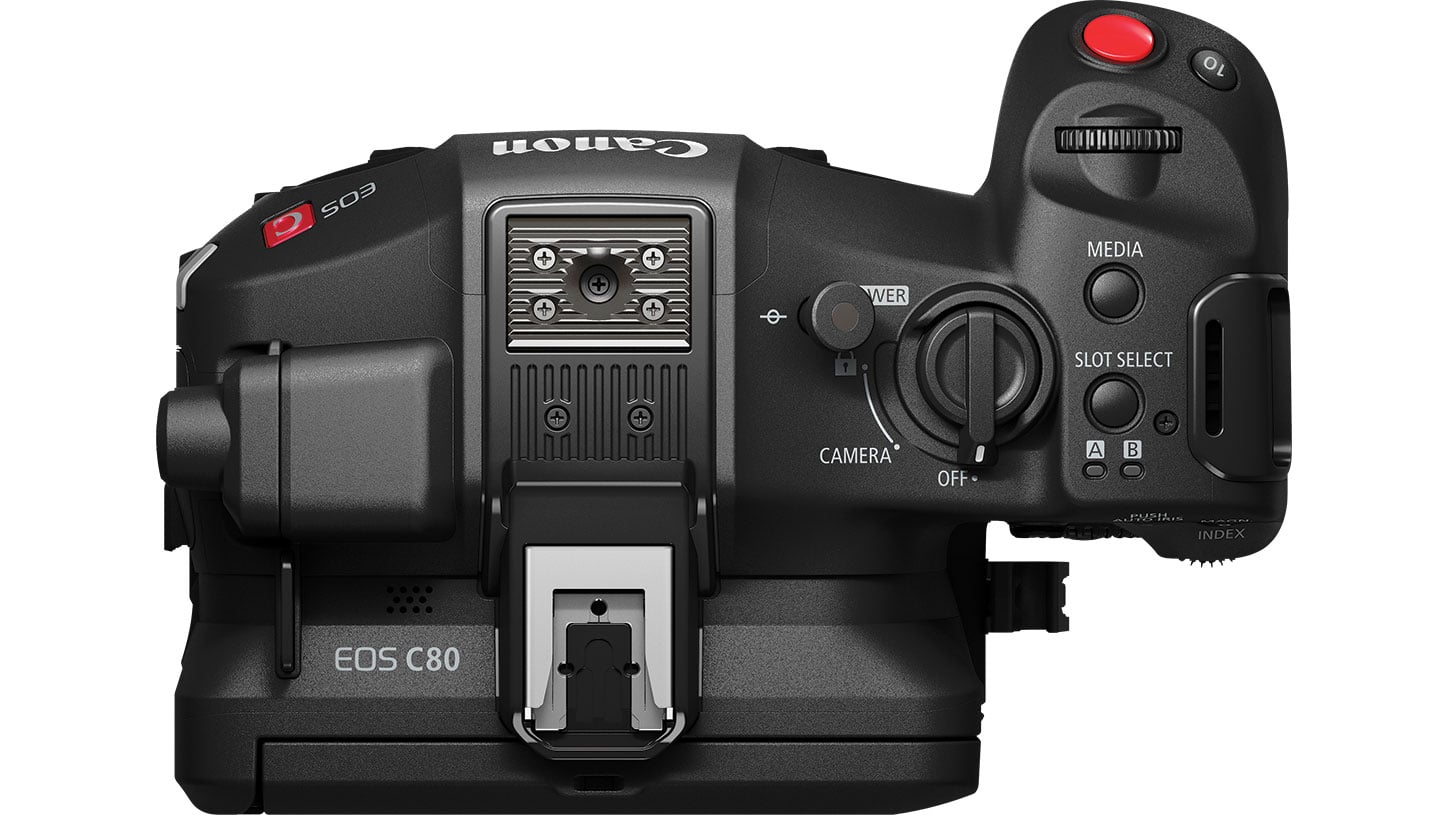
Canon says this makes the Canon EOS C80 as suitable for a drone or gimbal as it is for a tripod. But I wouldn’t try strapping one of these onto your Mavic. If you want it on a drone, it’ll still need to be a pretty beefy one.
It features a new lightweight handle design, with Canon’s Multi-Function Shoe. The new shoe, Canon says, is now being implemented in all new EOS R and EOS C cameras. In the case of EOS C, that primarily means on-camera microphones like the Canon DM-E1D Stereo Microphone ($299).


Canon EOS C80 Specs
| Canon EOS C80 | Canon EOS C70 | |
|---|---|---|
| Sensor Size | 36.0 x 19.0mm (Full-Frame) | 26.2 x 13.8 mm (Super35) |
| Sensor Type | Stacked BSI CMOS | CMOS |
| Sensor Resolution | Actual: 6202×4300 (26.67 MP) Effective: 6008×3170 (19.05 MP) | Actual: 4206 x 2280 (9.6 MP) Effective: 4096 x 2160 (8.85 MP) |
| Lens Mount | Canon RF | Canon RF |
| Built-in ND | 2, 4, 6, 8, 10 stops | 2, 4, 6, 8, 10 stops |
| ISO | 100-102,400 | 100-102,400 |
| Gain | -6 to 54 dB | -6 to 54 dB |
| Dynamic range | 16+ Stops | 16+ Stops |
| Video resolutions | 6K, 4K DCI, 4K UHD, 2K, 1080p | 4K DCI, 4K UHD, 2K, 1080p |
| Frame rates | 6K: Up to 30fps, 4K up to 120fps, 2K up to 180fps | 4K DCI/UHD 4:2:2 10-Bit up to 120fps, 2K/1080p 4:2:2 8-Bit up to 180fps |
| Storage | 2x UHS-II SD Card slots | 2x UHS-II SD Card slots |
| LCD | 2.76m-dot articulating LCD | 2.76m-dot articulating LCD |
| Dimensions | 160 x 138 x 116 mm | 160 x 130 x 116 mm |
| Weight | 1.31kg | 1.17kg |
| Launch Price | $5,499 | $5,499 |
Price and Availability
The Canon EOS C80 is available to pre-order now for $5,499 and is scheduled to start shipping in November.
See more from DIYPhotography.net on Google
Add DIYPhotography.net as a trusted source. This makes
our stories more likely to appear in your Google Search results.
 Add as a preferred source on Google

John Aldred
John Aldred is a photographer with over 25 years of experience in the portrait and commercial worlds. He is based in Scotland and has been an early adopter – and occasional beta tester – of almost every digital imaging technology in that time. As well as his creative visual work, John uses 3D printing, electronics and programming to create his own photography and filmmaking tools and consults for a number of brands across the industry.
Related Posts
 Canon issues service notice over lockups with Canon XF605, EOS C70 and EOS R5c cameras
 Canon EOS C400 is Canon’s first FF cine camera with stacked BSI CMOS sensor
 The Canon EOS C70 is Canon’s first RF mount cinema camera – 4K 120fps (without overheating?)
 Canon brings Eye Detection AF to 4K 120fps video and adds All-I 60p XF-AVD to the Canon EOS C70 Cinema Camera
Join the Discussion
DIYP Comment Policy
Be nice, be on-topic, no personal information or flames.