


























How To Tell A Good Battery From A Dead One? Bounce It!
Oct 1, 2014
Udi Tirosh
Udi Tirosh is an entrepreneur, photography inventor, journalist, educator, and writer based in Israel. With over 25 years of experience in the photo-video industry, Udi has built and sold several photography-related brands. Udi has a double degree in mass media communications and computer science.
Share:
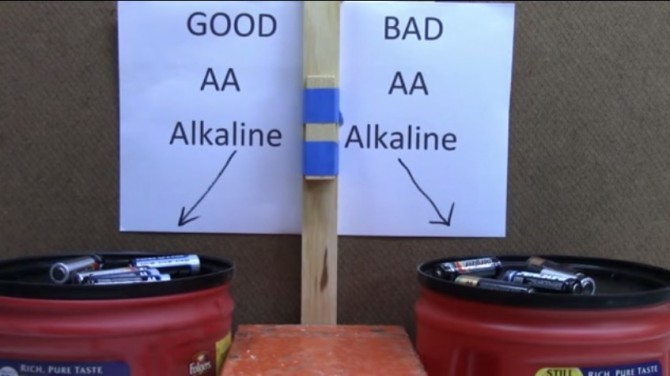
Batteries are a drag. They are loaded or unloaded, dead or alive and generally just always find their way out of their boxes and into to your bags floor, where they sit quietly and rot and destroy the bag…
Our usual recommendation is to use rechargeable batteries as default, but I always carry an extra set of Alkaline batteries as spare as well.
Engineer Lee Hite tested the theory that a dead Alkaline battery will bounces while a good battery will stay. Hite tested a few alternative explanations, including a test to see if the bounce is coming from released gas.
After dissecting a set of good and a set of bad batteries, Hite discovered that the electric paste inside the battery dries up upon usage and no longer absorbs the fall impact, thus enabling the bounce:
A non-rechargeable alkaline battery begins life using zinc powder mixed into a gel containing a potassium hydroxide electrolyte separated from a paste of manganese dioxide powder mixed with carbon powder using a porous membrane. To minimize hydrogen outgassing an extra measure of manganese dioxide is added. As the battery discharges manganese dioxide powder changes to manganese oxide causing the powdered granules to bond both chemically and physically. This packed-sand consistency reduces the antibounce effect exhibited by the gel mixture when the battery was fully charged. #
[Why A Dead Alkaline Battery Bounces! | Lee Hite]

Udi Tirosh
Udi Tirosh is an entrepreneur, photography inventor, journalist, educator, and writer based in Israel. With over 25 years of experience in the photo-video industry, Udi has built and sold several photography-related brands. Udi has a double degree in mass media communications and computer science.




Join the Discussion
DIYP Comment Policy
Be nice, be on-topic, no personal information or flames.
5 responses to “How To Tell A Good Battery From A Dead One? Bounce It!”
somone searching for a solution for a problem that does not exist.
While this is cool science… perhaps subjecting potentially volatile items to repeated impacts is not such a good idea, hmm?
Also, touching the inside of a battery without gloves on….
first person to try this with a lithium polymer battery gets a gold medal
oh my