



















“Fast” vs. “Slow”: Does lens “speed” really matter that much?
Jun 11, 2024
Chuck Haacker

Dunja Djudjic is a multi-talented artist based in Novi Sad, Serbia. With 15 years of experience as a photographer, she specializes in capturing the beauty of nature, travel, concerts, and fine art. In addition to her photography, Dunja also expresses her creativity through writing, embroidery, and jewelry making.
Share:

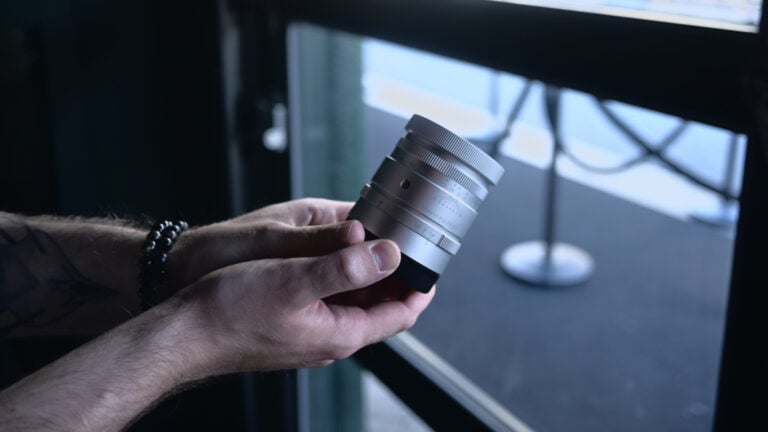
Camera lenses are rated “fast,” not so fast, or even outright “slow” based on their maximum aperture, the opening that controls the amount of image-forming (actinic) light that strikes the sensor or film when the camera’s shutter is open.
A lens’s adjustable aperture — its iris diaphragm — controls the amount of light coming through the lens over time (controlled by the shutter).

The wider its maximum opening, the “faster” any lens is said to be; it admits a lot of light. Generally, a lens with a maximum opening of at least f/2.8 or greater is considered “fast.” f/4.0 and above are considered “slow.” Many zoom or varifocal lenses will have designations like this one:
Sony E 55–210mm f/4.5–6.3, a lightweight lens I love and use constantly, but with a maximum aperture of f/4.5 it is slow to begin with, and its maximum working aperture varies as the lens is zoomed; the longer the focal length, the smaller, and slower, the maximum effective aperture. This lens varies by 1–1/2 stops. I joke that it is “slow and slower,” but that’s never stopped me from using it in any light or lack thereof. I am a deeply committed ambient (available) light shooter, yet I use “slow” lenses.
How is that possible? Many photographers, vloggers, and review sites deride such slow lenses as unsuitable (some say “useless”) for low light, yet I cheerfully shoot in sometimes ridiculously “available dark” with no qualms. My fastest lens is my Sigma 70mm f/2.8 Art DG Macro for Sony FE. All my other lenses are f/4.0 or slower, plus I prefer zooms for their flexibility. Some of my zooms are f/4.0 throughout their focal range, but others are variable depending on working focal length. Fast zooms are available, but they are fabulously expensive and massively heavy. To make fast glass takes lotsa glass.
I frequently swim upstream, doing what I think works, proudly and loudly non-purist about most things in general and photography in particular. I adhere to the KISS principle, preferring compact cameras and relatively lightweight lenses. While my kit is not classified professional — it’s referred to as “prosumer” — I have complete confidence in it. As a retired professional, I use it in a professional manner and get professional results. I would happily shoot a wedding with the kit I have. It would handle the job beautifully; the 80-year-old doddering photographer not so much.

There are many reasons why having a big maximum aperture in a lens is helpful. One of the most significant is bokeh control, background blur, which is harder to achieve with slower lenses. The first thing photographers think about when discussing bokeh is aperture. We can always stop down to increase apparent depth-of-field, but maximum aperture is maximum — you can’t open the lens past it, limiting bokeh control depending on other factors.

It is also harder to achieve pleasing bokeh/blur with short focal lengths and/or small formats. Older cell phones without the latest cameras will have apparent depth-of-field that seems to go from zero to infinity because the sensor is tiny, so the focal length of its basic lens is very short, 4–6mm or so. Most modern phones have computational aids onboard that can mimic the effect of longer lenses, but it’s not the same.
I made this picture at an event with my lightweight Sony E 55–210mm f/4.5–6.3 at maximum extension (210mm) and f/6.3, which is wide open at that focal length. I wanted to be sure that the background blurred nicely to keep the attention on my subject. I don’t usually shoot wide open, but there was no reason not to in this instance.


It is often said and written that working in low ambient light such as indoors without flash requires “fast glass,” f/2.8 or (preferably) better. But I work in low ambient light all the time with lenses considered “slow” by any standard, and I get away with it. How?
I use mirrorless cameras — MILCs.
DSLRs legitimately need fast glass in low light for the photographer to clearly see the finder image to focus and compose. DSLRs have optical finders. If the light is dim, the viewfinder is dim. The wider the maximum aperture, the more light gets to the eyepiece. The typical “Nifty-50” is an f/1.8 or f/1.2. By design, DSLR lenses are wide open until the shutter is released when they stop down to the preset working aperture. There is a switch or button on the lens to manually stop it down to the working aperture to gauge the depth of field, but when utilized, the image goes dark, sometimes too dark to see.
Mirrorless cameras like my Sony A6000-series compacts have Electronic ViewFinders (EVF) that can “see in the dark” by boosting the gain. The camera does not care what lens is on or its speed; it delivers a bright, crisp viewfinder image even in abysmal light because it is in live view full time. It’s the same as the live preview on your DSLR and can be set to keep the finder bright regardless of the settings. I can see if the image is too dark or light. I can see the DOF and adjust as needed. I use EVFs as faux light meters. I rarely miss a shot due to poor exposure.
I know many photographers who hate EVFs, but it’s different strokes. I love them while acknowledging their faults and foibles. When I couple on a relatively slow lens, my finder image is still crisp and bright. I can change that in the menu to show me what the light really looks like, just as I would with any SLR, but I don’t because I can’t see a good reason to.
How often are pictures made with any lens wide open?
A large maximum aperture is important to a DSLR shooter in low ambient light. Regardless of where the working aperture is set, the scene is focused and composed with the lens wide open, sucking in as much light as possible. But how many pictures are made wide open? When I worked in analog with SLRs, I appreciated fast glass in low light, but my working aperture was almost always in the midrange, f/5.6 to f/8 or so despite the lens being, say, an f/1.8.
For me, the fast lens was for focusing, but I would be shooting a 400-speed film pushed to 800, so I could stop down and get a little DOF. I rarely shot wide open, and besides, we knew in those long-ago days that no lens was ever at its crispest wide open or fully stopped down. Modern lenses may suffer less from such aberrations, but shooting an f/1.8 wide open likely yields vanishingly shallow DOF, especially if your subject is close.
Digital allows me to push the envelope — a lot. Routinely, I shoot auto ISO “floating” from 100 to 6400, four full stops faster than the 400-speed films I standardized on. Although it tests my half-frame APS-C sensors, I am not concerned about boosting the capped ISO to 12,800. I can go even higher; noise becomes an issue, but shooting raw and post-processing in any raw processor is controllable. Aftermarket apps can kill noise if needed; I use Topaz DeNoise AI if it’s very noisy. The Topaz apps are $pendy but astonishingly powerful.
My take is that MILCs do not need big apertures because of full-time live preview, in the finder and on the screen. I rarely shoot wide open with any lens at any focal length, preferring to stop down at least a little and get the shutter speed I need by allowing the ISO to “float” up to a maximum cap that is also adjustable. When I was working in analog, I shot almost everything with SLRs. I am not sure I could use a DSLR comfortably now that I am a total mirrorless freak.

Ya do what works. I shamelessly love everything digital and mirrorless, shoot only raw, and subscribe to Adobe CC (photography). You do you. I do me, but please don’t insist that I can’t do what I am doing when I am already doing it.
As always, thanks for reading.
See more from DIYPhotography.net on Google
Add DIYPhotography.net as a trusted source. This makes
our stories more likely to appear in your Google Search results.
 Add as a preferred source on Google

About Chuck Haacker
A seasoned photographer of over 30 years, Charles “”Chuck”” Haacker brings a craftsman’s approach to capturing the world around him. He specializes in realistic imagery, from portraits and weddings to landscapes and museums. While his editing ensures every photo shines, he focuses on capturing genuine moments using available light and minimal equipment. Though constantly striving to improve, his true passion lies in the joy of photography itself. You’ll find more of Chuck’s work on Flickr. This article was also published here and shared with permission.
We love it when our readers get in touch with us to share their stories. This article was contributed to DIYP by a member of our community. If you would like to contribute an article, please contact us here.


Join the Discussion
DIYP Comment Policy
Be nice, be on-topic, no personal information or flames.
3 responses to ““Fast” vs. “Slow”: Does lens “speed” really matter that much?”
TL;DR: Yes
As far as I know, not all mirrorless cameras stop the lens down to the desired aperture and use that to create the viewfinder image and actually expose the sensor for the final image. At least not all models, in all modes, for all apertures and despite some settings. For Sony, there is a setting called “Live view display” where the camera would behave like an ordinary DSLR if that mode is set to “Setting Effect OFF” in the sense that it leaves the lens wide open and only stops it down to create the image. But even in “Setting Effect ON” it would not stop down to the desired aperture if that aperture is ridiculously small.
And there are PDAF sensors and CDAF sensors for autofocus, that have there individual advantages and disadvantages.
Also, the image displayed in the EVF for a stopped down lens in a dark environment will be about as bright, crisp, noisy and laggy as if you were to actually shoot an image at those settings, no matter if DSLR or MILC if the sensor, amplifier, ADC, etc. are comparable. The EVF image might get some denoising, but there is no way around Physics.
So, simply put and in three words: Things are complicated.
Modern DSLRs as well as modern MILC will properly operate (i. e. focus, measure exposure, detect objects, …) in any but the very darkest environment which would sit at or even below 0EV. So in the end its all about what exposure time you would be willing to accept (depending on motion blur or limitations of handheld operation), what DOF is required and what level of noise is acceptable.
In that, there is no fundamental difference between a lens that is meant for DSLRs and a lens for a MILC. Very high transmission means a big aperture and heavy, expensive glass. Again: Physics.
Eight foot stringpod? How tall are you? :) Reminds me I need to make another stringpod.