

















Are deepscape images fake? Let’s find out
Dec 29, 2024
Soumyadeep Mukherjee
Soumyadeep Mukherjee is an award-winning astrophotographer from India. He has a doctorate degree in Linguistics. His work extends to the sub-genres of nightscape, deep sky, solar, lunar and optical phenomenon photography. He is also a photography educator and has conducted numerous workshops. His works have appeared in over 40 books & magazines including Astronomy, BBC Sky at Night, Sky & Telescope among others, and in various websites including National Geographic, NASA, Forbes. He was the first Indian to win “Astronomy Photographer of the Year” award in a major category.
Share:

Astrophotography has captivated audiences worldwide in recent years with its breathtaking portrayal of the cosmos. Deepscape images have gained immense popularity among the various genres for their stunning combination of landscapes and celestial wonders. However, these awe-inspiring images often spark debate, especially in social media, with some users questioning their authenticity. Are deepscape images fake, or are they the result of genuine photography? We try to find the answer in this article.
Table of contents
What is a deepscape image
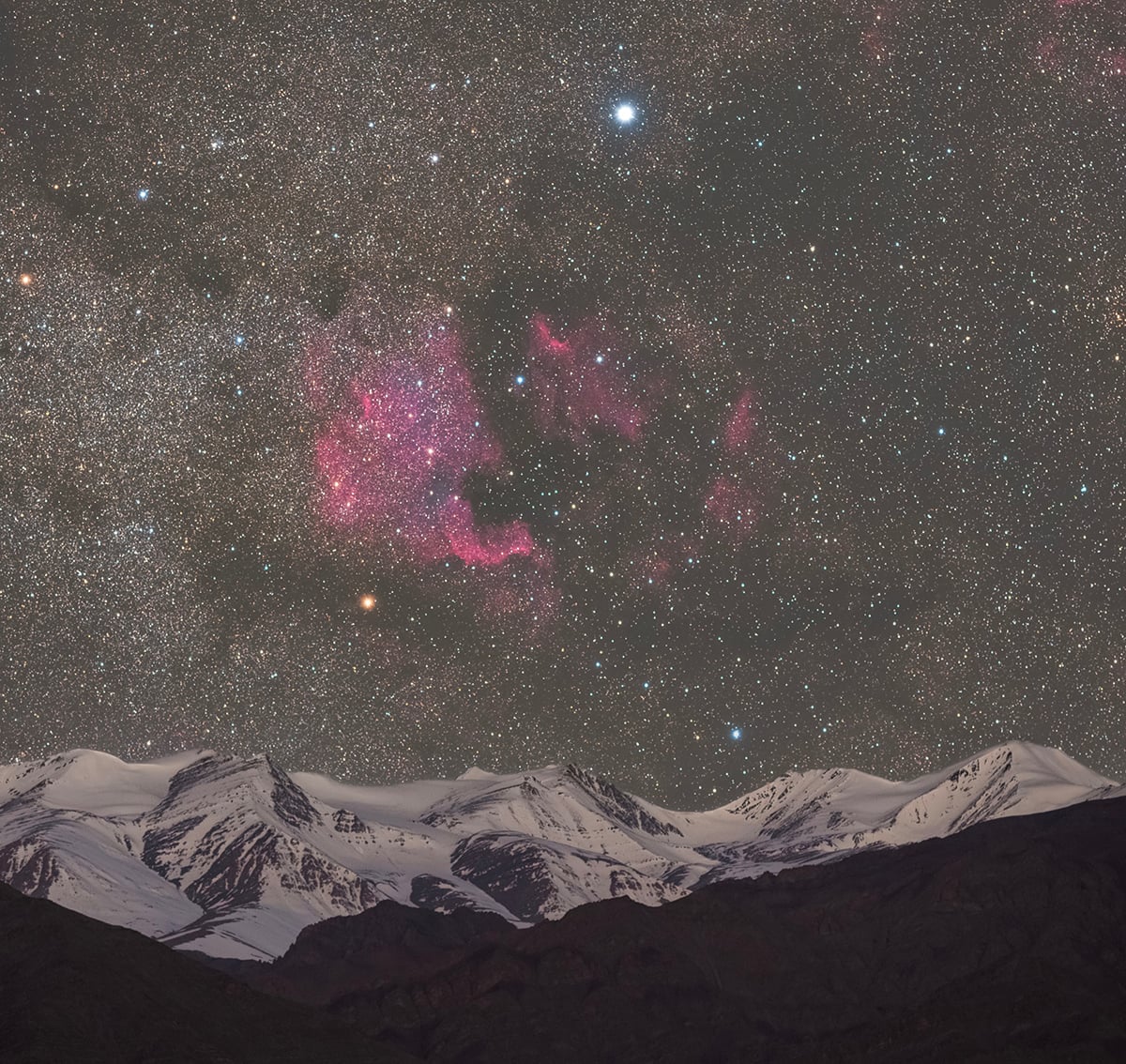
A deepscape image is a seamless blend of the natural world and the boundless cosmos. These images juxtapose a terrestrial foreground—such as mountains, deserts, or forests—with the grandeur of the night sky, emphasising celestial objects such as galaxies and nebula. This inventive method bridges the gap between Earth and space, producing a piece that conveys a cosmic connection story. The term “deepscape” is a combination of “deep-sky” and “landscape”. Deepscape photography typically requires long exposures, significant editing, and careful planning to blend the brightness of the foreground with the dim light of celestial objects. A deepscape is more than just a snapshot; it is a carefully produced piece of art that celebrates nature’s beauty (earth) and the marvels of the universe (sky).

Deepscape images can be more complex than other nightscape images
Deepscape photographs differ from regular nightscape or wide-field images in that they focus on deep-sky phenomena such as galaxies, nebulae, and distant star clusters, which are not visible in ordinary nightscape photography. While traditional nightscapes focus on terrestrial scenes beneath a starry sky or the Milky Way, deepscape photography expands the concept by incorporating elements of deep-space astrophotography. The inclusion of faint, distant celestial objects demands special processes and equipment to capture details that are typically millions of light-years away. This extra intricacy distinguishes deepscapes as a distinct fusion of landscape photography and astrophotography, whereas nightscapes often focus on the beauty of the local surroundings under the stars.

Additionally, deepscapes often demand higher precision and planning to align the foreground with a specific celestial object. It requires specialized equipment like a star tracker to allow long exposures. Post-processing in deepscape photography is also more intensive, as it involves bringing out subtle details in both the sky and the landscape while ensuring a seamless blend. Ultimately, while nightscapes capture the beauty of Earth under the stars, deepscapes aim to tell a larger story, bridging the terrestrial and the cosmic in a way that highlights humanity’s connection to the universe. However, artistically, both nightscapes and deepscapes, involve mastery.

Why people conceive them as “fake”
Despite their attraction, deepscape pictures are sometimes misunderstood as artificial, owing to their significant differences from what the human eye sees in reality. Unlike daytime photography, photographing the night sky requires overcoming considerable hurdles, such as low light levels and the faintness of distant celestial objects. Most people are accustomed to seeing stars as little, dull bits of light, making it difficult to conceive that such bright, realistic depictions of the cosmos are possible. One of the most popular myths among the masses includes perceiving deep sky objects as tiny and visible only through large telescopes. This scepticism is further fueled by the editing processes involved, which are sometimes misconstrued as manipulation rather than enhancement. The combination of these factors has led many to dismiss deepscape images as digitally fabricated.
Are they “fake”?
The idea that deepscape photographs are artificial originates from their almost surreal nature, however this does not exclude their reality. The key is to grasp the technological limits of human vision and the methods that photographers employ to overcome them. Our eyes, unlike camera sensors, cannot collect light over lengthy periods of time. Astrophotographers use techniques such as extended exposures and image stacking to capture subtle elements of the night sky that the naked eye cannot see. Furthermore, advanced post-processing is employed to make the deep sky objects “pop. While the final image appears “unreal”, it is based on “what is there in the sky”.

A simple test to defy their fakeness is to try out an online tool, Telescopius. This website lets you enter details about your equipment, such as sensor size, focal length, etc. It will also show you the field of view of the desired deep sky object. This shows how large the deep sky objects are in reality and how they can be photographed with medium or medium-telephoto lenses, which are generally considered for portrait photography.

How deepscape images are made
Creating a deepscape image requires a combination of creative vision and technological perfection. The procedure normally begins with scouting the ideal place and time, which might take months of planning to match the target celestial object with the surrounding scenery. Photographers utilise specialised equipment, such as star trackers, to offset the Earth’s rotation, allowing for longer exposures with no star trails. It also incorporates image stacking, which combines numerous exposures to reduce noise and improve clarity. The post-processing stage is similarly important, in which software such as Adobe Photoshop or Pixinsight is used to modify colours, contrast, and brightness, ensuring that the final image accurately depicts the data recorded.

While deepscape images may appear “too perfect” to some, they are not fake. These photographs represent a blend of science, technology, and artistry, crafted to reveal the cosmos in ways our eyes cannot naturally perceive. Far from diminishing their value, the advanced techniques used in creating deepscapes highlight the ingenuity and dedication of astrophotographers. The next time you see a deepscape image, consider the skill and effort required to bring such a breathtaking vision of the universe to life rather than questioning its authenticity. In doing so, you’ll appreciate the photograph and the incredible cosmos it seeks to represent.
Clear skies!
See more from DIYPhotography.net on Google
Add DIYPhotography.net as a trusted source. This makes
our stories more likely to appear in your Google Search results.
 Add as a preferred source on Google

Soumyadeep Mukherjee
Soumyadeep Mukherjee is an award-winning astrophotographer from India. He has a doctorate degree in Linguistics. His work extends to the sub-genres of nightscape, deep sky, solar, lunar and optical phenomenon photography. He is also a photography educator and has conducted numerous workshops. His works have appeared in over 40 books & magazines including Astronomy, BBC Sky at Night, Sky & Telescope among others, and in various websites including National Geographic, NASA, Forbes. He was the first Indian to win “Astronomy Photographer of the Year” award in a major category.
Related Posts
 This DIY 3D printed trinocular lens lets you lets you shoot digital wigglecams with your Sony camera
 Bye-bye fake news: This free tool spots AI-generated images in a second
 Does it matter that the viral snow leopard images are fake? Yes, and this is why
 Google Gemini Adds Hidden AI Watermark Detection to Expose Fake Images
Join the Discussion
DIYP Comment Policy
Be nice, be on-topic, no personal information or flames.