





















A Frigid Giant in a Chaotic Dance: Webb Photographs 14 Herculis C
Jun 18, 2025
Soumyadeep Mukherjee
Soumyadeep Mukherjee is an award-winning astrophotographer from India. He has a doctorate degree in Linguistics. His work extends to the sub-genres of nightscape, deep sky, solar, lunar and optical phenomenon photography. He is also a photography educator and has conducted numerous workshops. His works have appeared in over 40 books & magazines including Astronomy, BBC Sky at Night, Sky & Telescope among others, and in various websites including National Geographic, NASA, Forbes. He was the first Indian to win “Astronomy Photographer of the Year” award in a major category.
Share:

NASA’s James Webb Space Telescope has captured a cold and distant planet. The planet is called 14 Herculis c. It orbits a star about 59 light-years away from Earth. This discovery is not just another dot in the sky. It gives scientists new insight into the evolution of planetary systems. The planet is enormous. It is over seven times the mass of Jupiter. But what makes it special is its temperature and orbit. Unlike most exoplanets imaged directly, this one is icy cold. It orbits its star in a strange, tilted path. These facts make it one of the most fascinating discoveries of the year.
Webb’s eyes on a cold world
Webb has the power to observe in infrared. This means it can see heat, not just light. That’s what makes it ideal for spotting cold objects in space. 14 Herculis c is one such object. Its temperature is around minus 3 degrees Celsius (26°F). For comparison, most planets directly imaged so far are extremely hot, often over 800°C. NASA reports this is one of the coldest exoplanets ever directly imaged. It’s also older than many previously spotted ones. Most directly imaged exoplanets are young and warm. This planet, however, is mature and chilly. The success is a milestone. Scientists now know that Webb can detect even the coldest giant planets orbiting other stars.
A giant among giants
14 Herculis c is no small fry. It has a mass about 7 times that of Jupiter. Its size makes it a “super-Jupiter.” These massive planets are rare and mysterious. They are made mostly of gas, like Jupiter and Saturn. The planet orbits a star named 14 Herculis. The star is a little smaller and cooler than our Sun. It already had one known planet, 14 Herculis b. That planet is also a gas giant and has a long, elliptical orbit. Scientists had suspected another planet in the system for over 20 years. But they had no direct proof until Webb provided it.
A strange and tilted orbit
One of the most fascinating things about 14 Herculis c is its orbit. The planet moves around its star in a highly tilted orbit. Its orbit is inclined by about 40 degrees compared to 14 Herculis b. This is not normal. In most star systems, planets orbit in roughly the same plane. This strange tilt suggests the system had a violent past. NASA scientists believe a third planet once existed in the system. It may have been ejected after a gravitational tug-of-war. The result? A cosmic mess. The orbits of the two remaining planets now form an “X” shape when seen from above. This kind of orbital chaos is rare and fascinating. It gives researchers a new view into how planetary systems evolve.
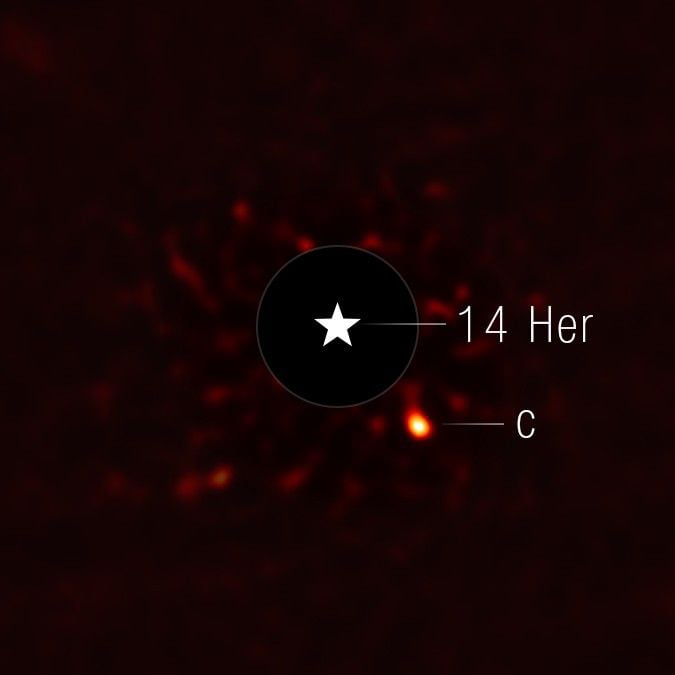
NASA, ESA, CSA, STScI, W. Balmer (JHU), D. Bardalez Gagliuffi
Cold and cloudy: A unique atmosphere
Webb’s instruments didn’t just capture the image. They also analyzed the planet’s atmosphere. The planet is surprisingly faint at a wavelength of 4.4 microns. This is unexpected. Models had predicted the planet to shine more at this infrared range.
This dimness suggests unusual chemistry. Scientists believe the atmosphere might be in carbon disequilibrium. This means chemical reactions are happening faster than the atmosphere can stabilize. This behavior is similar to what is seen in cold brown dwarfs. Even more exciting, there may be water ice clouds in the atmosphere. These icy clouds reflect light and affect the planet’s brightness. This kind of weather has never been directly observed on an exoplanet before.
How was the image captured?
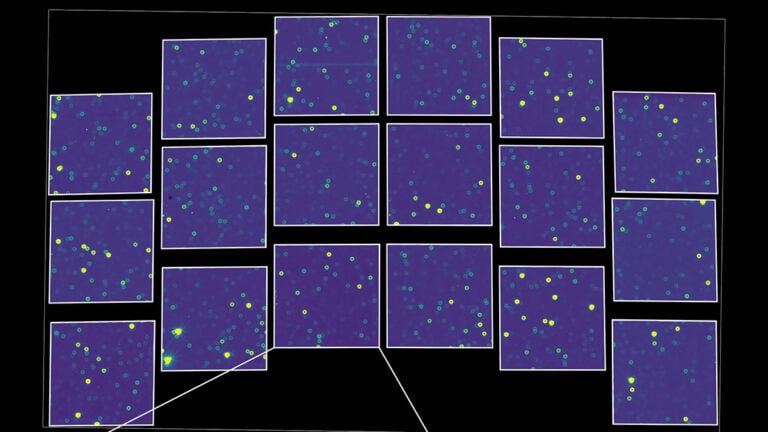
The planet was first suspected through a method called radial velocity. In this technique, scientists observe the slight wobble of a star caused by an orbiting planet. This wobble suggests the presence of a planet, but doesn’t show the planet itself. That’s where Webb came in. Scientists used Webb’s NIRCam instrument to image the planet directly. They also used a technique called coronagraphy. This blocks out the light of the star so the faint planet can be seen. The result was a stunning infrared image of 14 Herculis c. It confirmed what scientists had suspected for years. A second giant planet was indeed out there.
Webb’s success in imaging 14 Herculis c marks a new chapter. Cold, distant exoplanets are now within reach. Astronomers can now explore worlds like our own gas giants, but in faraway star systems. Every detail of this discovery, its temperature, orbit, and chemistry, tells a story.
Clear skies!
See more from DIYPhotography.net on Google
Add DIYPhotography.net as a trusted source. This makes
our stories more likely to appear in your Google Search results.
 Add as a preferred source on Google

Soumyadeep Mukherjee
Soumyadeep Mukherjee is an award-winning astrophotographer from India. He has a doctorate degree in Linguistics. His work extends to the sub-genres of nightscape, deep sky, solar, lunar and optical phenomenon photography. He is also a photography educator and has conducted numerous workshops. His works have appeared in over 40 books & magazines including Astronomy, BBC Sky at Night, Sky & Telescope among others, and in various websites including National Geographic, NASA, Forbes. He was the first Indian to win “Astronomy Photographer of the Year” award in a major category.
Related Posts
 You think James Webb is powerful? $1 billion Giant Magellan Telescope will have 4x higher resolution
 James Webb Reveals a Giant Protostellar Jet on the Edge of the Milky Way
 ALMA Photographs a Giant Cocoon around Stephenson 2 DFK 52
 Awakening of a Sleeping Giant: VLA and VLBA Photographs a Supermassive Black Hole
Join the Discussion
DIYP Comment Policy
Be nice, be on-topic, no personal information or flames.