
















Subaru Telescope Captures a Tail Stretching From Two Interacting Galaxies
Oct 26, 2026
Soumyadeep Mukherjee
Soumyadeep Mukherjee is an award-winning astrophotographer from India. He has a doctorate degree in Linguistics. His work extends to the sub-genres of nightscape, deep sky, solar, lunar and optical phenomenon photography. He is also a photography educator and has conducted numerous workshops. His works have appeared in over 40 books & magazines including Astronomy, BBC Sky at Night, Sky & Telescope among others, and in various websites including National Geographic, NASA, Forbes. He was the first Indian to win “Astronomy Photographer of the Year” award in a major category.
Share:
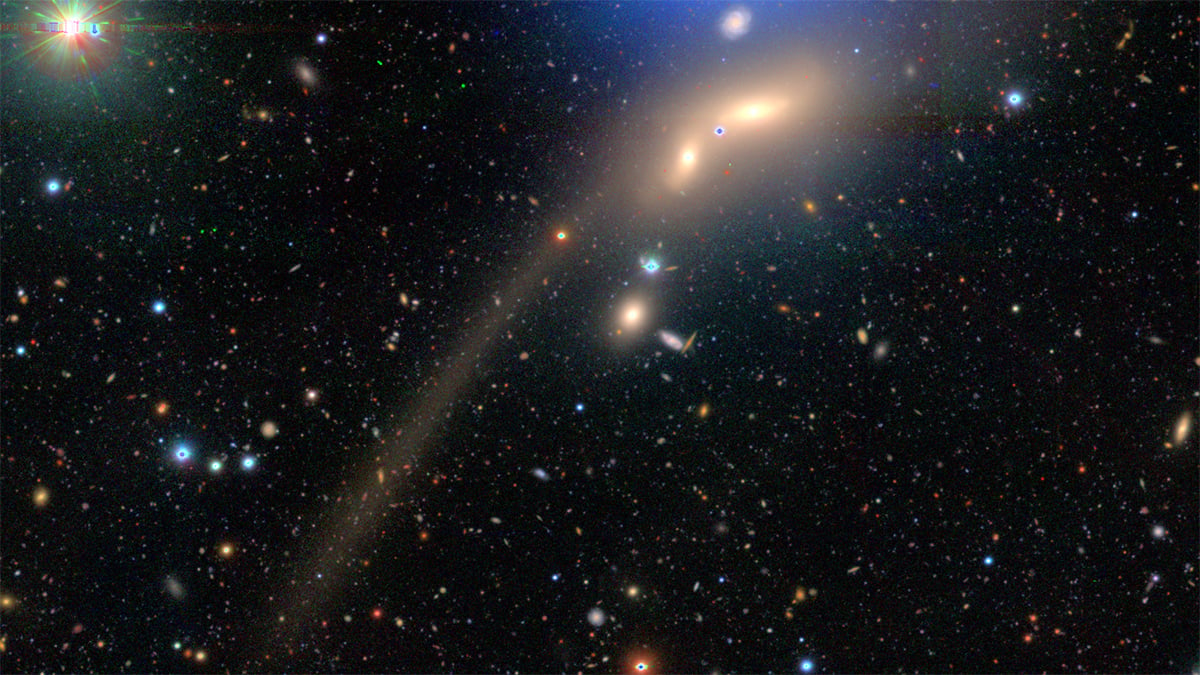
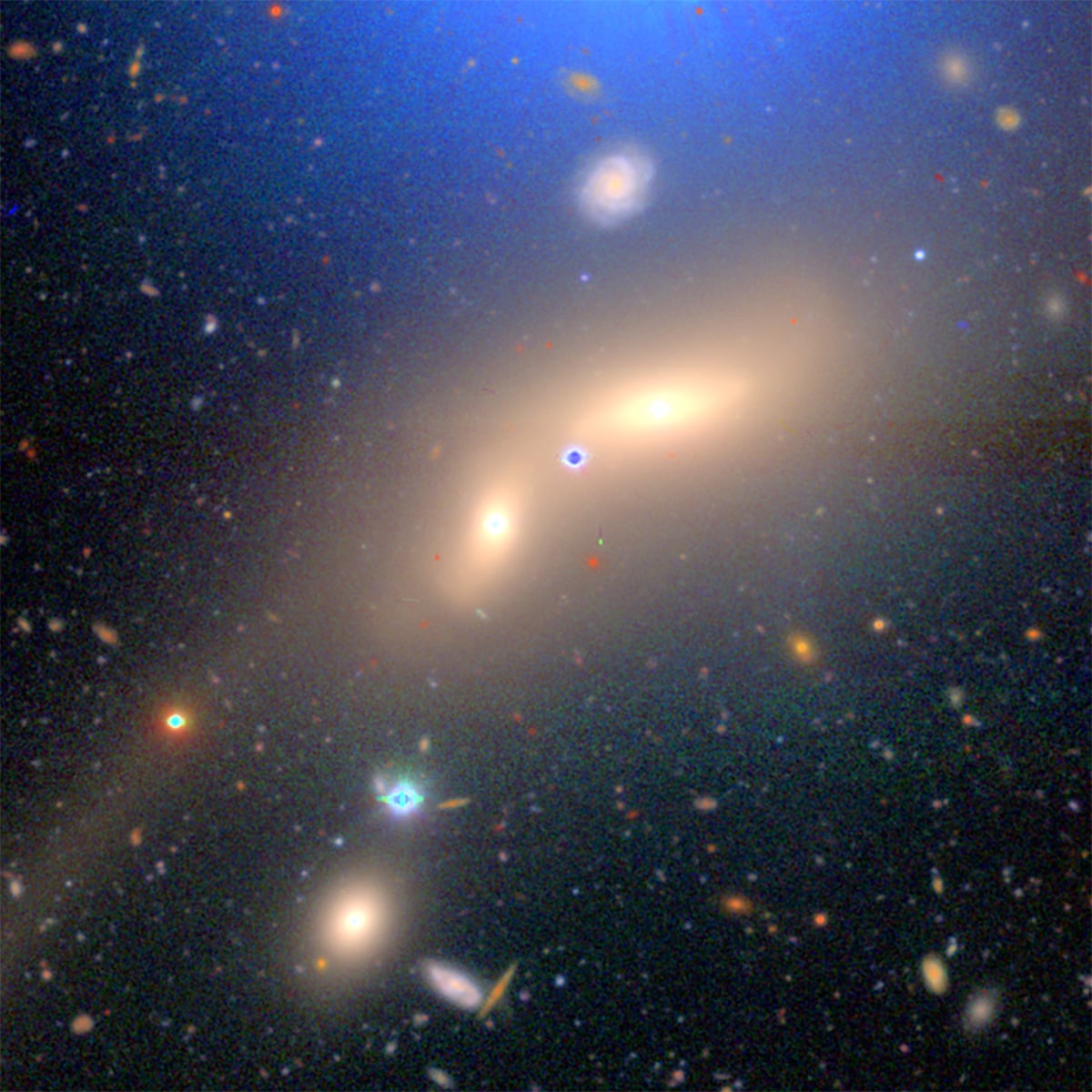
Two galaxies in the constellation Pisces share the frame in a new image from the Subaru Telescope. A long, narrow stream of material stretches away from the pair, giving the system a distinctive shape. Astronomers call it Arp 323, and it lies about 370 million light-years from Earth.
The image shows a little more than two galaxies passing close to each other. Recent studies suggest that a smaller, third galaxy may have helped form the extended tail. One of the main galaxies also has an active center, where a supermassive black hole feeds on surrounding material.
A long stream of material
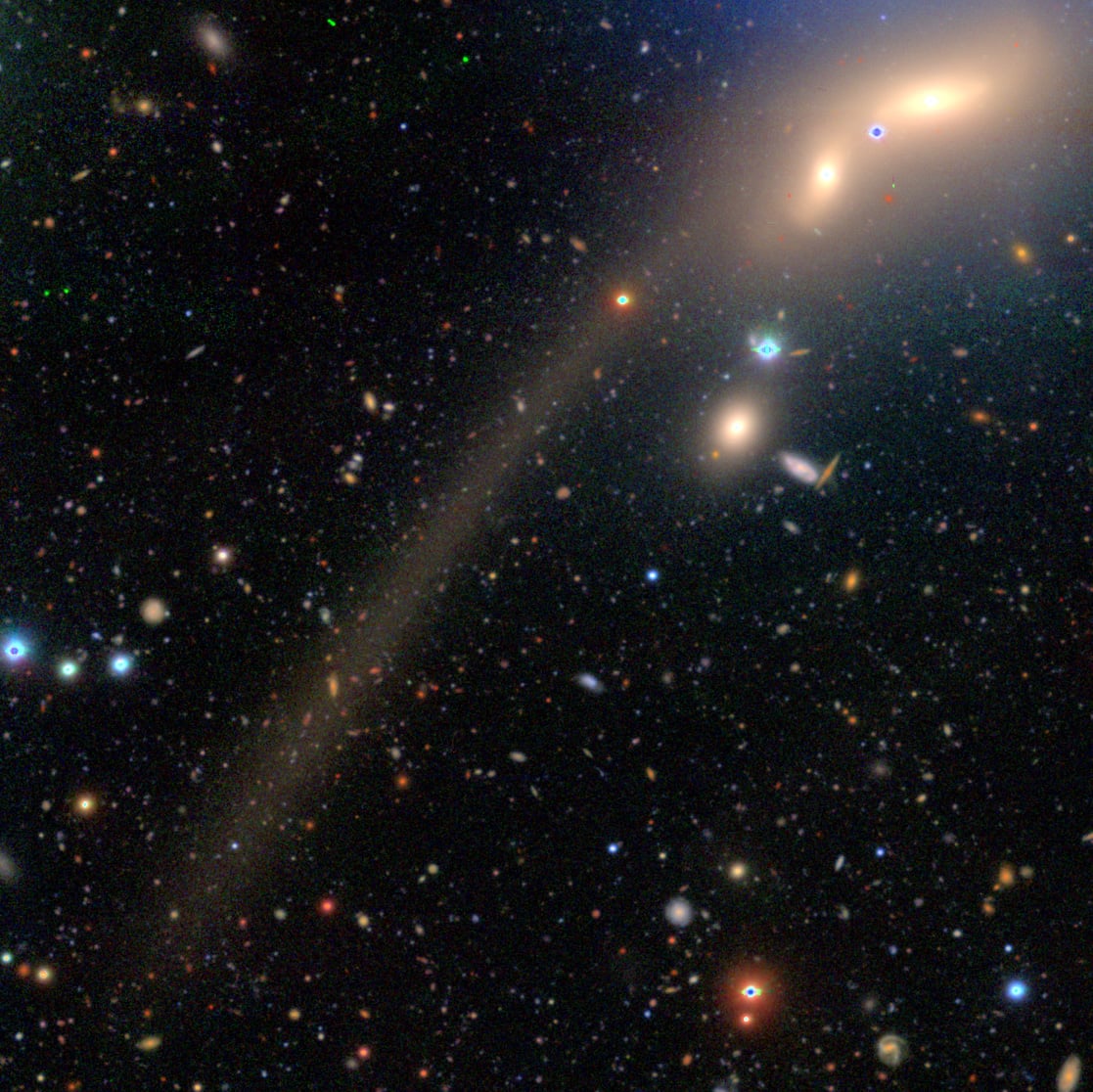
In Subaru’s image, Arp 323A appears on the right, and Arp 323B sits toward the lower left. The elongated stream extends toward the lower-left part of the frame. Its shape resembles a tadpole‘s tail, although the structure spans distances that are difficult to grasp from a single image.
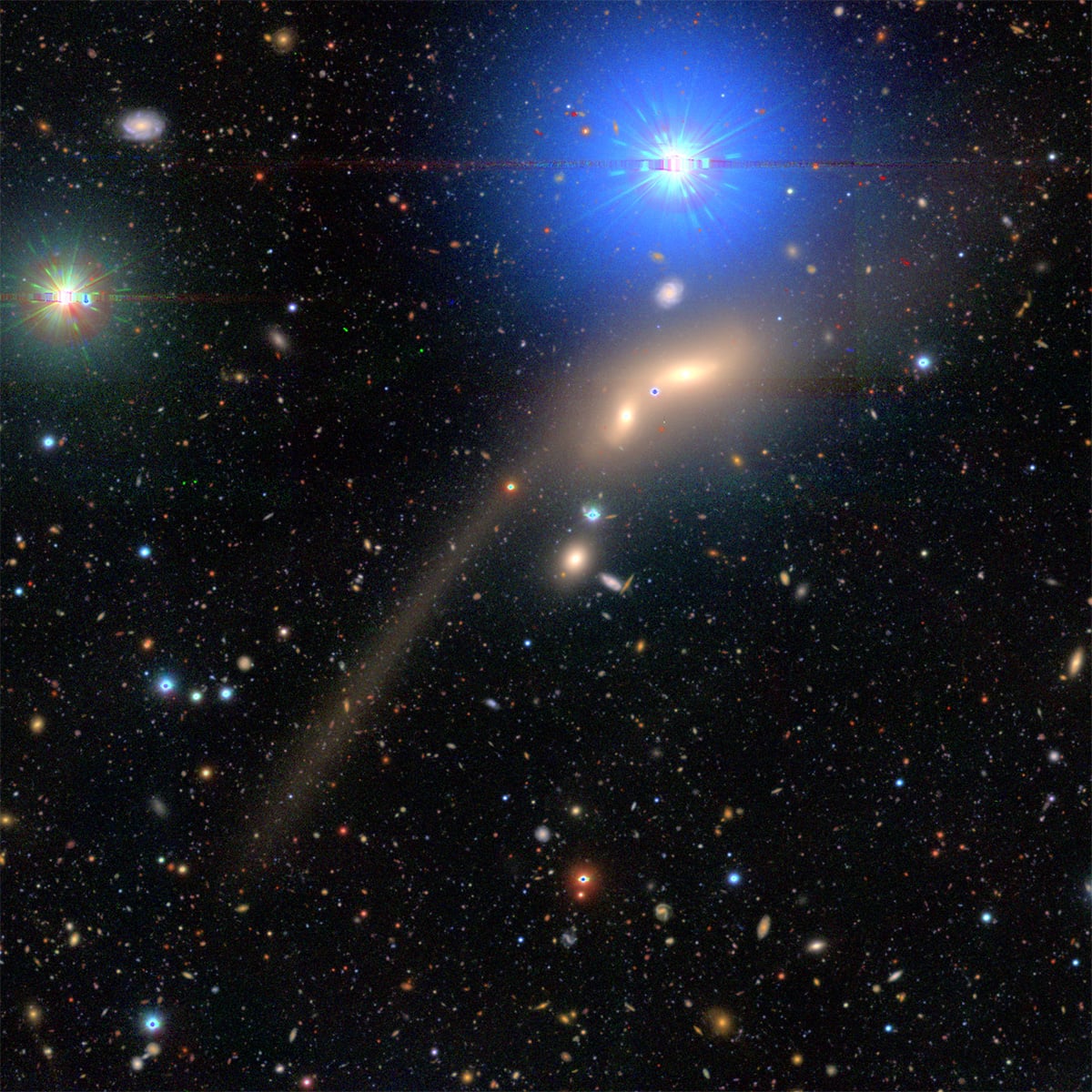
Astronomers call features like this tidal tails. They form when one galaxy‘s gravity disturbs the stars and gas in another. As galaxies pass close to each other, their gravitational fields pull at the material in their outer regions. Some stars move onto new paths, stretching the galaxies’ original shapes into long streams.
A galactic encounter does not usually involve stars crashing into one another. The distances between stars remain enormous, even when two galaxies overlap in an image. Gravity changes the paths of stars across the galaxies. Gas clouds also respond to the disturbance, sometimes gathering in new regions or moving toward the galactic centers.
A dwarf galaxy may have played a role
The Subaru Telescope release notes that recent studies suggest the tail may have formed through interactions involving three galaxies, including a dwarf galaxy. This means the two prominent galaxies may not tell the whole story.
Dwarf galaxies contain far fewer stars than large galaxies such as the Milky Way. Yet their gravitational influence can still change the structure of a larger neighbor. During a close passage, a dwarf galaxy can disturb the outer regions of a larger galaxy and lose stars of its own. Those stars may then spread along extended streams.
Astronomers can test these ideas by measuring the movements of stars and gas across the system. They can also run simulations with different galaxy masses and orbital paths. Researchers then compare the simulated structures with the actual observations to see which scenarios fit best.
An active black hole powers the center of Arp 323A
The galaxy on the right has another feature of interest. Subaru describes Arp 323A as an active galaxy believed to host a supermassive black hole that is accreting material at its center.
Black holes do not emit light from within their event horizons. However, gas and dust approaching a black hole can produce intense radiation. The material may form a rotating accretion disc, where friction and other processes heat it to extremely high temperatures. The disc can then shine across a wide range of wavelengths.
Astronomers call the energetic central region an active galactic nucleus, or AGN. Its brightness depends partly on how much material reaches the black hole. Some active galactic nuclei also produce powerful jets, though the Subaru release does not report such a feature in Arp 323A.
Clear skies!
See more from DIYPhotography.net on Google
Add DIYPhotography.net as a trusted source. This makes
our stories more likely to appear in your Google Search results.
 Add as a preferred source on Google

Soumyadeep Mukherjee
Soumyadeep Mukherjee is an award-winning astrophotographer from India. He has a doctorate degree in Linguistics. His work extends to the sub-genres of nightscape, deep sky, solar, lunar and optical phenomenon photography. He is also a photography educator and has conducted numerous workshops. His works have appeared in over 40 books & magazines including Astronomy, BBC Sky at Night, Sky & Telescope among others, and in various websites including National Geographic, NASA, Forbes. He was the first Indian to win “Astronomy Photographer of the Year” award in a major category.


Join the Discussion
DIYP Comment Policy
Be nice, be on-topic, no personal information or flames.