






















Subaru Captures Two Edge-On Galaxies 70 Million Light-Years Away
Oct 5, 2026
Soumyadeep Mukherjee
Soumyadeep Mukherjee is an award-winning astrophotographer from India. He has a doctorate degree in Linguistics. His work extends to the sub-genres of nightscape, deep sky, solar, lunar and optical phenomenon photography. He is also a photography educator and has conducted numerous workshops. His works have appeared in over 40 books & magazines including Astronomy, BBC Sky at Night, Sky & Telescope among others, and in various websites including National Geographic, NASA, Forbes. He was the first Indian to win “Astronomy Photographer of the Year” award in a major category.
Share:
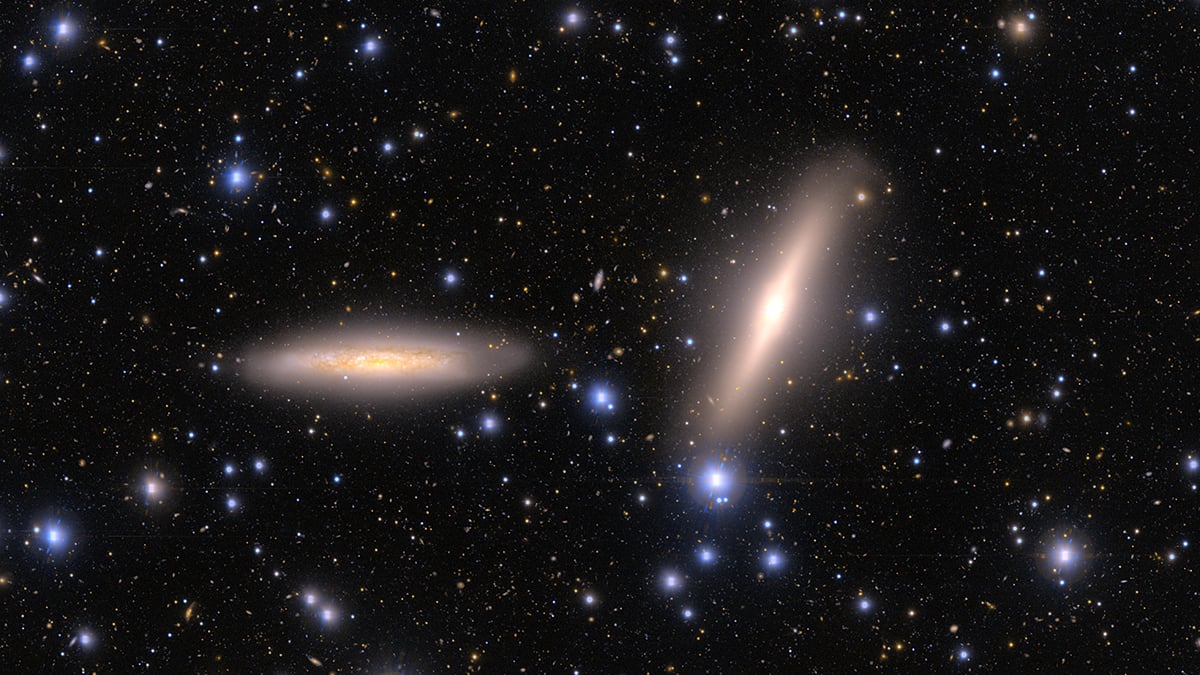
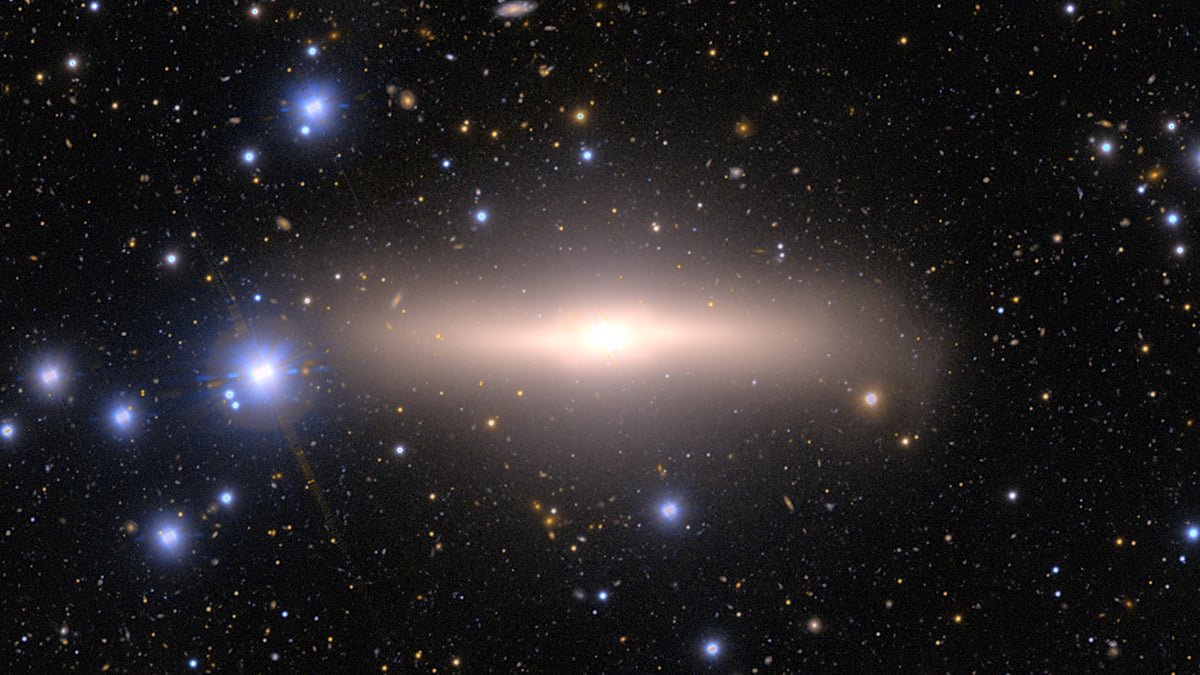
Two galaxies in Pegasus shine in a new image from the Subaru Telescope. NGC 7339, on the left, has a dark band of dust running through its disk. Beside it, NGC 7332 has a bright, swollen center with a distinctly boxy shape. Astronomers think that unusual central structure comes from a bar inside the galaxy, seen from the side.
The galaxies lie about 70 million light-years from Earth and appear close together in the sky. Subaru observations suggest that they are also gravitationally bound. Both galaxies present their disks almost edge-on to us, giving astronomers a view that can reveal structures that are harder to see in galaxies viewed face-on.
A pair of galaxies seen almost edge-on
The angle from which we see a galaxy has a major effect on what appears in an astronomical image. A face-on galaxy can reveal its full disk, making spiral arms and large star-forming regions easier to identify.
An edge-on galaxy presents a much narrower profile, with the disk appearing as a thin band across the sky. NGC 7332 and NGC 7339 are good examples. Their disks point almost sideways towards Earth, so we are looking across their galactic planes instead of seeing them from above.
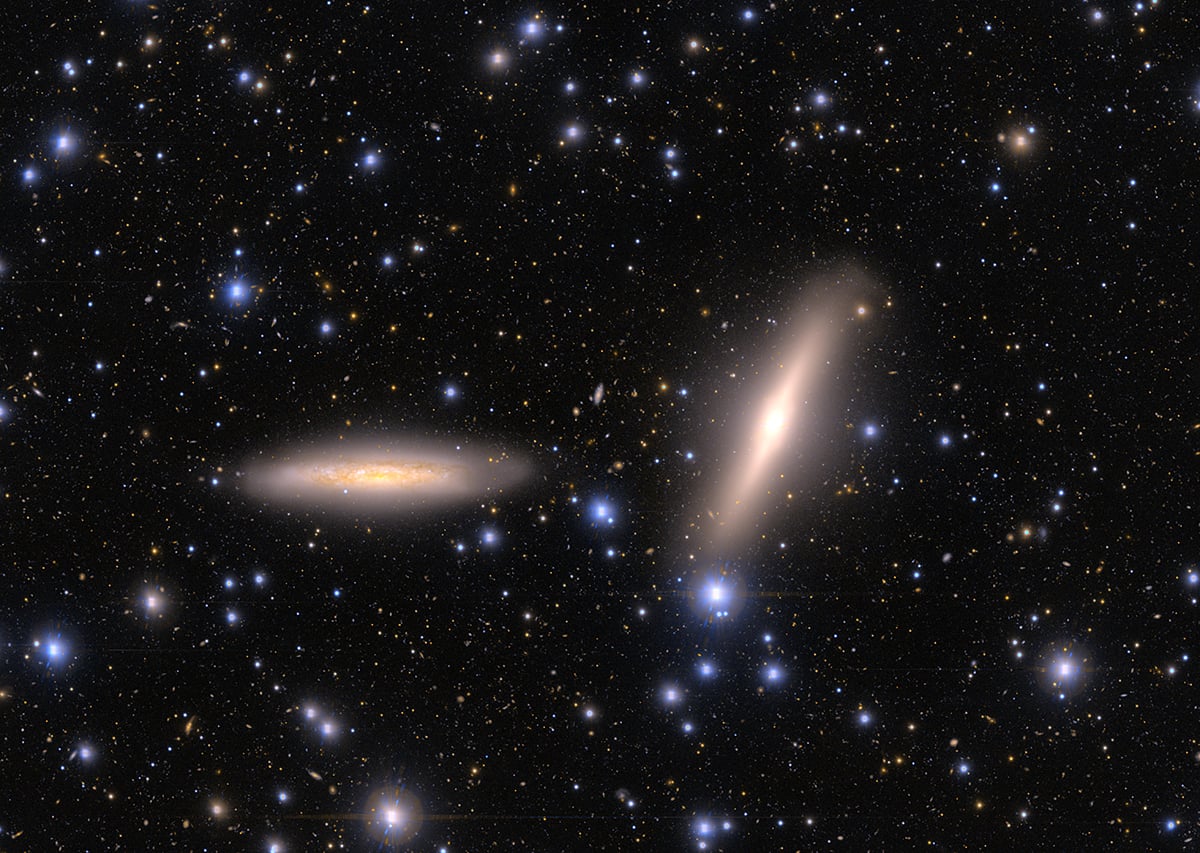
The two galaxies also provide a great comparison, as they have very different appearances. NGC 7339 occupies the left side of the Subaru image. Its central disk contains a prominent dark dust lane that extends across a large part of the galaxy. NGC 7332 sits to the right and has a much brighter-looking central region, with a broad bulge that gives it a noticeably different profile.

NGC 7332 has a peanut-shaped center
The central bulge of NGC 7332 does not look like a round concentration of stars. In Subaru’s image, it has a broad, box-like appearance. Astronomers call this type of structure a “peanut bulge” because its shape can resemble a peanut when viewed from the side.
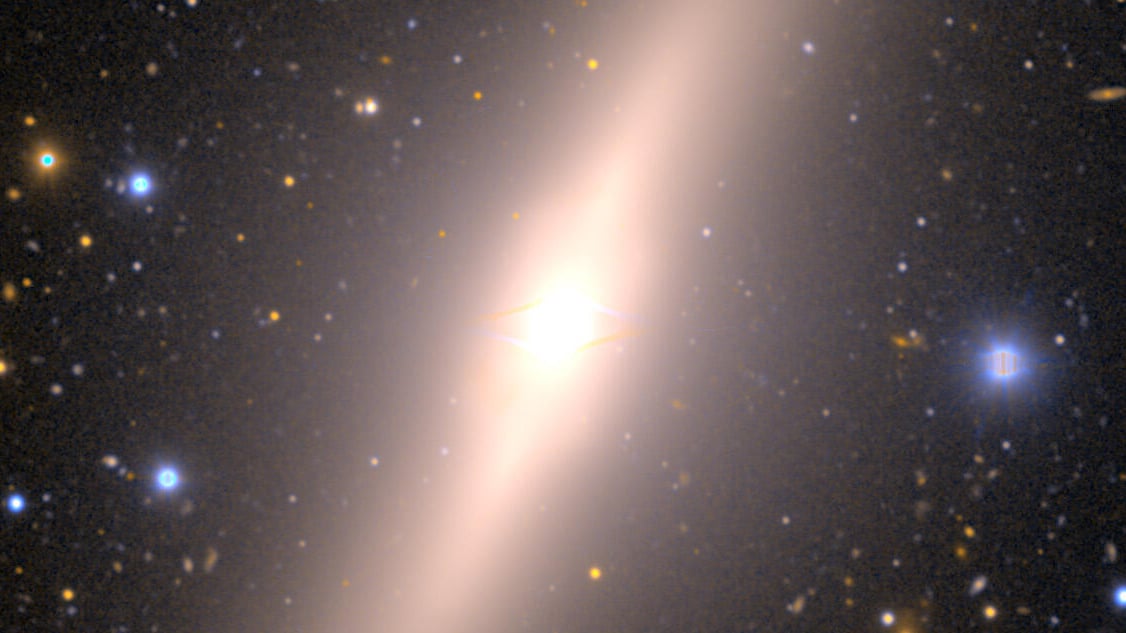
The explanation involves a bar-shaped structure in the galaxy. Bars are elongated concentrations of stars that stretch through the central regions of many galaxies. When astronomers view one of these structures edge-on, its three-dimensional shape can produce the boxy or peanut-like appearance seen in NGC 7332.
But if we could observe NGC 7332 from another direction, the same central structure would look different. From Earth, however, the galaxy gives us a near side-on view that makes the shape easier to recognize.
A prominent dust lane runs through NGC 7339
NGC 7339 has a much more obvious feature cutting across its central disk. A dark lane extends through a large part of the galaxy and blocks some of the starlight behind it. Subaru identifies this as a dust lane within the galactic plane.
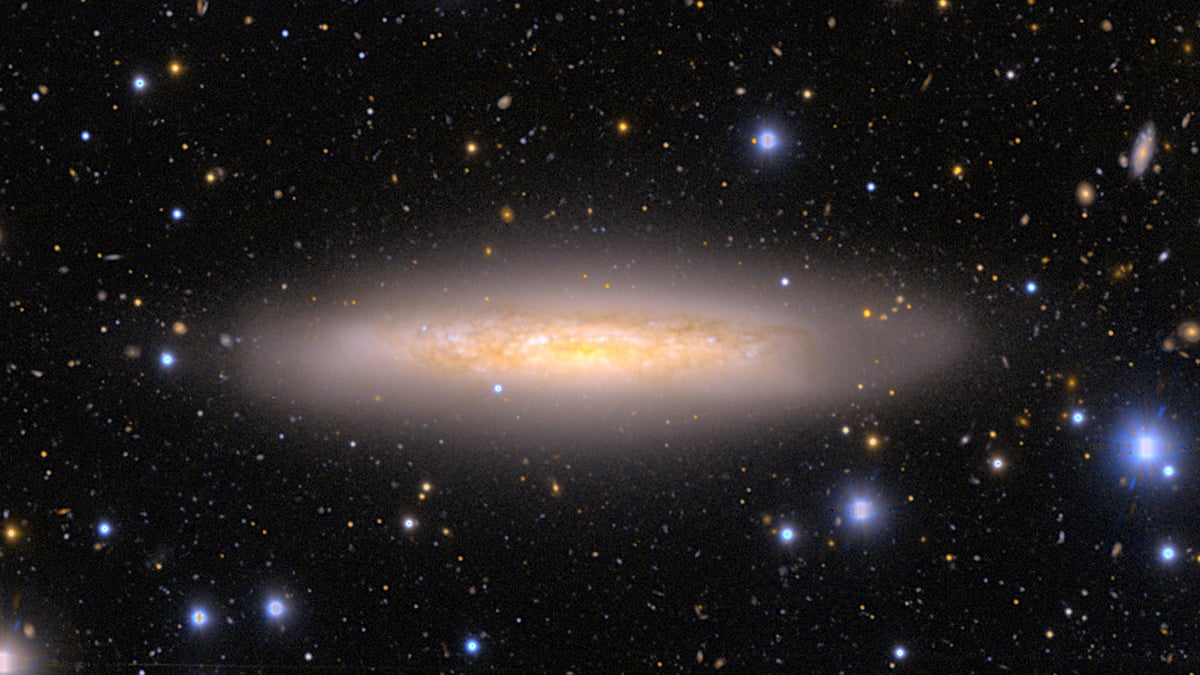
Dust absorbs and scatters visible light, which is why the lane appears dark against the brighter galaxy. It is also associated with the gas found within the disk. That gas provides the raw material from which new stars can form. The edge-on view makes the dust easy to spot. Looking across it, the dust forms a narrow, dark structure against the much brighter background of stars.
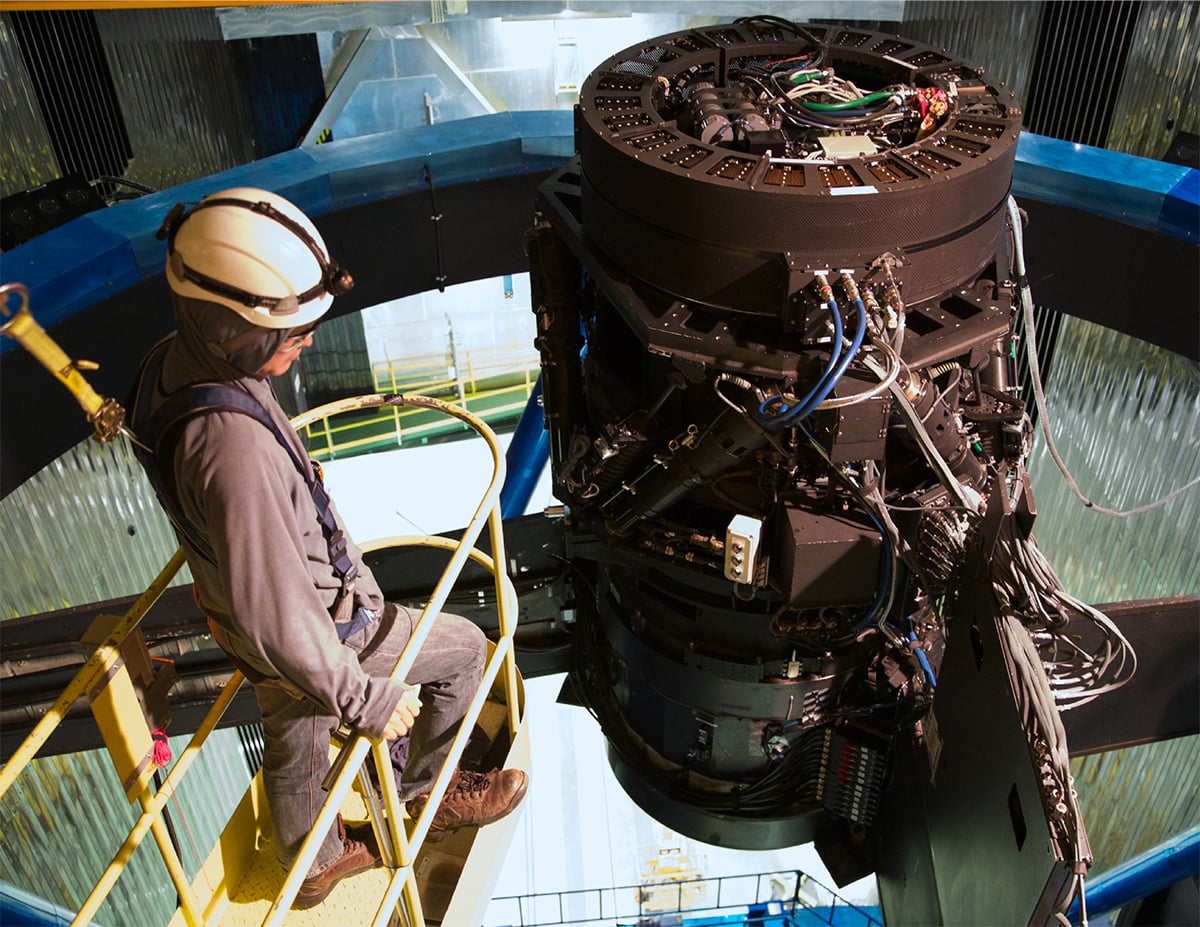
For this image, Subaru used the Hyper Suprime-Cam, or HSC, mounted at the prime focus of its 8.2-metre telescope. HSC is a large mosaic CCD camera. Its science detectors cover a field about 1.5 degrees across, giving it a view roughly equivalent to several full Moons placed side by side. The camera contains more than 87 million pixels and uses highly sensitive CCD detectors.
Clear skies!
See more from DIYPhotography.net on Google
Add DIYPhotography.net as a trusted source. This makes
our stories more likely to appear in your Google Search results.
 Add as a preferred source on Google

Soumyadeep Mukherjee
Soumyadeep Mukherjee is an award-winning astrophotographer from India. He has a doctorate degree in Linguistics. His work extends to the sub-genres of nightscape, deep sky, solar, lunar and optical phenomenon photography. He is also a photography educator and has conducted numerous workshops. His works have appeared in over 40 books & magazines including Astronomy, BBC Sky at Night, Sky & Telescope among others, and in various websites including National Geographic, NASA, Forbes. He was the first Indian to win “Astronomy Photographer of the Year” award in a major category.


Join the Discussion
DIYP Comment Policy
Be nice, be on-topic, no personal information or flames.