















ESA’s Satellite Images Show Greenland Glacier Breaking Apart
Aug 23, 2026
Soumyadeep Mukherjee
Soumyadeep Mukherjee is an award-winning astrophotographer from India. He has a doctorate degree in Linguistics. His work extends to the sub-genres of nightscape, deep sky, solar, lunar and optical phenomenon photography. He is also a photography educator and has conducted numerous workshops. His works have appeared in over 40 books & magazines including Astronomy, BBC Sky at Night, Sky & Telescope among others, and in various websites including National Geographic, NASA, Forbes. He was the first Indian to win “Astronomy Photographer of the Year” award in a major category.
Share:
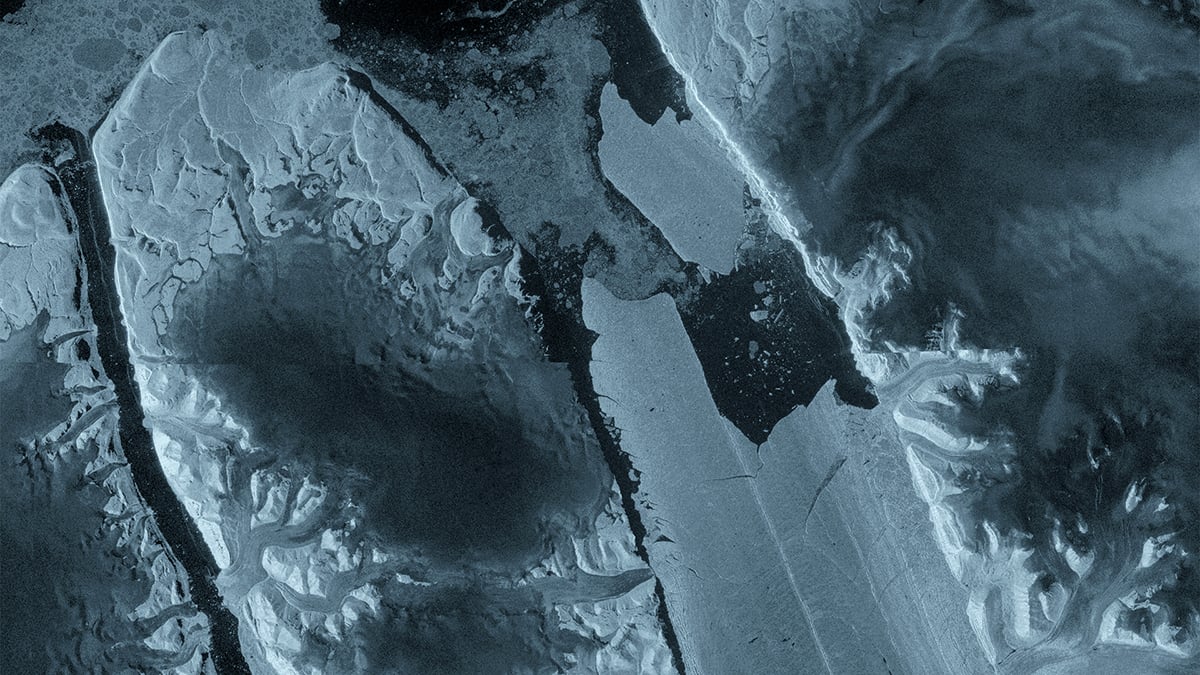
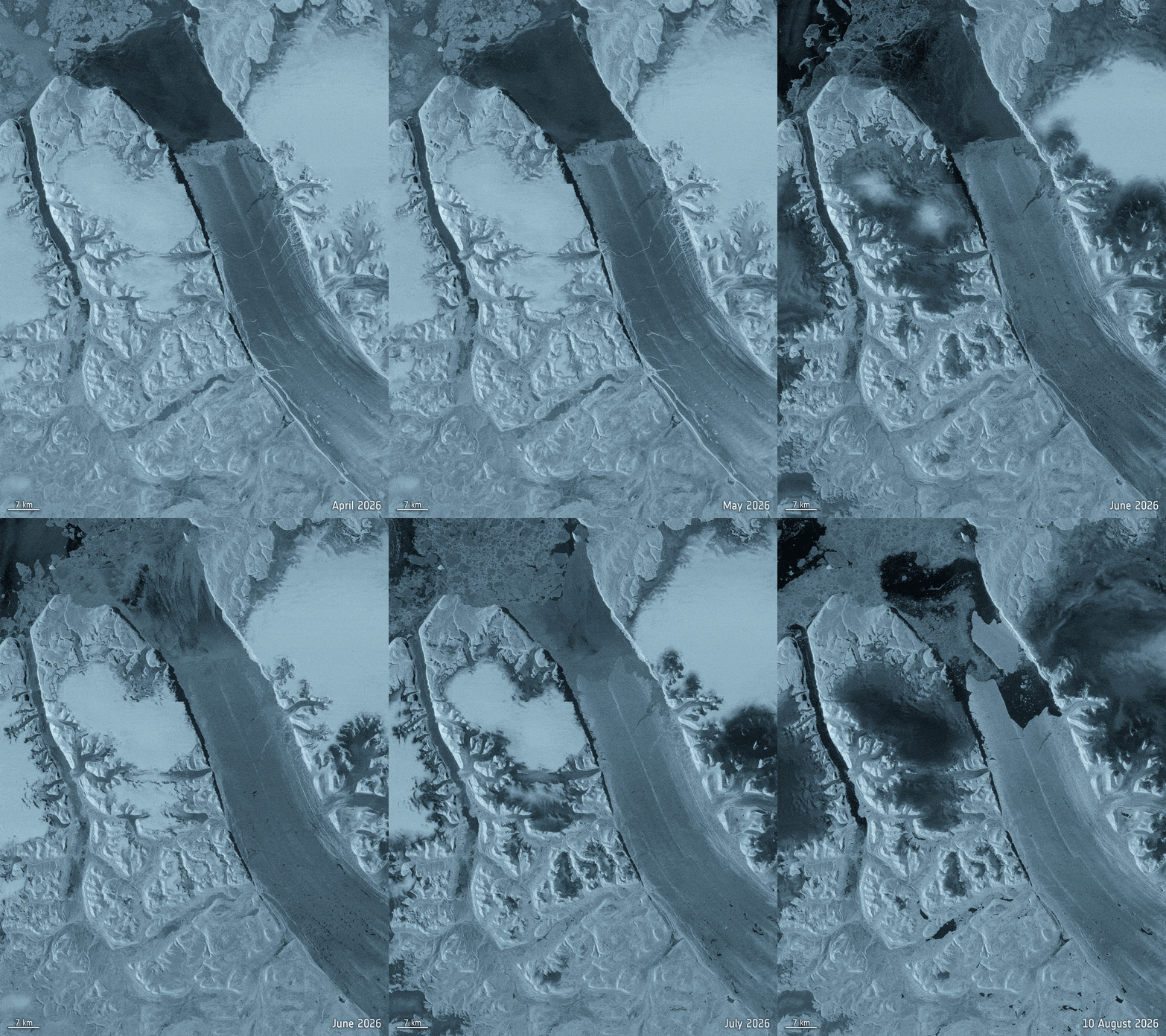
A 76-square-kilometre section of Greenland’s Petermann Glacier broke away on 4 August 2026. The separation occurred at the glacier’s floating ice tongue in northwest Greenland. ESA’s Sentinel-1 radar images captured the final stages of the event and the fractures that developed beforehand.
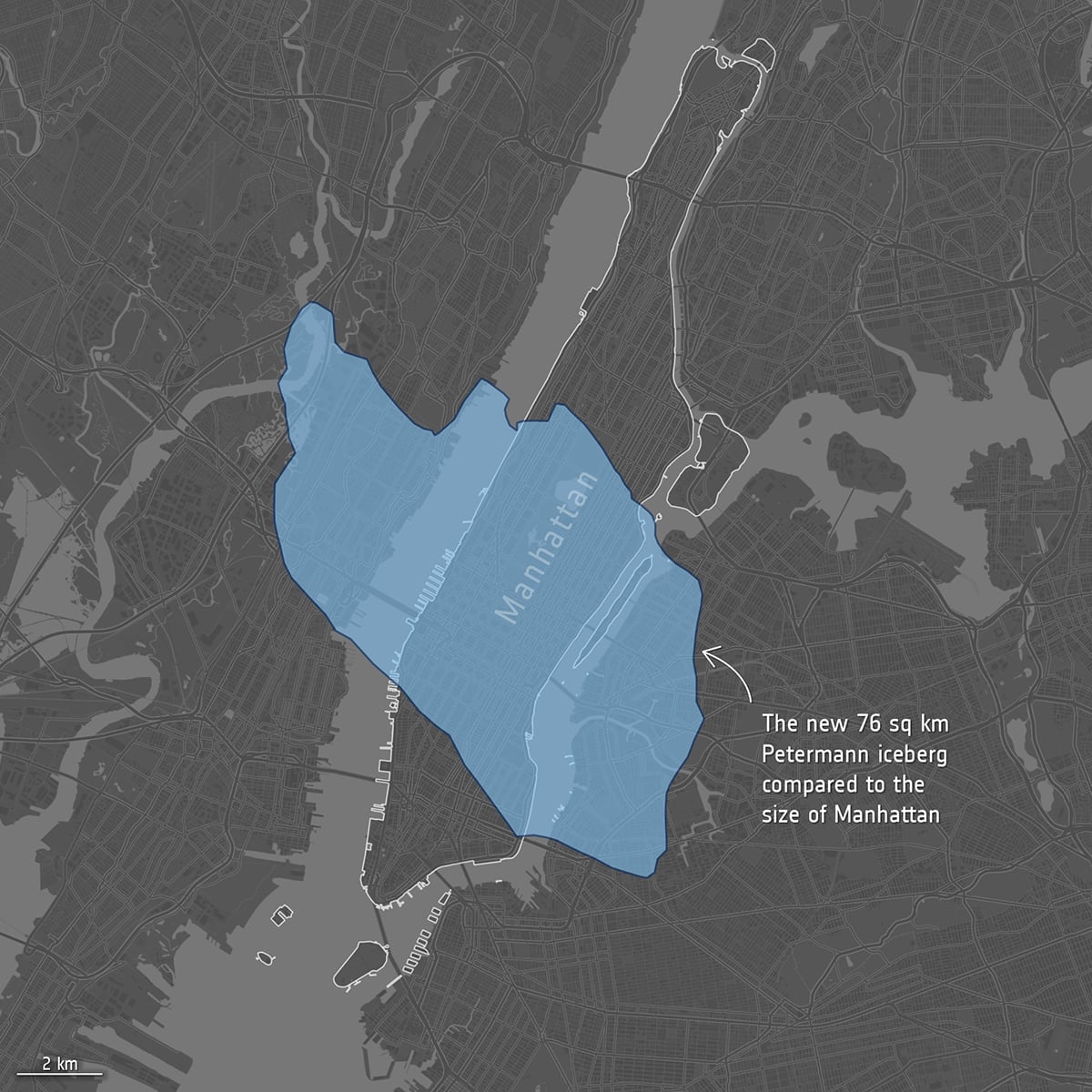
The newly separated ice forms a large tabular iceberg. ESA estimates that it could be up to 150 meters thick. Its surface area is similar to that of Manhattan. The event represents Petermann Glacier’s largest loss of floating ice since 2012. ESA also classifies it as the most significant Arctic calving event since 2020.
A major section breaks away from Petermann Glacier
Petermann Glacier is one of Greenland’s major outlet glaciers. Its ice flows towards the ocean and extends into a floating tongue. That floating section has experienced several large calving events during the past two decades.
Large ice islands broke away from Petermann in 2008, 2010 and 2012. The 2012 event was particularly significant. After that loss, the remaining floating tongue entered a relatively stable period. Smaller calving events continued, but the glacier did not lose another section on the same scale.
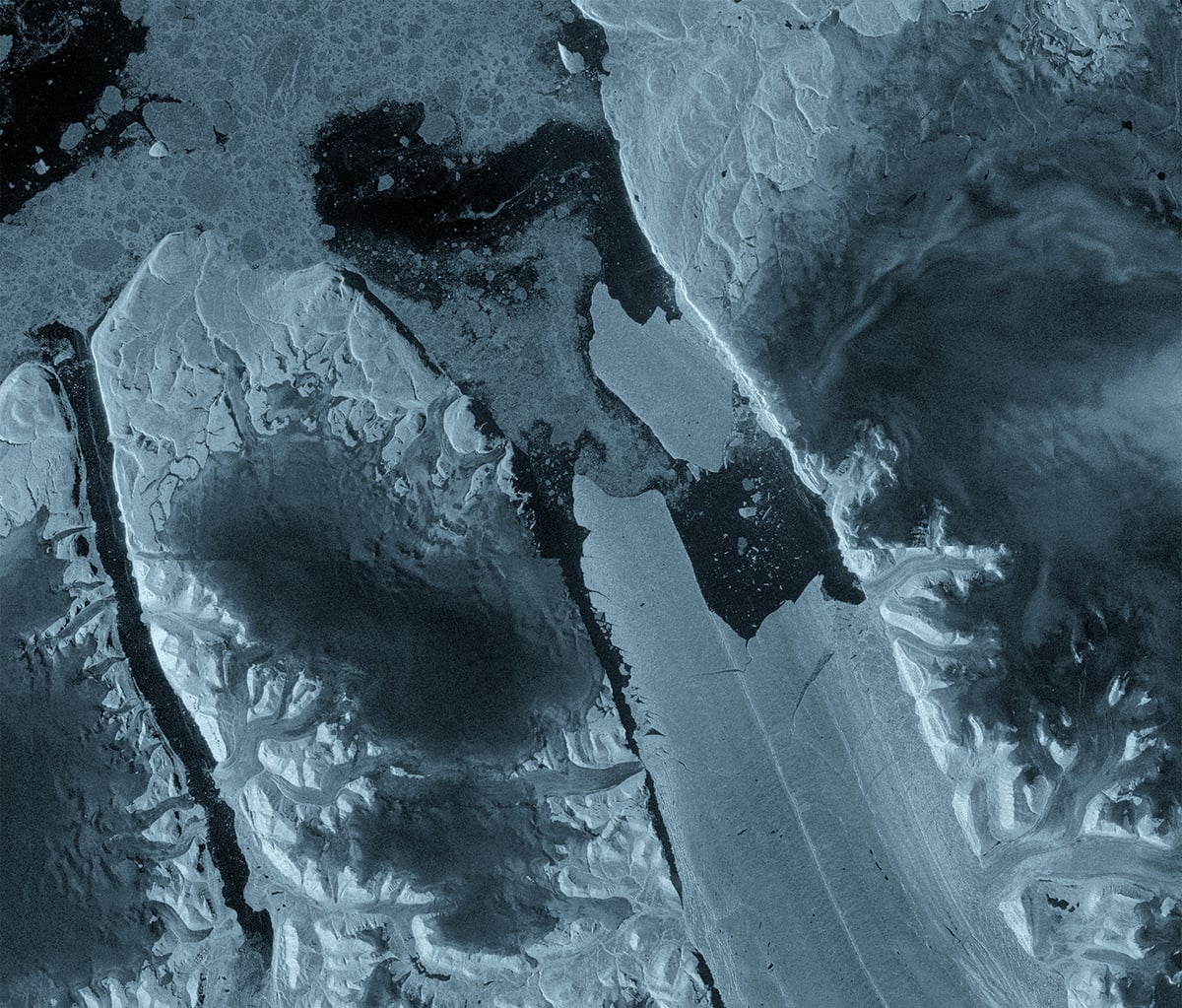
However, the situation changed in August 2026. Sentinel-1 imagery acquired on 3 August showed pronounced deterioration along the centerline of the floating tongue. By the following day, a huge section had separated from its eastern side. The detached area covered about 76 square kilometres.
The resulting iceberg has the broad, flat shape associated with a tabular iceberg. These large blocks form when extensive sections of floating ice break away. They are particularly common around Antarctica, where extensive ice shelves produce large tabular icebergs.
Sentinel-1 detected the warning signs before calving
The August calving was the end of a process that had been developing for months. An international research team has been monitoring Petermann Glacier with Sentinel-1 data since 2019. The collaboration includes scientists from the University of Ottawa, the Universities of Stirling, Lancaster and Leeds, and the Canadian Ice Service. ESA’s FutureEO ARCTEX project has also provided funding for part of the work.
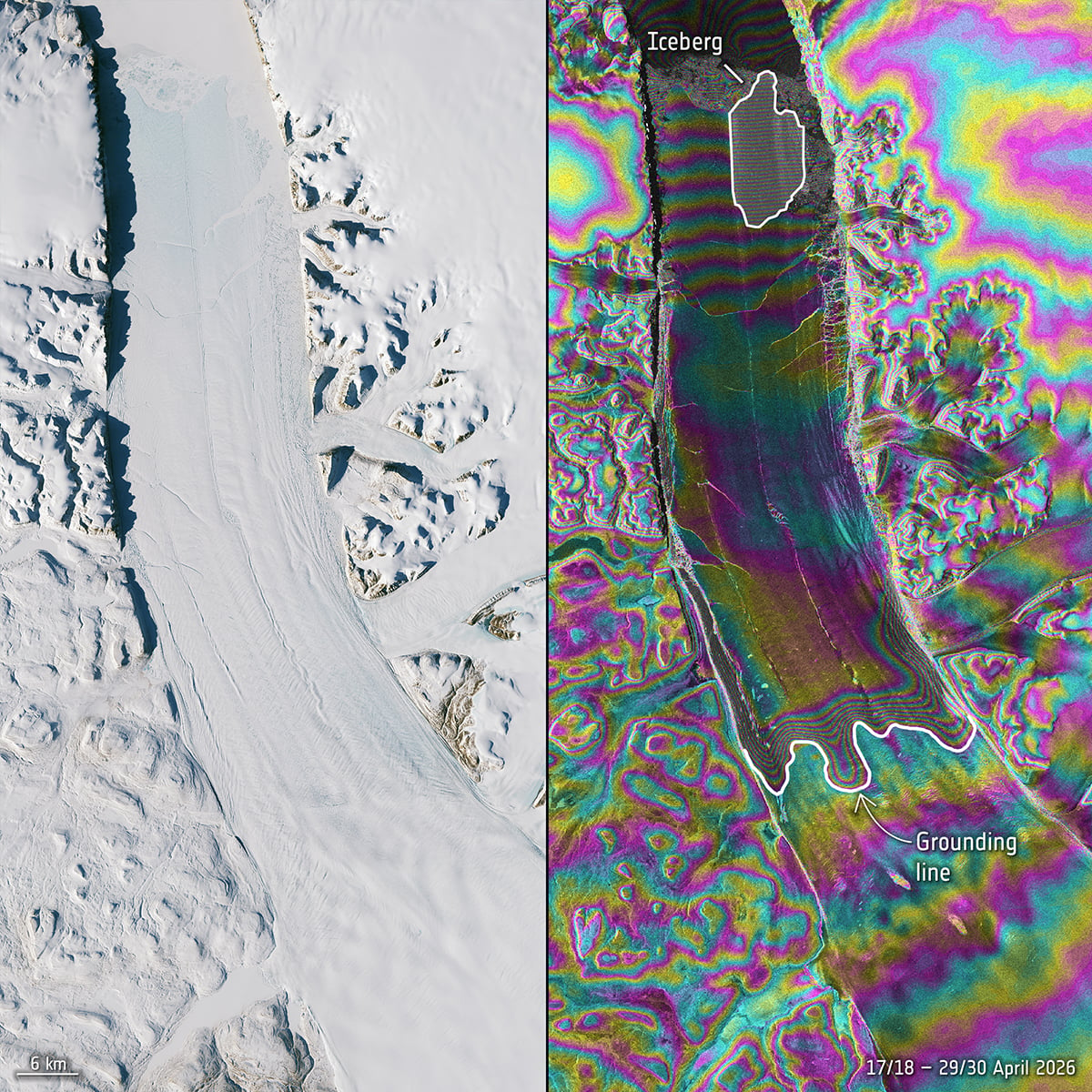
Earlier observations showed fractures developing within the floating tongue. Interferometric measurements collected in April revealed deformation across the ice and provided evidence of fractures that appeared months before the final break.
The Sentinel-1 observations captured surface motion associated with the tides as well. This allowed researchers to examine how the floating tongue moved while cracks developed within it. The combination of fracture mapping and motion measurements gives a more complete picture of the processes leading to the calving event.
Sentinel-1C and 1D captured the final stages
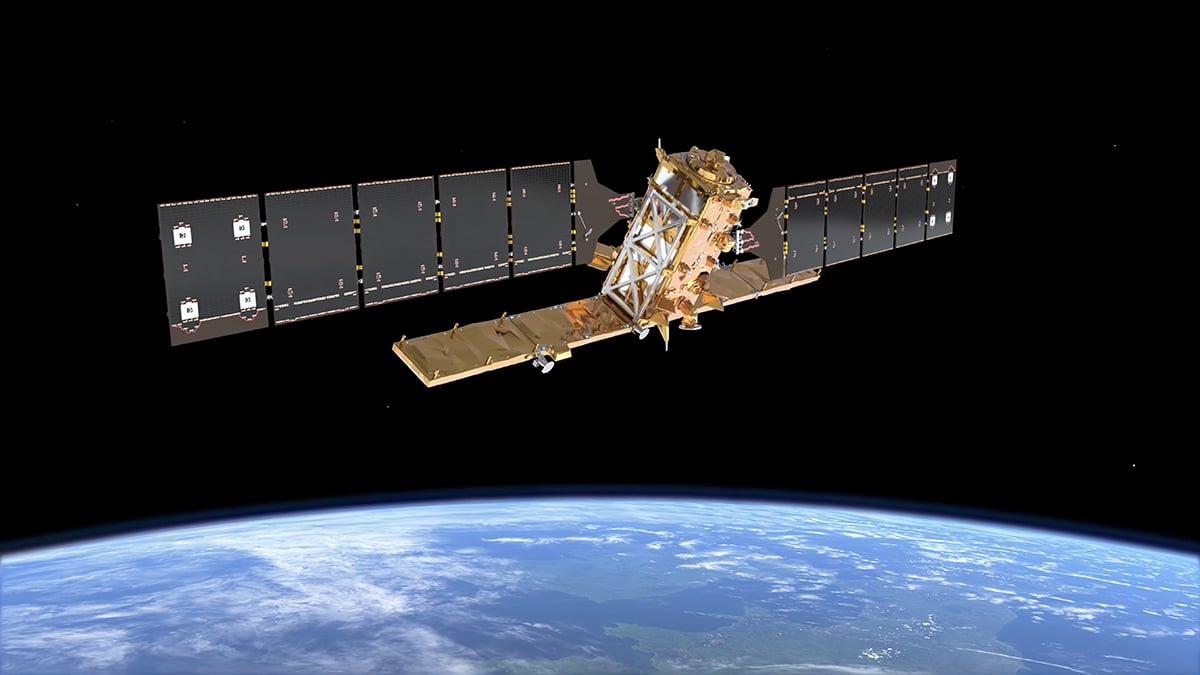
The most interesting part of the observation came from Sentinel-1C and Sentinel-1D. The two spacecraft briefly operated in a tandem configuration during Sentinel-1D’s commissioning phase. They observed the same area at a one-day interval.
Sentinel-1 uses C-band synthetic aperture radar, or SAR. The instrument operates at a frequency of 5.405 GHz and can acquire observations regardless of daylight or cloud cover. Its standard interferometric wide-swath mode covers a 250-kilometre-wide area.
SAR works differently from an optical camera. The instrument sends microwave signals towards Earth. It then records the returned signals. Scientists can compare the phase and amplitude of radar signals from different observations. Interferometric SAR, or InSAR, uses these differences to measure changes in the surface. When two observations are separated by a short period, researchers can detect movement and deformation with considerable precision.
Molly Hammond, a PhD student at the University of Leeds, processed the Sentinel-1 data. According to her, the changes became very rapid before the iceberg separated. The observations allowed the team to follow crack propagation using interferometry almost in real time.
Clear skies!
See more from DIYPhotography.net on Google
Add DIYPhotography.net as a trusted source. This makes
our stories more likely to appear in your Google Search results.
 Add as a preferred source on Google

Soumyadeep Mukherjee
Soumyadeep Mukherjee is an award-winning astrophotographer from India. He has a doctorate degree in Linguistics. His work extends to the sub-genres of nightscape, deep sky, solar, lunar and optical phenomenon photography. He is also a photography educator and has conducted numerous workshops. His works have appeared in over 40 books & magazines including Astronomy, BBC Sky at Night, Sky & Telescope among others, and in various websites including National Geographic, NASA, Forbes. He was the first Indian to win “Astronomy Photographer of the Year” award in a major category.


Join the Discussion
DIYP Comment Policy
Be nice, be on-topic, no personal information or flames.