





















Askar Launches WAF: Worm-and-Gear Automatic Telescope Focuser
Aug 18, 2026
Soumyadeep Mukherjee
Soumyadeep Mukherjee is an award-winning astrophotographer from India. He has a doctorate degree in Linguistics. His work extends to the sub-genres of nightscape, deep sky, solar, lunar and optical phenomenon photography. He is also a photography educator and has conducted numerous workshops. His works have appeared in over 40 books & magazines including Astronomy, BBC Sky at Night, Sky & Telescope among others, and in various websites including National Geographic, NASA, Forbes. He was the first Indian to win “Astronomy Photographer of the Year” award in a major category.
Share:
Nailing the focus is essential in every genre of photography, and astrophotography is no exception. Even a small focus error can affect every exposure in an imaging sequence. This becomes more difficult during long sessions. Telescope components can change slightly as their temperature changes, while different filters can require different focus positions.
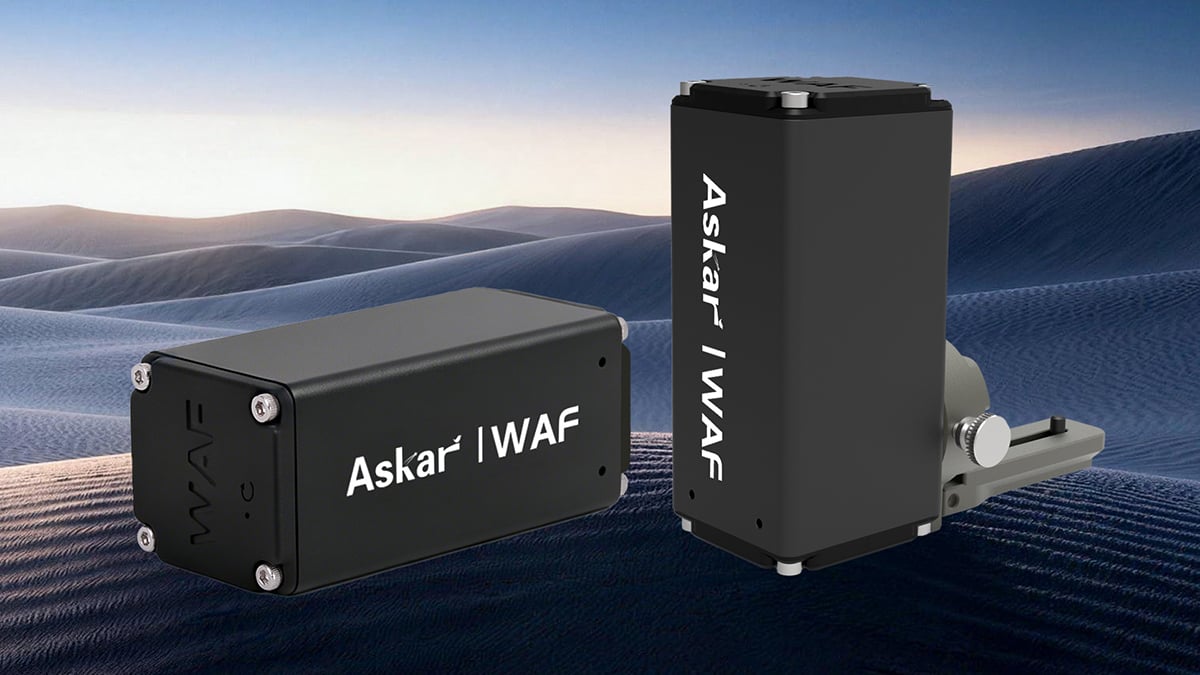
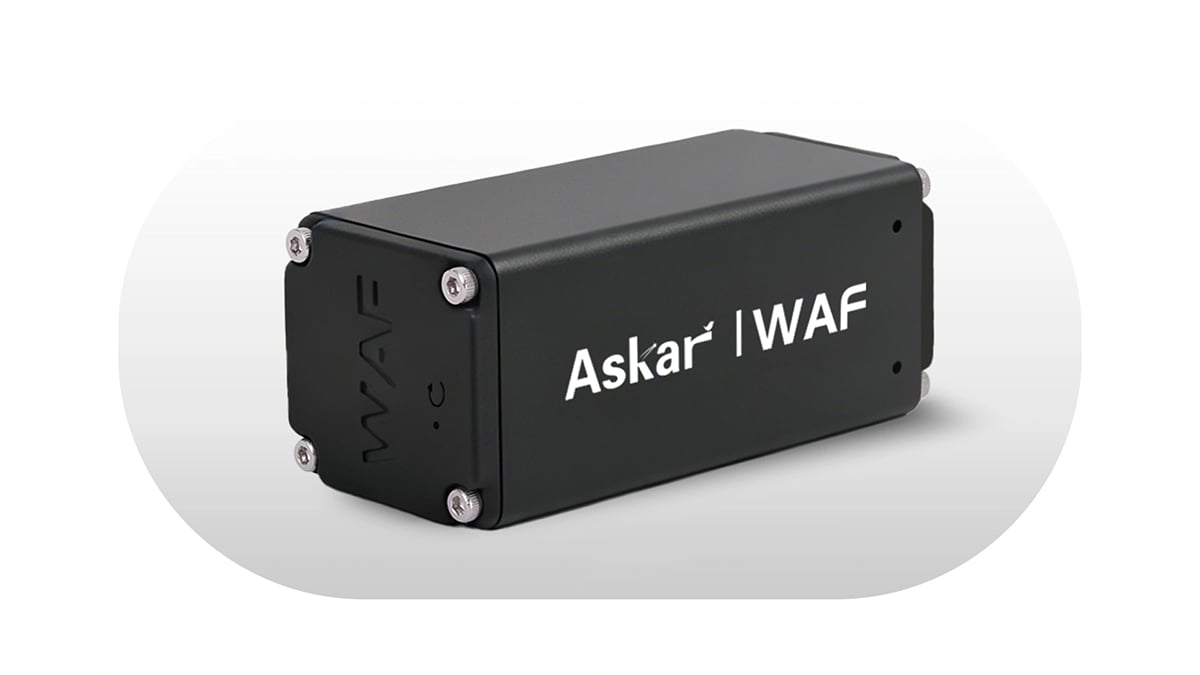
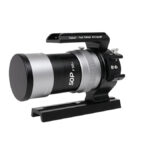
A motorized focuser allows software to compensate for these changes without requiring the astrophotographer to adjust the telescope by hand. Askar, the brand we mainly know for telescopes, has now introduced the WAF, or Worm-and-Gear Automatic Telescope Focuser. This piece of equipment does the focusing for you. The WAF uses a high-torque stepper motor connected to a worm-and-gear transmission. It supports wired and wireless control, as well as astronomy software standards such as ASCOM Alpaca and INDIGO.
A worm-and-gear drive: Fine focusing control
The Askar WAF’s main technical feature is its worm-and-gear transmission. A stepper motor drives the internal gear system, which reduces the motor’s movement before transferring it to the telescope’s focuser. Askar gives the system a 1:99 reduction ratio. This means the motor can make many small movements while the output shaft turns much more slowly.
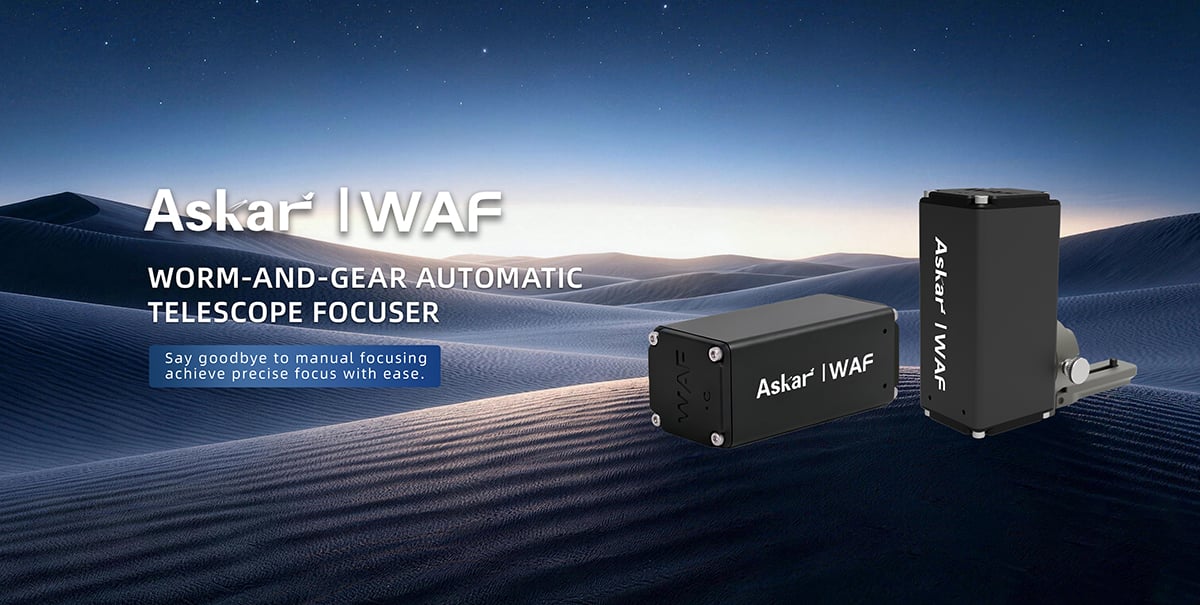
Askar specifies a minimum resolution of 0.0182 degrees for the WAF. The company also states that the focuser can achieve single-step positioning below 0.005 mm. The WAF does not replace the telescope’s existing focusing mechanism. It turns that mechanism under electronic control.
The output shaft provides 19,800 steps for one complete rotation, according to Askar’s specifications. Users can configure the focuser’s maximum travel from 100 to 1,000,000 steps, with 100,000 steps set as the factory default. This gives the system a large operating range for different telescope focusers. The useful range will still depend on the physical travel and gearing of the telescope‘s own focuser.
Adjustable mounting system
The WAF is designed to be used with different telescope focusers rather than being tied to one particular telescope model. This is possible through its adjustable mounting socket. Askar says the mounting system can accommodate most telescope focusers currently available. The company has also included a quick-release mechanism that allows the motor unit to be removed and reinstalled without permanently modifying the telescope.
This can be useful for astrophotographers who use several telescopes. A motorized focuser normally needs a suitable bracket and coupling for the focuser it is driving. If the same motor can be moved between compatible telescopes, users have more flexibility when configuring their equipment.
Design and software support
The WAF measures 101 × 47 × 43 mm and weighs 373 grams. It uses a 12V power supply and requires at least 1A of current. USB Type-C provides the wired communication connection. These dimensions keep the unit relatively compact, although its 373-gram weight still needs to be considered when balancing a telescope on an equatorial mount.
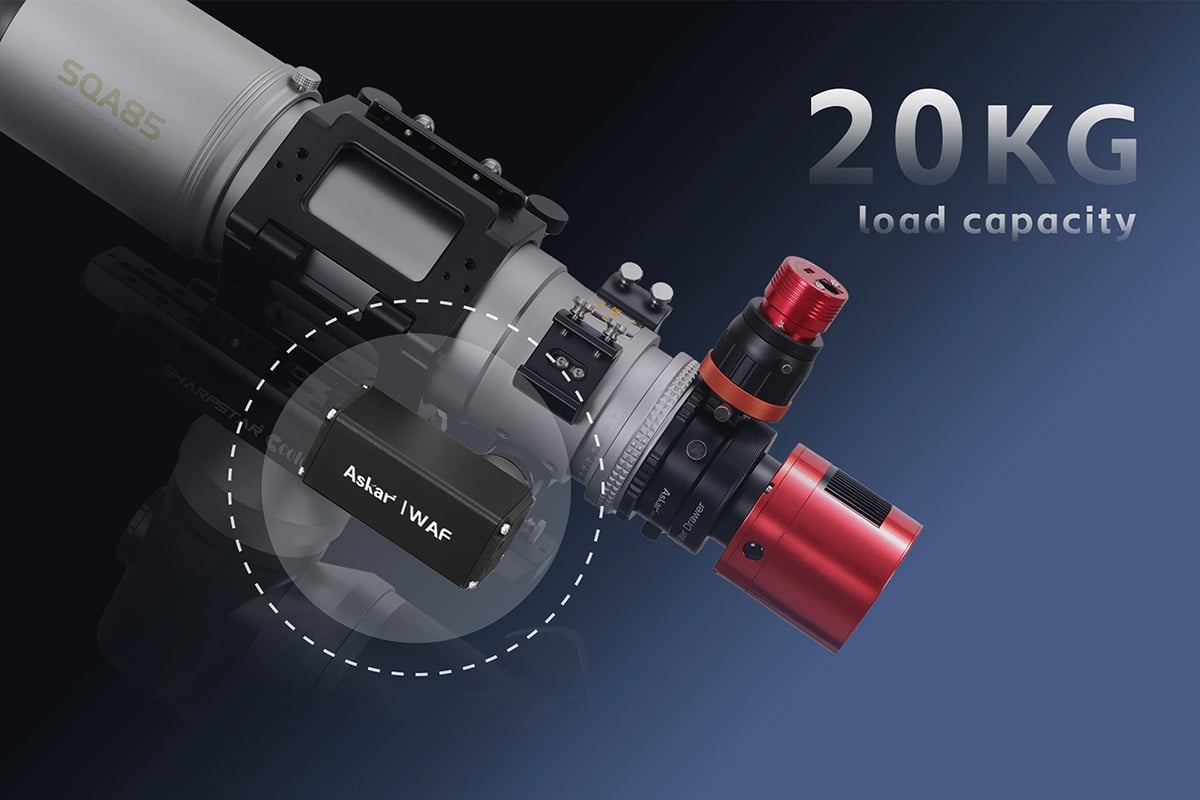
The WAF’s worm-and-gear transmission allows the stepper motor to produce high mechanical leverage at the output. Askar gives the unit a maximum output torque of 20 kgf·cm. The motor’s available travel is configurable. Askar lists settings ranging from 100 to 1,000,000 steps, while the default value is 100,000 steps.
On the software side of things, the WAF supports ASCOM Alpaca and INDIGO, giving it compatibility with established astronomy software platforms. Software can move the focuser through a series of positions while measuring the stars in the camera’s images. It can then identify the position that produces the best focus and command the WAF to return to that position.
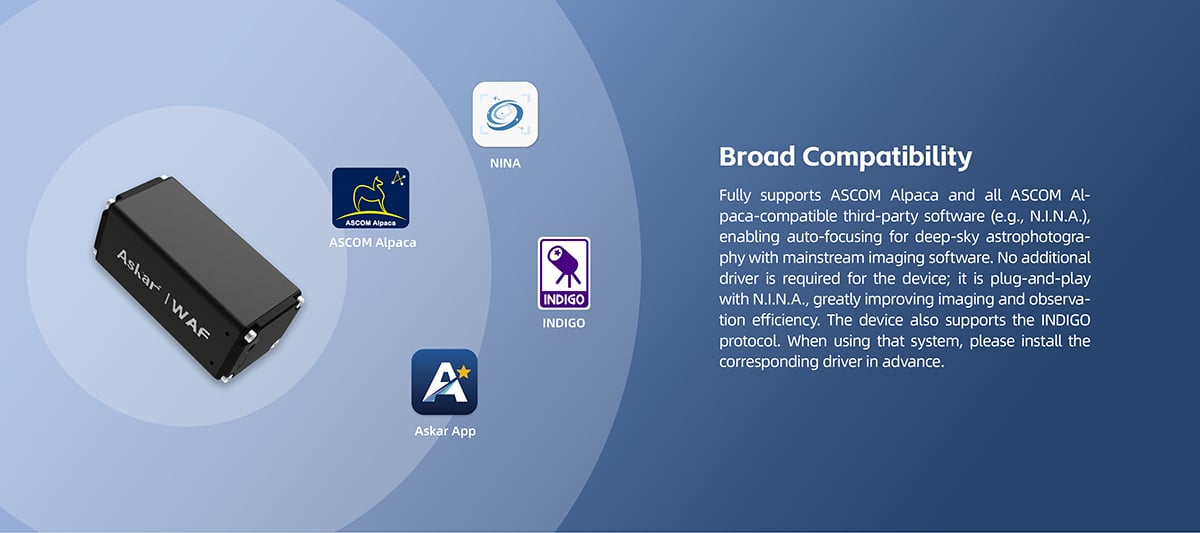
The WAF supports both wired and wireless control. For wired operation, it uses USB Type-C for data communication and a 12V power connection. Askar also provides a mobile application for wireless control. The app allows users to operate the focuser and adjust its settings. It includes device naming and grouping functions, which can help users manage several compatible devices.
The two control options suit different types of astrophotography setups. A permanent imaging system can use a wired connection to an imaging computer, while a portable setup may benefit from wireless operation.
Key specifications, price, and availability
Here are the key specifications of the Askar WAF:
| Motor Type | Worm-gear stepper motor |
| Gear Reduction Ratio | 1:99 |
| Maximum Output Torque | 20 kgf·cm |
| Equivalent Load | 20 kg |
| Output Speed | 2.6 rpm |
| Power/Data Interface | DC-044 12V / Type-C |
| Input Current | 1 A min |
| Body Dimensions | 101 mm × 47 mm × 43 mm |
| Body Weight | 373 g |
| Communication Protocol | ASCOM Alpaca and Indigo |
| Supported Software | Askar APP, ASCOM Alpaca third-party platform software (e.g., N.I.N.A.) |
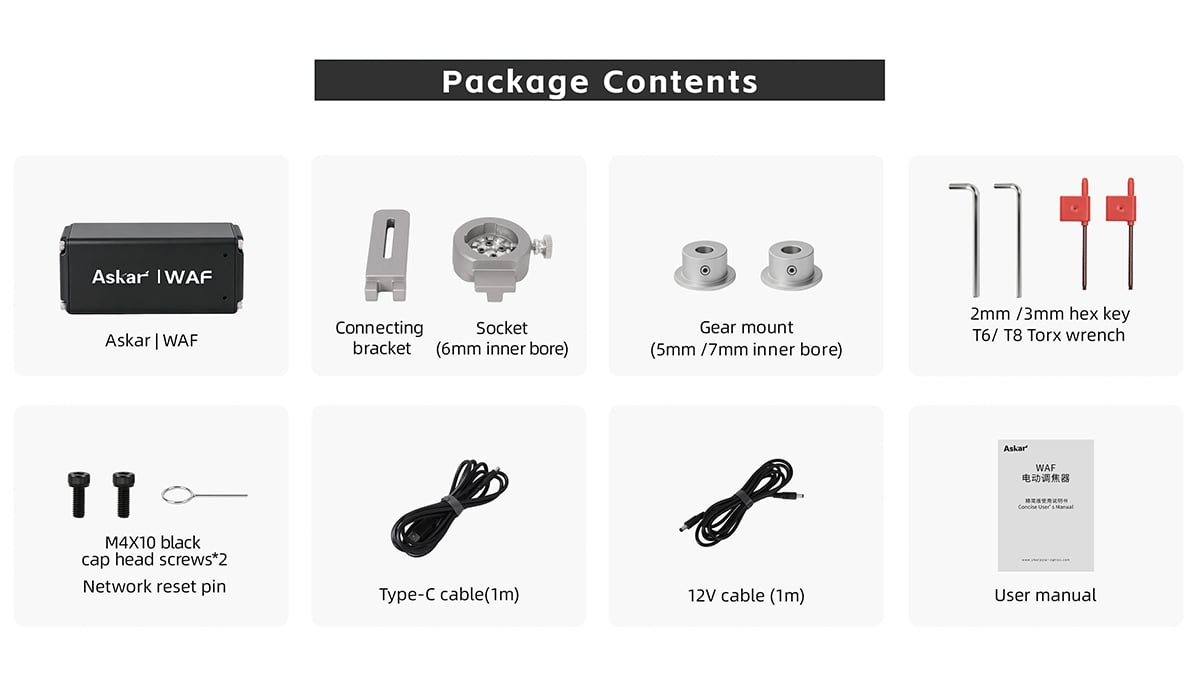
The Askar WAF is priced at $199. It is available for ordering via the official Askar website.
Clear skies!
See more from DIYPhotography.net on Google
Add DIYPhotography.net as a trusted source. This makes
our stories more likely to appear in your Google Search results.
 Add as a preferred source on Google

Soumyadeep Mukherjee
Soumyadeep Mukherjee is an award-winning astrophotographer from India. He has a doctorate degree in Linguistics. His work extends to the sub-genres of nightscape, deep sky, solar, lunar and optical phenomenon photography. He is also a photography educator and has conducted numerous workshops. His works have appeared in over 40 books & magazines including Astronomy, BBC Sky at Night, Sky & Telescope among others, and in various websites including National Geographic, NASA, Forbes. He was the first Indian to win “Astronomy Photographer of the Year” award in a major category.

Join the Discussion
DIYP Comment Policy
Be nice, be on-topic, no personal information or flames.