























ESO’s VLT Photographs a Rogue Planet Devouring Gas and Dust
Oct 3, 2025
Soumyadeep Mukherjee
Soumyadeep Mukherjee is an award-winning astrophotographer from India. He has a doctorate degree in Linguistics. His work extends to the sub-genres of nightscape, deep sky, solar, lunar and optical phenomenon photography. He is also a photography educator and has conducted numerous workshops. His works have appeared in over 40 books & magazines including Astronomy, BBC Sky at Night, Sky & Telescope among others, and in various websites including National Geographic, NASA, Forbes. He was the first Indian to win “Astronomy Photographer of the Year” award in a major category.
Share:
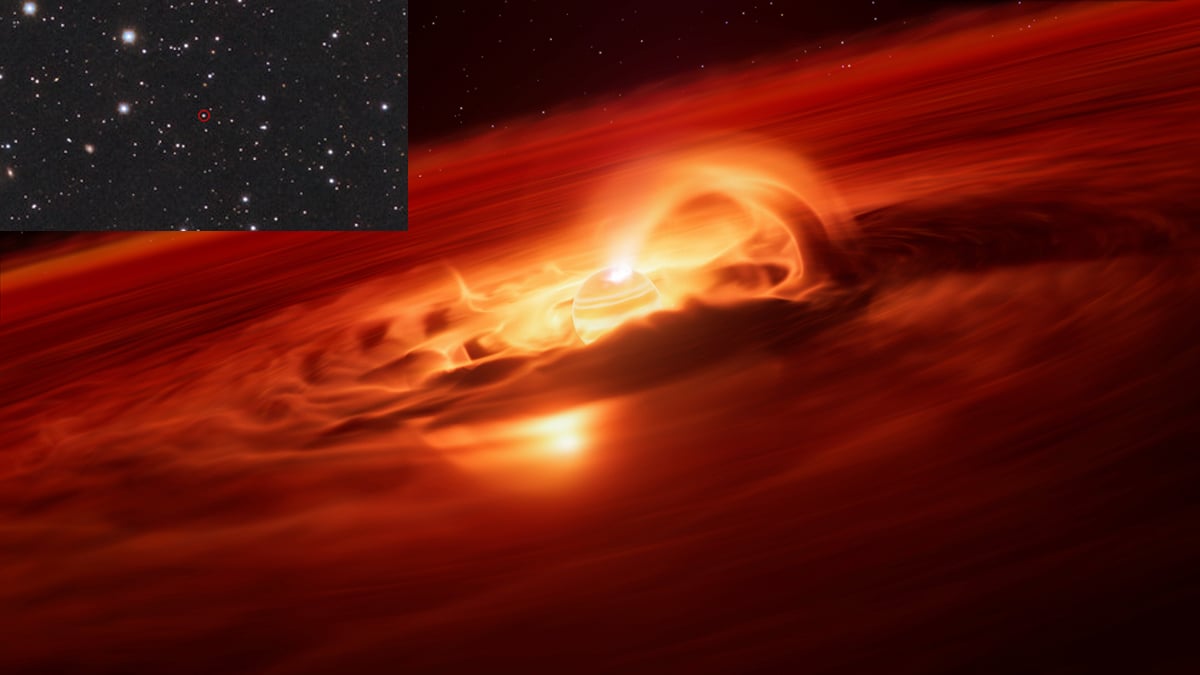
Space still holds surprises. A drifting planet, free of any host star, is feeding so fast that astronomers are scrambling to understand what this means for planet formation. The world is Cha 1107-7626. It lies in the Chamaeleon star-forming region, about 620 light-years from Earth. It has a mass between 5 and 10 times that of Jupiter. And in mid-2025, it began to devour gas and dust at an unprecedented rate: six billion tonnes per second. That is the fastest accretion ever recorded for a planet-mass object.
How the discovery was made
Astronomers used several observatories to catch this rogue planet in action. ESO’s Very Large Telescope (VLT), using its X-shooter spectrograph, played a central role. It captured spectra before, during, and after the accretion burst.
In April–May 2025, Cha 1107-7626 was relatively quiet. In June, its accretion rate rose sharply, and by August the rate had increased by a factor of about 6–8. It reached ~10⁻⁷ Jupiter masses per year, a huge rate for an object of its size.
Spectra revealed several key indicators. The Hα emission line developed a double-peaked profile plus red-shifted absorption. That is something seen when material is funneled by magnetic fields onto young stars (or brown dwarfs), i.e., magnetospheric accretion. The optical continuum brightened by factors of 3-6; mid-infrared flux rose by 10-20%. Chemically, hydrocarbons like methane (CH₄) and ethylene (C₂H₄) appeared in the disc; water vapour emissions were detected around 6.5-7 microns.
Planet vs star effects
Cha 1107-7626 is interesting because it behaves in ways normally reserved for stars during their formation. Typically, planets form within discs around stars; they accrete more slowly, etc. This object, though, is free floating, yet it shows bursty, high-rate accretion and magnetic funneling of gas. That suggests that even isolated, low-mass objects might undergo processes similar to stars.
This also shakes up how we classify objects. Is it a planet? A brown dwarf? Or close to a star in behavior? Its mass is firmly in the planetary regime, but its activity during this burst closely resembles that of young stellar objects. The boundary between what we call planets and stars grows fuzzier.
The images: Visible, infrared & what we truly see
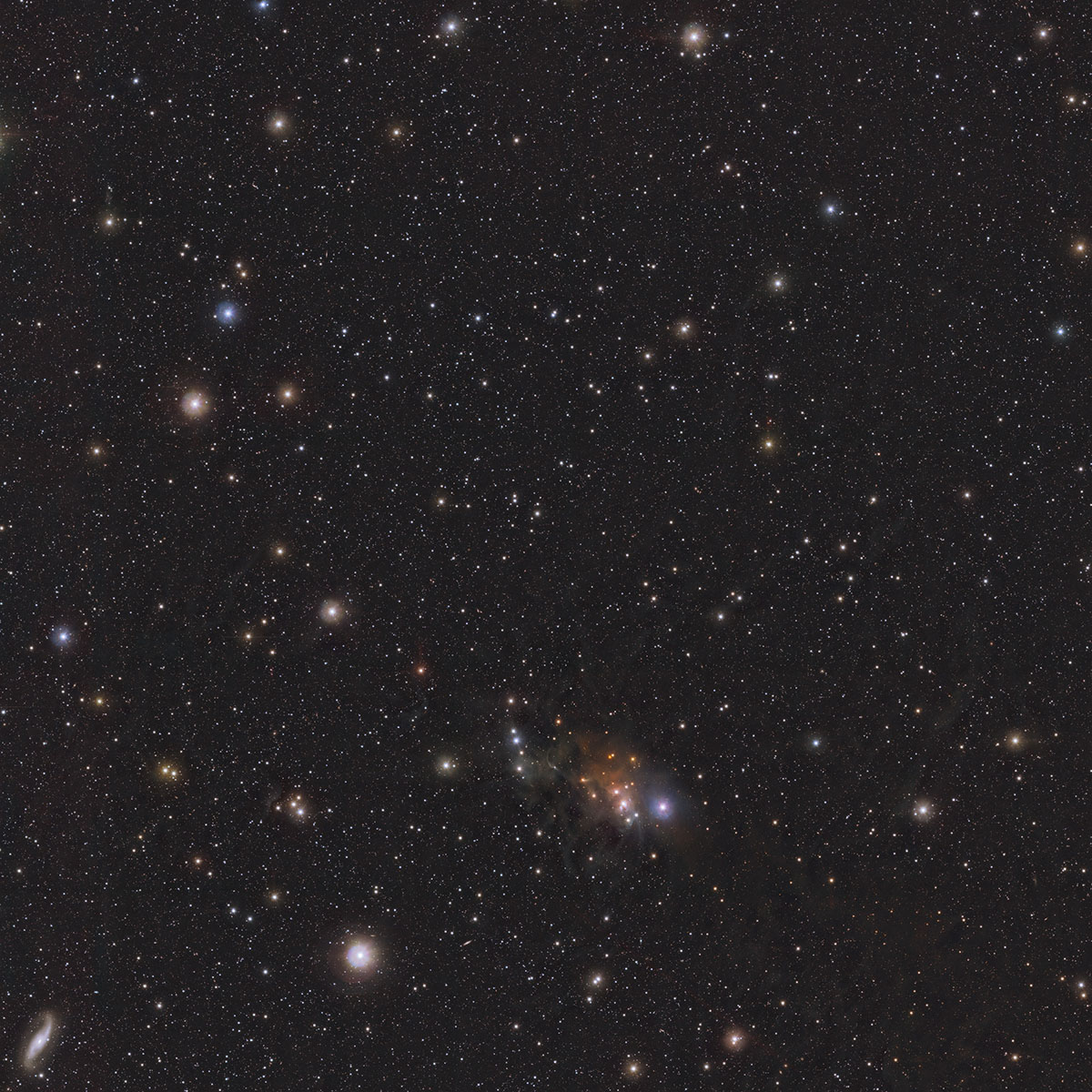
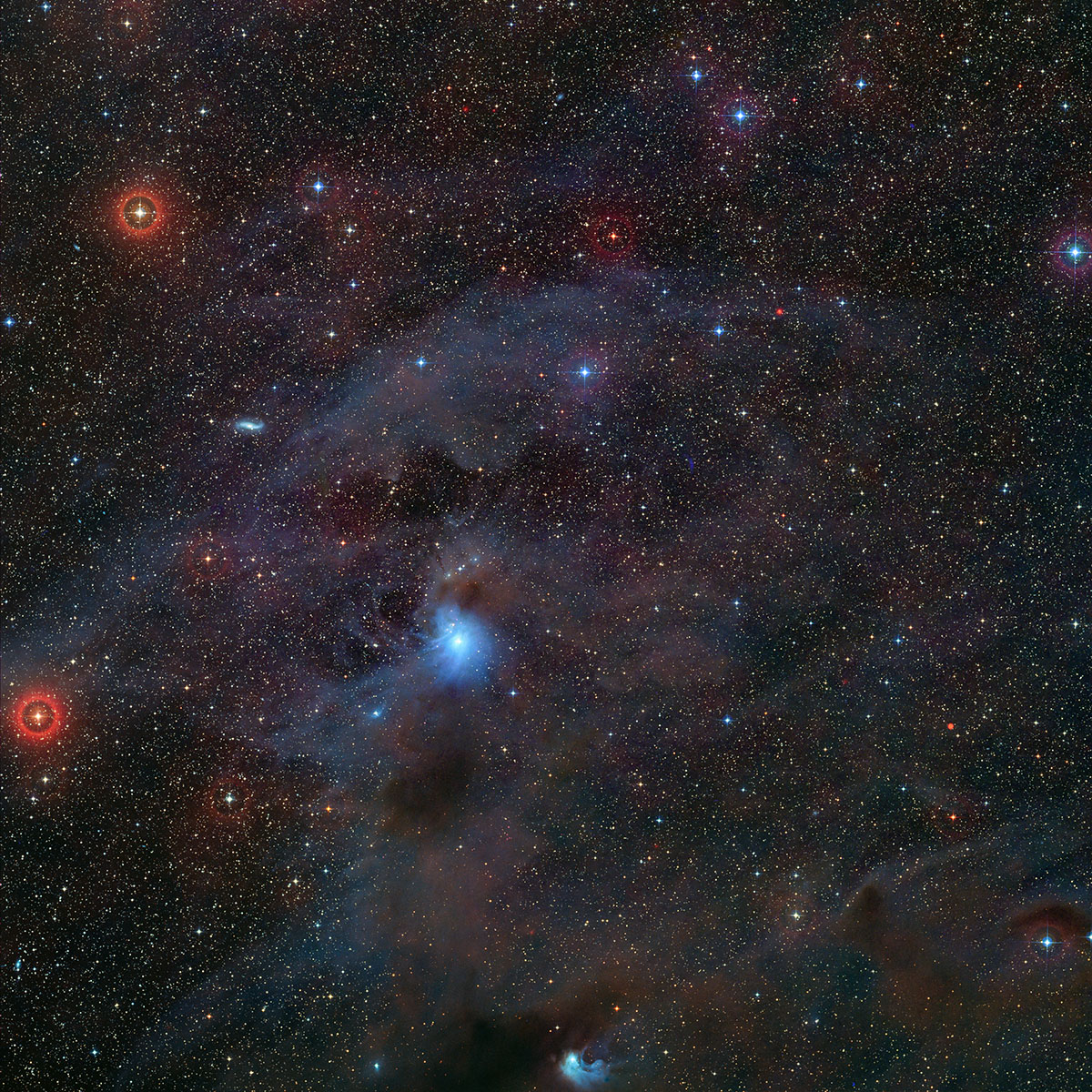
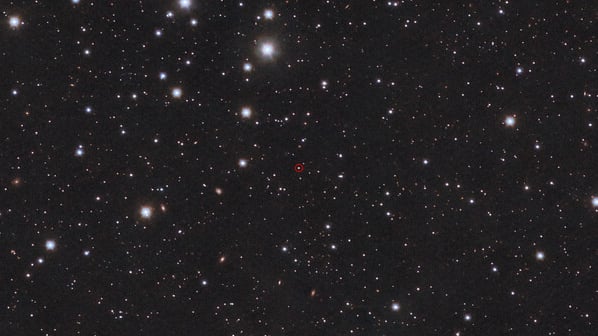
To place this discovery in a visual context, ESO released two key images that locate Cha 1107-7626 in the sky.
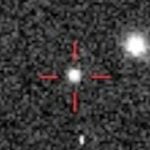
The infrared image comes from ESO’s VISTA telescope. It shows the region in infrared bands (J, H, Ks), revealing dust and stars with less interference from obscuring material. In this image, Cha 1107-7626 appears as a small dot at the centre of the frame.
The visible-light image is from the Digitized Sky Survey (DSS2). It captures the same area but in optical bands. The rogue planet is not visible in the visible frame; it is located at the centre, but its disc and accretion activity are not directly imaged.
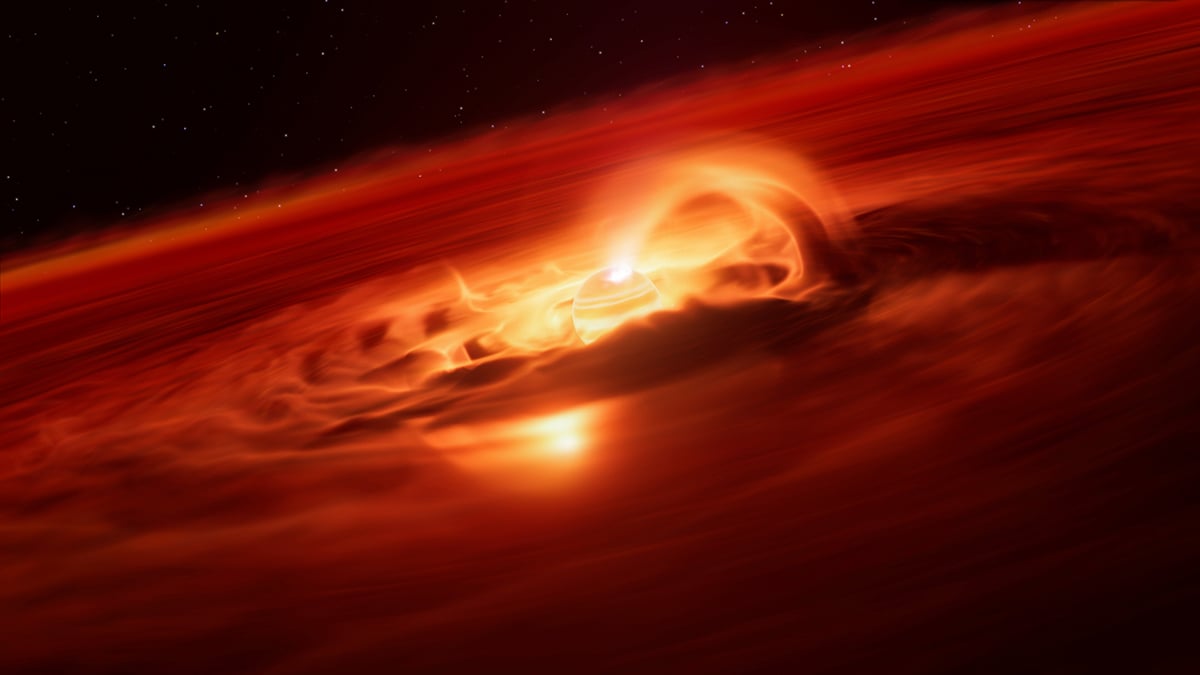
Neither image shows the accretion flow or any resolved structure around the planet. They serve more as locator maps. Alongside those observational frames, an artist’s impression shows how astronomers believe the accretion geometry looks, including a disc and funneling of material by magnetic fields, lit up by hot infalling gas.
What this rogue planet reveals
Many questions are now open: How long will this accretion burst last? Is this a one-time event, or will Cha 1107-7626 undergo multiple bursts? Evidence from a 2016 spectrum suggests high accretion may recur.
Researchers also want to measure the magnetic field strength directly. What field geometry allows such funnelled infall? More precise infrared-to-optical time series will help. Another goal is to compare this object to very low mass stars and brown dwarfs: how common are accretion bursts among free-floating planetary mass objects?
Cha 1107-7626 forces a rethink of how isolated planetary mass objects evolve. It confirms that free-floating bodies can grow via strong accretion bursts. It shows that disc chemistry in such objects can be rich, with hydrocarbons and water vapour appearing even in a low-mass disc.
Clear skies!
See more from DIYPhotography.net on Google
Add DIYPhotography.net as a trusted source. This makes
our stories more likely to appear in your Google Search results.
 Add as a preferred source on Google

Soumyadeep Mukherjee
Soumyadeep Mukherjee is an award-winning astrophotographer from India. He has a doctorate degree in Linguistics. His work extends to the sub-genres of nightscape, deep sky, solar, lunar and optical phenomenon photography. He is also a photography educator and has conducted numerous workshops. His works have appeared in over 40 books & magazines including Astronomy, BBC Sky at Night, Sky & Telescope among others, and in various websites including National Geographic, NASA, Forbes. He was the first Indian to win “Astronomy Photographer of the Year” award in a major category.


Join the Discussion
DIYP Comment Policy
Be nice, be on-topic, no personal information or flames.