























AI-Generated Holocaust Portraits Are Spreading on Facebook—And Historians Are Sounding the Alarm
Jun 10, 2025
Billy Cristal
I’m Billy Cristal—a photographer who’s always been curious about the world and the people in it. I like going places without much of a plan and seeing what turns up. When I’m not taking photos, I’m into horse racing, snowboarding, jet skiing, and the occasional round of golf. I’ve got a soft spot for Asian food, marinated meats, and the kind of cheese you have to ask how to pronounce. I believe in good light, good timing, and even better conversations.
Share:
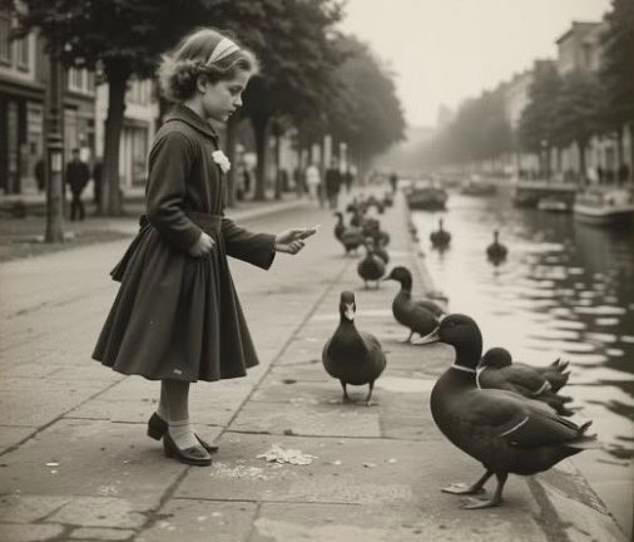
In an unsettling development at the intersection of artificial intelligence, historical memory, and online misinformation, AI-generated portraits and fabricated biographies of Holocaust victims are spreading across Facebook—misleading viewers and deeply troubling historians, reported by MSN Indonesia.
The Auschwitz-Birkenau Memorial and Museum has publicly condemned these posts, calling them “dangerous distortions” that invent people who never existed and present them as real victims of the Holocaust.
[Related Reading: Auschwitz Museum calls out “Holocaust trend” on TikTok as hurtful and disrespectful]
Too Perfect to Be True
These posts typically feature stylized images—often of young children in wistful, vintage settings—alongside emotionally charged stories about their supposed lives and tragic deaths.
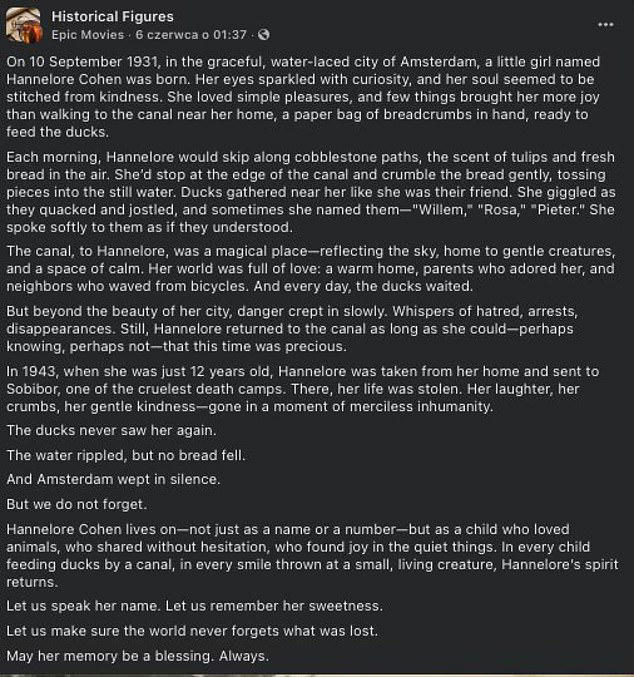
One example: a fictional girl named “Hannelore Cohen”, shown feeding ducks by an Amsterdam canal. The post claims she was killed at Sobibor at age 12. However, this story is entirely made up. A real Hannelore Cohen did exist and survived the Holocaust through the Kindertransport. The AI-generated image and fabricated biography have no connection to her real life.
Other fictional names include:
- “Nadine Levy”, supposedly a secret diarist in Auschwitz
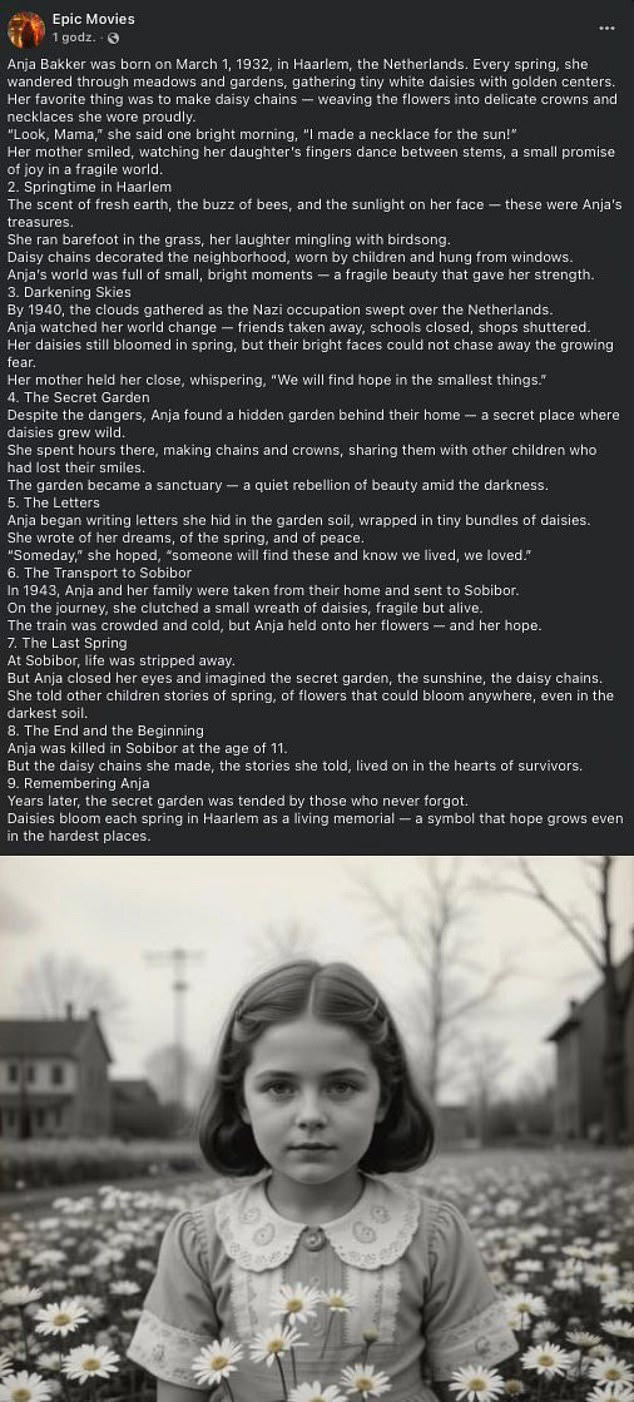
- “Anja Bakker”, described as making daisy chains in a field
None of these stories appear in verified Holocaust victim databases.
Where These Posts Appear
These AI-generated fictions are being widely shared in nostalgia-themed Facebook pages such as “Epic Movies” and “Days Gone By Memories.” Many of these groups have tens or even hundreds of thousands of followers.
The images are carefully crafted to mimic the aesthetic of real historical photography—just enough to feel plausible, but perfect enough to raise suspicions among those familiar with the inconsistencies of real wartime documentation.
Auschwitz Memorial Speaks Out
The Auschwitz Memorial Museum has taken a firm stance against these posts. A spokesperson stated that the content “exploits Holocaust memory for clicks, shares, and reach.”
Their concerns extend far beyond simple misinformation. These fictional narratives:
- Confuse the public about historical facts
- Blur the line between remembrance and invention
- Undermine the memory of actual victims and survivors
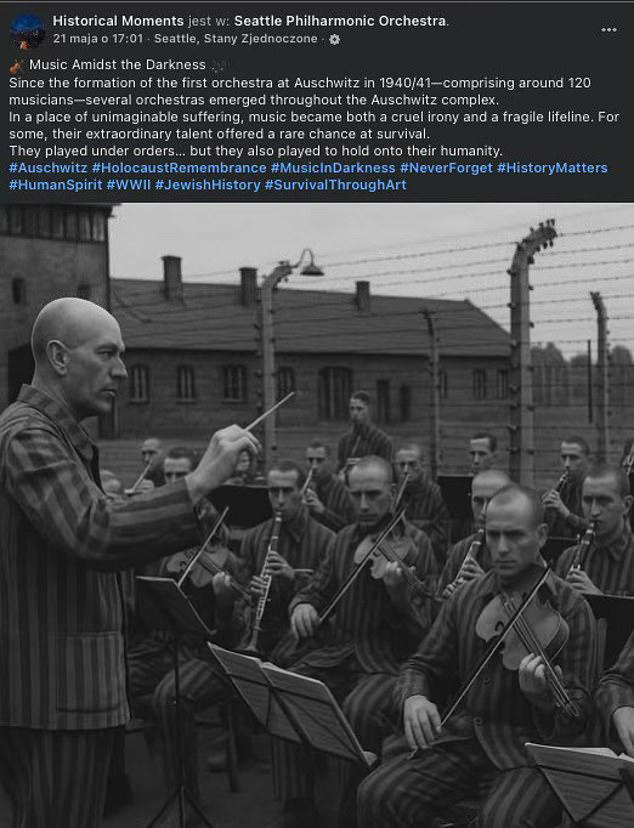
The museum has highlighted visual clues in the images—such as unnatural lighting, symmetry, and facial features—as clear signs of AI generation. Moreover, none of these names or stories appear in the museum’s records or other verified Holocaust databases.
[Related Reading: Auschwitz Isn’t Your Backdrop: Viral Photo Shoot on the Camp’s Train Tracks Sparks Outrage]
Meta’s Troubling Response
Despite appeals from the Auschwitz Memorial, Meta (Facebook’s parent company) has refused to remove the content.
Their reasoning? The posts don’t violate community standards.
That response has sparked outrage among educators and historians. According to the museum, this inaction “sets a dangerous precedent” and implicitly allows the continued spread of fictionalized Holocaust content under the guise of remembrance.
Meta’s platform is now home to posts that blend borrowed details from legitimate memorials with AI-generated characters—turning one of history’s most documented tragedies into algorithmic bait.
Meta Promised to Label AI Content—So Why Isn’t It Happening Here?
In February 2024, Meta publicly committed to labeling AI-generated images, video, and audio across all of its platforms—including Facebook and Instagram. The goal was to help users identify synthetic content and avoid misinformation.
But in the case of these fictional Holocaust victim posts, that promise appears to have been ignored. Despite the clear signs of AI generation and multiple reports from the Auschwitz Memorial, Meta has allowed the content to remain online without any warning, label, or context.
This contradiction between policy and practice is raising serious questions. If AI-labeled content is supposed to protect users from deception, why are emotionally manipulative, historically sensitive fakes being given a pass?
Meta to Label AI-Generated Content on All Its Platforms
The Role of Photography and Ethics in Historical Storytelling
Photography has long been a vital medium for remembering the Holocaust—from the haunting images taken at liberation to intimate portraits of survivors rebuilding their lives. These photographs are evidence. They’re testimony. They carry the weight of truth.
What these AI-generated images do is the opposite. They fabricate sorrow, often with an aesthetic polish that real historical images lack. In doing so, they dilute authentic remembrance and dishonor the lives of actual victims.
“Memory Must Be Protected, Not Invented”
The Auschwitz Memorial summarized the issue clearly:
“Memory must be protected, not invented.”
As visual creators—whether photographers, artists, or content curators—we carry a responsibility. New tools like AI can inspire, enhance, and inform. But when applied without care, they can distort, mislead, and harm.
If a Holocaust story feels too perfect or a child’s portrait appears eerily flawless, it’s worth a closer look. Real victims had real lives. They deserve to be remembered with dignity, not replaced by digital fiction crafted for engagement.
Explore the Creative Side of AI
While this story highlights the ethical dangers of AI misuse, there’s also a rapidly growing field of responsible, creative applications for AI in photography.
To learn how photographers are using AI tools for enhancement, storytelling, and innovation—without compromising authenticity—check out our full guide:
AI in Photography: Tools, Techniques, and Future Trends
See more from DIYPhotography.net on Google
Add DIYPhotography.net as a trusted source. This makes
our stories more likely to appear in your Google Search results.
 Add as a preferred source on Google

Billy Cristal
I’m Billy Cristal—a photographer who’s always been curious about the world and the people in it. I like going places without much of a plan and seeing what turns up. When I’m not taking photos, I’m into horse racing, snowboarding, jet skiing, and the occasional round of golf. I’ve got a soft spot for Asian food, marinated meats, and the kind of cheese you have to ask how to pronounce. I believe in good light, good timing, and even better conversations.



Join the Discussion
DIYP Comment Policy
Be nice, be on-topic, no personal information or flames.
One response to “AI-Generated Holocaust Portraits Are Spreading on Facebook—And Historians Are Sounding the Alarm”
Interestingly, I have just published a new article, AI Imagery Manifesto, on my site, keptlight.com. Ethical issues are part of the conversation.
If links are not allowed, please delete the link.
https://www.keptlight.com/ai-imagery-manifesto/