


















DIY - Universal Sound and Optical Slave Flash Trigger

diy flash triggerSee this exploding grape picture? it was taken using a method called high-speed-photography. Yap, this is the same image type as those exploding balloons, squashed tomatoes and bullet shots. The idea is to capture a tiny moment in time, so tiny in fact, that you will not see it with your bar eyes. Trying to capture a flying bullet is not trivial, you can read about the general setup here.

The most common way to take high-speed images is to place your setup in a dark location, set the camera on "bulb" exposure, and use the flash blast of light to capture a tiny fraction of a second (you can see how long the flash output is here). The flash can be triggered using several ways: it can be activated by an object crossing a ray of light, by by an object hitting a sensitive surface or by sound. A common issue with all high-speed flash triggers is the fact that the triggering event is usually too early and the flash fires a bit too early. To solve this issue, you'd want to use a delay circuit. The delay circuit will enable you to control the time between the triggering event and the flash burst. You can read about delay circuits here.

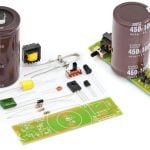
This simple circuit can trigger almost all external flashes, and is activated by sound. So any digicam, that can take a 2 seconds exposures, and has focus lock or manual focus, can capture events triggered by sound. This circuit does not include a delay mechanism, but there is a simple way to control the delay. Simply place the microphone closer or further from the sound source to create shorter of longer delays.

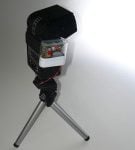
An added bonus for this circuit is that it can also be used as a "dumb" optical slave.

universal_trigger_sm-sound_slave_trigger

Just to show that it's possible, I have included a picture taken by a Friend. Pellet from a BB-gun hits a grape.

The gear used to capture this image, was a "old" Nikon CoolPix990, an old second-hand flash and the trigger circuit above, a BB gun and one sad grape.

This article was contributed by Karsten Stroemvig (aka Lullaby), see his other great high speed photograph projects


Comments

I tried the circuit ... but does not work

Hi. A very good idea to trigger the flash by sound.

I have constructed the circuit following this scheme but I have not managed to make it work. I think that everything is well mounted, but the flash does not work.

Can you help me?. Any test measures or something ....

Regards

Excuse my english if wrong ......

what kind of mic are you

what kind of mic are you using? It looks like this is set up to work with a condenser mic

I´m sorry ...... work´s fines, my fault ....

Hi. I´m sorry, i spoke so soon .... The circuit works perfectly, it was just a little weld that did not make good contact :( If you want to see a test: http://www.bajolagua.es/globo.html Now I just need a place that can be dunked, stained and where I can break crystals… Good work! and thank you for your response.

Nice to see that you got it

Nice to see that you got it working, I will bee looking forward to seeing more test pictures :-)
By the way, I have made a special "shooting box" which both holds the target contained, and to help setting the lighting. It’s essentially just a white box. The side towards the camera is cut out. The flash is placed at the top of the box, shooting though a small hole, this way the white box will help reflecting more light.
It’s a little difficult to explain… perhaps I should take some pictures of my setup

Nice to see ...

The shotting box idea is veeery clear, but I want to see those photos of your box. I had thought to make something similar, covered with lavable plastic on the inside to be able to break apples, tomatos ... and wash before another shot.

At the moment I have put it everything inside of a small box and have test with a PC microphone and works fine. Either I have bought 100 globes and I will begin the tests with globes and smoke ...

When i have more photos i will up and will tell you. Greetings.

Excuse my poor english if wrong ...

Re: Nice to see ...

Sounds great.
Pictures of my set up are coming

Excellent!

It's cool to see such detail introduction. I'm thinking to start my project now :)...

I got a couple of quesitons but I'm completely new so please excuse me if the questions appear to be sputid.

Why is a Sigma flash used? Was it becasue Canon speedlite like 550EX or 420EX only can be triggered by IR signal but not other light source?

Using flash with camera in bulb mode means the work has to be done in total darkness. To avoid this another way is to trigger the camera shutter instead of flash, so the embient light can be on all the time. Is this very difficult to do? Is the timming of the shutter a too big concern so we may not have a chance at all.

Thanks,

Good idea

Hello.

I have used a Metz flash, but in my opinion it does not matter what kind of flash you use. The only important thing which you must consider is that been possible to be shot from a shoe of “universal” flash, this is a shoe just by 2 contacts mechanisms, because, at the end of the circuit, we have a “switch” who forces the flash to shot.

http://www.fotolab30.com/xcart/images/thumbnails/t_4784.jpg (this one is good)

http://recursos.cnice.mec.es/bancoimagenes/ArchivosImagenes/DVD05/CD07/5025__35_a_1.jpg (this one is not good. You will have to look for the correct contacts)

I like the idea to shoot the camera directly, but two forms are only happened to me:

1 Construct a mechanical invention that presses the trigger.

2 Connect the camera to a computer and make a program with "software development kit" that shoots the camera through a signal of the serial port of the pc (fot example). It is necessary to know programming, at least, C++.

I don´t know another way to shot a camera from an external event without human performance. But i´m sure that something will be happened to us…

The 25 of that month i´ll do more photos with glass, ballons, paints, water and more ... let´s see

Good look and cheer up!.

(Excuse my poor english if wrong)

question for the author

i made the circuit today and i was very happy as i got the audio trigger to work, but unfortunatley i can't get the optical trigger circuit to work.

I have two questions for you.

1) is that a 10-160mh inductor you are talking about, because i went to buy that part and not many stores stock it, i bought a .82mh inductor just incase thiniking maybe you were referring to that instead and it was hige in size so a 180mh inductor would be too big, could you send me a picture of what the inductor looks like.

Also i bought a photodiode but i dont know if it is right either, could you also post a picture of what your photodiode looks like,

or could you find me the parts ie(inductor and photodiode) required for the optical trigger. We have www.rs-components.com.au in australia if they dont have the part no-one will, heheh

many thanks.

Trigger the camera, Flash type and Components

The kit can actually easily trig a camera.
Instead of connecting to a flash, just connect as a remote to the camera, like in the DIY - Release Cable for Canon DSLRs
http://www.diyphotography.net/release_cable_for_canon_dslr

Only problem is that the shutter delay in the camera is way to long, so you will have great problems with timing.

Flash types:
Any flash will work, but you will need one with adjustable output, so that a faster light-flash can be obtained.

Harpreet: The inductor needs to be so "big" in order to have the wanted effect.
This is the one I use, http://lullaby.homepage.dk/inductor.jpg
The Inductor is a high pass filter, the value sets lowest trigger frequency.
This is used to avoid false trigger events from other light sources. (daylight shadows etc.)
Some examples:
160mH - 1/1000sec or 1kHz
80mH - 1/2000sec or 2kHz
10mH - 1/16000sec or 16kHz
.82mH - 1/200000 or 200kHz
As you can see a .82mH is way to small.
10mH would work, but sensitivity will be reduced a little.

Inductor

Harpreet, I had no luck finding anything at RS
But Farnell got what we are looking for:

http://au.farnell.com/jsp/Passive+Components/EMC,+Filters+&+Suppression/TOKO/10RB104K/displayProduct.jsp?sku=1193630
or
http://au.farnell.com/jsp/Passive+Components/EMC,+Filters+&+Suppression/TOKO/10RB124K/displayProduct.jsp?sku=1193631

BR. Karsten, Denmark

Inductor help

Hi Karsten! I've gathered all my parts for this project and i'm very excited to get started. Is there a suitbale inductor available at mouser.com. I'm a bit of a novice and i'm having difficulty locating one. Thank you so much for your time.

What a great DIY tip only

What a great DIY tip only trouble now is I have no idea how to make the trigger as I have no electronics training.

unfortunately i am unable to

unfortunately i am unable to get my optical trigger to work, but i'm having alot of fun with the sound trigger, can we post some pics from our experiments, anyone know of a free picture hosting website??

that's great

you can use flickr for your images. and then use the img tag to post them images

More photos

Hi again.

More photos:

www.bajolagua.es/globo

We have learned too much, and the next time we will do it better.

Thank´s Karsten, it´s very funny.

electronics components

Take a look at
http://www.digikey.com/
for electronics parts- fast, small quantities, etc.

I'll need to take a look at this project- it occurs to me that many computers still have parallel ports and one could use this to trigger/readin the flash/camera/mic as long as we were thinking about fairly slow (max 2ms?) times. Then you'd be able to run an arbitrary delay. We use parallel ports as quick and dirty DAQ boards for slow signals at my lab.

I built the sound trigger

I built the sound trigger without the optical circuit, but I am not getting enough voltage on the MOC3020 to trigger it. I am gettin .7 volts, but the datasheet for the NTE version of the MOC3020 list 1.15 v as the minimum. Any ideas what could be wrong?

I got it to work after

I got it to work after replacing the transistors, but I have to disconnect the cable to the flash to basically reset it. Not sure if this is by design or not.

Thanks,

Robbie

Hi robbie Skipping the

Hi robbie

Skipping the optical trigger part is quite ok, just skip the photo-diode, 80mH inductor and the 10uF cap.
0.7 volt on the MOC? Is that when the circuit is idle ?
The idle voltage at pin 1 of the MOC should be 9v.

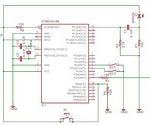
Circuit description:
The 1Mohm resistor and the 1uF capacitor are used as a very simple single shot circuit.

The capacitor is used to store the energy for triggering the MOC.
When power is added to the circuit, the capacitor is slowly charged via the 1 Mega ohm resistor. After a few seconds the capacitor will be fully charged and the voltage across it will have risen to 9volts. The circuit is now ready and in idle state (no trigger sound).

The first transistor stage is a simple microphone amplifier.
All detected sounds are amplified and when it’s loud enough the second transistor will conduct. The energy charged in the 1uF cap is then discharged trough the MOC and the flash is trigged.
The circuit can’t trig again until the capacitor is recharged.

Resistor

What is the value of the 4K7 resistor? 47K? 4.7K?

Im referring to the resistor between the 9V source and the mic element.

Thanks,

Scott

Scott, The resistor is

Scott,
The resistor is 4.7kohm.
Actually the value off the resistor has to match the microphone, it can be found in the datasheet for the microphone.
The resistance is usually 4-12kohm.

Suppose I don't know

Suppose I don't know anything about building circuits, but want to be able to do this . . . can someone buy a simple device that does the same thing?

flash trigger kit

hivitz has some kits for sale

Little problems with sound trigger

Hi!
I built my sound trigger project but I have no ideia how can I conect it to my camera. Does anybody has a schematic of how can I do that?
Thanks.

Many Thanks!!!

Many thanks for the response on the 4.7k resistor. I shall check the tech sheet of the mic element that I ordered. I was able to order most of the parts from jameco.com at a very inexpensive price. The only part I got elsewhere was a printed circuit board from radio shack which was on sale for 2.99.

Parts are on order, should have them by next week. I'll let ya know how it works.

Thanks again,

Scott in Myrtle Beach, SC

Question

Can i use other types of npn transistors ? and if i use other type will i have to change the values of the resistors and capacitor in the circuit ? (sorry for my speeling ..don't know very much english)

Triggering Device

Hey, I am interested in acquiring a device that will trip my flash by sound or light. This device on your site, do I have to build this or can I buy it?

Theresa

Help

I know nothing about electronics. Can I buy one of these sound triggering devices already made?

Theresa P.
Tulsa, Ok

PC sync terminals

I am planning on building this tomorrow. Being an engineer myself I've got a somewhat obsessive problem with doing things properly, but I can't for the life of me figure out where to get PC sync terminals from. Does anyone have any idea? So far searches have been useless because PC is such a generic term :S.

I'm getting ready to hack up a PC sync cord to get the connector out, but I would still kill for this to be a little box with a PC connector on it, rather than some ugly alien looking thing :) Any ideas?

- Garbz

Trying to shoot the camera ....

Hi again, Karsten.

I am trying to give one step beyond and i am trying to connect the circuit directly to the camera, a nikon d70s. I bought the shutter release cable and i have connected it to the MOC3020 directly (i must simulate a switch). But, it works sometimes, and i can not find the reason.

I have little knowledge about electronics but i think that the reason could be that the "signal out" of the MOC3020 is so short, enough for fire a flash, but not enough to shot the camera. I have not oscilloscope to see the "signal out" of the moc3020 ...

The circuit works fine and the new wire is ok, if i make a short circuit with other wire, the camera shoots. What you think?. I hope you can help me.

Thank you and regards.

Excuse my english if wrong ...

Is there a full parts list

Is there a full parts list available for this vs. just an electrical diagram?

Parts list

Can someone post a parts list from Mouser.com or Digikey.com? I'm an electronics newbie. I'd like to build the circuit, but Digikey has 128 pages of different photodiodes to chose from. Guidance would be great.

to those who want this to

to those who want this to trigger their cameras...

It makes no sense to do it this way. You want it to trigger the flash to "paint" the image onto your camera as it happens. Eg.

Set your target up and flash with sensor and point the camera, mounted on a tripod, at it. Focus it on the target.
Set the camera to 30secs exposure time.
Switch the camera over to manual focus so the focus doesnt change.
turn the lights off.
press the shutter on your camera.
fire your bb gun at the target. the flash will trigger and "paint" the stopped image onto the image sensor on your camera.

If you had the camera being triggered, the shutter wouldnt activate fast enough to catch the image.
Hope this helps

Triggering the camera

Hi Anonimous. Finaly and with the help of Kirsten, i can trigger the camera with a sound. There are too much reasons to shoot the camera and not the flashes, for example, now i don´t need to be in total darkness to 'play', it is better to prepare all, and the results are better because i have less noise (long exposures). Now I can shoot in exteriors in the middle of a bright day .... I think it have all the sense. You can see some results in:

Milk drops

Besides, if you can shoot several flashes whit slaves circuits, the result is almost perfect and controled, and in exteriors you don´t need any flashes.

And about the loudness of the sound. I am using a Computer Mic, exactly this one:

The microphone is very, very sensible, so sometimes shoot the circuit just with walk slowly around the circuit. The microphone is so sensitive to loud sounds (like a gas pistol). Indeed sounds too strong, the circuit is saturated and stops working, I have to put a shirt on top so they do not come much sound. Try to change it if you need more sensibility.

I will shoot in exteriors shortly.

Vern, you circuit is fine, very pretty and order ... you have to see mine. Can you show us the mic?.

Excuse my english if wrong ....

Thank you! The mic im using

Thank you! The mic im using is a Rode Videomic :

While you're mostly right on

While you're mostly right on the money, it doesn't make any sense to choose a 30 second exposure time. This sort of shooting is best done in bulb mode.

Mic sensitivity?

Hi there! First, I want to thank the author for sharing this with us. I bought everything i needed to build this today. I was just wondering how sensitive was the trigger for the microphone? Does it need a very loud sound? Is there any way to control its sensitivity? Thank you!!!

Confirmed, the sound trigger

Confirmed, the sound trigger works. I haven't built the optical part of the circuit since I did not need it. As I expected, the mic needs a loud sound to trigger the flash (like a hand clap). Still wondering if there is any way of making it more sensitive. Anyway, here are some pictures of what I did with 10$ in parts:


(The second 9V battery is only to power the LED on the power switch)

Could you make it for me, please

Hello,

really exited with the article, already have many shooting ideas in my mind.. but... I am not good at making electronics....

If you can do it for me, I will pay as much as you ask. Please drop me an email : VictorSav@gmail.com

Cheers!
Victor

Does someone have the pcb

In order to make the circuit "look good" if someone has the pcb to etch I would be truly thankful.
Jose Pedro Lopez from Uruguay

I have the PCB

Hola, motivado por tu comentario, he hecho el PCB con EAGLE para Linux. Si lo deseas puedes ver el PCB y foto de ejemplo aquí

Hi, I made the PCB using EAGLE for Linux . You can see it here and a picture too.

Saludos.

Wilbe - El Salvador

Thanks Wilber

The test shot looks on the dot.

Thanks for sharing the PCB.

Finished building my own...

... but I cannot make it run on a regular 9V mains battery eliminator. It runs fine with a 9V battery tho - and on my Manson bench power supply.

If i run it on a battery eliminator it makes the flash trigger with approx half a second delay. Peculiar stuff indeed. Any clues?
(I've tested with 3 different power adapters, and they all result in the same type of delayed triggering).

(Btw I've changed the MOS3020 with a IL420)

Some pics of my unit...


Universal Photo Timer

High speed photography always fascinated me. I constructed a timer for high speed photography that allows me to trigger a flash or or a camera shutter. I was able to capture water drops, popping balloons and shuttering light bulbs without much trouble.

See the attached image of a shattering light bulb (please note that the light bulb is still on). The picture was taken using the Universal Photo Timer. The timer was sound triggered.

The timer integrates an infra-red camera remote, flash sync output and timer with triggering sensors.

It comes pre-programmed with Canon as well as Nikon codes. The unit can learn new camera codes from your existing infra-red camera remote, allowing virtually unlimited interface options.

The timer contains a flash interface for both high voltage and low voltage flash units.

The triggering can be done through the built in microphone or an external light sensor.

If you are interested in a ready made solution or would like to view other examples of high speed photography, please check my website Universal Photo Timer for more info.

Misplaced

Of course with the permission of Karsten ...

This is a DIY "Do it yourself" website. But your message says "Buy it yourself".

Sorry, but I think your message is misplaced and not contributing anything to this website.

Parts list minus light trigger for UK interest

http://www.chris-hamlet.co.uk/pictures/DSCF0052.JPG
http://www.chris-hamlet.co.uk/pictures/DSCF0055.JPG

Maplins order numbers and description

www.maplins.co.uk

QQ10L MOC3020 TRIAC DRIVER OPTOISOLATOR
QQ14Q BC547C TRANSISTOR NPN TO-92 50V
AT98G 10UF 50V LOW IMPEDANCE ELECTROLYT CAP
VH03D 1UF 250V 10% MET POLYESTER CAPACITOR
M4K7 4K7 0.1% 0.4W PRECISION RESISTOR
M2K2 2K2 0.1% 0.4W PRECISION RESISTOR
M220K 220K 0.1% 0.4W PRECISION RESISTOR
M10K 10K 0.1% 0.4W PRECISION RESISTOR
M1M 1M 0.1% 0.4W PRECISION RESISTOR
FS43W PCB MOUNTING MICROPHONE INSERT
JP47B STRIP BOARD 2939

Approx £7.50 without a little box to put it in

Hi! I really need your help,

Hi!
I really need your help, about that part, where i can make trigger with photo diode. In shop, they say, i need some parameters, they really do not know hoe to help me with this photo diode part....Maybe somebody can give some technical information about these parts. About this Photo diode and this part with 80mH.... And maybe somebody can explain, how can i made, that, photo diode works only on flash light...on very strong light... There need some extra parts?

P.S. Sorry for my English...

Alvis

Diagram labels

Hi I like the units and the possibilities it allows for. Even though I am reasonably good with wires and simple circuits I dont understand circuit diagrams, the pictures added of the units built are good to see too however there are no labels so I dont know what some part are what they lead to and so on could you guys help me out with labels on the diagrams please

I beg of you

More pics

Second test of the system, playing with water and red backgrounds, now shooting the camera directly and, with some slaves circuits, shooting 2 external flashes. Hope you like.

bajolagua.es/globo

The next test will be in exterior.

PCB del DIY - Universal Sound and Optical Slave Flash Trigger

Saludos.

Este circuito es una maravilla ya que con él se logra hacer un excelente trabajo, he leído que aun no hay un PCB por lo que me he tomado el tiempo y lo he hecho en Eagle para linux.

El esquemático, los elementos y el PCB lo pueden ver en http://www.panoramio.com/user/170919, si están interesados en las figuras originales, dejar su correo en este medio y yo se las enviaré.

Saludos.

Esquemático
Elementos
PCB
PCB en Blanco y negro

Corrección de enlaces

Saludos,

El PCB anterior no me gustaba del todo, por lo que les presento una versión mejorada y definitiva.

Ver PCB y foto de ejemplo aquí

Por cierto, tengo el CANON Speedlite 430EX y para hacer un segundo disparo, debo apagarlo o desconectarlo, esto es debido al TRIAC ya que es un interruptor de estado sólido con retención, por lo que espero hacer pruebas con el NTE3083 o NTE3084 en lugar del MOC3020.

Los interesados en obtener las imágenes originales del PCB, por favor hacer su petición por esta vía.

Atentamente,

Wilber - El Salvador
http://www.flickr.com/photos/wilber-elsalvador/
http://www.panoramio.com/user/170919

Más muestras / More samples

He hecho tres tomas más con este circuito, si están interesados por favor visitar mi pagina en panoramio o en flickr.

I made three shots using this circuit. You can see these samples in my panoramio or flickr site.

Muestra / Samples
Wilber - El Salvador

Saludos

I love it

Wilbor, Your Flickr stream rocks!!!

More pics

Hi again.

finally I could try firing the camera rather than the flash. It is much easier.

Here you can see the result:

http://www.bajolagua.es/globo/index.html

Greetings.

Post new comment

The content of this field is kept private and will not be shown publicly.
  • Allowed HTML tags: <a> <em> <strong> <cite> <code> <ul> <ol> <li> <dl> <dt> <dd> <img> <a>
  • Lines and paragraphs break automatically.
  • Web page addresses and e-mail addresses turn into links automatically.

More information about formatting options