





















PSEUDO Film Canister plans to succeed where others failed, bringing digital sensors to 35mm bodies
Jun 1, 2016
John Aldred
John Aldred is a photographer with over 25 years of experience in the portrait and commercial worlds. He is based in Scotland and has been an early adopter – and occasional beta tester – of almost every digital imaging technology in that time. As well as his creative visual work, John uses 3D printing, electronics and programming to create his own photography and filmmaking tools and consults for a number of brands across the industry.
Share:

I’d love nothing more than to be able to slap a digital sensor into my old mechanical film bodies and wander off doing some street photography. So, I’m trying really really hard to get excited about this one, but the lessons of the past have taught us to not get our hopes up.
The PSEUDO Film Canister plans to succeed where the previous attempts have failed and finally allow us to shoot digitally with our 35mm film bodies.
It’s a product that’s generally considered to be vapourware, with a lot of past promises that never came to fruition, due to the technical issues that plague this type of device.
It’s been well over fifteen years now since SiliconFilm attempted to bring such a unit to market, when DSLRs were just beginning to reach the quality of 35mm film, and many photographers were worried about the big investments they’d made in their film cameras.

It was an ambitious goal, and this first idea replaced your camera’s back door with a complete digital back. I was especially excited by this, because the camera I was shooting at the time, the Nikon N90s, was one of the cameras listed as being guaranteed to work with it.
Fast forward to 2011, and the announcement for the RE-35 came along. With 4, 8 and 12MP flavours, being able to fit into any 35mm analogue camera, and the ability to shoot raw, it seemed too good to be true.
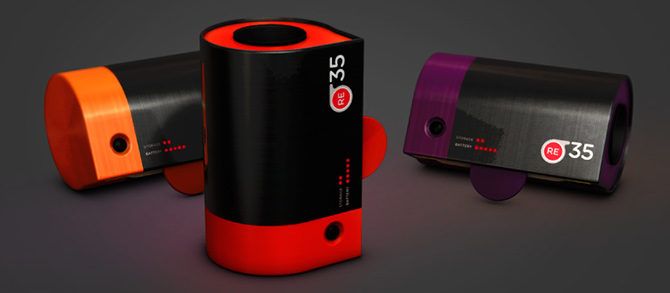
It turns out, that it was. The whole thing was a hoax. The RE-35 never existed, and was created only as “an exercise in identity-design”. They assumed the April 1st press release would clue people into this fact, but apparently not.
A little while later, in 2014, we had a couple more contenders. The DigiPod actually managed to raise over £15,000 (around $21,600) before the IndieGoGo campaign was cancelled, somewhat short of its £199,000 (approx US$290,000) goal. If nothing else, at least the DigiPod presented us with some sample images to show proof of concept.

The FrankenCamera II also fired up that year, attempting to bring a digital conversion kit to the Leica M3. While a proof of concept was created using a Konica Auto S3, the relatively limited audience of Leica M3 owners who wanted to shoot digital, pretty much spelled doom from the start.
So, what about PSEUDO? Unlike SiliconFilm and FrankenCamera, PSEUDO isn’t being designed as a replacement back for your 35mm SLR. It’s a drop in replacement for a film canister, much as DigiPod was supposed to be, meaning that you’ll be able to use it with pretty much anything.
There’s even a concept mockup of the PSEUDO showing how it will fit into your camera.

Camera technology has certainly come a long way since the days of SiliconFilm, and with sensors getting better and cheaper, now seems as good a time as any to give this concept another go.
With a goal to keep things as simple as possible, early specs have been released, along with the issues that may be faced.
- Power Source – Removable and readily available, like AAA or watch batteries.
- Memory/Storage – Expected to be microSD, which would make sense, given their availability and cost.
- Sensor – Ideally they want full frame, which was unrealistic in the past, but who knows what they may come across today?
- WiFi – This would be nice, especially given that you still wouldn’t be able to see the images you’re shooting unless you can tether to an external viewer or mobile device.
- ISO – Probably locked to 100 or 200. Works for me, but if there were an ISO400 or 1600 flavour (even if only black & white), I could see myself buying a couple of these for going out with multiple bodies. 100, 400 and 1600 would be the perfect combination for me.
- Battery level indicator – Potentially tricky, you’d have to open the camera’s back to be able to look at it if there was no WiFi available.
- On/Off button – Makes sense. Many older mechanical cameras wouldn’t have a way to tell the PSEUDO that it was “off” and stuffed in a backpack.
- B+W and Colour versions – I like this idea very much. I wouldn’t have much interest in a colour version, but black and white? Yes, please!
They don’t forget to mention the biggest hurdle, the shutter release button.
Shutter release button – This will probably be the biggest challenge. I want the cartridge to fit in and out easily, with no mechanical changes needed to the camera. So the original shutter release button will be used to open the shutter still.
This means, that something will be needed to trigger the digital sensor taking the photo. I am looking into audible feedback from the sound of the shutter being engaged. But there are a number of ways to go.
I have a feeling that audible sensors will simply be too slow to react, especially with something more modern and quiet like the Nikon F100 or F6. While my Nikkormats have a fairly substantial clunk, my N90s is also pretty quiet.
It’s a problem, for sure, and one that many of the other projects failed to solve without attempting to physically alter the shutter of the camera (which defeats the purpose of an insert you can use with any camera).
Like I said at the start of this post, I really want to get excited about this one, but I also don’t want to set myself up for disappointment, again.
However, I’ll be keeping a close eye on this project, and absolutely wishing them all the best. It’d be great to finally see somebody crack this one.
You can find out more about the PSEUDO Film Canister on their website, and see the project over on IndieGoGo.
What do you think? Are you as excited as I’d like to be? Or do you think the “turning a film camera into a digital camera” ship has long since sailed? Let us know your thoughts in the comments.
[via Phoblographer]

John Aldred
John Aldred is a photographer with over 25 years of experience in the portrait and commercial worlds. He is based in Scotland and has been an early adopter – and occasional beta tester – of almost every digital imaging technology in that time. As well as his creative visual work, John uses 3D printing, electronics and programming to create his own photography and filmmaking tools and consults for a number of brands across the industry.




Join the Discussion
DIYP Comment Policy
Be nice, be on-topic, no personal information or flames.
109 responses to “PSEUDO Film Canister plans to succeed where others failed, bringing digital sensors to 35mm bodies”
How much are camera sensors these days?
Hope!
I love the concept, but I think there is a good reason those were never made before.
Now, even if the technology exists, it is way too late for that train. modern DSLRs are better than old SLRs now in terms of build and ergonomics, and it would be amazingly surprising if they can cram a decent sensor in there.
it’s more for the charismatic cameras from the 30-80’s cameras, before af slrs, that have the size, aesthetics, feel, lenses. the older fixed lenses rangefinders are a charm to use and have terrific lenses and so on.
That would be fun.
Cool idea.
Andrew Taylor I hope they get this going!
Dan Druf pretty sweeeeet
yoooo this looks unreal in concept – really curious to see if they develop it successfully
Not this agsin
Love it!
This would be amazing!!
Finally! Also a hybrid digital/analog camera would not be a bad idea..
Hopefully technology has developed enough to make this idea feasible now.
I’m sorry but they guy got a background doing “films and websites” and the same idea that thousands of people had before him. In time he “hope to bring in more people” with knowledge. I applaud the effort but creating a fundraiser and getting published on photography sites only because you’ve got an idea is absurd.
Time to dust off those Nikon F5’s
Hang on, it’s not April…..
This would be so awesome! I could break out the old camera and start using it again! BUT what kind of money are we talking? and what are the specs
Just spitballing…
Most likely an APS-C sensor to keep costs reasonable. Sony’s 16MP would be a good choice (see Fuji and Pentax). Pair that with Raspberry Pi 1 Model A+ to run the thing.
As far as “audible feedback from the sound of the shutter being engaged” to engage the sensor, perhaps motion sensor of the shutter? More reliable, and a audio trigger might be prone to unwanted shots from ambient noise?
One issue might be vignetting from vintage glass to the APS-C sensor. Might be dependent on the camera body?
why would there be vignetting? if the sensor is APS-C it should be more than filled by a lens designed for 35mm film, no?
Could perhaps proper sensor alignment with different cameras be an issue though? is the position of the actual shutter compared to the film canister position a constant in 35mm cameras?.. it would need some form of lateral adjustment for the sensor position otherwise.
I think it would have to be full frame for it to be worth fooling with but the shutter issue is simple; just wire it to the pc connector with an adjustable delay of a few milliseconds. Film plane is set on all film cameras so as long as the sensor rides in the same location it’ll be fine. have it wi/fi enabled so images are sent directly to your smartphone for preview and storage, make the insert universal and have 3D printed backs for different cameras available for download and Bob’s you uncle.
Yeah, had a brain cramp and had it backwards. Sorry. :)
Oh I know all about those :-)
wont happen, but its a nice idea, as a collector (and user) of vintage cameras i cant think of a way this could work, the sensor would have to be movable, with different loading methods and camera body sizes/shapes etc this would be compatible with about 3 cameras.
Canon, Nikon, Minolta, Pentax versions? Once a design of the housing for the chip and sensor are finalized, it would be easy and cost-effective to replicate with 3D printing.
they would have to, this is advertised as a “one design for all” which couldnt work. i really hope they make it though, i’d love one, if only as a way for testing what a lens/camera is like, putting a roll of film through a camera just to find out it has horrible light leaks or the rangefinder isnt calibrated is frustrating and expensive.
could be some sort of revolutionary !
I own film cameras to shoot film with because it looks like film. I own digital cameras for the purpose of something like this. Just saying. It’s a very limited market.
Italian supercars are a limited market but Lamborghini and Ferrari still make them. It may not be for everyone but there are folks who would jump to have something like this.
I can agree with that. Especially if it were a full frame sensor.
Not this bollocks again ?
Hey, nice. I still have my ol’ N70 on mothballs…
1000000000000 times YES !! Full Frame !!
So is my Canon 5d…
Yes! Personnaly, I hope that will be delivered on the back of an unicorn. It could be fun!!
Just stop dreaming man…
They planned something like this for Super 8 too years ago, was EXPENSIVE and must not have worked well.
If it costs as much as a good Digital body it will fail
There was a Company about 20 years ago, that wanted to make this also…
They have cardboard with marker on it. Stuff just got realz. another great DIY post
Actually this is already being done, I have a college who has an older hasselblad camera, he sent it back to Hasslblad and they made a back to snap into the back and now it’s a digital camera and it shoots in raw. It cost him $35000 to have it done, but it was cheaper than buying a new one.
You’re comparing apple to oranges…
he did his quite a few years ago, so the price to do this must be coming down, for other applications, you would think
Digital backs for MF are already on the market, one for 35mm is still a concept.
Neat tech. ???
Calin Andra :o
Great news. I hope somebody will do this for old film cameras. I’d love to use primes on a 16mm turret, again! Yet I’m not 100% sure whether I’d like the optics of back then – maybe it’s just nostalgia getting the better of me.
This is Gay!
Paul.
Interesting technical idea but if I want to use my film camera I just go buy some film ?.
I would love to have this. I kept my Contax cameras and Zeiss lenses, probably for purely sentimental reasons. Would love to be able to use them again.
I use those Zeiss Lenses on Canon with adaptors, and they are amazing!!!
Amélie Kenny Robichaud
Malaaaade
Hector Gomez
Cool but to go backwards to move forward is foolish but it’s still cool for those old school photogs.
Maybe I can break out my old AE1
Hector Gomez lmao, that thing will cost more than 10 old AE1’s. Also there were just a limited real high end FD lenses that would do well with a digital chip.
Makes me wish I hadn’t just sold my near perfect F100. ?
Not gonna get my hopes up, this has failed twice already that I know of. It would be nice though.
The shutter problem isnt a problem. Software monitors the sensor for changes. It is of course…a sensor. You could also use a vibration sensor in concert with monitoring of light sensing… the shutter problem is not really a problem.
doesn’t even have to be that complicated, just simply plug it into the pc connector and have an adjustable delay of a few milliseconds or so
Maybe a remote to open the sensor pixels, then you activate the shutter.
Thought that the PC would only fire when the shutter is already open? And that would only work for times with a Flash sync.
What !!!
I have 2 lovely old medium format cameras lying around. Would love to use them with a system like this
So… They have an idea… and they stucl card board into an old film roll. Good idea but nothing to show so far
This has been thought of ages ago . It didn’t seem to get off the ground.
Jesse Gordon
good idea but it’s never gonna to be practical
Might be it would be awesome
Think Fiji killed the first attempt at this about 15 years ago and Nikon basically did it with the f90 with the digital back from Kodak.
Sweet
Very reminiscent of the medium format digital backs for old Hasselblads, Contax, and Rolleis. When this happened for MF, the backs were very pricey (think a new luxury car), and initially the same would probably follow for 35FFDF (“35 full frame digital film”). Intriguing…
Sean Molloy
That would be cool. I have a couple old 35mm bodies that would be fun to shoot this way.
would be cool. we’ll see if it actually happens or not.
Wow, so much negativity in the comments ?
Except people with film cameras want to shoot film. The only people who’ll use this are people looking to save money on the cost of a digital camera.
I have a film camera and want to shoot digital. Concepts changed already before the advent of the digital age, and I simply like the ergonomics of the older cameras better. Imho, most of the changes that were introduced are either cost saving measures (due to the high sensor costs), intended to overcome the photographers’s deficiencies, or only apeal to check list fanatics. Of the features of the Nikon Df, e.g. I would cancel about two thirds. (examples being: 1/3 step Setting, DX mode, image quality and size, compression, bit depth, AF are mode, focus point selection, electric rangefinder, Auto ISO sensitivity control, maybe even white balance (use filters), picture controls, and even flash modes (These should be incorporated into the flash unit, appears more Logical)
I would like this product as I have an old slr camera which I would like to use and not throw it in waste and spare the struggle of going to the shop and buying a film roll everytime I need it
This is utter crap. This guy, if he gets funded, is never going to get it built and he’s going rip people off. It’s a crappy Sketchup model and a an example made of an old film canister and cardboard. No actual engineering ever went into this. It’s a laundry list of wants and a sketch. Total crap.
I hope these folks know photography and aren’t just placing a sensor attached to housing to fit inside a 35mm camera –
http://www.siliconfilm.com
This is the closest thing I’ve seen and I don’t think it actually works, or it doesn’t work well.
Did you see the time line? All the announcements in the list were from 2000.
I am working at a different approach: a body with both a digital and a film back. You could be able to use your lens on the body through dedicated mounts. The backs (and so the bodies) will be in 35mm, 6×6 and 4’x5′ format. In a couple of month we will be ready to have the first functional prototypes.
You will be able to follow the development on randtglobalservices.com, until the first pre-release launch.
fail from the start.. there are so many reason why this will not work.
one reason displace a digital sensor a bit in your digital cameras and all you get is oof images.
film is much more forgiving.
so everyone who expects digital quality files from this will be dissapointed.
think about the kodak backs for analog cameras.. i guess that´s the quality we can expect from a “one fits all approach”.
Nice article. Trying the same failed concept once again seems pointless. And it sounds like it wouldn’t be very good even if it was funded.
it would be much better to put 35mm Film into a Digital Camera, THE FILM (NEGATIVE) IS THE MEDIUM! plus it seems that the digital will only bring out the faults in the older camera mechanisms.
Concept been around for a long time and every few years someone would make a concept only of it but still no one really made it.
It’s a bit late for April Fools jokes….
looks like the old school lego car door
butwhy.gif
The great thing about this is that it looks just like an old film cannister and a piece of cardboard so no-one is going to steal that!
Yes please, especially if later versions can do video!
How would they line up the sensor with different cameras that have a slightly different distance between the film canister and the mirror box?
Good question. Two options: either a slightly movable sensor that shifts a couple cm in either direction, or an oversized sensor that crops to the image box. Neither would be ideal, but would avoid needing customized models.
A digital insert to replace 35mm film is what I’ve wanted for years. The ideas I’ve heard and seen are pretty much what I thought myself. all it needs is a commitment from users and techs to work it out. will it be simple no, it would have already been done if it was. i just bought a used Nikon digital SLR and I miss my manual film cameras that I used in Alberta for 10.5 years. I look forward to a genuine product. R.R.C. Kimmirut, Nu Canada.
knowing when the shutter button is pressed is easy. It is when light hits the sensor.
Sorry for my English.
It is necessary to make a matrix with two cassettes.
1) The light hits the matrix
2) The matrix saves the image
3) The second cassette is inserted where the rewind film
4) Rewinding the film or cocking the trigger – saving the image from the matrix
5) We are waiting for a new shot.
…Shutter release button – This will probably be the biggest challenge. I want the cartridge to fit in and out easily, with no mechanical changes needed to the camera. So the original shutter release button will be used to open the shutter still.
This means, that something will be needed to trigger the digital sensor taking the photo. I am looking into audible feedback from the sound of the shutter being engaged. But there are a number of ways to go.
I have a feeling that audible sensors will simply be too slow to react, especially with something more modern and quiet like the Nikon F100 or F6. …
Why not use the light from the lens? Modern electronics can surely detect light coming in as the shutter opens, wait for a few thousanths, read the CCD and then reset waiting for the next light…?
Focal plane? The first motion could trip a sensor.
I recall being offered one of these way back when the digitals started to come good and I guess what I was being offered was the Silicon Film version…. well, not really offered, the guy in the camera shop in Atlanta was waxing lyrical about it…. but that’s about as far as we went.
But I’m surprised that in 2017 we don’t actually have something.
I have quite an lot of camera gear and yes, maybe some of my various lenses will work with a digital SLR… but?
I was wondering exactly that myself…
A shutter connection isn’t really needed. If you put in the digital film and the camera back is closed the digital back is now in a dark box. At that point you would simply advance the film as normal which would trigger the digital back to set itself. It would then be open to accepting any light to capture it because the only time it would have light is when the shutter activated. Of course once the shutter activates it will also trigger the film advance which would tell the digital back to transmit any data to memory and reset the digital back for the next shot. You would of course be limited in speed to the same speed the camera was originally designed to shoot film at but so what. That type of setup would eliminate any need to somehow connect the shutter button to the internal digital back.
Use a low power uv laser.
When the laser detect a movement in the curtain, the sensor goes on.
The good thing is that it can calculate the exposition speed also. Choose an non visible uv Ray.
Or you can buy a leica m-d :)
Some people discussed why do this? I feel they missed a reason. Correct me if I am wrong but I think there is still no digital camera that s quickly as a camera with a leaf shutter in the lens (Compur and similar)
Only full frame cameras have an opening that really fills the 35mm frame. If you put in a sensor that’s slightly smaller than that, and set a motion trigger on either side, the first motion trigger pics up the shutter opening and activates the sensor, the third active motion of the shutter, presumeably handled by the same motion tracker, tells the main sensor to deactivate. The time between the second and third sensor should tell the chip the shutter speed. Add to that a small screen you stick on the back and you can tell it the f-stop. If you’re only setting ISO like that of an OM-10 or similar, rather than shutter, you could type in the iso setting, and then have the camera handle the shutter speed, with the motion trackers on the leafshutter giving you the shutter speed. For diagonal or dual side shutters, you could use a start stop type, which watches for motion, starts, and waits for the original condition, then calls the timing. Essentially, this would probably work with all shutter styles, but if you know you’ve got a single leaf, it would be better to use one designed for leaf, as only one marker would really catch the biggest change in condition and be able to track it.
Also, in a full frame sensor, you could just use the outside pixels to capture any changes that then activate the other pixels, and time the conditions of the changes. This would work for leaf, but less so for diagonal or dual door shutters because it would be working from the corners and some jostling could leak some light in, or the design of the shutter doors could keep you in the dark until the whole shutter were open. Best fix here: use some pixels at the outside (the corners) and a few in the middle to activate the rest. This solves the shutter problem.
Image capture and reset could be accomplished by activation of the incoming light through the mechanical shutter (power on, snap the shutter and an algorithm saves the image, resets the sensor.
Power on/off could be triggered with the rewind nob (turn clockwise = on, counter clockwise = off)
CRV2 battery is 3V for micro power.
Also, there is no reason not to use the use the spent film side of the film bay for additional electronics.
As a friend of mine used to say… “There is no problem so insurmountable that cannot be cured by throwing enough money at it…”