























William Optics Pleiades 68: The Next-Generation f/3.8 Astrograph
Oct 31, 2025
Soumyadeep Mukherjee
Soumyadeep Mukherjee is an award-winning astrophotographer from India. He has a doctorate degree in Linguistics. His work extends to the sub-genres of nightscape, deep sky, solar, lunar and optical phenomenon photography. He is also a photography educator and has conducted numerous workshops. His works have appeared in over 40 books & magazines including Astronomy, BBC Sky at Night, Sky & Telescope among others, and in various websites including National Geographic, NASA, Forbes. He was the first Indian to win “Astronomy Photographer of the Year” award in a major category.
Share:

Every once in a while, a telescope design appears that marks a clear step forward in the way imagers work. The William Optics Pleiades 68 Astrograph belongs to that category. Compact, fast, and finely engineered, it’s built not as a general-purpose refractor but as a pure imaging instrument. It reflects a new direction in refractor design, one that integrates field flattening, color correction, and precision focusing inside a single optical body.
William Optics, known for its attention to mechanical quality and optical precision, introduced the Pleiades series to meet a growing need. As more photographers move toward large-sensor cameras and faster optical systems, a telescope that maintains edge-to-edge sharpness at f/3.8 becomes more than an advantage; it becomes essential. The Pleiades 68 was designed from the ground up with that purpose in mind.
The concept behind the Pleiades 68
Astrophotographers often juggle multiple accessories, flatteners, reducers, and custom adapters to match their telescope’s field curvature and back-focus. The Pleiades 68 takes a different approach. It integrates these corrections into its optical design. The telescope is a seven-element refractor with a native flat field. There’s no need for an external flattener or reducer. Everything is built in, optimized, and permanently aligned.
The optical system uses FPL-53 synthetic fluorite glass combined with three Super ED elements. This combination minimizes chromatic aberration and maintains color neutrality across the spectrum. With an aperture of 68 mm and a focal length of 260 mm, the telescope delivers a fast focal ratio of f/3.8. That’s bright enough to capture extended nebulae, molecular clouds, and Milky Way regions with short exposures. William Optics calls it a “septuplet astrograph,” and the phrase accurately describes the level of engineering involved.

Internal focusing and mechanical precision
One of the most distinctive features of the Pleiades 68 is its WIFD (William Internal Focusing Design). Instead of moving the camera or extending a drawtube, the focuser moves internal lens groups along a guided rail. This keeps the telescope’s overall length constant while focusing, preserving balance and alignment. It also eliminates image shift, a common issue in traditional focusers when shooting at high magnifications or with heavy cameras.
The internal focuser uses a fine adjustment system with a 1:10 reduction ratio, allowing extremely precise control. It’s also fully compatible with electronic focus motors, including the popular ZWO EAF, which many imagers use for automated focusing. Once locked, the WIFD mechanism is completely stable, holding focus throughout long imaging sessions and temperature changes.
This design marks a shift in how refractors are built for imaging. By moving the focus inside the tube, William Optics ensures the optical alignment remains fixed, which is especially important at the fast f/3.8 focal ratio. The result is a system that behaves like a precision instrument rather than an adapted visual telescope.

Full-frame coverage and optical correction
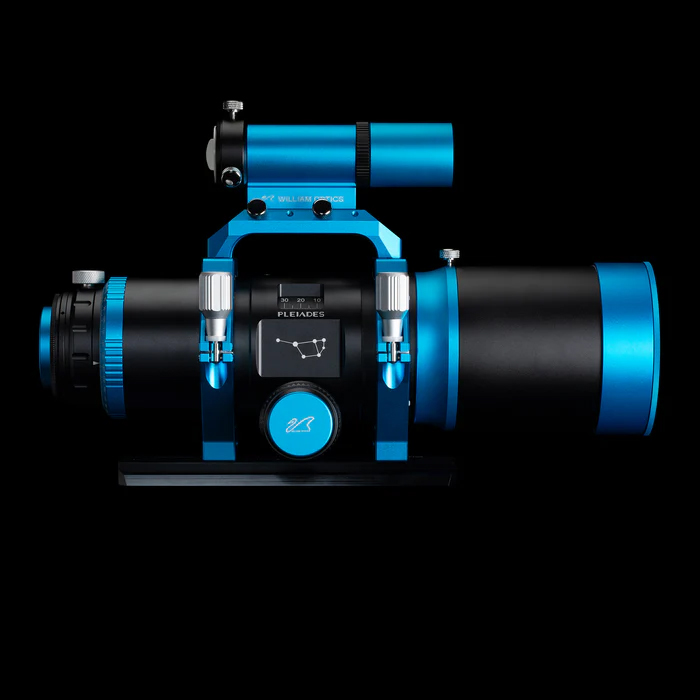
The Pleiades 68 is built for modern sensors. It provides a 48 mm image circle, large enough to fully illuminate full-frame cameras without noticeable vignetting. The integrated optical corrector keeps the field flat and maintains round stars even in the extreme corners.
William Optics achieved this by designing the optics as a single, sealed unit where the corrector elements are part of the main assembly. There’s no need to calculate back-focus distances for separate flatteners or reducers. The telescope’s back-focus is a fixed 55 mm, the standard distance from the last optical surface to most camera sensors when using standard adapters. For imagers, this simplicity is invaluable. It ensures that once spacing is set correctly, the system performs consistently across sessions and camera changes.
This native flat-field capability also helps maintain contrast. Without additional glass in the imaging train, light transmission remains high. The coatings on each element minimize reflections and internal scatter, giving clean, high-contrast data suitable for narrowband or broadband imaging.
Fast optics for the modern imager
With its 260 mm focal length and f/3.8 aperture, the Pleiades 68 is among the fastest refractors in regular production. This speed brings clear benefits. Exposure times can be much shorter than with conventional f/6 or f/7 refractors, yet the telescope still delivers wide, detailed frames.
Fast optics are particularly suited to large emission nebulae: the North America Nebula, Heart and Soul, Rosette, and similar targets that span several degrees of sky. It’s also well-suited for the wide Sagittarius region and dark nebula regions where subtle gradients of dust and gas fill the frame. When paired with a cooled camera or a modern full-frame DSLR, the scope can capture rich data sets in just a few hours under dark skies.
Despite its speed, the Pleiades 68 maintains control over star quality. William Optics’ optical coatings and careful element spacing minimize aberrations common in fast systems. The telescope manages to combine brightness with crisp, well-corrected stars, a balance few instruments achieve easily.

Compact design and field portability
Physically, the Pleiades 68 is compact and robust. The optical tube measures around 346 mm when retracted and 410 mm when extended. It weighs about 3.8 kilograms, making it easy to carry and mount. The body is fully CNC-machined from aluminum and finished in William Optics’ signature blue anodization. The lens cell, focusing unit, and rotator are all precision-engineered to tight tolerances.
The telescope includes a rotating rear cell with a tilt adjustment mechanism. This allows users to square the camera sensor perfectly to the optical axis, a vital step for achieving pinpoint stars across the field. It also makes framing targets simple, letting you rotate the camera without disturbing focus or back-focus spacing.
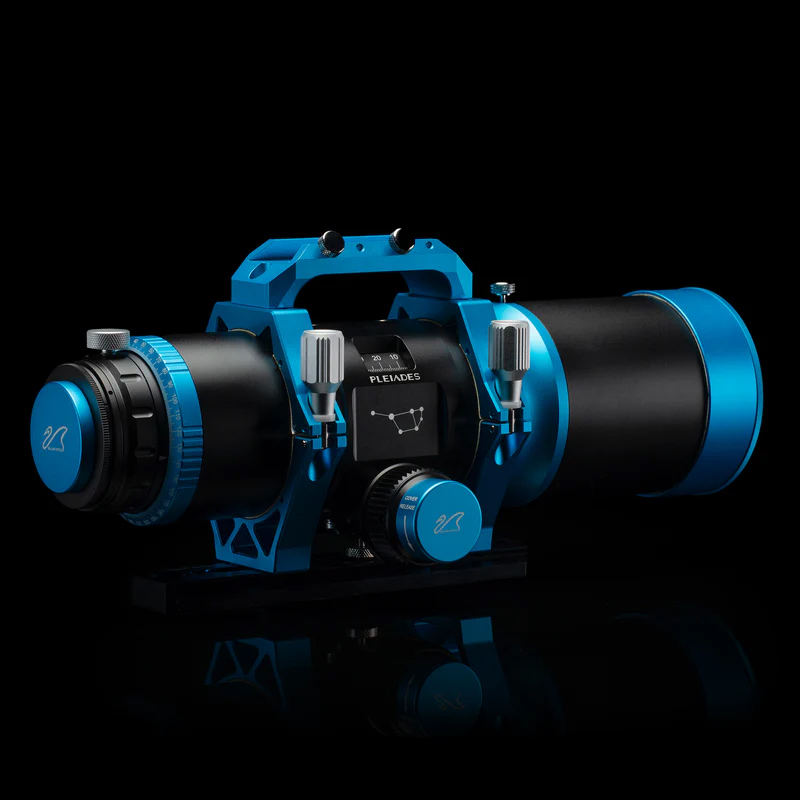
The dual mounting plate fits standard Vixen or Arca-Swiss dovetails, and the package ships with rings, adapters, and a padded carry case. For imagers who travel, the Pleiades 68 fits easily into a standard camera bag or carry-on case, making it ideal for expeditions to dark-sky sites.
Key specifications
Here are some of the key specifications of William Optics Pleiades 68 astrograph:
| Lens Type | 7-Element Astrograph |
| Lens Elements | Super ED Glass x3 |
| Focal Length | 260 mm |
| Diameter | 68 mm |
| Focal Ratio | f/3.8 |
| Image circle | 48 mm |
| Focuser | WIFD R&P Focuser |
| Dovetail Type | Vixen, Arca-Swiss |
| Tube Length | 366 mm – 410 mm |
| OTA Weight | 2.98 kg / 6.57 lbs |
| Total Weight | 3.83 kg / 8.44 lbs |

Price and availability
The William Optics Pleiades 68 astrograph is priced at $1,998 and is available via the official website.
The Pleiades 68 shows where refractor design is heading. As imaging dominates the hobby, manufacturers are rethinking what an optical tube should do. The integration of flatteners, the use of internal focus mechanisms, and the push toward faster focal ratios all reflect that change. The Pleiades 68 stands as one of the clearest examples of that new design language. It’s compact enough for travel, accurate enough for large sensors, and fast enough to make efficient use of precious clear nights.
Clear skies!
See more from DIYPhotography.net on Google
Add DIYPhotography.net as a trusted source. This makes
our stories more likely to appear in your Google Search results.
 Add as a preferred source on Google

Soumyadeep Mukherjee
Soumyadeep Mukherjee is an award-winning astrophotographer from India. He has a doctorate degree in Linguistics. His work extends to the sub-genres of nightscape, deep sky, solar, lunar and optical phenomenon photography. He is also a photography educator and has conducted numerous workshops. His works have appeared in over 40 books & magazines including Astronomy, BBC Sky at Night, Sky & Telescope among others, and in various websites including National Geographic, NASA, Forbes. He was the first Indian to win “Astronomy Photographer of the Year” award in a major category.


Join the Discussion
DIYP Comment Policy
Be nice, be on-topic, no personal information or flames.
One response to “William Optics Pleiades 68: The Next-Generation f/3.8 Astrograph”
In New Zealand Son Recently been to 3 places on Thursday 30 October 2025:
NUMBER 1: Petone PAK’nSAVE, NUMBER 2: Petone The Warehouse and NUMBER 3: Petone Briscoes.
And So DIYPhotography, Canada, Mexico, Central America, Caribbean, South America, Polynesia, Greenland, Europe, United States, Japan, New Zealand, Africa, West Asia, Laos, Myanmar, Vietnam, Thailand, Cambodia, Philippines, Micronesia, Melanesia, Australia, North Korea, South Korea, Central Asia, South Asia, Malaysia, Indonesia, Brunei, East Timor and Everyone, now all go have a best upgraded realest strongest extremely biggest fighting and moreover to get all the money, everything, whatever and many more out from 4 Sextuple Country List: List 1 Singapore/China/Mongolia/Taiwan/Macau/Hong Kong, List 2 Malaysia/Indonesia/Brunei/East Timor/Southeast Asia/Laos, List 3 Myanmar/Vietnam/Thailand/Cambodia/Philippines/Micronesia and List 4 Melanesia/Australia/North Korea/South Korea/Central Asia/South Asia into 1 Quadruple Country List: List 1 New Zealand/United States/Europe/Japan for every time.