



















Where Was the First Photograph Taken? The Story Behind the World’s Oldest Photograph
Aug 17, 2026
Leonard Skapp
Alex Baker is a portrait and lifestyle driven photographer based in Valencia, Spain. She works on a range of projects from commercial to fine art and has had work featured in publications such as The Daily Mail, Conde Nast Traveller and El Mundo, and has exhibited work across Europe
Share:
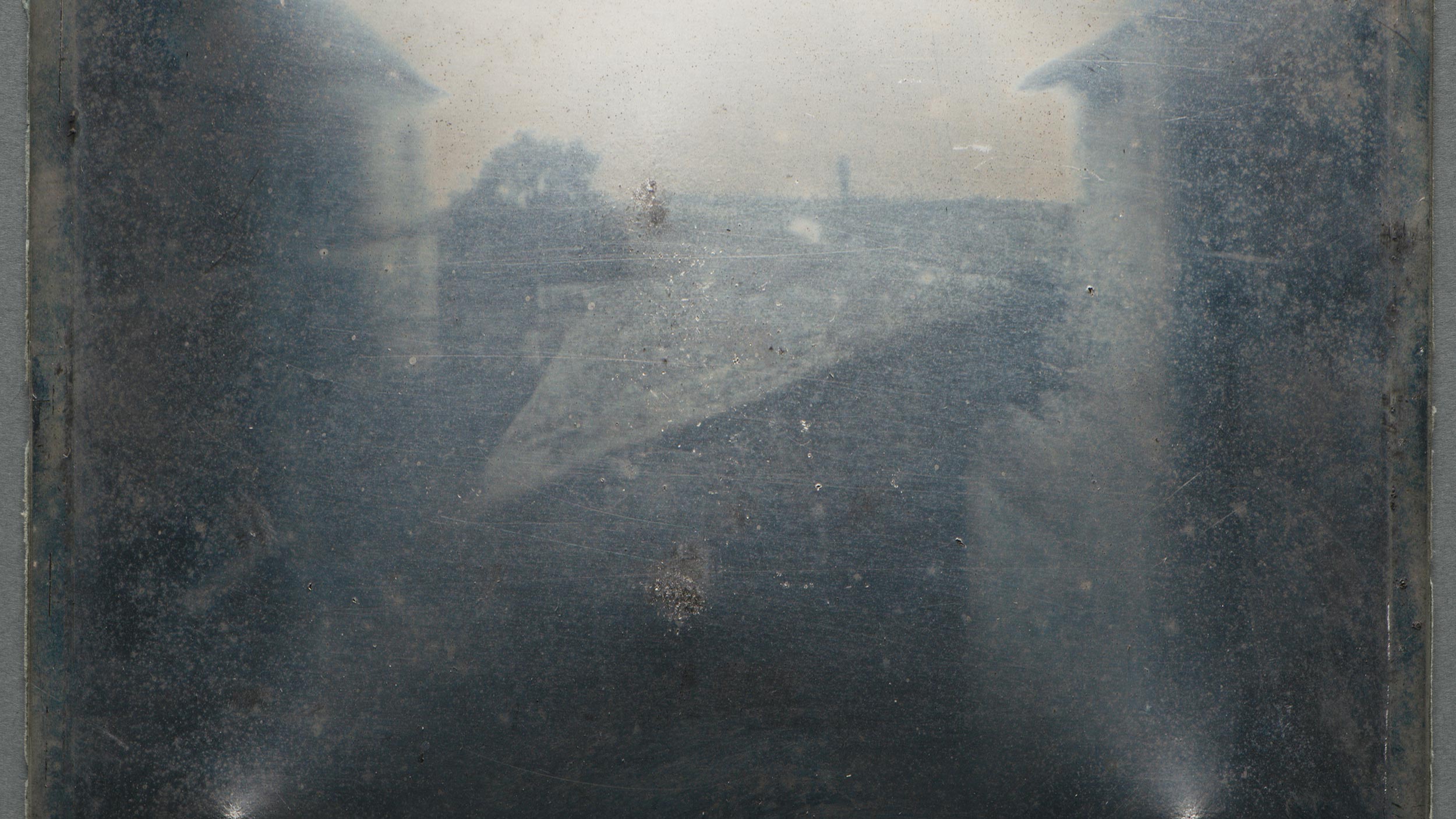
The first photograph was taken in Saint-Loup-de-Varennes, France, from an upstairs window of a country house. And no, it wasn’t a glamorous portrait, a beautiful landscape, or even a particularly interesting picture of a person. It was a photograph of some buildings.
But when you consider that it was made around 1826–1827, it suddenly becomes considerably more exciting. Created by French inventor Joseph Nicéphore Niépce, View from the Window at Le Gras is generally considered the oldest surviving photograph made with a camera.
Where exactly was the first photograph taken?
Niépce took the photograph from a window of his country estate, known as Le Gras, in Saint-Loup-de-Varennes in Burgundy, France.
He pointed his camera obscura out of the upstairs window and captured a view of the estate’s courtyard and surrounding buildings. The scene included a pigeon house, a pear tree, a barn with a sloping roof, and other parts of the property. The house still exists today, although the view obviously isn’t quite what Niépce saw nearly 200 years ago.
Who took the first photograph?
The photograph was made by Joseph Nicéphore Niépce, a French inventor who had been experimenting with ways of permanently recording images produced by light.
Niépce wasn’t starting from scratch. Artists had been using the camera obscura for centuries to project scenes onto a surface, but the projected image disappeared as soon as the light went away. The problem was figuring out how to make the image permanent.
Niépce eventually developed a process he called heliography, using a plate coated with bitumen of Judea, a light-sensitive material.
How did Niépce take the photograph?
The process was somewhat more involved than pointing a camera and pressing a button. Niépce coated a polished pewter plate with bitumen and placed it inside a camera obscura. He then left the lens open for an extraordinarily long time while light slowly hardened the bitumen.
And when we say long, we mean really long. The traditional estimate is around eight hours, although more recent research suggests the exposure may actually have lasted several days. Either way, this wasn’t exactly a case of “hold still for a second.”
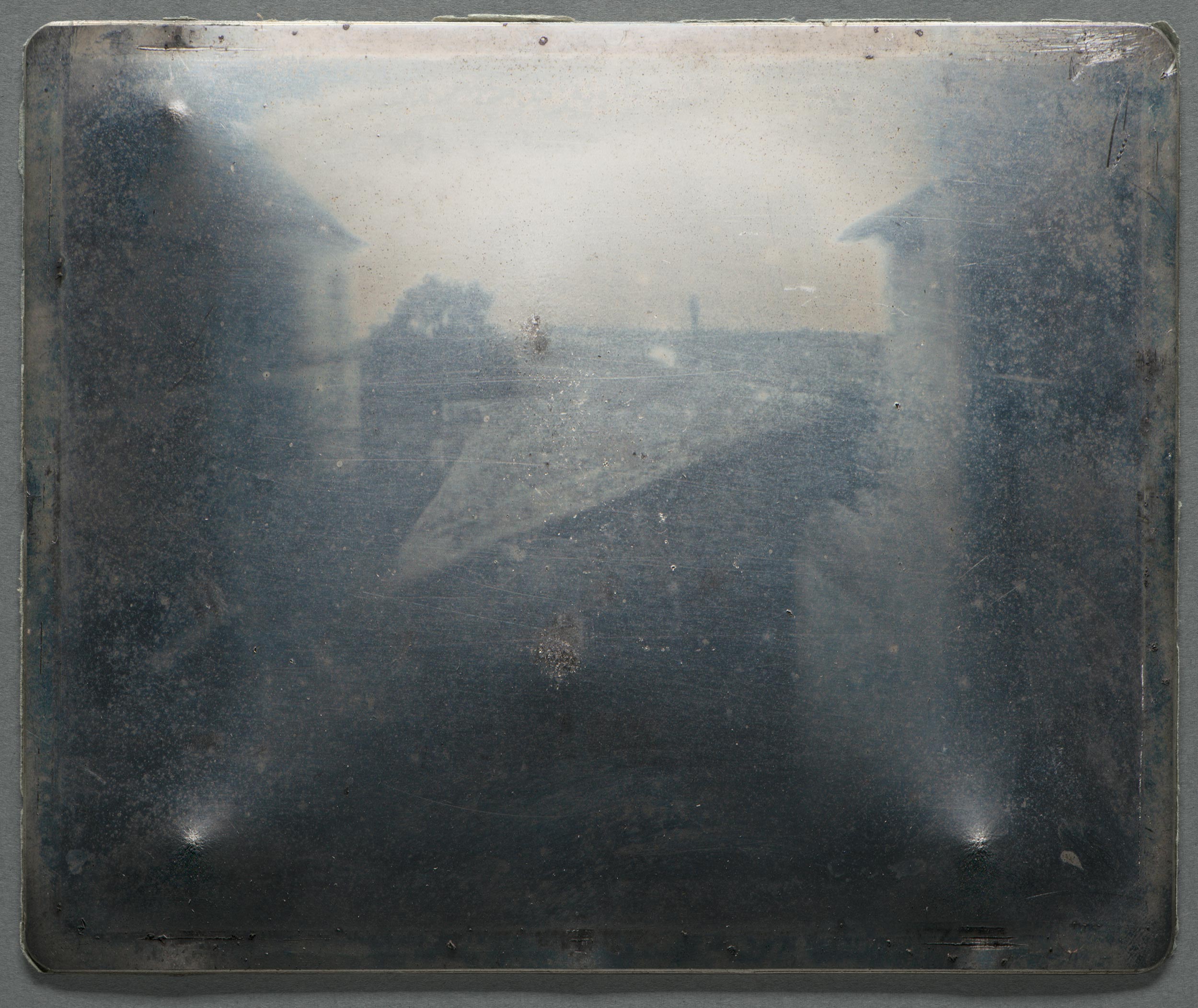
The long exposure also explains why the photograph looks rather strange. Sunlight appears to illuminate parts of the buildings from different directions because the Sun moved across the sky during the exposure. So if you’re ever frustrated by a two-second shutter speed, spare a thought for Niépce.
What does the first photograph look like?
The photograph is fairly difficult to make out compared with modern images. It shows the buildings and courtyard around Niépce’s estate, but the image is dark, faint, and lacking in the kind of detail we’d expect from even a terrible smartphone photograph.
That’s not because Niépce was a bad photographer. His equipment was simply doing something nobody had successfully done before. The original plate is around 20 × 25cm and is now held by the Harry Ransom Center at the University of Texas at Austin.
Was it really the first photograph?
This is where things get slightly complicated. Niépce had produced photographic images before View from the Window at Le Gras, including experiments dating back to the 1810s. However, some of these early images have not survived.
There is also an earlier surviving example of Niépce’s heliographic work from around 1825, but it is a reproduction of an engraving rather than a photograph of a scene captured directly from nature.
That’s why View from the Window at Le Gras is generally described as the oldest surviving camera-made photograph. So technically, asking for “the first photograph ever taken” opens up a surprisingly complicated historical rabbit hole. For most purposes, however, Niépce’s photograph is the answer you’re looking for.
Where is the first photograph now?
Interestingly, the photograph isn’t still sitting in France. The original View from the Window at Le Gras is held at the Harry Ransom Center in Austin, Texas, where it forms part of the centre’s photography collection.
Which means that if you want to see one of the most important objects in photographic history, you’ll need to travel considerably further than Burgundy.
What happened next?
Niépce’s breakthrough didn’t immediately turn photography into the hobby we know today. He continued experimenting and later entered into a partnership with Louis Daguerre. After Niépce died in 1833, Daguerre continued developing the process, eventually producing the daguerreotype.
In 1839, the daguerreotype was publicly announced, marking the beginning of photography’s much more rapid development as a practical medium.
Within a few decades, photographic processes had become dramatically faster and more practical. Glass plates arrived, cameras became more accessible, and eventually roll film helped photography escape the laboratory and become something ordinary people could actually do. And eventually, someone invented Instagram.
Key takeaways
The oldest surviving camera-made photograph was taken by Joseph Nicéphore Niépce around 1826–1827, from a window of his estate at Le Gras in Saint-Loup-de-Varennes, France.
View from the Window at Le Gras was created using a camera obscura and a pewter plate coated with bitumen. The exposure took at least several hours and may have lasted several days.
It might look rather underwhelming to modern eyes, but that slightly fuzzy view of some French rooftops represents one of the biggest technological breakthroughs in the history of photography.
After all, every photograph taken since then owes something to the guy who looked out of a window and thought, “I wonder if I can make this stay there.”
See more from DIYPhotography.net on Google
Add DIYPhotography.net as a trusted source. This makes
our stories more likely to appear in your Google Search results.
 Add as a preferred source on Google

About Leonard Skapp
Leonard “Len” Skapp is a photographer with a particular interest in cameras, lenses, accessories, camera bags, lens filters, tripods, camera straps, and, on rare occasions, photography itself. Equal parts reviewer and enthusiast, he enjoys digging into the technical details behind the latest gear and translating them into plain English for fellow photographers. He maintains that every purchase is a carefully considered investment, although his bank account and overflowing camera cupboard continue to dispute this claim.
We love it when our readers get in touch with us to share their stories. This article was contributed to DIYP by a member of our community. If you would like to contribute an article, please contact us here.

Join the Discussion
DIYP Comment Policy
Be nice, be on-topic, no personal information or flames.