




















Proposed US Law Aims to Simplify Copyright Registration for Photographers and Visual Artists
Dec 22, 2025
Alysa Gavilan
Alysa Gavilan has spent years exploring photography through photojournalism and street scenes. She enjoys working with both film and mirrorless cameras, and her fascination with the craft has grown over the decades. Inspired by Vivian Maier, she is drawn to capturing everyday moments that often go unnoticed.
Share:

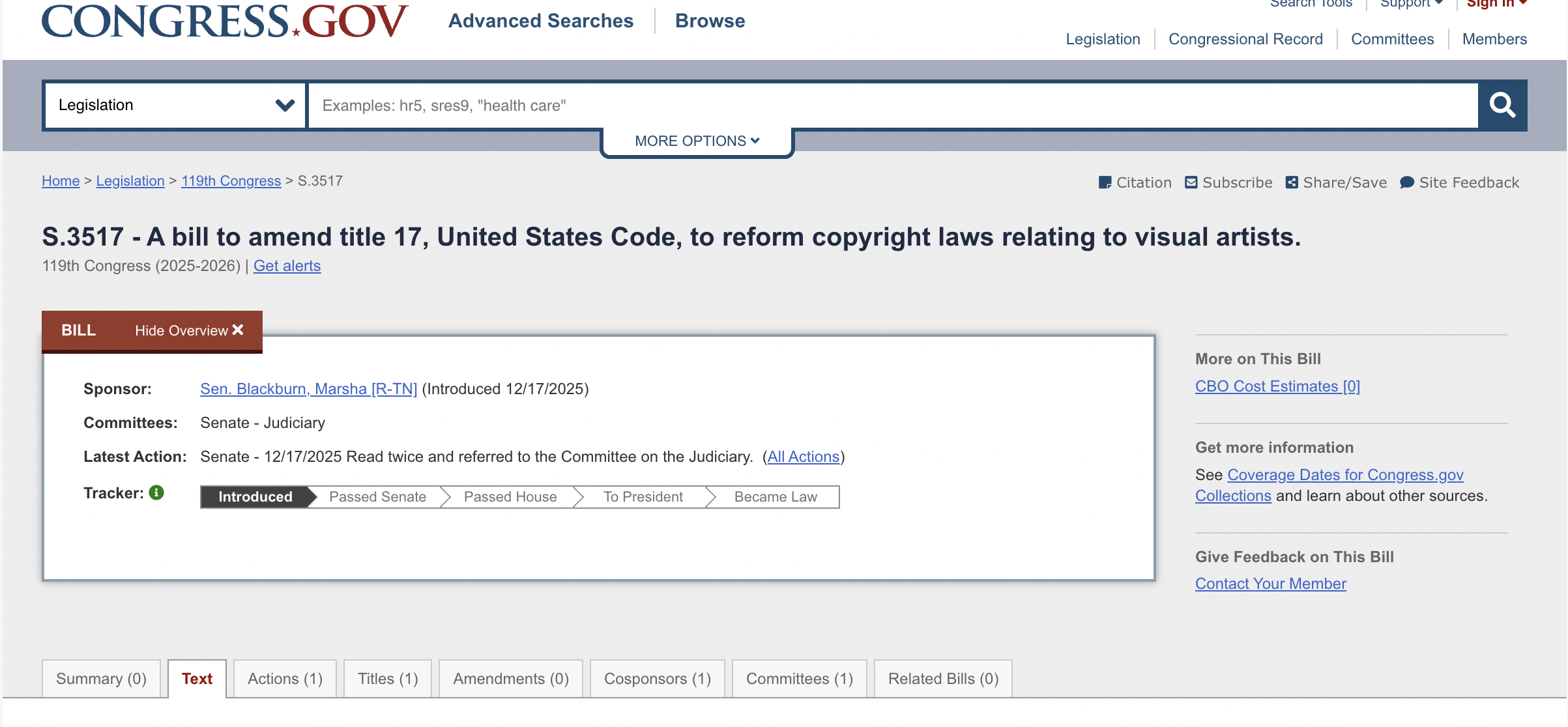
Photographers and visual artists across the United States have long faced obstacles when it comes to registering and protecting their work. Now, a proposed law introduced in Congress could change that.
Senators Peter Welch and Marsha Blackburn introduced the Visual Artists Copyright Reform Act (VACRA) designed to modernize copyright registration, reduce costs, and make it easier for high-volume creators to safeguard their work.
The legislation is being hailed by professional organizations as a significant step forward for photographers, illustrators, and graphic artists who have struggled with the complexities of the current system.
Challenges Facing Photographers, Visual Artists
Under the Copyright Act of 1976, original works are automatically protected as soon as they are fixed in a tangible form. However, these rights cannot be fully enforced unless the work is formally registered with the US Copyright Office. For photographers and other visual creators, the registration process has become increasingly difficult and expensive.
Currently, the Copyright Office allows group registration, but the limits are restrictive. Photographers can register up to 750 images at a time for a fee of $55, while graphic artists and illustrators can submit only 10 unpublished works in a group registration. Published works must be registered separately.
For visual artists producing hundreds or thousands of works per year, the time, cost, and administrative burden make compliance nearly impossible. Many creators simply forgo registration, leaving their work vulnerable.
Key Provisions of VACRA
VACRA aims to address these issues through a series of targeted reforms.
One of the most notable provisions increases the maximum number of photographs in a single group registration from 750 to 3,000, with the possibility of expanding further as technology improves. This allows photographers to register large batches of images in one filing, reducing both time and expense.
The bill also introduces a deferred registration option, allowing creators to submit applications at a lower cost and postpone examination until the copyright owner requests it. Under this system, registration becomes effective on the day the deferred application is submitted, meaning creators can enforce their copyright in court even if the Office has not yet reviewed the work.
Another important measure is the creation of subscription-based registrations for pictorial, graphic, and sculptural works. This “all-you-can-register” approach would enable visual artists to submit new work on an ongoing basis, aligning registration with contemporary creative workflows.
VACRA also authorizes third-party registries certified by the Copyright Office. Photographers and visual artists could deposit works in these private registries, satisfying copyright deposit requirements until the Office develops its own secure, searchable electronic registry. This provision is designed to streamli
ne the process while providing the public with useful information about copyrighted works.
Support from the Creative Community
VACRA has garnered support from several major organizations representing visual artists. The American Society of Media Photographers and the Professional Photographers of America have both endorsed the bill, emphasizing its potential to reduce barriers and protect creators’ intellectual property.
The National Press Photographers Association also praised the legislation, noting that it modernizes copyright registration and strengthens the public copyright record while lowering costs.
ASMP Chief Executive Thomas Maddrey described VACRA as the biggest move in recent history that seeks to modernize and simplify the copyright process for visual creators.
“VACRA breaks down the barriers that prevent so many creators and photographers across the country from being able to protect the fruits of their life’s work and passion,” he said.
What’s Next?
If enacted, VACRA could have a significant impact on photographers who produce high volumes of work. By allowing bulk registration of images, deferred examination, subscription-based submissions, and third-party registries, the bill reduces administrative burden and cost, making it feasible for more photographers to register and enforce their rights.
For visual artists, this legislation may also encourage more creators to participate fully in the copyright system, ensuring that their work is legally protected and publicly documented. In practical terms, VACRA could help photographers safeguard images used commercially or online, giving them more control over how their work is shared and monetized.
VACRA reflects a growing recognition in Congress that copyright law must evolve to accommodate modern creative practices. Senators Welch and Blackburn have framed the bill as a bipartisan effort to empower artists and streamline the registration process, ensuring that creators can protect their work without excessive bureaucracy or cost.
The bill also complements previous legislative efforts by the senators, including the TRAIN Act, which addresses copyright concerns related to generative AI.
See more from DIYPhotography.net on Google
Add DIYPhotography.net as a trusted source. This makes
our stories more likely to appear in your Google Search results.
 Add as a preferred source on Google

Alysa Gavilan
Alysa Gavilan has spent years exploring photography through photojournalism and street scenes. She enjoys working with both film and mirrorless cameras, and her fascination with the craft has grown over the decades. Inspired by Vivian Maier, she is drawn to capturing everyday moments that often go unnoticed.



Join the Discussion
DIYP Comment Policy
Be nice, be on-topic, no personal information or flames.