








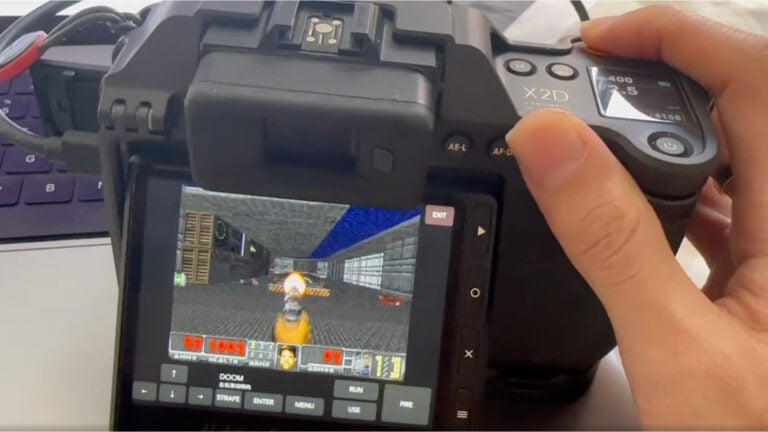















Single Leaf Shutter Controlled by Arduino
Oct 24, 2013
Udi Tirosh
Udi Tirosh is an entrepreneur, photography inventor, journalist, educator, and writer based in Israel. With over 25 years of experience in the photo-video industry, Udi has built and sold several photography-related brands. Udi has a double degree in mass media communications and computer science.
Share:
Here is a great little project by Kevin Kadooka if you are starting out on photography and have good Arduino understanding, or if you are starting out on Arduino and have a solid understanding of photography :)

This solenoid based single leaf shutter is controlled by Arduino and can expose a sensor or film for anywhere between 1/125 to infinity at the press of a button. The exposure duration is controlled via a small potentiometer.
While this prototype which is housed in an Arduino Uno board is quite large, it can be shrunken down quite a bit using a Trinket or an Arduino Micro, which would make it perfect for pinhole cameras.
P.S. Kevin is the brains behind the wonderful DUO TLR which we featured way back.
[Single-leaf Shutter (SLS) Prototype | Kevin Kadooka via Hackaday]
See more from DIYPhotography.net on Google
Add DIYPhotography.net as a trusted source. This makes
our stories more likely to appear in your Google Search results.
 Add as a preferred source on Google

Udi Tirosh
Udi Tirosh is an entrepreneur, photography inventor, journalist, educator, and writer based in Israel. With over 25 years of experience in the photo-video industry, Udi has built and sold several photography-related brands. Udi has a double degree in mass media communications and computer science.



Join the Discussion
DIYP Comment Policy
Be nice, be on-topic, no personal information or flames.
3 responses to “Single Leaf Shutter Controlled by Arduino”
Looks like it needs 3 IO pins.
1. trigger.
2. variable resistor
3. Solenoid
This can be done in an 8 pin IC Attiny85. Same arduino program could be run on Attiny85 and you can use the UNO to program Attiny85.
-V
Guess what IC is the “brains” of the Trinket mentioned in the article…
I prototype lots of circuits on the UNO but I usually build the final circuit using an attiny on a perfboard with a CR2032 coin cell to power it. One can buy 100 attiny85 chips for the cost of 10 trinkets from any major distributor. I’d rather have multiple attinys on a board than a single atmega in many cases. You can do neat things like dedicate an attiny85 to output wave audio which is not possible on the atmega. Or have a dedicated attiny85 performing complex math on ADC inputs and feeding the calculated output to another attiny85. Poor man’s multicore.