
















Photographer Sues Copyright Office After His AI-Blended Van Gogh Photo Gets Rejected
May 26, 2026
Dunja Đuđić Kalinin
Dunja Djudjic is a multi-talented artist based in Novi Sad, Serbia. With 15 years of experience as a photographer, she specializes in capturing the beauty of nature, travel, concerts, and fine art. In addition to her photography, Dunja also expresses her creativity through writing, embroidery, and jewelry making.
Share:
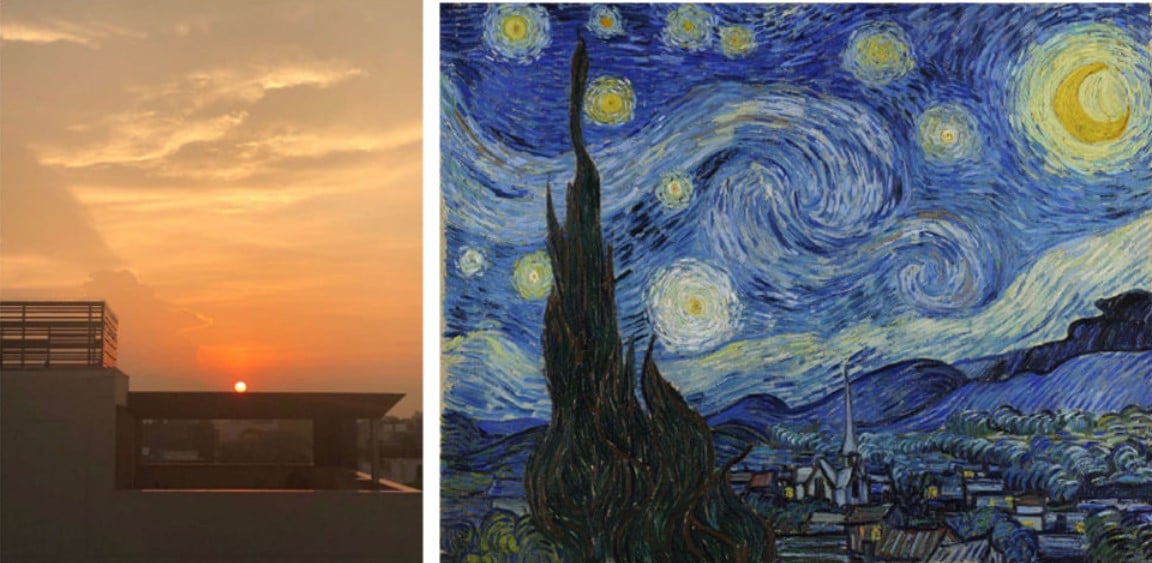
Ankit Sahni is taking the U.S. Copyright Office to court. He blended his own photo with Van Gogh’s The Starry Night using AI, and wanted legal protection for the result. The Copyright Office rejected him – and now he’s filing a lawsuit against them.
The Copyright Office rejected Sahni’s registration bid for the image titled Suryast back in December 2023. Now, via his company Suryast U.S. Enterprises LLC, he’s filed a lawsuit in the Central District of California challenging that decision.
What is Suryast?
As I mentioned, Sahni took a sunset photo himself and “enhanced” it with AI. He reportedly used an app called RAGHAV to process it in the style of Van Gogh’s The Starry Night. The result is a hybrid: part original photo, part iconic painting. And part AI-generated, apparently.
The Copyright Office wasn’t convinced it qualified for protection. It found there was “not enough human involvement for the artist to claim copyright,” determining that too much of the final image was the work of the RAGHAV app rather than Sahni himself.
In his complaint, filed earlier this month, Sahni argues he provided “the baseline creative elements” that copyright law is meant to protect.
The complaint reads:
“ […]the human author exercised his creative control to make the Work: 1) feature a sunset, 2) feature clouds, 3) feature contours of a building; 4) frame the composition such that the sky accounts for the upper two thirds of the work; and 5) appear in a precise and deliberate style of Van Gogh’s Starry Night. Such addition of colors, shapes, and style are traditional elements of authorship that the Office has recognized as copyrightable.”
The complaint also claims that Suryast is not a derivative work.
“However, not all works that are recast, transformed, or adapted from another work are derivative works. Indeed, courts require that a younger work be substantially similar to the original work to be considered a derivative. […] In cases where the younger work represents a substantial transformation of the preexisting work, it cannot be considered derivative.”
Murky Waters of AI and Copyright
The Sahni case isn’t the only one that shows how unclear copyright protection still is in the AI realm. The U.S. Copyright Office has stated outright that AI-generated images are not eligible for copyright protection. However, it has since walked that back slightly, saying that it would protect some AI-generated art under certain conditions. The catch, unsurprisingly, is human authorship. The more creative control a human can demonstrate, the better the chances of protection.
Then there’s Dr. Stephen Thaler, who tried to push things in a very different direction by arguing a machine should be named the author of an AI image. That argument didn’t get far. The Supreme Court declined to hear his case earlier this year, leaving lower court rulings (those requiring human authorship firmly in place.
And in what might be the most surprising development so far, at least one AI-generated image did win copyright protection in what was called a historic ruling. However, it remains an exception rather than a rule. At least for now.
What do you think about Sahni’s case? Did he do enough creative work to deserve copyright protection? Let us know in the comments.
[via PetaPixel; Image via court documents]
See more from DIYPhotography.net on Google
Add DIYPhotography.net as a trusted source. This makes
our stories more likely to appear in your Google Search results.
 Add as a preferred source on Google

Dunja Đuđić Kalinin
Dunja Djudjic is a multi-talented artist based in Novi Sad, Serbia. With 15 years of experience as a photographer, she specializes in capturing the beauty of nature, travel, concerts, and fine art. In addition to her photography, Dunja also expresses her creativity through writing, embroidery, and jewelry making.
Related Posts
 Artist sues U.S. Copyright Office for not protecting copyright of his AI-generated image
 US Copyright Office: Photos Taken by Animals Have No Copyright. Nor Do Photos Taken by God.
 This 570-Megapixel DECam Image Reminds Us of Van Gogh’s “Starry Night”
 Stars of Night – Recreating Van Gogh’s masterpiece with collaborative light painting
Join the Discussion
DIYP Comment Policy
Be nice, be on-topic, no personal information or flames.