





















Five optical wonders you can photograph from your backyard
Dec 4, 2024
Soumyadeep Mukherjee
Soumyadeep Mukherjee is an award-winning astrophotographer from India. He has a doctorate degree in Linguistics. His work extends to the sub-genres of nightscape, deep sky, solar, lunar and optical phenomenon photography. He is also a photography educator and has conducted numerous workshops. His works have appeared in over 40 books & magazines including Astronomy, BBC Sky at Night, Sky & Telescope among others, and in various websites including National Geographic, NASA, Forbes. He was the first Indian to win “Astronomy Photographer of the Year” award in a major category.
Share:
Once in a while, when you look up at the sky, you may have come across some colourful phenomena. And you may have wondered what it could be! Well, it is highly likely to be an optical phenomenon. They are enchanting. Unlike nightscape or deep sky photography, these can be captured from anywhere in the world, and many of these are not affected by light pollution. However, these are not regular (some of them are pretty rare) and you won’t be able to predict them. But the good thing is that some can be captured even with a smartphone. Let’s look at five optical phenomena you can capture from your backyard (or terrace).
Table of contents
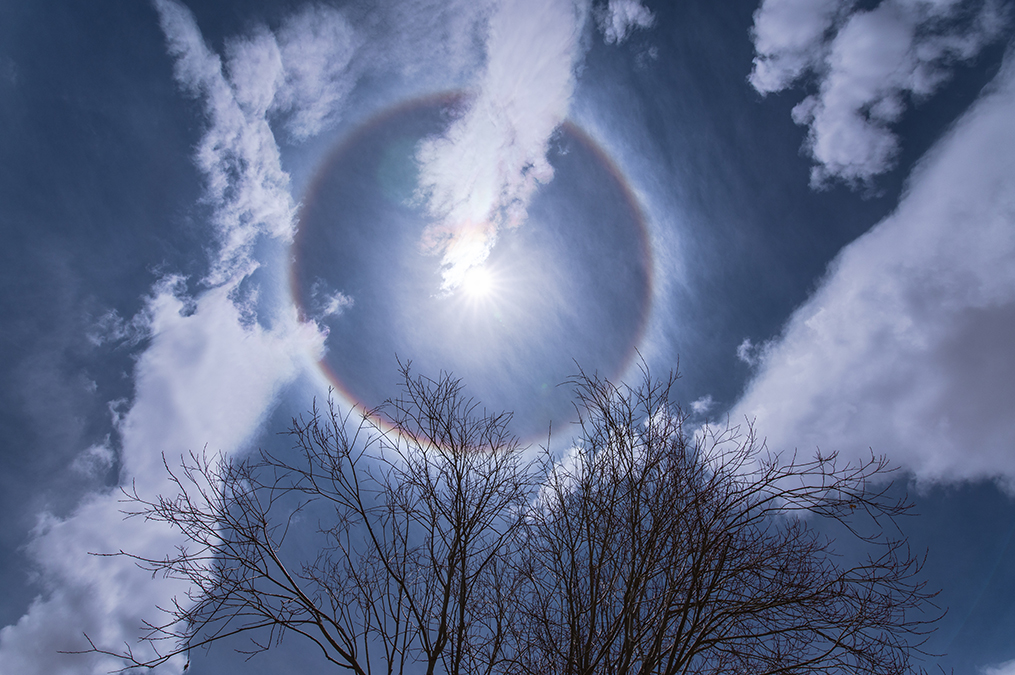
Solar/Lunar halo
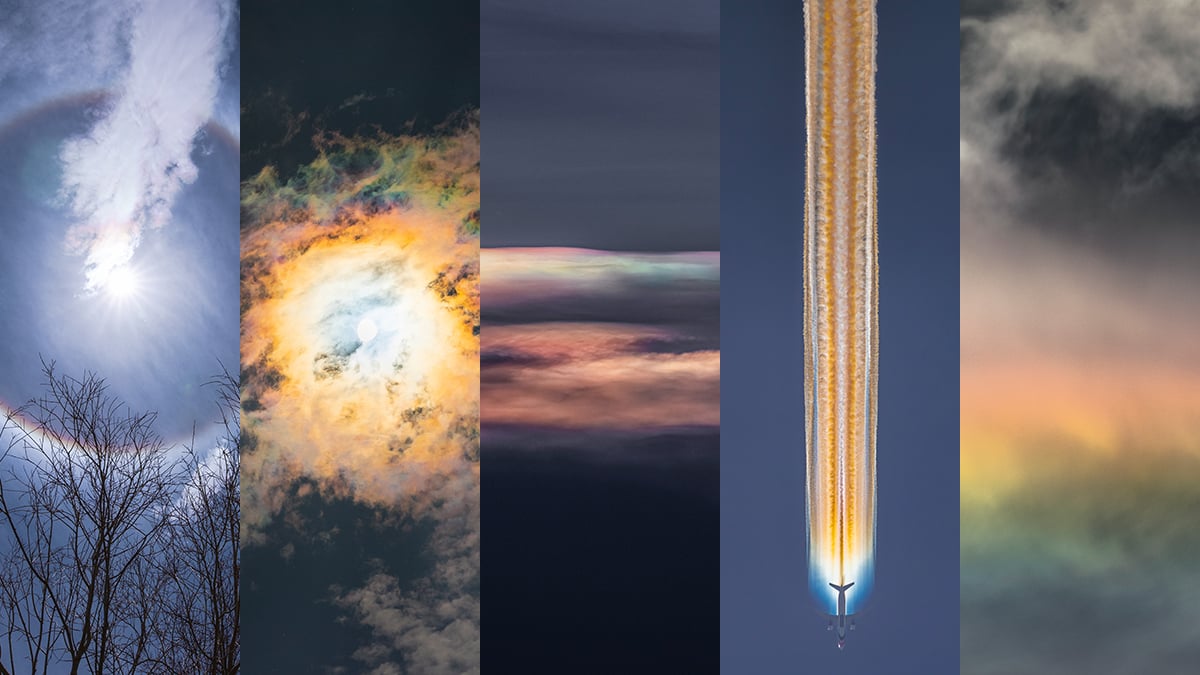
A 22-degree solar halo is a breathtaking optical phenomenon that occurs when sunlight passes through ice crystals in the atmosphere, typically at high altitudes. As sunlight enters the ice crystals, it is refracted, or bent, due to the difference in speed between light travelling through air and ice. This refraction causes the light to split into its colours, a process known as dispersion. The dispersed light is then internally reflected off the inside of the ice crystal, creating a ring-like shape. Finally, the light exits the ice crystal and forms a bright, colourful ring around the sun, with a radius of approximately 22 degrees from the sun’s centre. This stunning display is relatively rare, requiring precise conditions, including ice crystals in the atmosphere and sunlight shining through them at a specific angle.
When the same phenomenon is created with moonlight, it is known as a lunar halo. While solar halos can appear on any day of the month or year, lunar halos appear when the moon is very bright, usually around the full moon. Lunar halos are fainter than their solar counterparts. Both phenomena can be photographed with a wide-field lens or even a smartphone. Learn more about photographing solar/lunar halos.
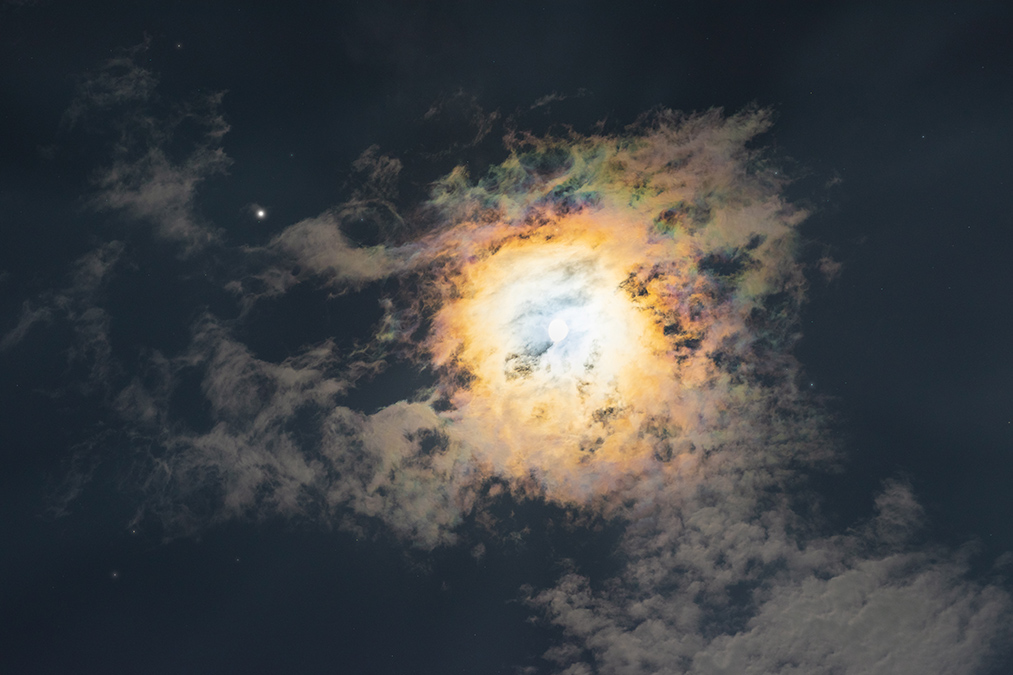
Lunar corona
A lunar corona is an optical phenomenon that appears as a glowing halo around the moon, typically visible when the moon is full and is shining brightly through a layer of water droplets in the Earth’s upper atmosphere. As the moon’s light passes through this layer, it is diffracted or bent and split into its individual colours, creating a glowing halo that can appear in a range of colours, from white to pastel shades. The lunar corona can also exhibit a delicate, lacy texture with intricate patterns and shapes, making it a truly spectacular sight to behold.
The best conditions come when the moon is hidden behind newly developed, mid-level clouds like altostratus. Newly formed clouds contain the same-sized droplets, but as the cloud grows, the droplets change, resulting in irregularly shaped rings and more dispersed hues in the corona.
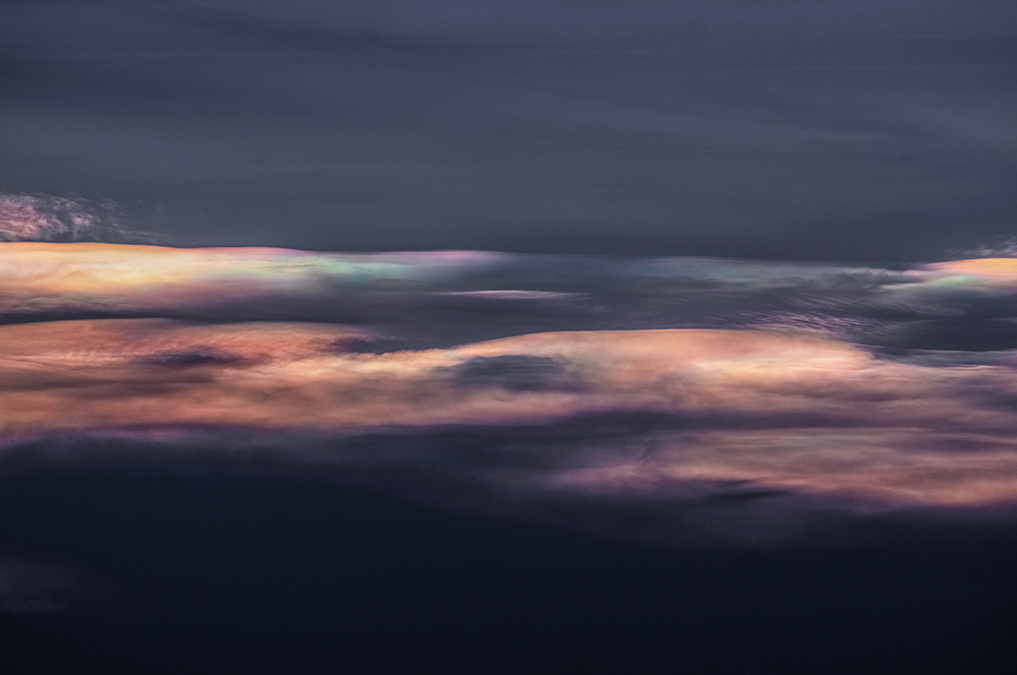
Iridescent cloud
Iridescence in clouds occurs when thin cloud portions contain droplets of uniform size. These drops induce diffraction, making the clouds glitter with colours suggestive of a corona. Essentially, the colours we perceive are bits of a corona. The name “iridescence” or “irisation” comes from Iris, the Greek personification of the rainbow, and describes this phenomenon’s captivating and colourful character. These clouds are formed by smaller ice crystals or water droplets in the air, typically between 0.05 and 1 millimetre in diameter. Larger ice crystals form lunar or solar halos. In contrast, microscopic ice crystals or water droplets allow light to be diffracted and spread out, resulting in a rainbow-like appearance in the clouds.
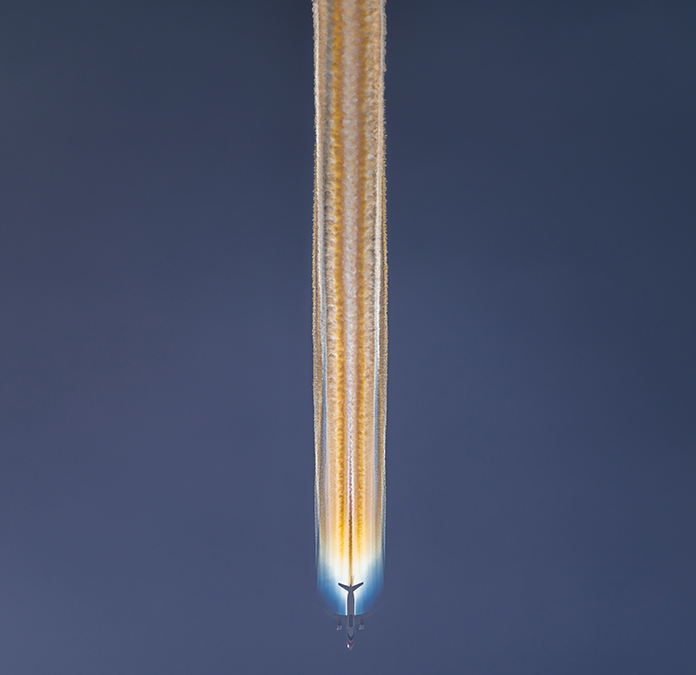
Iridescent contrail
Iridescent contrails are a mesmerising atmospheric phenomenon that occurs when sunlight interacts with the water droplets or ice crystals present in the exhaust plume of an aeroplane engine, typically at high altitudes. As the aeroplane engine burns fuel, it releases water vapour and soot particles into the air, mixing with the cold ambient air and condensing into small, uniform water droplets or ice crystals. These droplets or crystals are typically between 0.05 and 1 millimetre in diameter and are uniformly dispersed throughout the contrail. When sunlight passes through these droplets or crystals at a precise angle, typically between 40° and 42°, it is refracted and separated into its colours, producing a range of pastel colours, typically shades of pink, blue, and green. The resulting iridescent colours appear to shift and change as the observer moves or the angle of the sunlight changes, creating a breathtaking and dynamic display of colour in the contrail. The iridescence can also be influenced by the size and shape of the water droplets or ice crystals, as well as the presence of other atmospheric particles, making each iridescent contrail a unique and fleeting work of art.
Circumhorizontal arc
A circumhorizontal arc (formerly called the lower circumzenithal arc) is a near-horizon arc that runs parallel to the horizon. A circumhorizontal arc is equally vibrant and dazzling as a circumzenithal arc. Due to its vibrant nature, it is also called the “Fire Rainbow”. The circumhorizontal arc arises when the light source’s height exceeds 58°. When the Sun reaches a height of around 68°, the circumhorizontal arc achieves its peak intensity. The circumhorizontal arc cannot be observed in nations north or south of 55° latitude since the Sun is always lower than 58°. As a result, this is one of the few halos that cannot be seen from every location on Earth.
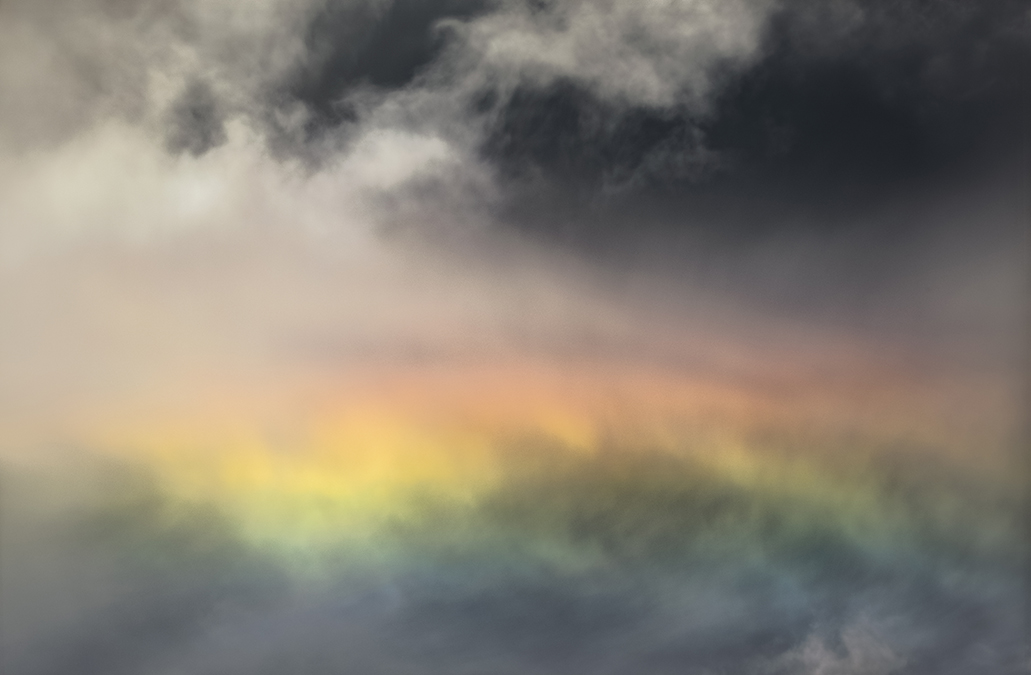
All the optical phenomena listed here appear large in the sky, except for the iridescent contrail. You will require a mid-telephoto or telephoto lens to capture at least 200 mm or above the colourful contrails. Since none of these optical phenomena can be predicted, the key is to keep looking up.
Clear skies!
See more from DIYPhotography.net on Google
Add DIYPhotography.net as a trusted source. This makes
our stories more likely to appear in your Google Search results.
 Add as a preferred source on Google

Soumyadeep Mukherjee
Soumyadeep Mukherjee is an award-winning astrophotographer from India. He has a doctorate degree in Linguistics. His work extends to the sub-genres of nightscape, deep sky, solar, lunar and optical phenomenon photography. He is also a photography educator and has conducted numerous workshops. His works have appeared in over 40 books & magazines including Astronomy, BBC Sky at Night, Sky & Telescope among others, and in various websites including National Geographic, NASA, Forbes. He was the first Indian to win “Astronomy Photographer of the Year” award in a major category.
Related Posts
 Huawei P30 Pro boasts four cameras, 5x optical zoom and optical image stabilization
 How to photograph wild backyard birds using flash on pre-built sets
 This solar system photo was composited from photos shot from a photographer’s backyard
 Photographer shoots breathtaking image of comet Leonard from his backyard
Join the Discussion
DIYP Comment Policy
Be nice, be on-topic, no personal information or flames.
2 responses to “Five optical wonders you can photograph from your backyard”
This is such a beautiful article, and beautiful photos (as always). Thank you for reminding us that we don’t have to travel far far away to see and capture some of the wonders of our world :)
This is such a fascinating guide for sky enthusiasts! Optical phenomena like halos, iridescent clouds, and fire rainbows are such magical sights—and the best part is, you can catch them right from your backyard. It’s amazing how even a smartphone can capture some of these wonders if you’re lucky. Definitely a reminder to look up more often and keep a camera handy! 🌈📸