






















Exploring the Cosmos from Home: Celestron Origin Intelligent Home Observatory
May 30, 2025
Soumyadeep Mukherjee
Soumyadeep Mukherjee is an award-winning astrophotographer from India. He has a doctorate degree in Linguistics. His work extends to the sub-genres of nightscape, deep sky, solar, lunar and optical phenomenon photography. He is also a photography educator and has conducted numerous workshops. His works have appeared in over 40 books & magazines including Astronomy, BBC Sky at Night, Sky & Telescope among others, and in various websites including National Geographic, NASA, Forbes. He was the first Indian to win “Astronomy Photographer of the Year” award in a major category.
Share:

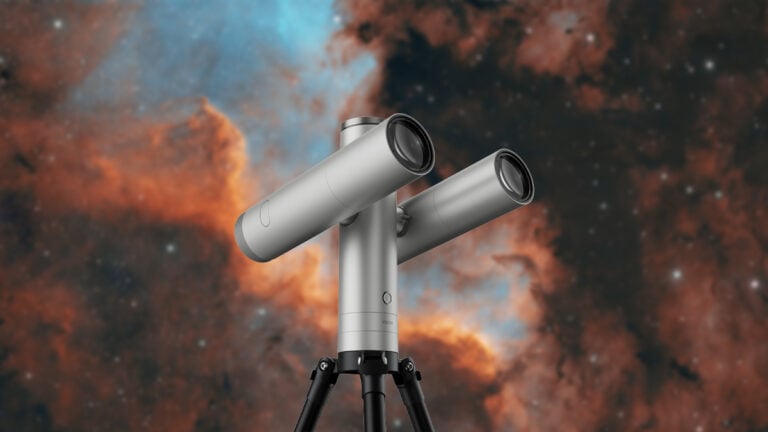
The Celestron Origin Intelligent Home Observatory is a revolutionary telescope that brings the wonders of the universe to your backyard. Designed for both beginners and seasoned astronomers, it combines advanced optics with user-friendly technology to make stargazing accessible and enjoyable.
Design and build
The Origin features a classic telescope design with modern enhancements. Its 6-inch (152mm) aperture Rowe-Ackermann Schmidt Astrograph (RASA) optical tube offers a fast f/2.2 focal ratio, ideal for capturing detailed images of deep-sky objects. The telescope is mounted on a computerized GoTo alt-azimuth mount, which autonomously aligns and tracks celestial objects.

Astrophotography capabilities
At the heart of the Origin is the Sony IMX178 color CMOS sensor, featuring STARVIS back-illuminated technology for high sensitivity and low noise. With a resolution of 6.4 megapixels and a field of view of 1.27° x 0.85°, it delivers sharp, vibrant images of galaxies, nebulae, and more.
The telescope’s AI-powered image stacking technology captures multiple exposures and combines them in real-time, producing detailed and colorful images without user intervention. Advanced users can download raw image files via USB-A ports for further processing.

Automation and ease of use
The Origin is equipped with Celestron’s patented StarSense technology, which scans the sky and autonomously focuses and aligns the telescope in less than two minutes. The companion Origin app, developed in partnership with Simulation Curriculum, offers a planetarium-style interface for easy navigation and control.

Additional features
- Dew Prevention: An automated heating element integrated into the front lens prevents dew formation, ensuring clear observations.
- Cooling System: Dual fans cool the optics and electronics, maintaining optimal performance during extended sessions.
- Battery Life: The built-in 97.9 Wh LiFePO4 battery provides up to 6 hours of operation, allowing for uninterrupted stargazing.
Educational and sharing capabilities
The Origin app includes educational audio presentations on selected celestial objects, enhancing the learning experience. Users can also cast live views to smart TVs or share images instantly, making it perfect for group observations.

Key specifications
Here are the key specifications of the Celestron Origin:
Optics
- Optical Design: Rowe-Ackermann Schmidt Astrograph (RASA)
- Aperture: 152mm (5.98″)
- Focal Length: 335mm (13.18″)
- Focal Ratio: f/2.2
- Optical Coatings: StarBright XLT coatings throughout
- Central Obstruction Diameter: 63mm (2.48″) (41% of aperture diameter)
- Light Gathering Power: 474x (compared to the human eye)
- Image Resolution: 1.48 arcsec/pixel
- Dovetail: CG-5 Dovetail Bar
- Filter Drawer: Integrated, accepts 1.25″ or 2″ astroimaging filters
Imaging sensor
- Sensor Type: Sony IMX178LQJ, color, back-illuminated CMOS
- Sensor Size: 8.92mm (0.35″) diagonal
- Pixel Size: 2.4μm x 2.4μm
- Effective Pixels: 6.44 Megapixels (3096 x 2080)
- Field of View: 1.27° x 0.85°

Integrated electronics
- Onboard Computer: Raspberry Pi 4 Model B
- Mount: Computerized GoTo altazimuth mount
- Dew Prevention: Fully automated heating element integrated into front lens; removable dew shield/lens shade
- Focus Motor: Autofocus or manual control
- Cooling Fans: One fan for optics, one fan for electronics; both pull air through vents with wire mesh
- LED Status Ring: Indicates status “at-a-glance”
Power
- Battery: Integrated LiFePO4, 97.9 Wh, capable of 6+ hours of use
- Power Input: 12V DC adapter for charging internal battery or running on external AC power
User interface
- Control App: Celestron Origin App
- Compatibility: iOS 16 or higher, Android 12 or higher
Dimensions
- Optical Tube: 609.6mm x 177.8mm (24″ x 7″) diameter
- Mount: 457.2mm x 304.8mm x 254mm (18″ x 12″ x 10″)
- Tripod (Collapsed): 330.2mm x 304.8mm x 812.8mm (13″ x 12″ x 32″)
- Assembled System: 609.6mm L x 660.4mm W x 1219.2mm H (24″ L x 26″ W x 48″ H)
Weight
- Optical Tube: 10.6 lb (4.8 kg)
- Mount: 17 lb (7.7 kg)
- Tripod: 14 lb (6.35 kg)
- Total System: 41.6 lb (18.87 kg)

Final thoughts
The Celestron Origin Intelligent Home Observatory stands at the forefront of amateur astronomy, blending powerful optics with intelligent automation. Its user-friendly design and advanced features make it an excellent choice for anyone looking to explore the cosmos from the comfort of their home.
Clear skies!
See more from DIYPhotography.net on Google
Add DIYPhotography.net as a trusted source. This makes
our stories more likely to appear in your Google Search results.
 Add as a preferred source on Google

Soumyadeep Mukherjee
Soumyadeep Mukherjee is an award-winning astrophotographer from India. He has a doctorate degree in Linguistics. His work extends to the sub-genres of nightscape, deep sky, solar, lunar and optical phenomenon photography. He is also a photography educator and has conducted numerous workshops. His works have appeared in over 40 books & magazines including Astronomy, BBC Sky at Night, Sky & Telescope among others, and in various websites including National Geographic, NASA, Forbes. He was the first Indian to win “Astronomy Photographer of the Year” award in a major category.


Join the Discussion
DIYP Comment Policy
Be nice, be on-topic, no personal information or flames.
2 responses to “Exploring the Cosmos from Home: Celestron Origin Intelligent Home Observatory”
Celestron guys decided to make a competition with european Interstellar astrophoto solvings :) well. It sounds interesting.
yes it’s a great scope, but not mentioning even once the main issue – the enormous price: $4,000 – is a bit of a joke…. especially when it doesn’t even have a mosaic mode (FoV very narrow) or takes the same sensor as the Vaonis Stellina (IMX 178) that was released years ago. There is definitely as good and cheaper on the market right now with the scopes available at Vaonis or even Seestar (not as good but much cheaper). I’d definitely recommend a Vaonis Vespera 2 (here some of my images: https://www.astronotrip.fr/2024/06/observations-de-nebuleuses-et-galaxies.html) over this over priced scope. If you find a 2nd hand Origin at $2500-3000 yes.