













Sir Brian May Turns ESA’s Asteroid Images into Stunning 3D Views
Nov 19, 2026
Soumyadeep Mukherjee
Soumyadeep Mukherjee is an award-winning astrophotographer from India. He has a doctorate degree in Linguistics. His work extends to the sub-genres of nightscape, deep sky, solar, lunar and optical phenomenon photography. He is also a photography educator and has conducted numerous workshops. His works have appeared in over 40 books & magazines including Astronomy, BBC Sky at Night, Sky & Telescope among others, and in various websites including National Geographic, NASA, Forbes. He was the first Indian to win “Astronomy Photographer of the Year” award in a major category.
Share:
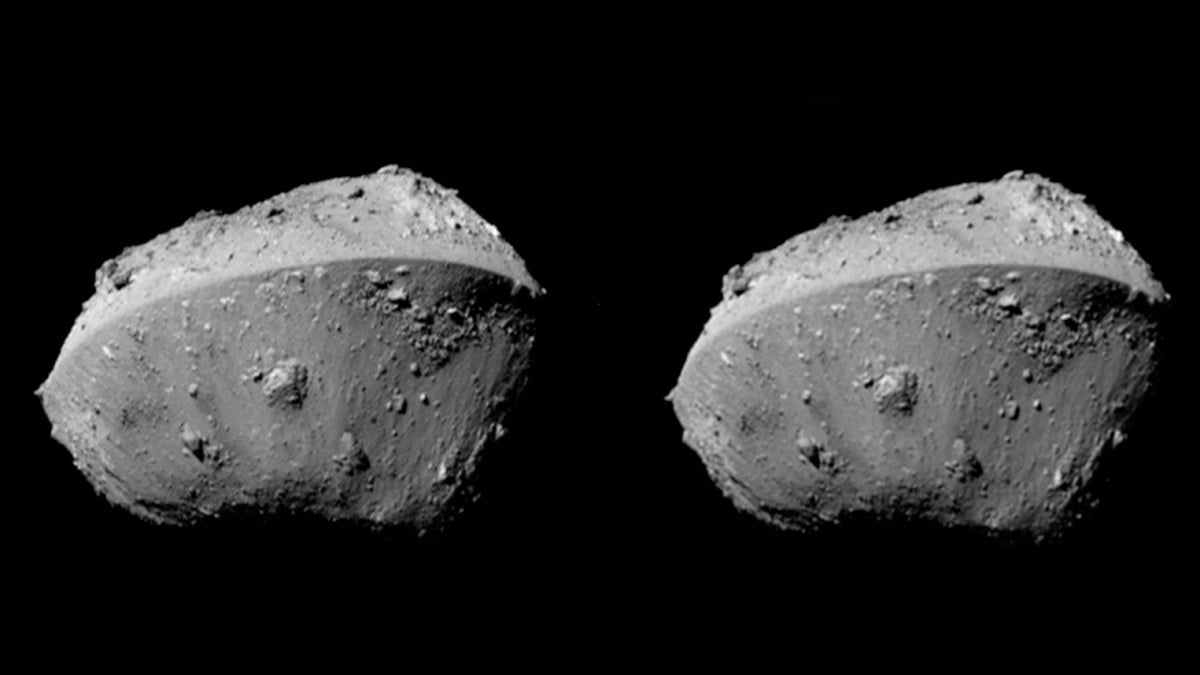
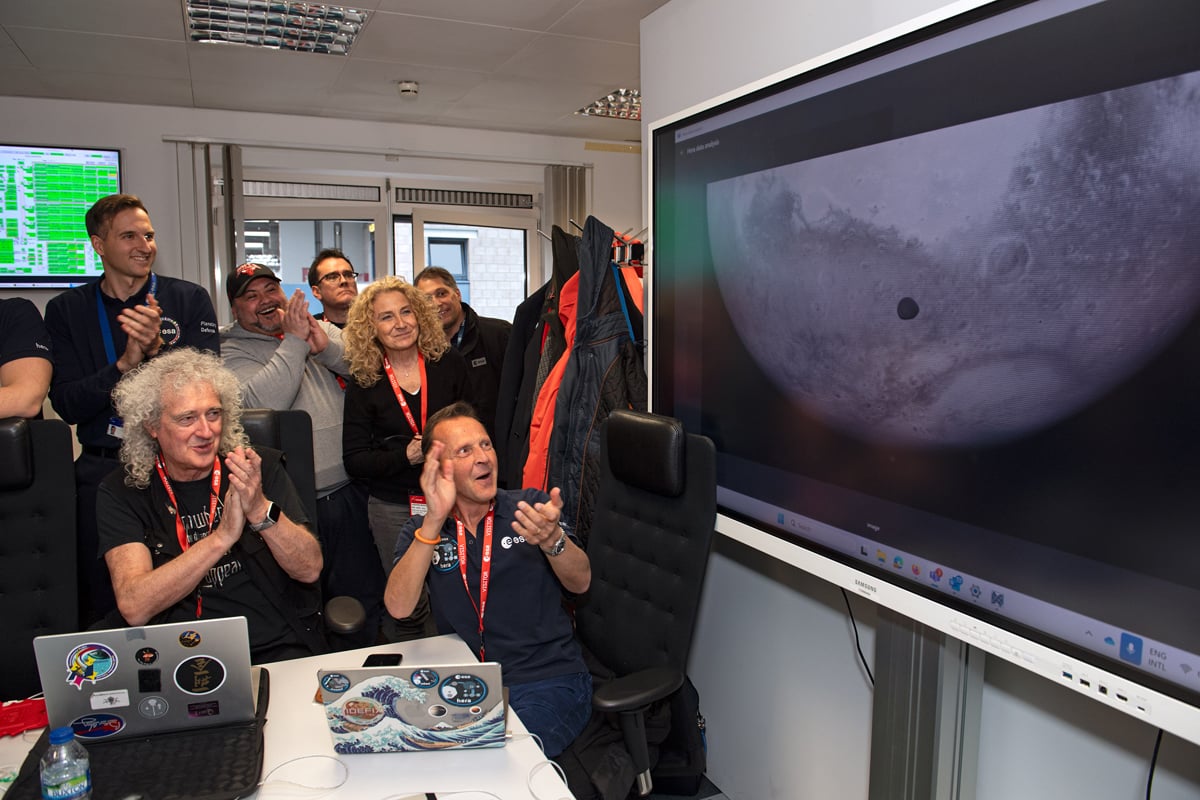
Two photographs taken by a spacecraft near an asteroid have allowed Sir Brian May to show the object in three dimensions. The astrophysicist and Queen guitarist has combined two images from the European Space Agency’s (ESA) Hera mission to create stereoscopic views of asteroid Didymos. He worked with fellow stereoscopic photographer Claudia Manzoni to produce the images, which reveal more detail of the asteroid‘s surface and a stronger sense of depth.
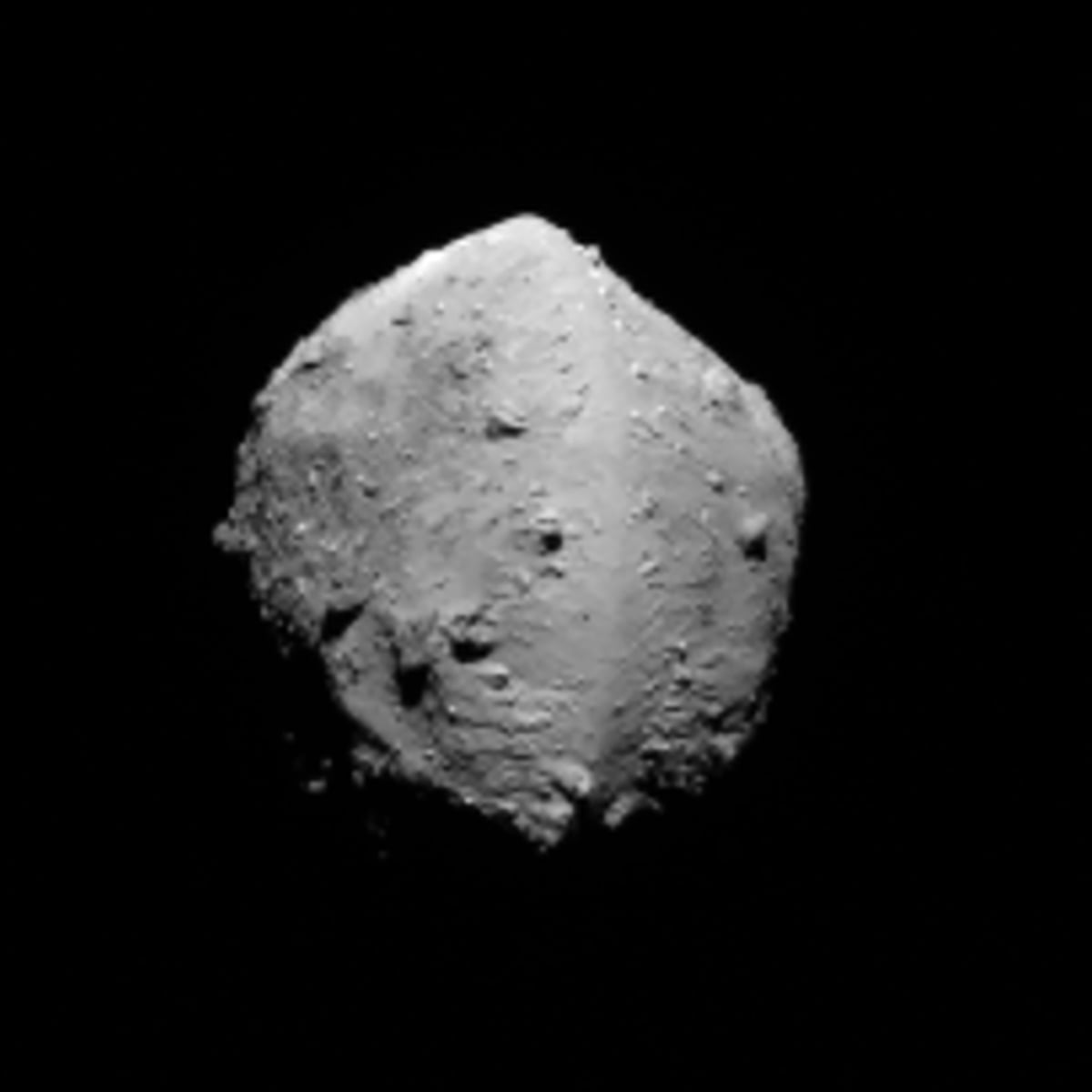
Hera’s Asteroid Framing Camera captured the photographs on November 6, 2026. The spacecraft was then 29.7 kilometers from Didymos, with an image resolution of 2.8 meters per pixel. The two frames show nearly the same portion of the asteroid, but each captures it from a slightly different angle.
How Brian May Created a 3D View
Anyone who looks at an object with both eyes has a natural sense of depth. Each eye sees the object from a slightly different angle. The brain compares those views and uses their differences to judge distance and position. Stereoscopic photography recreates this process with two photographs.
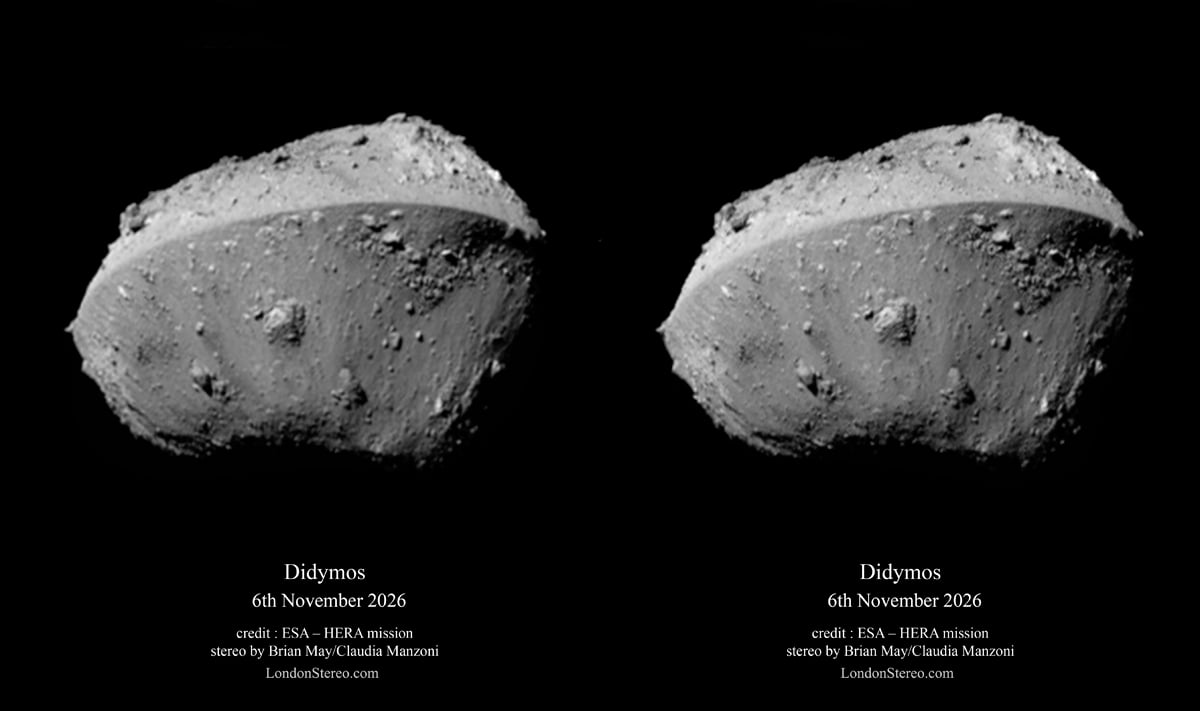
A photographer usually takes the first picture, shifts the camera slightly, and takes another. The two frames contain almost identical information, but their perspectives differ. When viewers look at them together, their eyes combine the separate views into one image with depth.
Hera’s Asteroid Framing Camera took two successive images while the spacecraft moved relative to the asteroid. May and Manzoni combined these adjacent camera acquisitions. They also had to align corresponding surface features. A boulder in one frame, for example, must match the same boulder in the other.
The equatorial ridge of Didymos
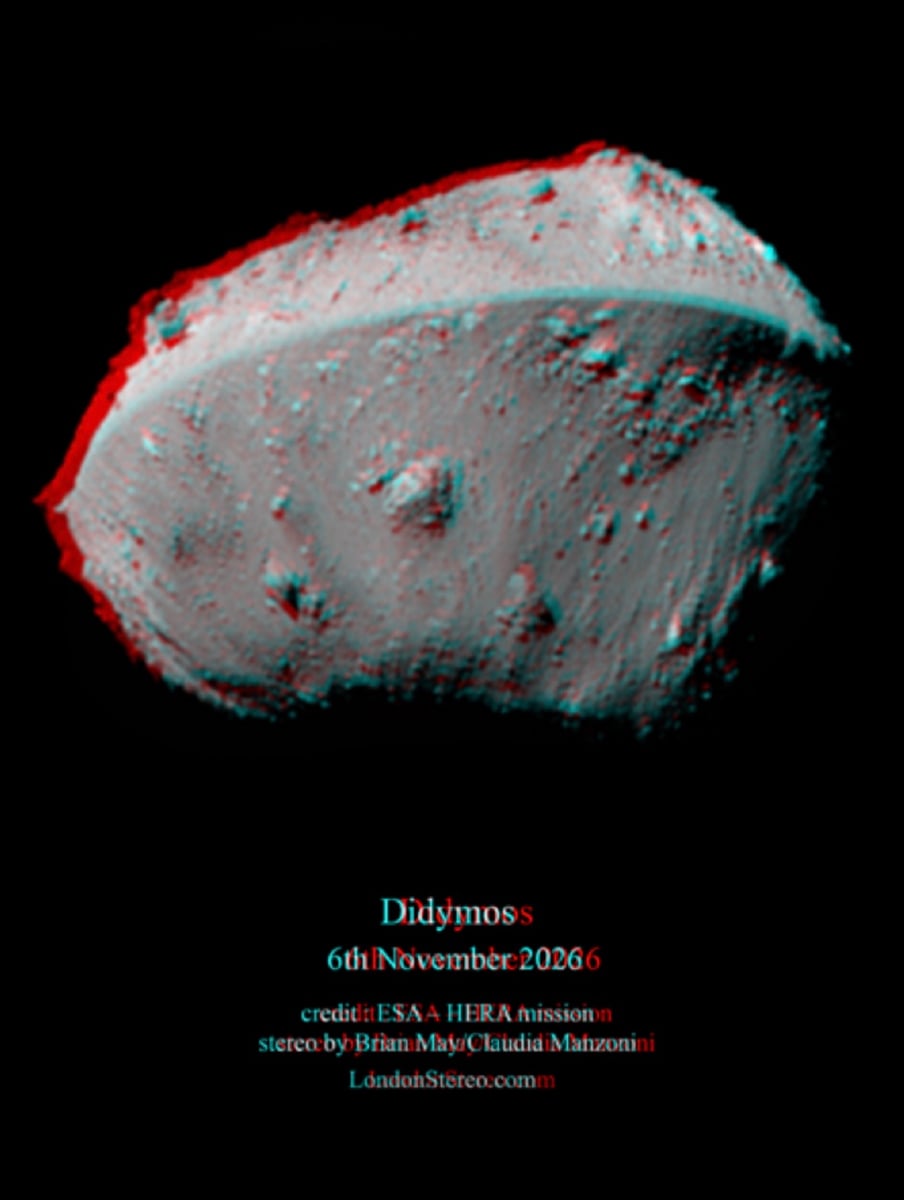
Probably the most striking feature in the new stereo views is the ridge that circles Didymos’s middle. It gives the asteroid its distinctive spinning-top shape. The ridge has a relatively smooth appearance, while much of the surrounding terrain contains scattered rocks and boulders.
May specifically pointed out this contrast when describing the images. The stereoscopic view makes the ridge’s sharp outline and smooth surface easier to appreciate. It also gives viewers a better sense of how the structure rises above the neighbouring terrain.
Three ways to see the asteroid images in 3D
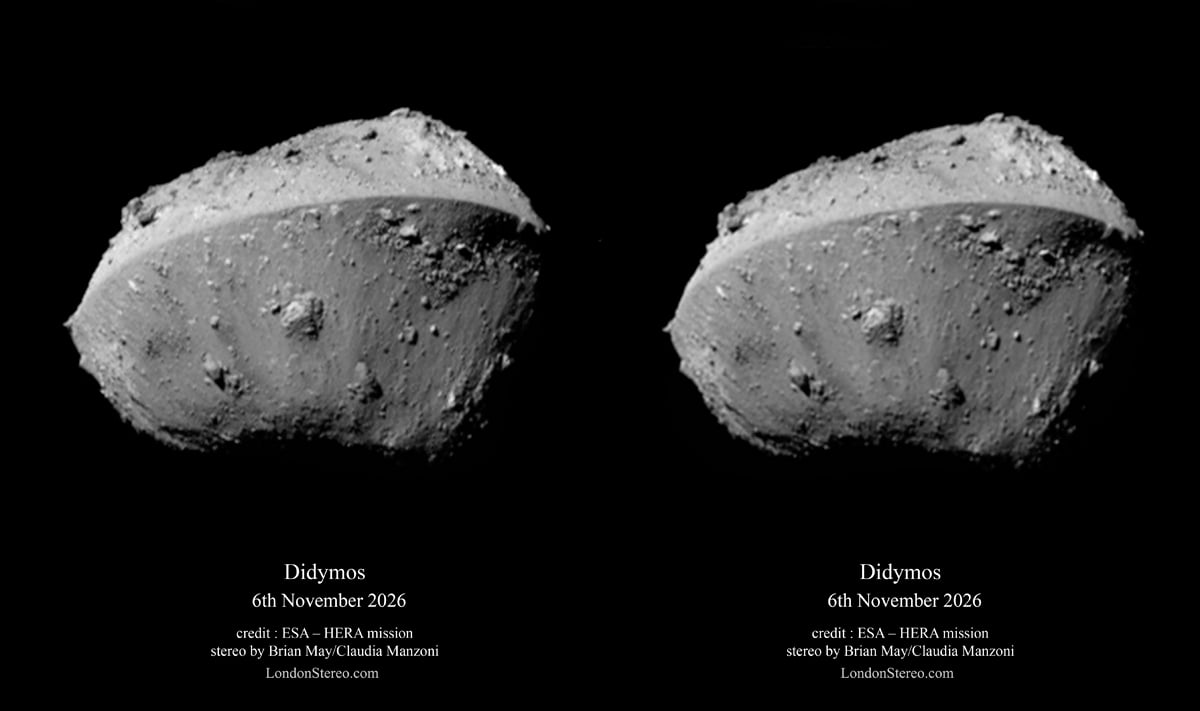
ESA has released three versions of the stereoscopic images. Each uses a different method to bring the two photographs together. Viewers can choose between color 3D glasses, cross-eyed viewing, and parallel viewing.
The first version uses anaglyph photography. It separates the two images into different color channels, usually red and cyan. Viewers wear matching 3D glasses, which filter the images so that each eye sees its corresponding view. The brain then combines them into a single scene with depth.
The second version uses cross-eyed viewing. Here, viewers cross their eyes until the two photographs overlap. The central image should then appear three-dimensional. It can take a little practice to find the correct position, but the method requires no special equipment.
The third version uses parallel viewing, also known as free viewing. Instead of crossing their eyes, viewers relax their focus and look beyond the photographs. The eyes gradually bring the two images together. A dedicated stereoscopic viewer can make this process easier.
Clear skies!
See more from DIYPhotography.net on Google
Add DIYPhotography.net as a trusted source. This makes
our stories more likely to appear in your Google Search results.
 Add as a preferred source on Google

Soumyadeep Mukherjee
Soumyadeep Mukherjee is an award-winning astrophotographer from India. He has a doctorate degree in Linguistics. His work extends to the sub-genres of nightscape, deep sky, solar, lunar and optical phenomenon photography. He is also a photography educator and has conducted numerous workshops. His works have appeared in over 40 books & magazines including Astronomy, BBC Sky at Night, Sky & Telescope among others, and in various websites including National Geographic, NASA, Forbes. He was the first Indian to win “Astronomy Photographer of the Year” award in a major category.



Join the Discussion
DIYP Comment Policy
Be nice, be on-topic, no personal information or flames.