


















Hubble Reveals a Giant Superbubble in the Large Magellanic Cloud
Sep 3, 2026
Soumyadeep Mukherjee
Soumyadeep Mukherjee is an award-winning astrophotographer from India. He has a doctorate degree in Linguistics. His work extends to the sub-genres of nightscape, deep sky, solar, lunar and optical phenomenon photography. He is also a photography educator and has conducted numerous workshops. His works have appeared in over 40 books & magazines including Astronomy, BBC Sky at Night, Sky & Telescope among others, and in various websites including National Geographic, NASA, Forbes. He was the first Indian to win “Astronomy Photographer of the Year” award in a major category.
Share:
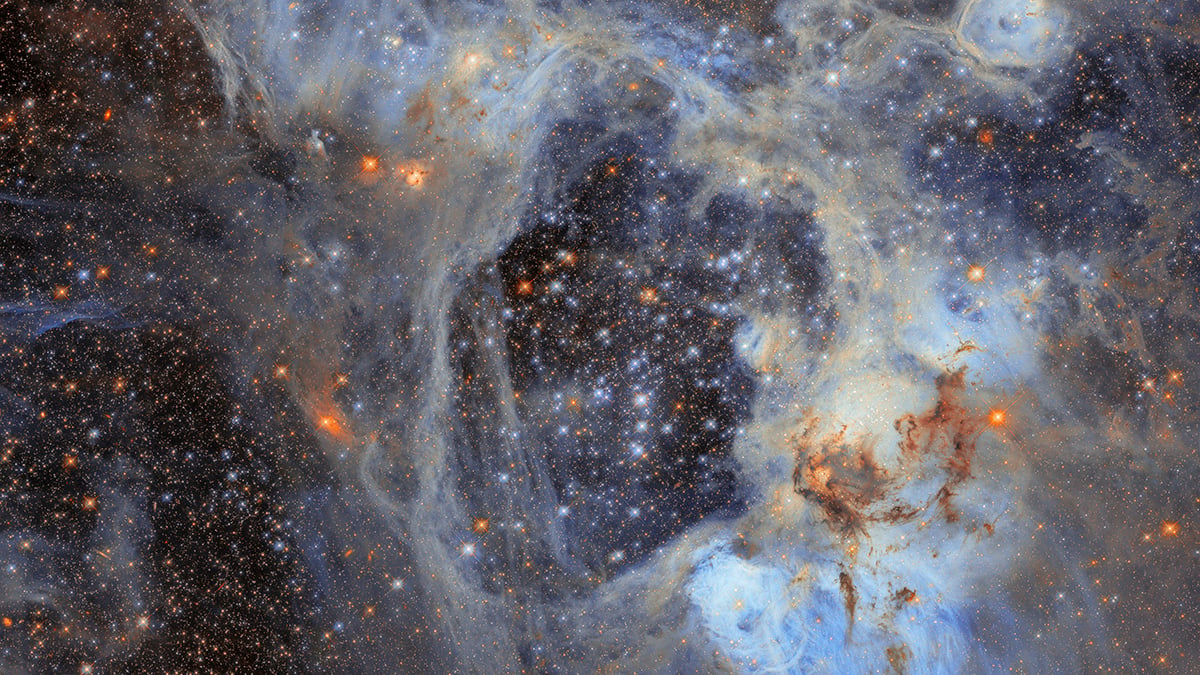
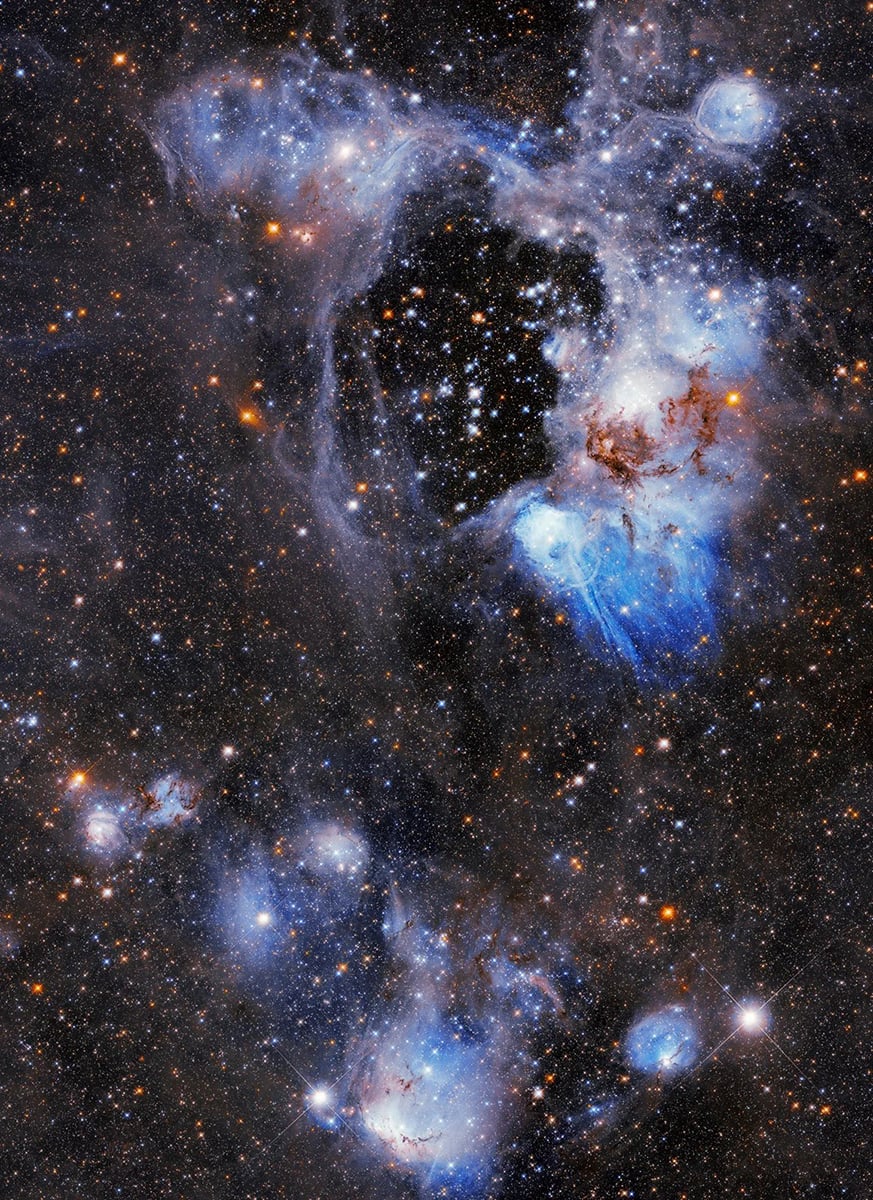
It seems like Hubble is not taking even a single day off! After we just came across its brilliant image of Saturn’s south pole, the Hubble Space Telescope has photographed one of the most distinctive structures inside the Large Magellanic Cloud. The new image shows N44, a large emission nebula in the constellation Dorado, with a huge cavity cutting through its center. The cavity measures about 210 by 140 light-years and is surrounded by glowing gas, dark dust, and dense fields of stars.
The new Hubble image contains bright emission regions, dark dust lanes, dense groups of stars, and several smaller structures within the wider N44 complex. Hubble’s resolution also allows individual stars to remain visible across the nebula, giving the image considerable detail even when viewed at a much smaller scale.
The “superbubble” in N44
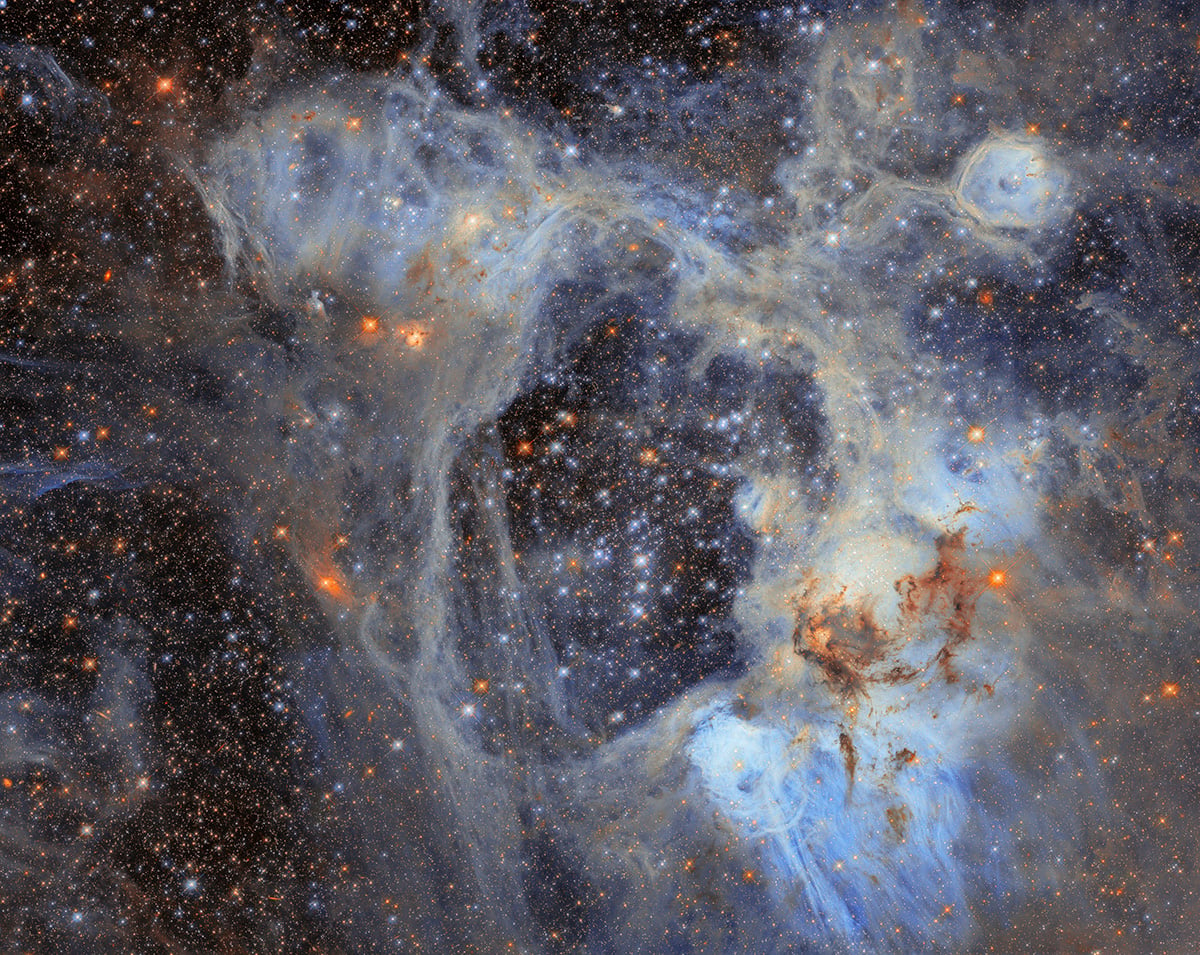
The large cavity sits within a much more complicated field of gas and stars. Its edges are particularly easy to follow because the material around the cavity is denser and brighter than the interior. The contrast makes the superbubble stand out against the surrounding nebula.
The cavity itself is not an empty space. Stars are scattered across it, including members of the central stellar population that helped create the structure. Their winds pushed surrounding gas outward, while supernova explosions added further energy to the expanding region. The gas that remained around the cavity became compressed into a shell.
The structure has appeared in earlier Hubble images, although its dimensions and interpretation have been presented somewhat differently over time. A Hubble image from 2021 described the cavity as about 250 light-years wide and said its origin was still uncertain.
The earlier report considered stellar winds and expanding shells from older supernovae as possible explanations. The newer 2026 image describes the superbubble as the result of both powerful stellar winds and supernovae.
The surrounding gas
Moving away from the central cavity makes the image increasingly busy. Glowing gas fills large sections of the field, while darker dust cuts across some of the brighter regions. Thousands of stars are scattered through the scene, with some standing out clearly against the nebula and others blending into the dense background.
The gas glows because radiation from massive stars energizes it. This process produces the emission seen across N44 and gives the nebula much of its color and contrast. The shell around the superbubble is forming new stars.
A smaller bubble near the upper right
The main superbubble is so large that it can be easy to overlook another bubble in the same frame. Near the upper-right portion of the image is N44F, a much smaller interstellar bubble created by the stellar wind of a single hot, massive star.
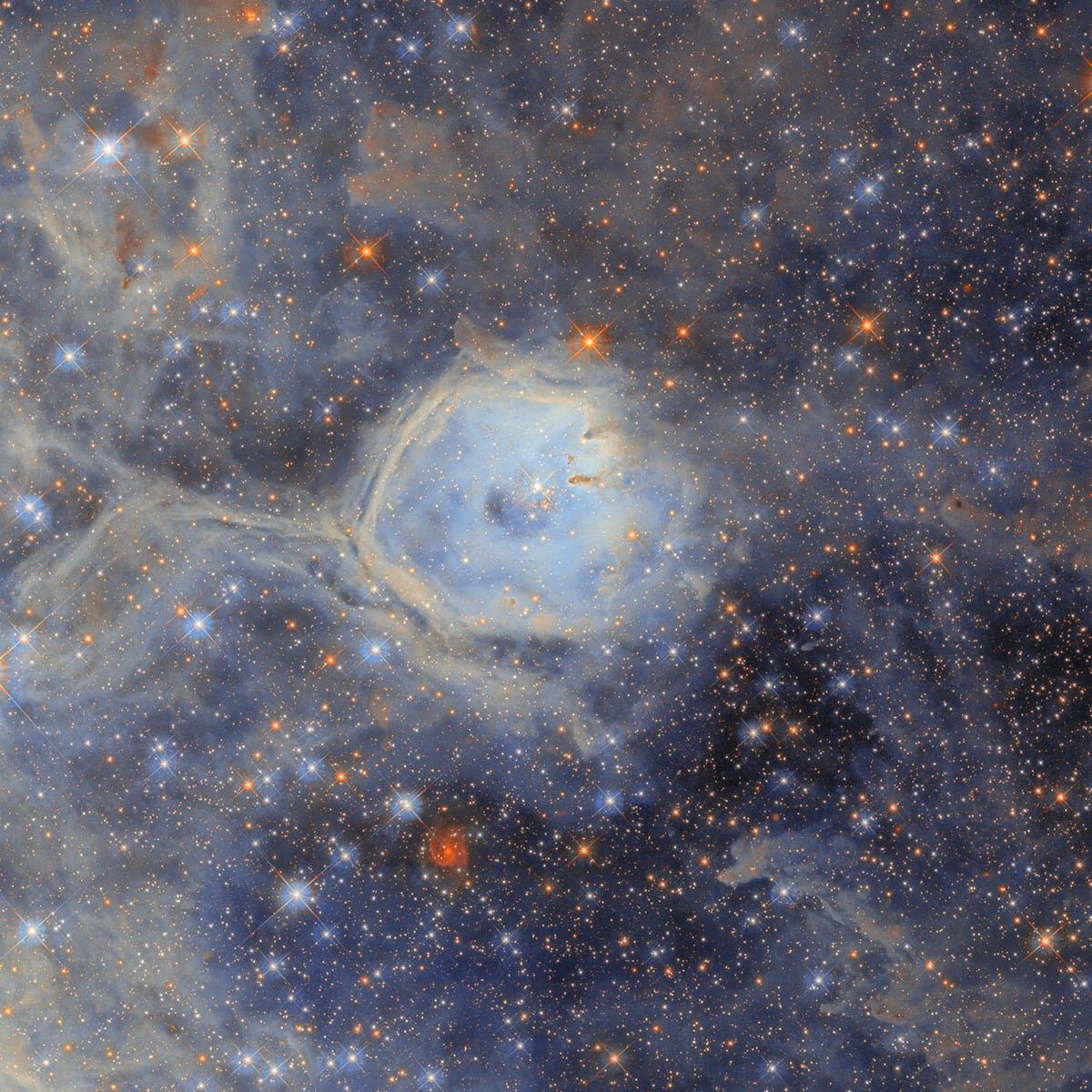
Hubble previously photographed N44F in detail. Those observations showed the star’s powerful wind interacting with the surrounding gas and dust. The interaction has shaped the bubble and produced columns of dusty material along its interior wall. NASA’s earlier observations measured those columns at roughly 4 to 8 light-years in height.
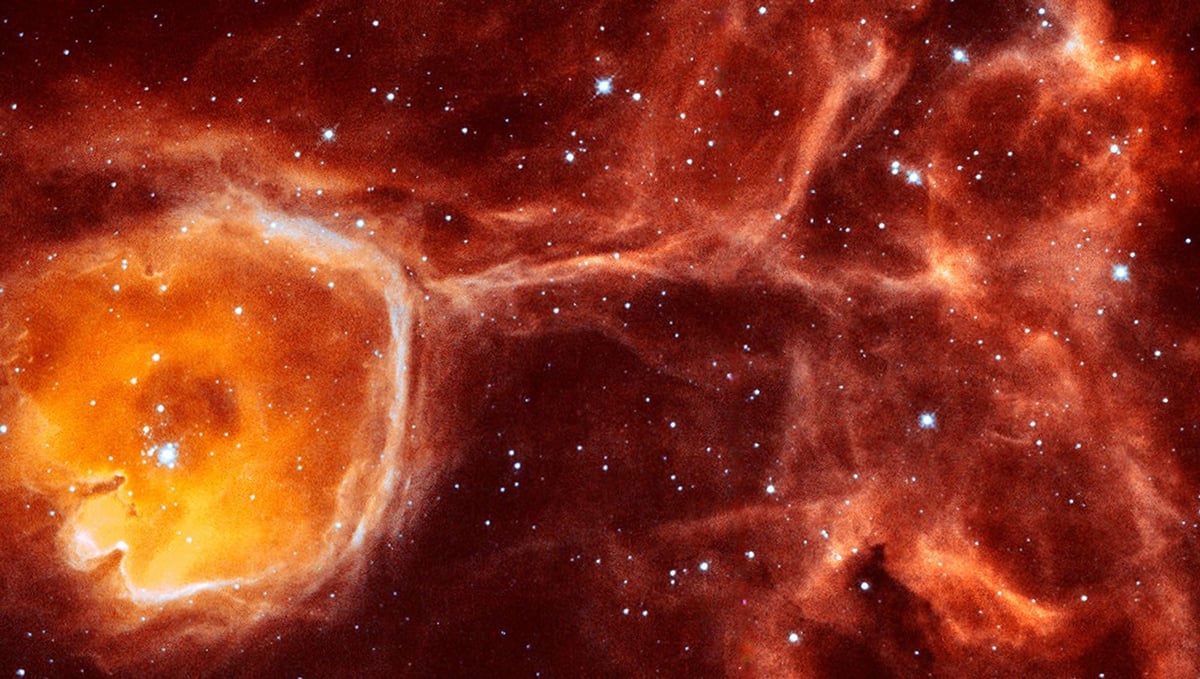
N44F provides a good scale comparison within the new image. The smaller bubble is produced by one star, while the enormous cavity dominating the wider scene is associated with the combined effects of massive stars and supernovae. Both structures appear within the same star-forming complex.
Clear skies!
See more from DIYPhotography.net on Google
Add DIYPhotography.net as a trusted source. This makes
our stories more likely to appear in your Google Search results.
 Add as a preferred source on Google

Soumyadeep Mukherjee
Soumyadeep Mukherjee is an award-winning astrophotographer from India. He has a doctorate degree in Linguistics. His work extends to the sub-genres of nightscape, deep sky, solar, lunar and optical phenomenon photography. He is also a photography educator and has conducted numerous workshops. His works have appeared in over 40 books & magazines including Astronomy, BBC Sky at Night, Sky & Telescope among others, and in various websites including National Geographic, NASA, Forbes. He was the first Indian to win “Astronomy Photographer of the Year” award in a major category.

Join the Discussion
DIYP Comment Policy
Be nice, be on-topic, no personal information or flames.