























This is the Most Detailed View Yet of Betelgeuse’s Surface
Aug 24, 2026
Soumyadeep Mukherjee
Soumyadeep Mukherjee is an award-winning astrophotographer from India. He has a doctorate degree in Linguistics. His work extends to the sub-genres of nightscape, deep sky, solar, lunar and optical phenomenon photography. He is also a photography educator and has conducted numerous workshops. His works have appeared in over 40 books & magazines including Astronomy, BBC Sky at Night, Sky & Telescope among others, and in various websites including National Geographic, NASA, Forbes. He was the first Indian to win “Astronomy Photographer of the Year” award in a major category.
Share:
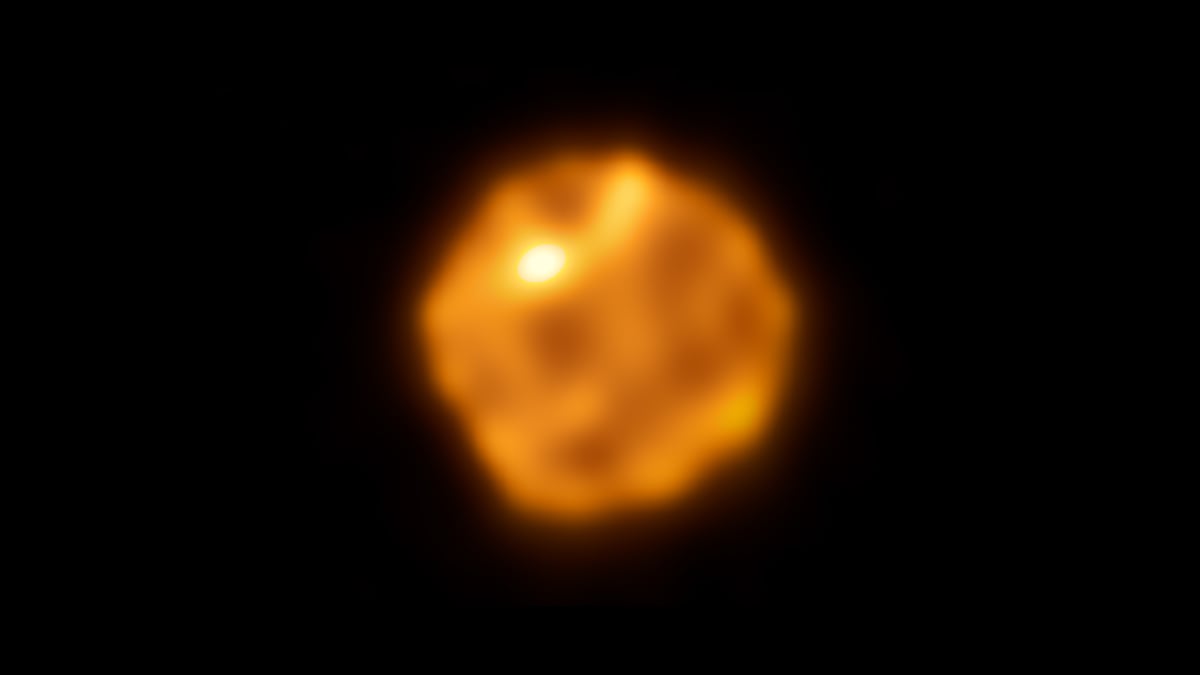
Astronomers have obtained a surprising view of the surface of Betelgeuse, revealing a star that is far more structured than its familiar orange appearance suggests. And this is the most detailed view of the star’s surface captured to date. New observations from the Atacama Large Millimeter/submillimeter Array (ALMA) show a highly uneven photosphere, with two prominent hot regions standing out from the surrounding gas. The brighter of the two appears in almost the same location as a feature recorded about seven years earlier.
ALMA sees a remarkably detailed and uneven Betelgeuse
Betelgeuse is almost 800 times larger than the Sun. Its enormous size gives convection a very different character from what we see on our own star. Deep inside Betelgeuse, hot material rises towards the outer layers while cooler material sinks. These movements can produce enormous convective structures across the stellar surface.
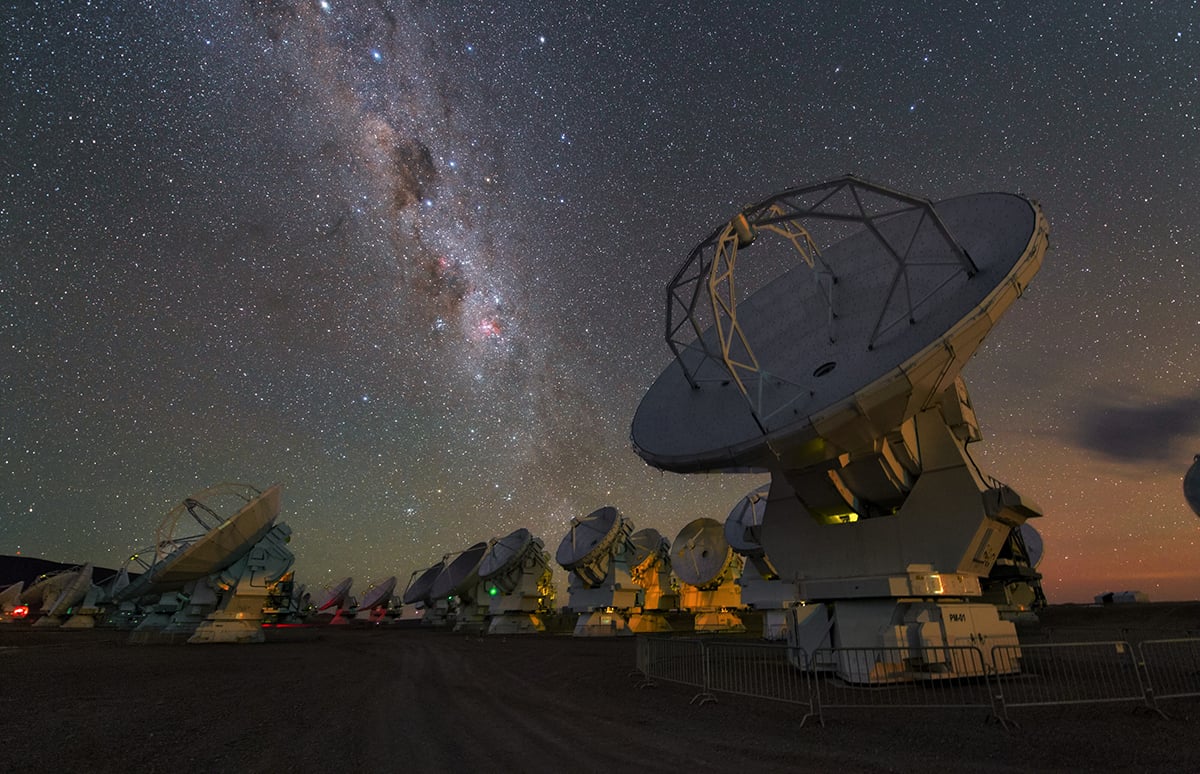
The new ALMA observations provide a close look at the result. The telescope observed Betelgeuse at wavelengths between 0.6 and 1.4 millimeters. The observations used ALMA‘s longest-baseline configuration and reached an angular resolution of about seven milliarcseconds at the shortest wavelengths. This resolution allowed the team to study structures across the star’s millimeter and submillimeter photosphere.
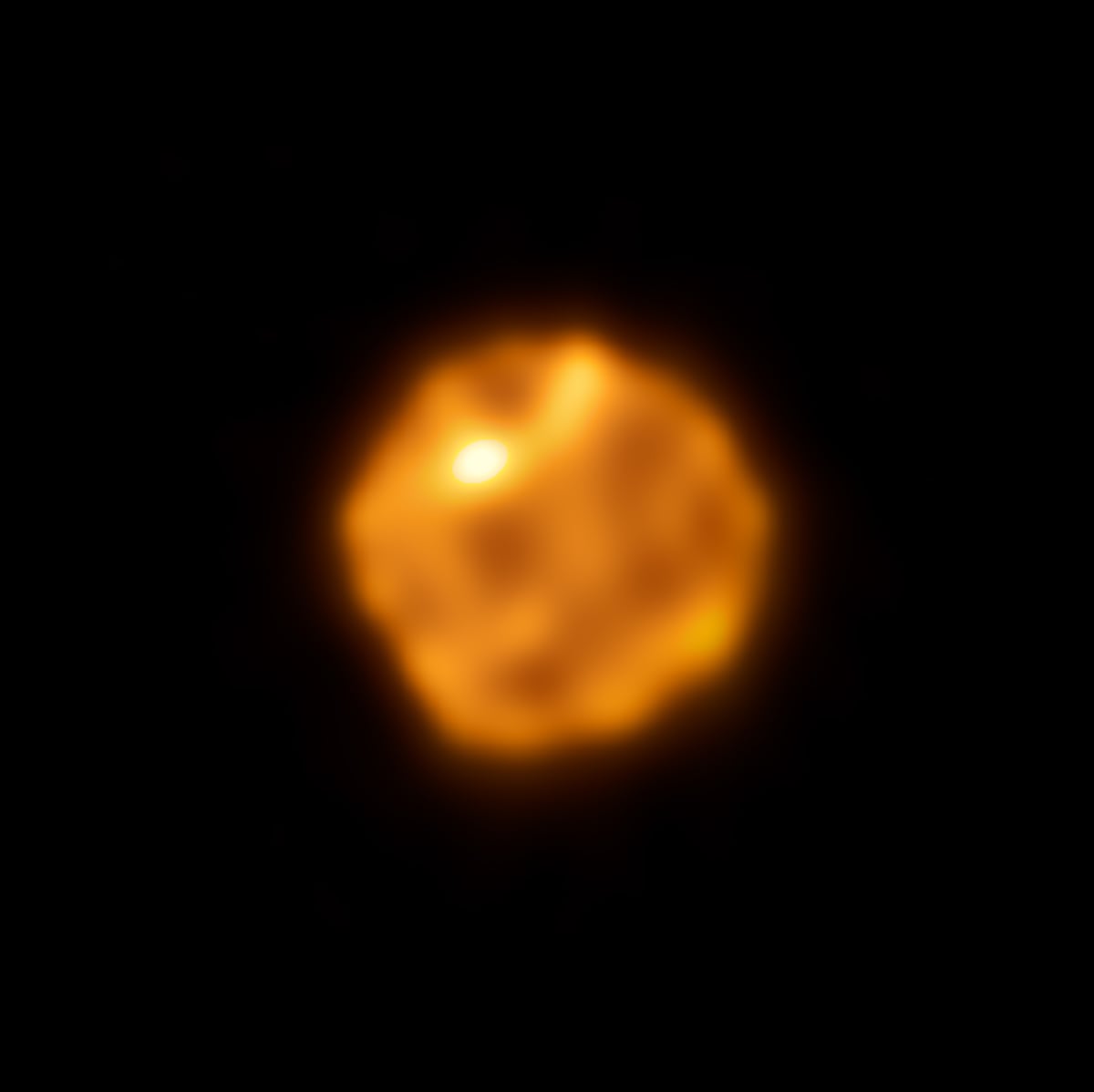
Two hotter regions stand out in the observations. One lies towards the northeast and another towards the southwest. The brightest hotspot has a temperature enhancement of about 800 kelvins compared with the surrounding photosphere. The distribution of these regions fits with the idea that large convective movements are shaping the surface.
The observations also show that Betelgeuse’s photosphere is not perfectly circular. Its measured radius varies by as much as six percent across the observed disc. Weaker emission extends much farther, reaching roughly 2.5 times the stellar radius. Similar clumpy structures appear in molecular emission from carbon monoxide and silicon monoxide.
The hotspot that refused to disappear
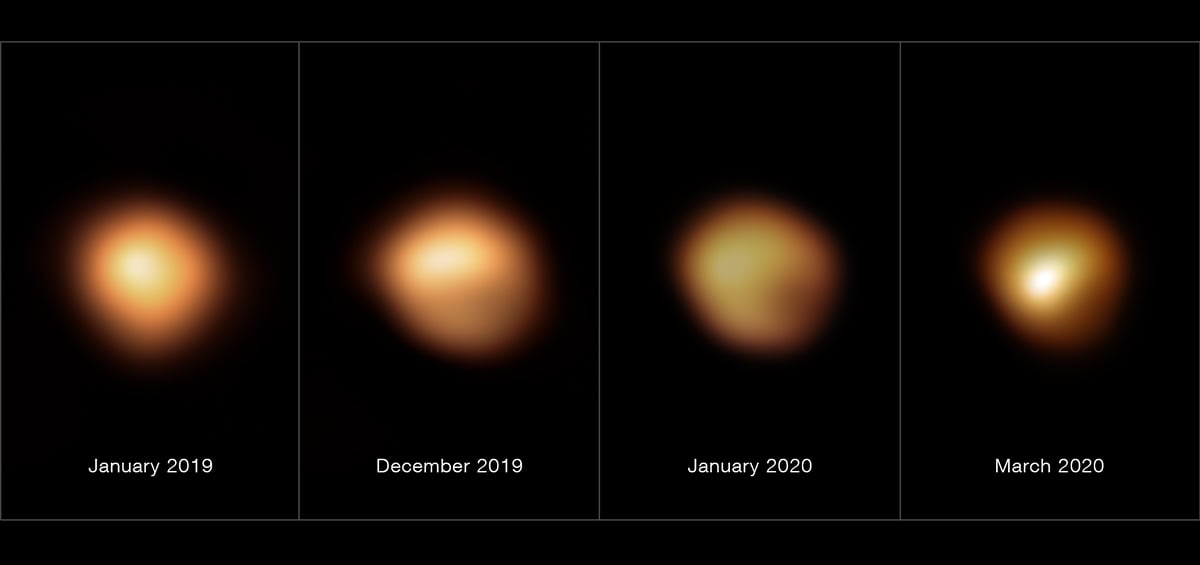
The most interesting feature in the new image becomes apparent when astronomers compare it with older ALMA observations. A similar observation was made about seven years earlier at a wavelength of 0.9 millimeters. The brightest hotspot seen today occupies almost the same position as the earlier feature and has a similar intensity.
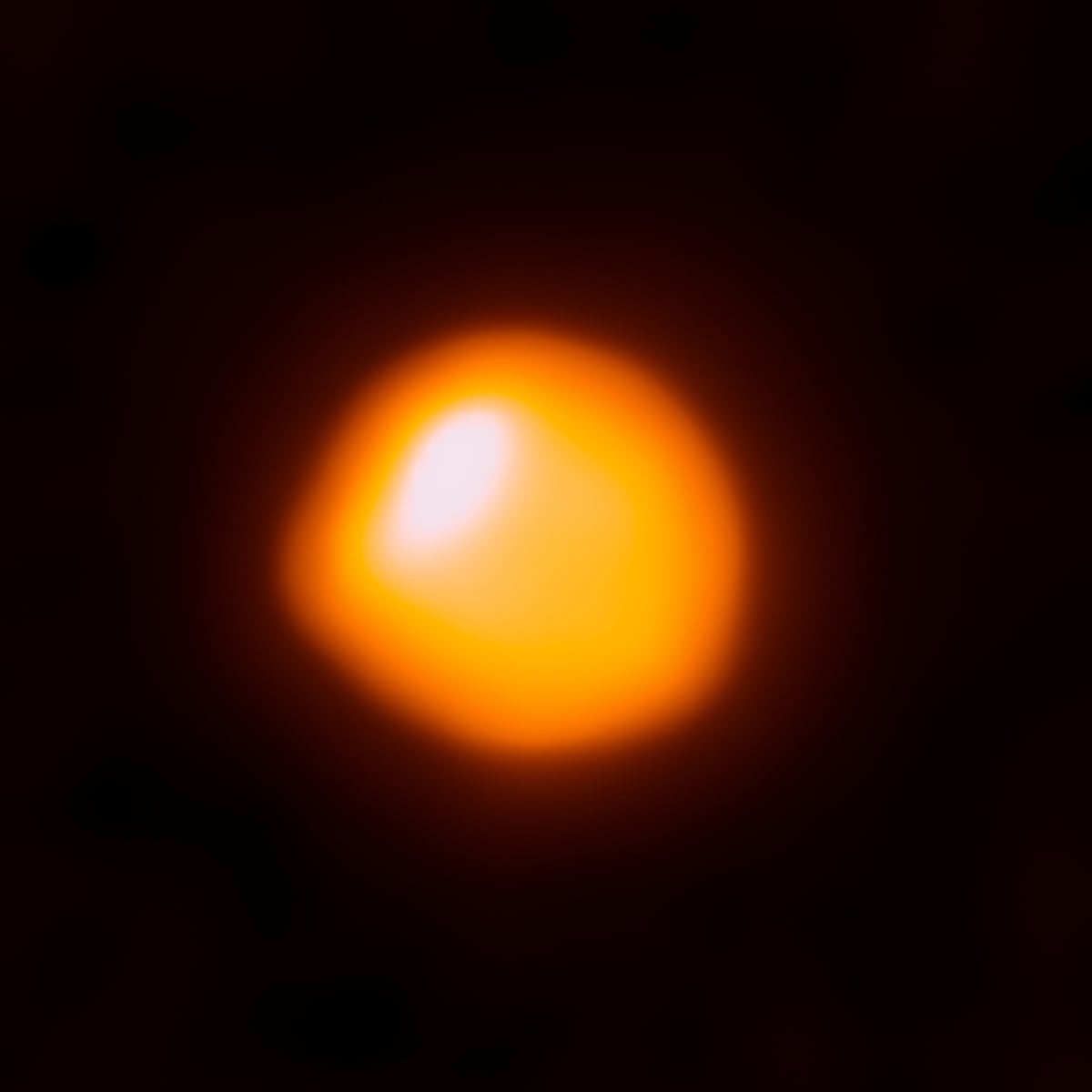
Convection should constantly rearrange the gas on the surface of a red supergiant. Individual hot structures should rise, spread, and fade. They should not remain unchanged for many years. The researchers stress that this does not mean the same mass of gas has sat there since the earlier observation. The atmosphere is still moving. The large-scale structure producing the hotspot appears to have remained active in roughly the same part of the star.
The team suggests that shocks driven by underlying convective cells could produce the hot regions. However, their apparent lifetimes are longer than model predictions. The two hotspots also sit near the proposed poles of Betelgeuse. That raises the possibility of enhanced polar convection that remains relatively stable over long periods.
A companion star could be influencing the atmosphere
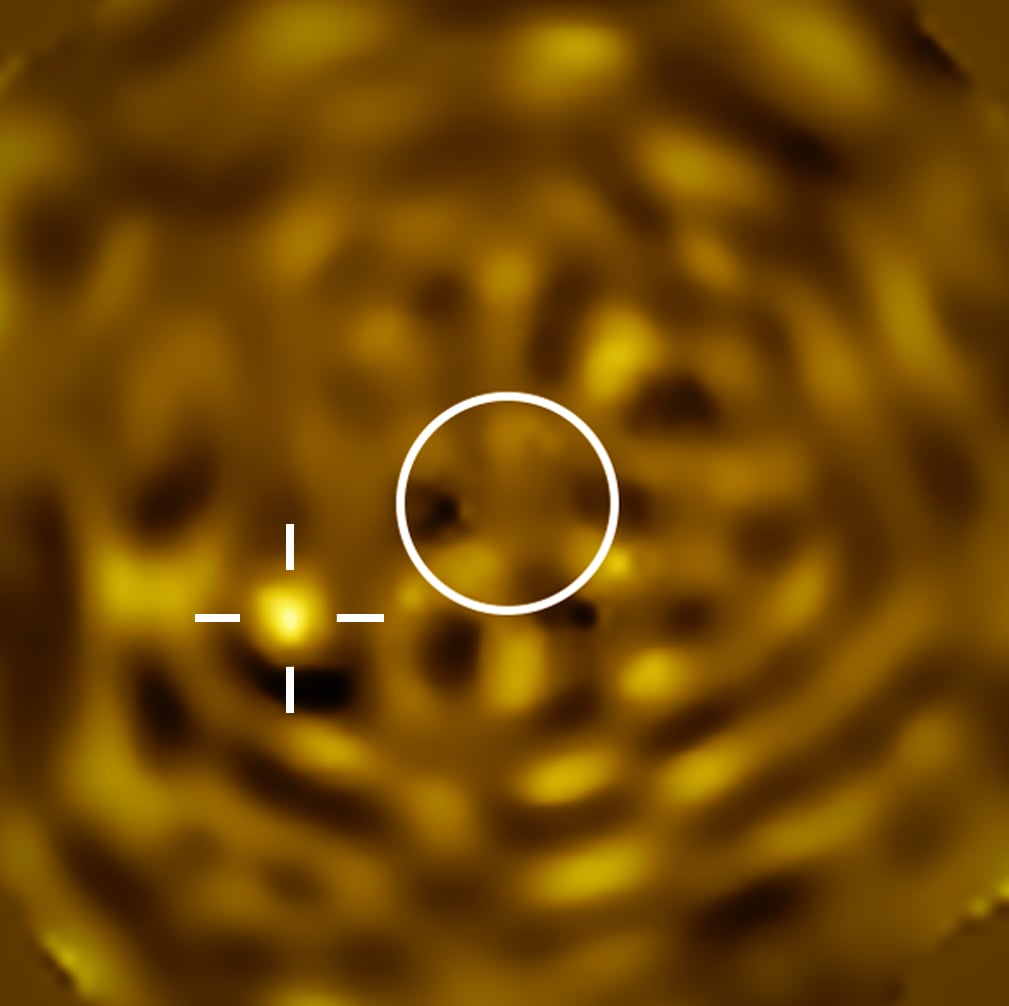
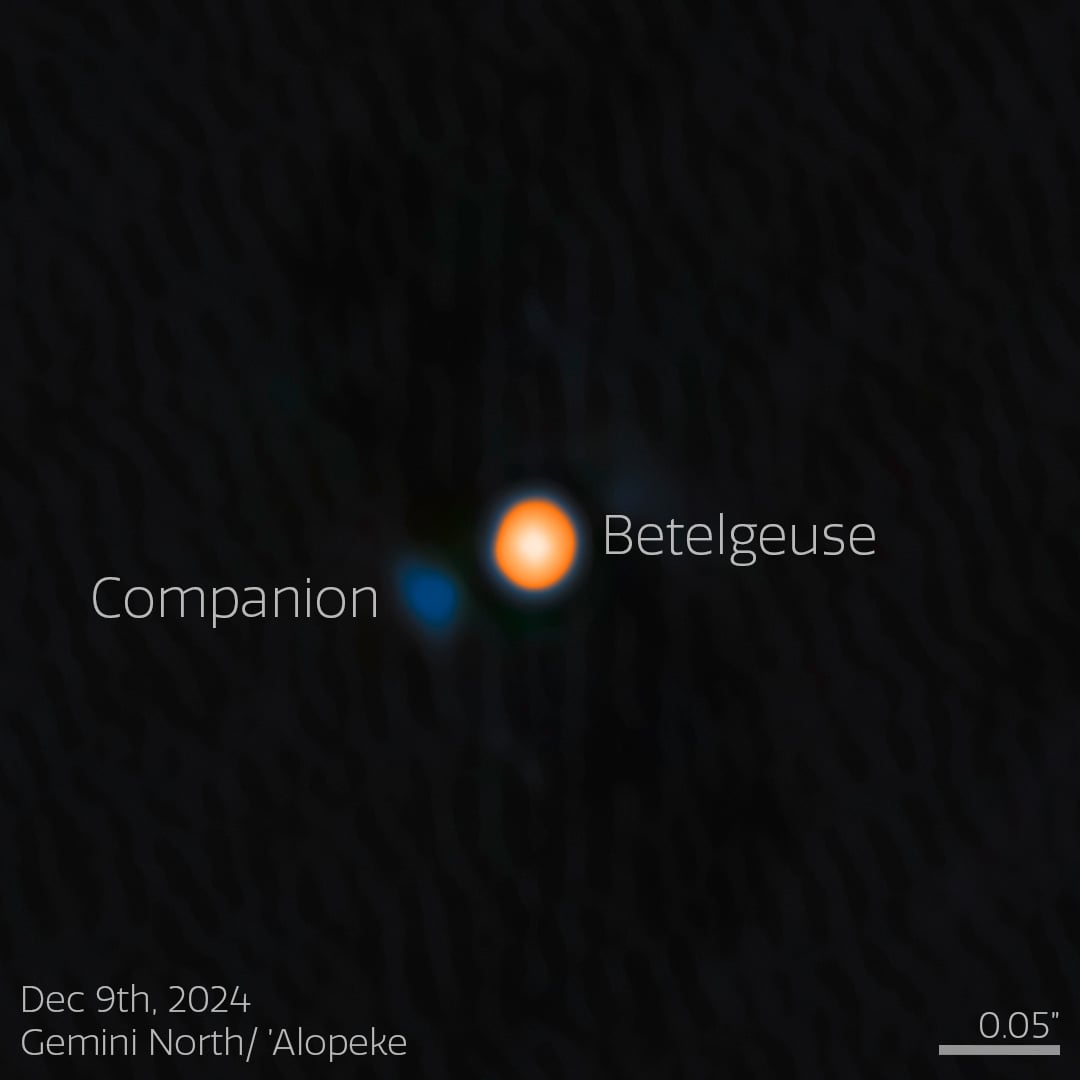
Last month, ESO reported observations from the Very Large Telescope that revealed a faint object close to Betelgeuse. The object is considered a strong candidate for Betelgeuse B, a companion star that has been suspected for decades. The Very Large Telescope‘s SPHERE instrument detected the candidate in observations made on 6 December 2024.
The candidate lies about 52 milliarcseconds from Betelgeuse. If the two stars formed together, astronomers estimate that the companion could have between 2.6 and 3.1 times the mass of the Sun. It would be a young main-sequence star.
A companion this close could affect the outer layers of Betelgeuse through gravity. Its orbit could disturb the extended atmosphere and change the distribution of gas around the red supergiant. Recent radio observations have found changes in Betelgeuse’s shape that appear to correlate with the proposed companion’s orbital phase. The results support the possibility of periodic atmospheric disturbances.
Clear skies!
See more from DIYPhotography.net on Google
Add DIYPhotography.net as a trusted source. This makes
our stories more likely to appear in your Google Search results.
 Add as a preferred source on Google

Soumyadeep Mukherjee
Soumyadeep Mukherjee is an award-winning astrophotographer from India. He has a doctorate degree in Linguistics. His work extends to the sub-genres of nightscape, deep sky, solar, lunar and optical phenomenon photography. He is also a photography educator and has conducted numerous workshops. His works have appeared in over 40 books & magazines including Astronomy, BBC Sky at Night, Sky & Telescope among others, and in various websites including National Geographic, NASA, Forbes. He was the first Indian to win “Astronomy Photographer of the Year” award in a major category.



Join the Discussion
DIYP Comment Policy
Be nice, be on-topic, no personal information or flames.