




















Who Was Dorothea Lange? The Photographer Who Changed Documentary Photography
Jul 29, 2026
Alex Baker
Alex Baker is a portrait and lifestyle driven photographer based in Valencia, Spain. She works on a range of projects from commercial to fine art and has had work featured in publications such as The Daily Mail, Conde Nast Traveller and El Mundo, and has exhibited work across Europe
Share:
Even if you’ve never heard the name Dorothea Lange before, you’ve almost certainly seen her photos. Arguably, few photographers have had as much influence on documentary photography as she did. She’s best known for her powerful images of the Great Depression, where she used her camera to document history and helped the rest of the world understand what was happening.
Her photographs gave a voice to people who were often overlooked, capturing the hardships faced by migrant workers, farming families, and communities struggling through one of America’s toughest economic periods. More than 80 years later, her work continues to inspire photographers and photojournalists around the world
From portrait photographer to documentarian
Dorothea Lange was born in 1895 in Hoboken, New Jersey. After studying photography in New York, she began her career as a portrait photographer and opened a successful studio in San Francisco during the 1920s.
However, everything changed after the Wall Street Crash of 1929 and the onset of the Great Depression. Instead of photographing wealthy clients, Lange took her camera onto the streets, documenting unemployment, poverty, and the growing number of people forced from their homes in search of work. These images marked the beginning of her career as a documentary photographer. She often talked to her subjects, helping them to feel at ease, which also made her understand her subjects better. This approach delineated her from more ‘pure’ forms of photojournalism; however, her approach was no less powerful.
Working for the Farm Security Administration
In 1935, Lange began working for the Farm Security Administration (FSA), a New Deal programme that commissioned photographers to document life in rural America during the Great Depression. Alongside her husband, economist Paul Schuster Taylor, Lange travelled across the United States photographing struggling farming communities, migrant workers, and families displaced by drought and economic hardship.
Taylor interviewed subjects and gathered economic data while Lange produced photographs and accompanying data. The photographs weren’t simply historical records, they were intended to show the realities of life in America and help build public support for government relief programmes.
Migrant Mother
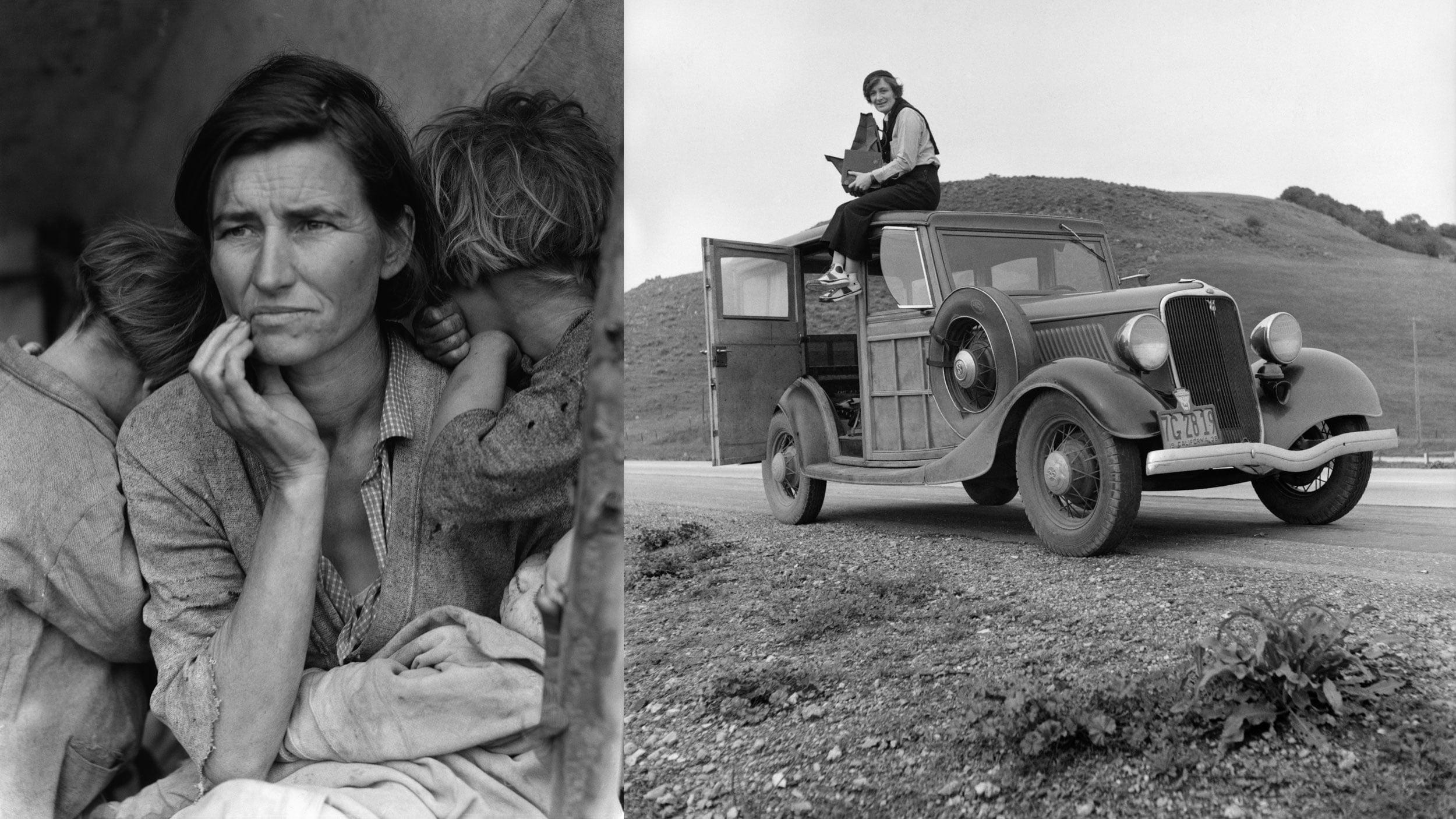
Lange’s most famous photograph is undoubtedly Migrant Mother, taken in 1936 in Nipomo, California, and has since become almost synonymous with the Great Depression.
The image shows Florence Owens Thompson, a mother of seven, sitting with her children during the height of the Great Depression. Thompson’s worried expression became one of the defining images of the era and remains one of the most recognisable photographs ever made.
In 1960, Lange spoke about her experience taking the photograph, saying: “I saw and approached the hungry and desperate mother, as if drawn by a magnet. I do not remember how I explained my presence or my camera to her, but I do remember she asked me no questions. I made five exposures, working closer and closer from the same direction. I did not ask her name or her history. She told me her age, that she was thirty-two. She said that they had been living on frozen vegetables from the surrounding fields, and birds that the children killed. She had just sold the tires from her car to buy food. There she sat in that lean-to tent with her children huddled around her, and seemed to know that my pictures might help her, and so she helped me. There was a sort of equality about it.“
The photograph was published widely and is often credited with helping draw attention to the desperate conditions faced by migrant workers. Relief supplies were reportedly sent to the camp shortly after Lange’s photographs were distributed. Today, Migrant Mother is considered one of the greatest examples of documentary photography.
Beyond the Great Depression
Although she’s best remembered for her Depression-era work, Lange continued photographing important social issues throughout her career.
During the Second World War, she documented the forced internment of Japanese Americans following the attack on Pearl Harbour. Many of these photographs were considered too politically sensitive at the time and were suppressed by the US government, only becoming widely known decades later.
Throughout her career, Lange focused on ordinary people living through extraordinary circumstances, always approaching her subjects with dignity and empathy.
Why is Dorothea Lange still important?
Lange helped define what documentary photography could achieve. Rather than simply recording events, her photographs encouraged viewers to think about inequality, poverty, migration, and social justice. They demonstrated that photography could influence public opinion and even political decisions.
Many modern photojournalists continue to follow the path she helped establish, using photography not only to document history but also to encourage understanding and compassion, and help make meaningful change.
What photographers can learn from Dorothea Lange
If you ignore the fact that Lange was shooting on a Graflex large-format film camera and all the associated complications, her photographs weren’t especially technically complicated by the standards of the day. However, they were still emotionally powerful and flawlessly executed.
She spent time getting to know the people she photographed and believed that empathy was just as important as camera settings. Her work reminds photographers that storytelling, patience, and genuine human connection often matter more than expensive equipment.
Perhaps her greatest lesson is that some of the most important photographs aren’t of famous people or spectacular places, they’re images that help us better understand one another. More than eight decades later, her work continues to inspire photographers to look beyond technical perfection and focus instead on telling honest, human stories.
[Cover Image Credit: Rondal Partridge, Public domain, via Wikimedia Commons/ ‘Migrant Mother’ By Dorothea Lange, Public domain, via Wikimedia Commons]
See more from DIYPhotography.net on Google
Add DIYPhotography.net as a trusted source. This makes
our stories more likely to appear in your Google Search results.
 Add as a preferred source on Google
Alex Baker
Alex Baker is a portrait and lifestyle driven photographer based in Valencia, Spain. She works on a range of projects from commercial to fine art and has had work featured in publications such as The Daily Mail, Conde Nast Traveller and El Mundo, and has exhibited work across Europe
Related Posts
 How street photography changed my lifestreet photography changed my lifeHow street photography changed my life
 Dorothea Lange’s iconic “Migrant Mother” is up for auction, expected to fetch $70,000
 ‘The Salt of the Earth’ – ‘Shattering’ Documentary on the Life of Photographer Sebastião Salgado
 Photographer hires Nigerian scammer to be a documentary filmmaker, and the results are beautiful
Join the Discussion
DIYP Comment Policy
Be nice, be on-topic, no personal information or flames.