























Two Solar Filters in One: The Daystar Quark Gemini
Jul 18, 2025
Soumyadeep Mukherjee
Soumyadeep Mukherjee is an award-winning astrophotographer from India. He has a doctorate degree in Linguistics. His work extends to the sub-genres of nightscape, deep sky, solar, lunar and optical phenomenon photography. He is also a photography educator and has conducted numerous workshops. His works have appeared in over 40 books & magazines including Astronomy, BBC Sky at Night, Sky & Telescope among others, and in various websites including National Geographic, NASA, Forbes. He was the first Indian to win “Astronomy Photographer of the Year” award in a major category.
Share:
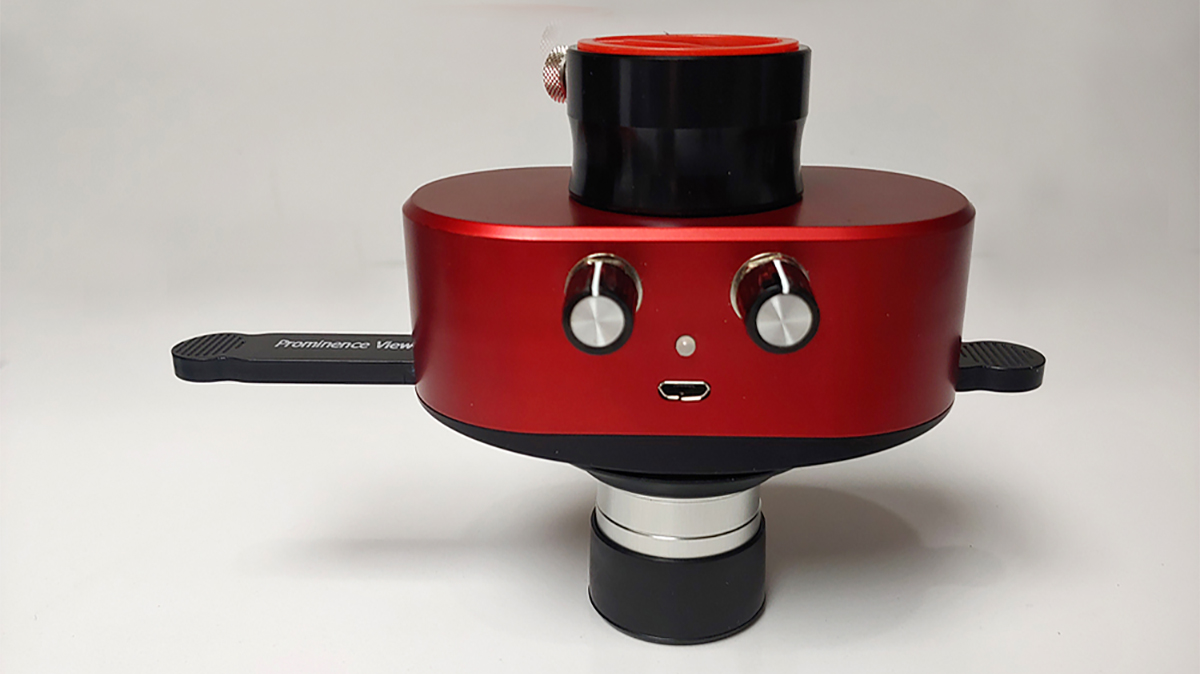
Solar astronomy is unlike any other branch of stargazing. It involves peering into a constantly changing, dynamic star. To observe it safely and in great detail, you need specialized filters. One name that continues to lead in this space is Daystar Filters. Their Quark Gemini brings a powerful twist to solar observation. It offers two hydrogen-alpha filters in one compact device. You can switch between them instantly with a simple slide. This game-changing tool allows astronomers to capture both the solar chromosphere and prominences during the same session, without changing gear.
The Quark Gemini
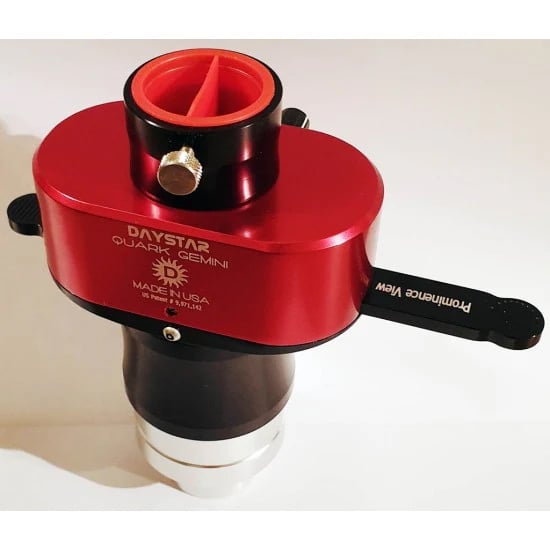
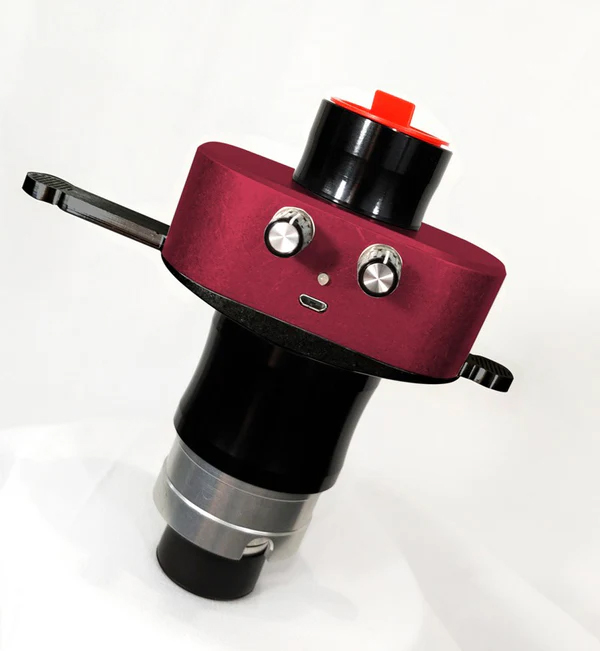
The Quark Gemini is a dual-bandpass hydrogen-alpha (H-alpha) solar filter. It combines two different etalons inside a single filter housing. These etalons are designed to show different layers of the solar atmosphere. One side targets the chromosphere. The other captures prominences. A mechanical slider lets users switch between the two instantly. The Gemini builds on the legacy of Daystar’s popular Quark series. But this one is different. It houses two Quark filters in one. It gives you the freedom and speed to explore two types of solar features with one tool.
The science behind it
Hydrogen-alpha filters isolate a very narrow slice of the light spectrum. This band is centered around 656.28 nanometers, the H-alpha line. At this wavelength, you can see many important solar features. The chromosphere appears in amazing detail. Prominences at the solar limb shine brightly. Filaments, plages, and spicules all become visible. The Quark Gemini contains two separate etalons. One has a narrow bandpass (≤0.5 Å) for the chromosphere. This gives high contrast and sharp surface details. The other has a wider bandpass (≈0.6 Å) tuned for prominences. Prominences are more visible with a slightly wider filter, as they emit over a broader H-alpha range. The slider mechanism allows quick switching. You don’t need to remove the filter or reconfigure your setup. There’s no refocusing required. This innovation saves time and reduces equipment wear.
Compatibility
The Gemini works with many telescopes, especially refractors. For apertures up to 80 mm, no additional filters are needed. For larger apertures, Daystar recommends a front-mounted Energy Rejection Filter (ERF). This protects the internal optics from excessive heat.
It also works with Schmidt-Cassegrain (SCT) and Maksutov telescopes. But in those cases, a front ERF is absolutely necessary. SCTs have large corrector plates that can overheat without protection. ERFs reduce UV, IR, and visible light intensity before it enters the telescope.
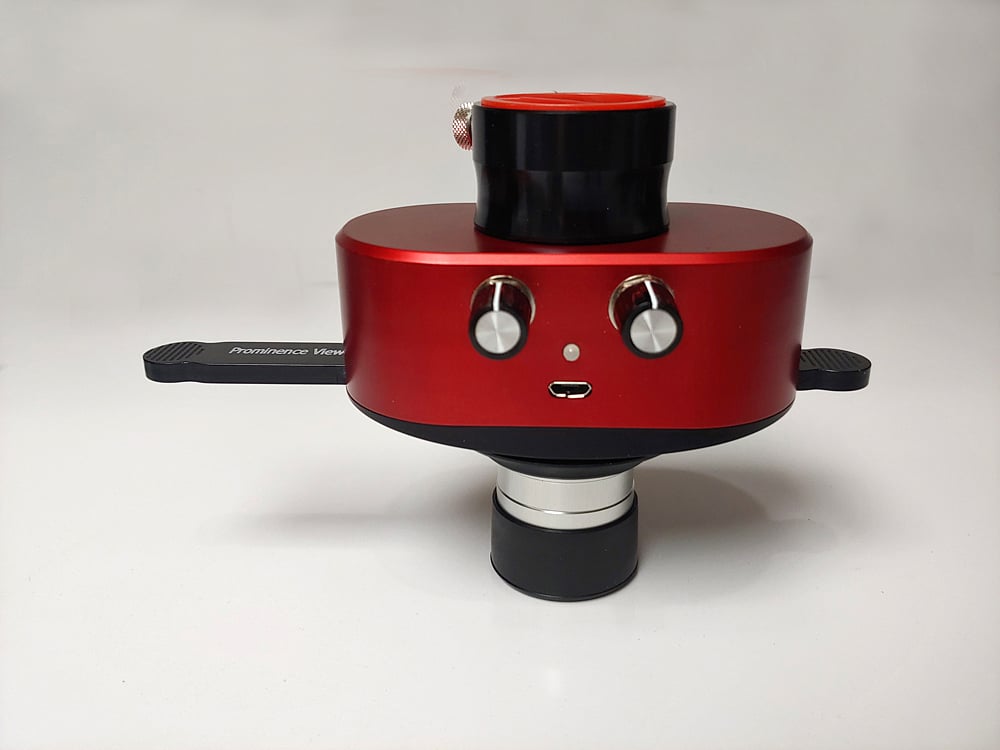
The Quark Gemini fits 1.25-inch or 2-inch eyepiece holders. You can also attach it behind a diagonal. It is powered by a standard 5V USB power source, drawing about 1.5 to 2 amps. Most users power it using a USB battery pack, laptop port, or AC adapter.
What can you see and photograph?
The Quark Gemini opens up two very different solar worlds.
In chromosphere mode, you’ll see:
- Active regions with sunspots and magnetic loops
- Filaments: dark, thread-like structures stretched across the solar surface
- Spicules: small jets at the limb
- Plages: bright areas near sunspots
- Flares, when they erupt
In prominence mode, the sun’s limb comes alive. You’ll see:
- Arching loops of plasma rising off the limb
- Detached clouds of gas floating in space
- Tornado-like structures of twisted magnetic fields
Being able to switch between these modes instantly is a huge advantage. It allows you to study the interaction between surface and limb activity in real-time. This is especially useful during solar eclipses, flare events, or outreach programs.
Imaging capabilities
The Gemini is not just for visual use. It is a superb tool for solar imaging. You can pair it with any standard planetary or astronomy camera. It supports high-resolution video or still image capture. Daystar recommends using the chromosphere mode for surface detail imaging. Use prominence mode for limb imaging. For advanced solar photographers, this tool saves time and improves workflow. There’s no need to switch filters mid-session. Just move the slider. The thermal stability is maintained by an internal precision heater. The filter warms up and locks to the target wavelength within about 5 to 10 minutes. The built-in temperature controller keeps the etalon at an optimal temperature. The tuning range allows you to make fine adjustments, called wing shift, which helps match the filter to your telescope’s specific light cone.

Price and availability
Daystar Quark Gemini is available for ordering via the official website for the price of $2,595.
Final thoughts
The Quark Gemini gives you two high-end solar filters in one. It’s fast, flexible, and built for serious work. The ability to instantly switch between solar surface and limb views is a huge advantage. You don’t need to carry or swap filters. Just slide and observe. Whether you’re an astrophotographer, an educator, or a dedicated solar watcher, the Gemini puts the power of dual-mode H-alpha observation in your hands. It makes solar astronomy faster, simpler, and far more rewarding. If you love the Sun, this filter will make you love it even more.
Clear skies!
See more from DIYPhotography.net on Google
Add DIYPhotography.net as a trusted source. This makes
our stories more likely to appear in your Google Search results.
 Add as a preferred source on Google

Soumyadeep Mukherjee
Soumyadeep Mukherjee is an award-winning astrophotographer from India. He has a doctorate degree in Linguistics. His work extends to the sub-genres of nightscape, deep sky, solar, lunar and optical phenomenon photography. He is also a photography educator and has conducted numerous workshops. His works have appeared in over 40 books & magazines including Astronomy, BBC Sky at Night, Sky & Telescope among others, and in various websites including National Geographic, NASA, Forbes. He was the first Indian to win “Astronomy Photographer of the Year” award in a major category.



Join the Discussion
DIYP Comment Policy
Be nice, be on-topic, no personal information or flames.