






















We Bought the Kodak Charmera, So You Don’t Have to Waste Your Money
Mar 26, 2026
David Prochnow
Our resident “how-to” project editor, David Prochnow, lives on the Gulf Coast of the United States in Ocean Springs, Mississippi. He brings his expertise at making our photography projects accessible to everyone, from a lengthy stint acting as the Contributing How-To Editor with Popular Science magazine. While you don’t have to actually build each of his projects, reading about these adventures will contribute to your continued overall appreciation of do-it-yourself photography. A collection of David’s best Popular Science projects can be found in the book, “The Big Book of Hacks,” Edited by Doug Cantor.
Share:

Remember that craze that whipped perfectly normal people up into an elbow-throwing, expletive-cursing frenzied mob trying to buy a plush toy doll? That insanity-inducing doll was the Labubu. Marketed in a box that masked the identity of the doll’s appearance, prices for the toy reached $70 during the peak of its boom, but its maker, Pop Mart, has seen sales fall to near $16, now.
What if a camera manufacturer attempted to cash-in on the “blind-box” phenomenon by packing a toy camera inside a sealed container and hyping it as a collectable? Would anybody buy it? Unfortunately, yes, way too many photographers plunked down $34.95 for a fad device that’s better off left inside its blind box.
[Related Reading: Toy Cameras Aren’t Serious Gear. That’s the Point.]

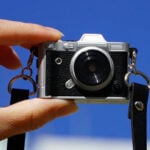
The object of this infatuation is the Kodak Charmera. This is a finger-sized rectangle of plastic that purportedly mimics the Kodak Fling 200 of 1987, which was a disposable camera that used 110 format film. Laughably, a 110 format film cartridge dwarfs the Charmera.
[Related Reading: How to Find Kodak Charmera When It’s Sold Out]

But this ain’t 1987 and the Charmera has been “modernized” to appeal to the masses. Sporting a 1.6MP sensor that’s being exposed through a 35mm f/2.4 plastic lens with the results shown on a low-resolution LCD screen, it makes you wonder exactly what is “modern” about this camera.
[Related Reading: Best Toy Camera Alternatives to Kodak Charmera]
I Won’t Get Charmed, Again
Ironically, the Charmera is a RETO Production camera, just like the Kodak Snapic A1 camera. That’s where any similarity ends, however, because the 35mm Snapic is at the opposite end of the camera spectrum from the Charmera.

Thank goodness, RETO didn’t skimp on the actual construction of the Charmera. The camera is a well-made chewing gum pack-sized chunk of plastic that is trimmed with thickly printed graphics. Additionally, each of the five pushbuttons are easily accessed and faithfully command all camera actions.
A microSD card is not included with the Charmera. Virtually any size capacity will work, but opting for the smallest size that is manufactured by the cheapest vendor would be a prudent choice. In this regard, a Kodak-branded 16GB card would be an ideal candidate.

In operation, Charmera makes a cheesy “motordrive” sound when the shutter button is released. Similarly, every other key echos an annoying chime when pressed. Otherwise, this is a simplistic snapper that is hindered by its petite form factor and “modern” specifications.
Supporting this mediocre hardware is a silly software mandate. When the Charmera is powered ON, the user must select the mode of operation, for example, photo or video, every single time. While the date/time can be “saved” by the camera’s operating system, this crucial mode setting becomes an unfortunate speed bump in throttling candid photographic operation.

Of course, the Charmera is very pocketable, but at what cost, you might ask? A Badgera is a much more capable camera at one third the cost of Charmera. But capability and cost don’t seem to be the driving factors that are propelling this blind box camera craze.
It might be the thrill of the chase that’s turning perfectly respectable photographers into impulse-buying camera charm collectors. Sure the Charmera is a cute little knickknack, but your integrity might be better served by hanging a Leica rope keychain from your camera’s strap eyelet, instead.
All critiques of its physical specifications aside, can the Charmera provide any semblance of a practical photographic experience? You be the judge. Study this collection of sample photographs taken with the Kodak Charmera.


If you foolishly elect to throw caution to the wind and make an ill-advised purchase of the Kodak Charmera, please, please save the last crumb of your dignity by eschewing the viewfinder during operation. Your children will thank you.
Enjoy.
See more from DIYPhotography.net on Google
Add DIYPhotography.net as a trusted source. This makes
our stories more likely to appear in your Google Search results.
 Add as a preferred source on Google

David Prochnow
Our resident “how-to” project editor, David Prochnow, lives on the Gulf Coast of the United States in Ocean Springs, Mississippi. He brings his expertise at making our photography projects accessible to everyone, from a lengthy stint acting as the Contributing How-To Editor with Popular Science magazine. While you don’t have to actually build each of his projects, reading about these adventures will contribute to your continued overall appreciation of do-it-yourself photography. A collection of David’s best Popular Science projects can be found in the book, “The Big Book of Hacks,” Edited by Doug Cantor.

Join the Discussion
DIYP Comment Policy
Be nice, be on-topic, no personal information or flames.