

















Kirill Neiezhmakov Behind the Edit: How ‘Amsterdam in Royal Motion’ Was Shot in 2.5 Days?
Jul 21, 2025
Anzalna Siddiqui
A psychology major in her third year of Bachelor’s, Anzalna Siddiqui has endless curiosity for the human mind and a deep love for storytelling – both through words and visuals. Though she hasn’t taken up photography as a profession, her Instagram is where her passion finds its home. In addition to this, she’s a travel enthusiast who never travels without her camera because every place has a story waiting to be captured.
Share:
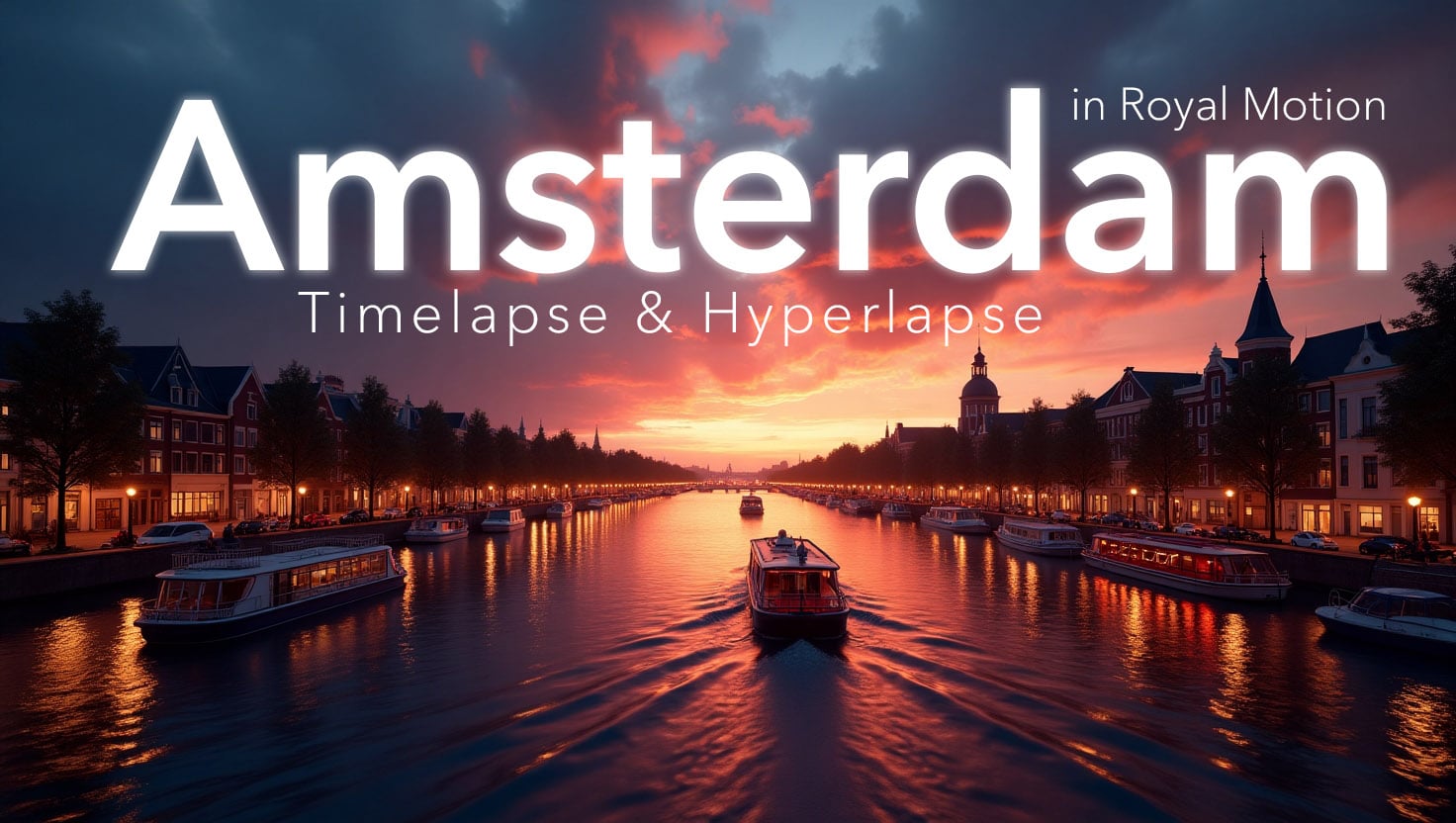
In just under three minutes, Kirill Neiezhmakov’s “Amsterdam in Royal Motion” incorporates more visual rhythm than any feature film. Using smooth hyperlapses, precisely timed morph transitions, and a rigorous shooting plan, the film whisks viewers away on a kinetic, atmospheric tour through one of Europe’s most architecturally unique cities.
Shot in two and a half days in mid-August 2024, Amsterdam in Royal Motion was created during a six-week solo journey that took Neiezhmakov from Lisbon across Spain, France, Germany, and the Netherlands, then back home. Amsterdam had been an artistic aspiration for him for a long time; its crossing canals, stacked past, and architectural complexity offering a specific type of motion to explore and bring into time.
Amsterdam in Royal Motion: Layering Place, Rhythm, and Transition
The movie quietly opens over the Amstel River, the Munttoren tower shining against a pastel horizon. But what begins as peaceful quickly becomes a kinetic composition of Amsterdam’s old and new: the storied Dancing Houses, the pulsating energy of Dam Square, and trams cutting through Damrak, every frame packed with movement. Morph transitions smoothly sweep us from place to place, instilling a sense of visceral geography.
“Something is fascinating about how the canals seem to pulse with even more life than the roads,” Neiezhmakov shared. “My goal was to show that motion not only through the scenes themselves, but through the visual tempo of the film.”
Centraal Station functions not only as the anchor and catalyst of the story, but also as a hub through which the action spreads: from there, we move through the Rijksmuseum, Royal Concert Hall, and Stedelijk Museum to loop back around to the National Opera, Maritime Museum, and the twisting canals of the old center. It all seems tightly choreographed but spontaneous, a combination of pre-planned shots and on-the-spot improvisation. Kirill ended up shooting 60 sequences; 40 were edited into the final version.
Most strikingly, no drone, no gimbal, no fancy camera rig. Only patience, shoe leather, and a comprehensive map with location notes, timed visits, and weather observations. Landmarks like the Royal Palace had to be abandoned at the last minute because of restoration scaffolding. “I adjusted the list depending on light, composition, and how the location felt on-site,” he explained.
Tools, Techniques, and AI Experiments
The equipment list stays compact: Canon 5D Mark III and EOS R bodies with Canon, Sigma, and Laowa lenses, and two tripods with geared heads. Post-production was completed using Lightroom, LRTimelapse, and Adobe After Effects. New to this shoot was an in-depth exploration of AI-powered transitions. Kirill tested software such as Pixverse and Dream Machine, ultimately deciding that Pixverse was more stable for the smooth, architectural morphs he had in mind.
“I see AI as an extension of my creative toolbox,” he said. “It’s not about replacing the craft, but enhancing it.”
AI-enhanced morphs helped in tightening transitions without jarring visual gaps. Used sparingly, they complement the natural hyperlapse motion, pushing scenes along without disrupting realism. Kirill remains cautious about AI’s role, especially in a genre like timelapse, where the beauty lies in capturing light and time authentically. But he welcomes the future: “If it can take over the boring, time-consuming parts of editing or stabilization, that gives creators more space to focus on imagination and composition.”
Soundtrack, Structure, and Serendipity
Technically, the toughest job was balancing scenes with the tone and structure of the soundtrack. With no time to shoot, he feared there would not be enough variety. The weather cooperated, and only a half-day was lost to rain, but last-minute decisions and on-location surprises kept tension high.

His go-to scene? The day-night hyperlapses. “They are technically more difficult and time-consuming, but visually they are some of the most rewarding. The city comes alive with illumination; it creates a magical effect when done right.”
If the film’s first act captures Amsterdam’s grandeur and design, its second act is all about tempo and visual energy. We are taken from river reflections to canal traffic, barges sliding past historic homes, and flower markets fading into golden-hour light. The Oude Kerk and Beurs van Berlage nod to the city’s layered history, while the final act, drenched in deep twilight blues and glowing streetlights, settles the pace with a cinematic goodbye.
Neiezhmakov’s transitions are more than visual illusions. They are working for the architecture, capturing how buildings and spaces coalesce into one another through the city’s narrow streets and curved canals. The result is immersive, occasionally hypnotic. And when you think it is all going to fade to black, the Munttoren tower pops back into view, enveloped by trams, pedestrians, and the unmistakable flow of a city that never truly sleeps.
“With more time, I would’ve worked out a more structured narrative and added a stronger, more dynamic opening,” Kirill admitted. “But considering the constraints, I’m happy with what I was able to accomplish in such a short span.”
However, there is truth to it. Amsterdam has a sense of spontaneity in Royal Motion that is difficult to manufacture. It has a lived-in feel. Transitory. But also deeply thought out.
Final Thoughts
Neiezhmakov’s film is a wonderful representation of what you can do with a story, and that too without too much process when you leave your footage alone. Sure, there is AI involved. But the rhythm, the composition, the movement of the camera through the city? That is still intensely human, and that is what it reveals.
From a visual narrative standpoint, I thoroughly enjoy how the film does not overachieve in being too perfect or symmetrical. Transitions work with the rhythm. Music swells, but it does not intrude. The editing strikes a fair balance between digital smoothness and analog restraint.
More than anything, it made me want to look at cities differently, not just as spaces to visit, but as stories in motion. If you are into time-lapse, travel, or architecture, this one is worth your three minutes.
Watch the video below and make sure to follow Kirill on Instagram, YouTube, and Facebook.
[Amsterdam in Royal Motion. Timelapse & Hyperlapse with AI morphing transitions you never seen before]
See more from DIYPhotography.net on Google
Add DIYPhotography.net as a trusted source. This makes
our stories more likely to appear in your Google Search results.
 Add as a preferred source on Google

Anzalna Siddiqui
A psychology major in her third year of Bachelor’s, Anzalna Siddiqui has endless curiosity for the human mind and a deep love for storytelling – both through words and visuals. Though she hasn’t taken up photography as a profession, her Instagram is where her passion finds its home. In addition to this, she’s a travel enthusiast who never travels without her camera because every place has a story waiting to be captured.
Related Posts
 Annie Leibovitz shoots British Royal Family portraits for The Queen’s 90th birthday celebration
 Royal Photographic Society puts 165 years-worth of its Journals online for free
 Winners announced of the 2022 Royal Horticultural Photographic Competition
 Winning photo of Royal Society of Biology’s contest will break your heart
Join the Discussion
DIYP Comment Policy
Be nice, be on-topic, no personal information or flames.