
















How a photo walk almost turned deadly
Jan 29, 2019
Tim Shields

We love it when our readers get in touch with us to share their stories. This article was contributed to DIYP by a member of our community. If you would like to contribute an article, please contact us here.
Share:

On December 20th, 2018, a winter storm in the City of White Rock, British Columbia, Canada made for some dramatic photos and resulted in the helicopter rescue of one man.
The event started out as a photo walk with my adult daughter. Waves were crashing against the shoreline as we walked along the promenade which is a pathway usually busy with walkers. The wind was blowing in strong gusts and picking up water with it.
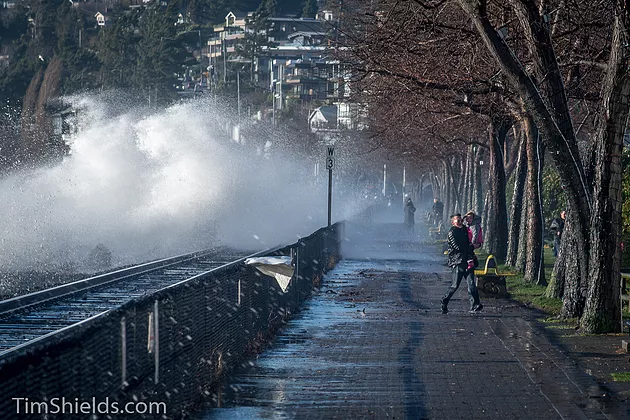
A man holding a child runs to avoid the blowing surf from a crashing wave.
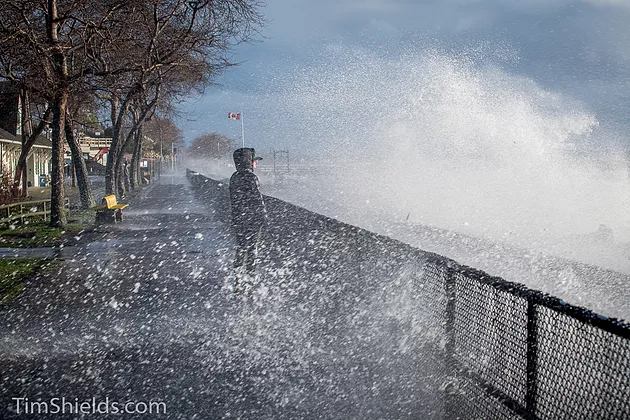
Many people walked to the ocean shore to witness the weather event.
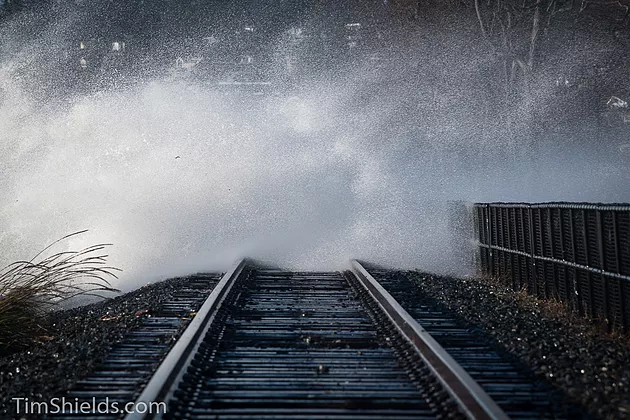
The train tracks in White Rock covered with blowing surf from crashing waves.
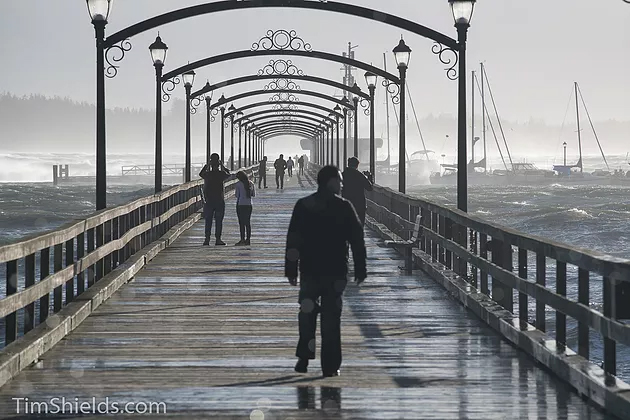
We walked out onto the pier. There was no sense of danger at the time. The pier was busy with other people walking out to the end where there is a large rock breakwater that protects about 25 boats that are always moored there. The pier felt secure and there was no indication of what was to come. This pier has been the icon of White Rock for the past 100 years and it has withstood many storms stronger than this one.
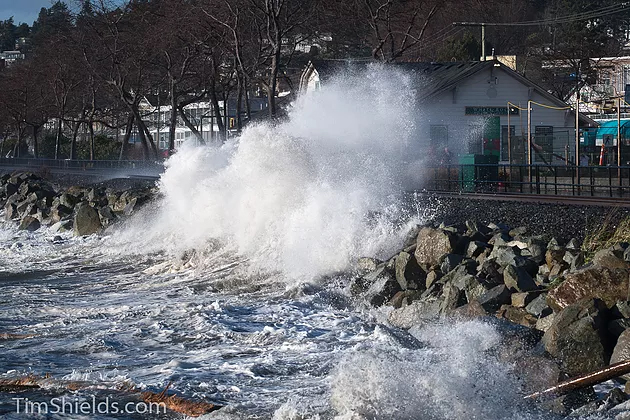
The view from the pier allowed us to see The White Rock museum as it was covered in blowing water from crashing waves.
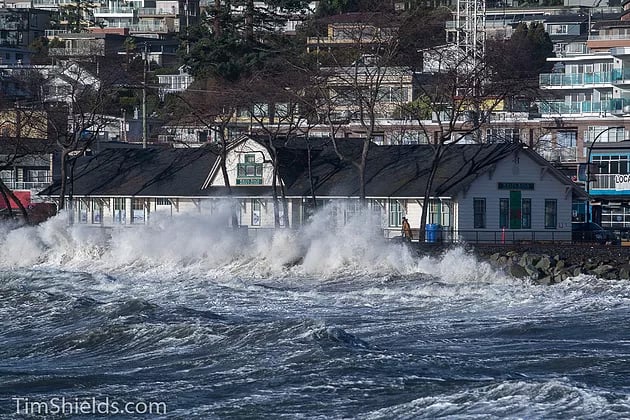
A long crashing wave in front of the White Rock museum. The building wasn’t flooded, but it looked like it from this vantage point.
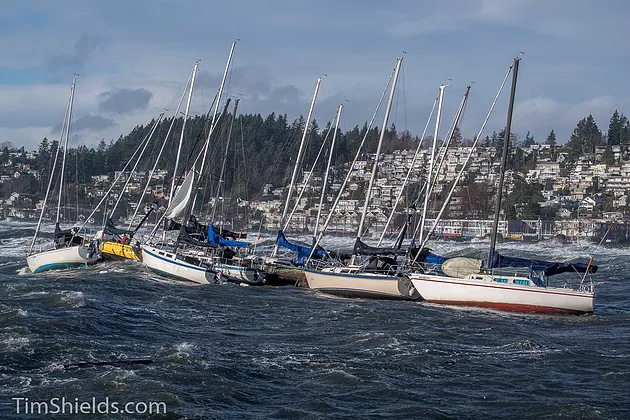
A dock with about 12 sailboats tied to it broke loose from its mooring at the end of the pier. The dock and sailboats were being blown in the direction of land. If you look closely, you can even see two light standards on the dock.
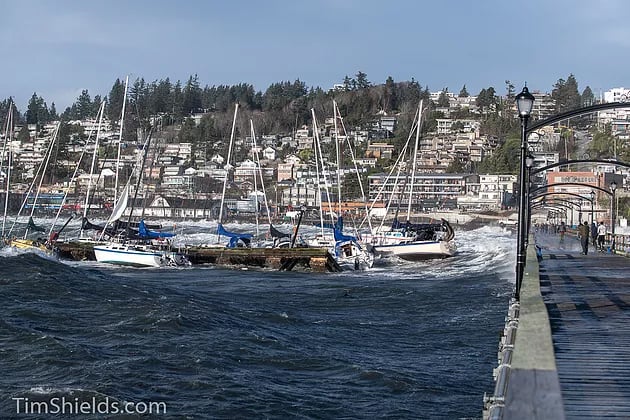
The moving dock and boats changed direction and headed towards the pier. This change in direction happened quickly. At this point, the pier was still stable and solid.
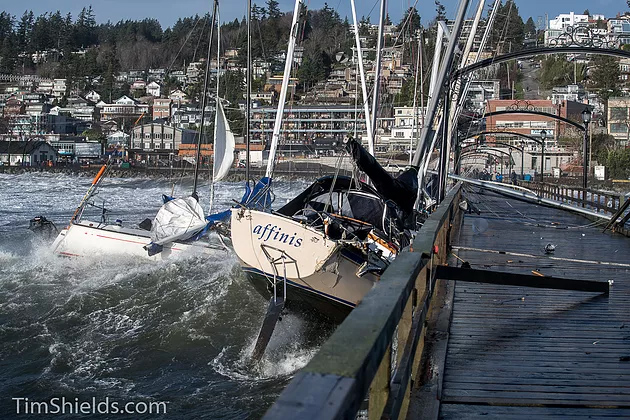
The boats struck the pier and almost immediately two masts came crashing down on the pier deck in a tangle of cables. The masts and cables were flailing up and down in a dangerous mess. As soon as the boats came in contact with the pier, the pier deck began pitching and heaving. We had to make a decision, do we run towards land now and risk having a third mast fall on top of us, or do we wait?
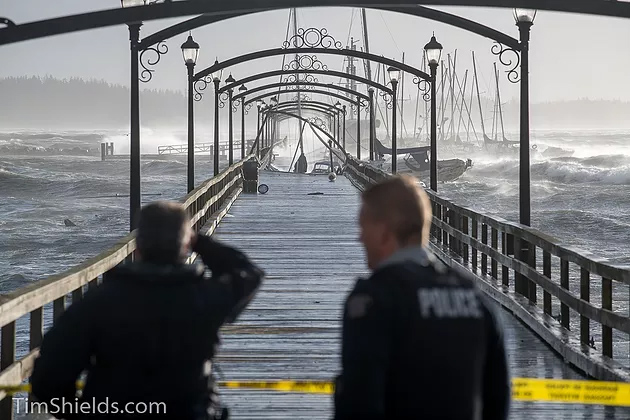
We ran for it. There were five of us who ran through the fallen masts and tangled cables. It was a dramatic and scary moment in time. The pier deck broke up very quickly after we crossed over.
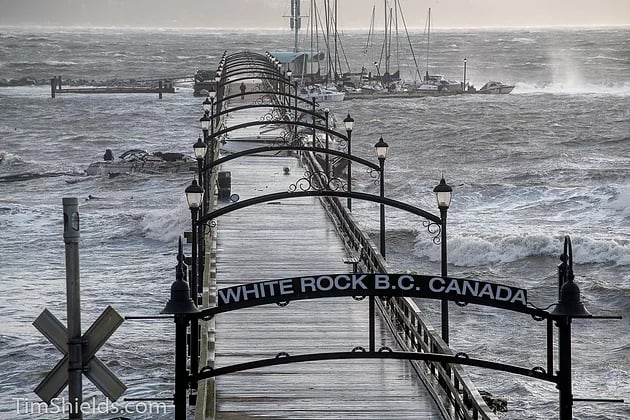
One man who had been alone at the very end of the pier was cut off from land. He can be seen in this photo standing alone. The pier has clearly been cut into two parts by the boats.
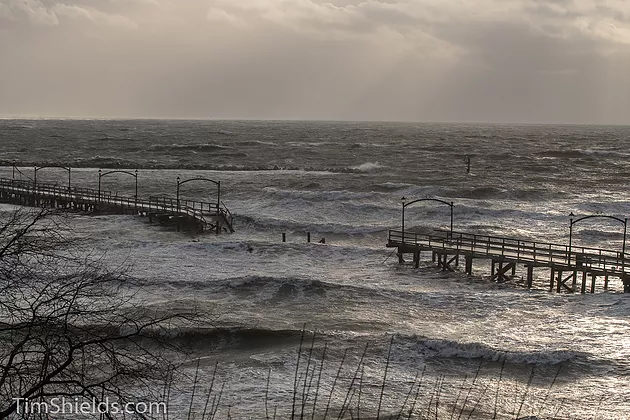
The damage caused by the boats was extensive. It seemed as if the boats themselves were crushed by the process and all but one of them disappeared. 12 boats … down to just one. And the stranded man was still at the end of the pier.
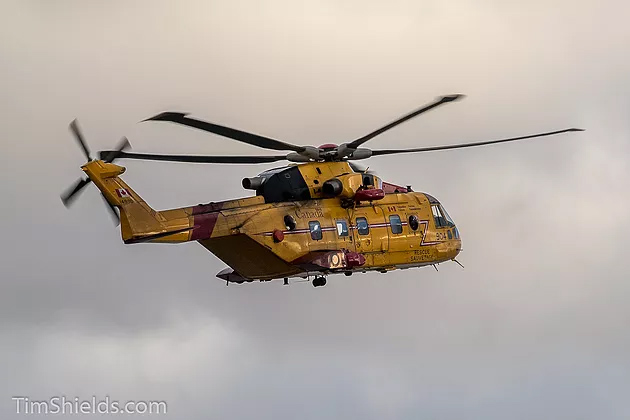
A Canadian Armed Forces search and rescue helicopter was dispatched to the scene from Vancouver Island to rescue the stranded man.
A rescue diver was lowered down to the man, and they were both lifted to safety. The pier remains closed with no set date to fix it.
The takeaway as a photographer is all about risk assessment. During situations such as this, or even when crawling around at the top of a canyon or cliff, we photographers need to be conducting a continuous risk assessment. But the problem is that as people we are often not very good at doing two things well at the same time. You can either concentrate on taking good photos or concentrate on your risk assessment. It is very difficult to do both at the same time. This applies to photography in a windstorm equally as much as it applies to photography while standing at the top of a canyon. Danger can sneak up on you slowly, or it can hit suddenly. In my situation it was a bit of both. Although we cannot foresee every possible eventuality and outcome, we can however continually assess the level of risk we are in and be quick to move yourself out of harm’s way.
Late January 2019 updates: The Weather Channel from Atlanta, Georgia sent a video crew to the City of White Rock and they gathered my video footage and interviewed me and others. They will be creating a five minute segment on this event.
The Mayor of White Rock announced on January 24th, 2019 that it will cost up to $16 million to replace the broken pier with a concrete pier structure. There is no timeline for fixing it. The pier remains gated off and now White Rock has the appearance of an empty and lonely place…a ghost town.
Robbie Knievel, son of legendary motorcycle stunt man Evel Knievel, has offered to put on a show for the opening ceremony of the pier by jumping it on his motorcycle. The reception to this idea has been somewhat frosty. I think it would be an epic event. Make it happen!
Update January 28, 2019: I created a new video using the original video footage I shot during the storm. This video is my firsthand account of how a simple photo walk almost turned deadly.
About the Author
Tim Shields is a master photographer in fine art, landscape photography coach and eCommerce entrepreneur from Vancouver, British Columbia, Canada. You can see more of his work on his website and follow him on Instagram, Facebook, Twitter, and Flickr. This article was also published here and shared with permission.

We love it when our readers get in touch with us to share their stories. This article was contributed to DIYP by a member of our community. If you would like to contribute an article, please contact us here.


Join the Discussion
DIYP Comment Policy
Be nice, be on-topic, no personal information or flames.
One response to “How a photo walk almost turned deadly”
I have been on that pier and down on the docks several times, but only on calm days. It would have been thrilling to be out there during that storm. As an avid sailor, I would have been interested in seeing the docks to which the sailboats were moored being curious about how the boats were riding out the storm and how well their moorings were holding up. Perhaps those observations may have revealed impending danger for a dock breaking loose. I wonder if the dock actually come apart, or did it “float over” the pilings which holds it in place.
After the dock broke loose it should have been obvious what direction it would drifted and perhaps early action could have been taken before it collided with the pier. The video shows waves direction crashing onto the pier at an approximate angle of 45 degrees though this may have been overlooked standing at the end of the pier because that area is in the lee of the breakwater. Another indication of drift was a partially unfurled sail on one of the sailboats showing the wind was blowing onto the dock. Even if there was no unfurled sail indicating wind direction, one should have been able to feel the wind. The dock may have drifted parallel to the pier initially, but one could have anticipated a change in direction after it moved out from the lee of the breakwater.
Would I have evacuated the pier? If other people were there I would have pointed out the pending danger to unsuspecting storm watchers prior to the collision and perhaps encouraged everyone to leave by setting the example myself. One thing is certain, after the collision with the pier occurred, it remained safe at the end of the pier and I would never have risked trying to work my way through the tangled mess of rigging that was laying on the pier given how violently the boats were moving in the water and the fact that all this “stuff” was still attached to the boats. Without regard to the pier breaking up, the biggest risk would be getting feet tangled in the cables or lines laying across the pier and then being pulled into the water with a severe injury. There was also risk of being struck from above by a mast or other falling bits when moved through the danger area. Fortunately there were no injuries or loss of life, but there very easily could have been.
C.B. Edmonton