





















This is the Highest-Resolution Image Ever of Our Sun’s Surface
Aug 8, 2026
Soumyadeep Mukherjee
Soumyadeep Mukherjee is an award-winning astrophotographer from India. He has a doctorate degree in Linguistics. His work extends to the sub-genres of nightscape, deep sky, solar, lunar and optical phenomenon photography. He is also a photography educator and has conducted numerous workshops. His works have appeared in over 40 books & magazines including Astronomy, BBC Sky at Night, Sky & Telescope among others, and in various websites including National Geographic, NASA, Forbes. He was the first Indian to win “Astronomy Photographer of the Year” award in a major category.
Share:
For most of human history, the Sun was a featureless disc. Even after Galileo turned a telescope towards it, observers could see little beyond sunspots and the broad structure of the solar surface. Modern solar telescopes changed that picture, revealing granules, magnetic fields, and violent eruptions. Yet many of the processes that control the Sun still occur on scales too small to resolve.
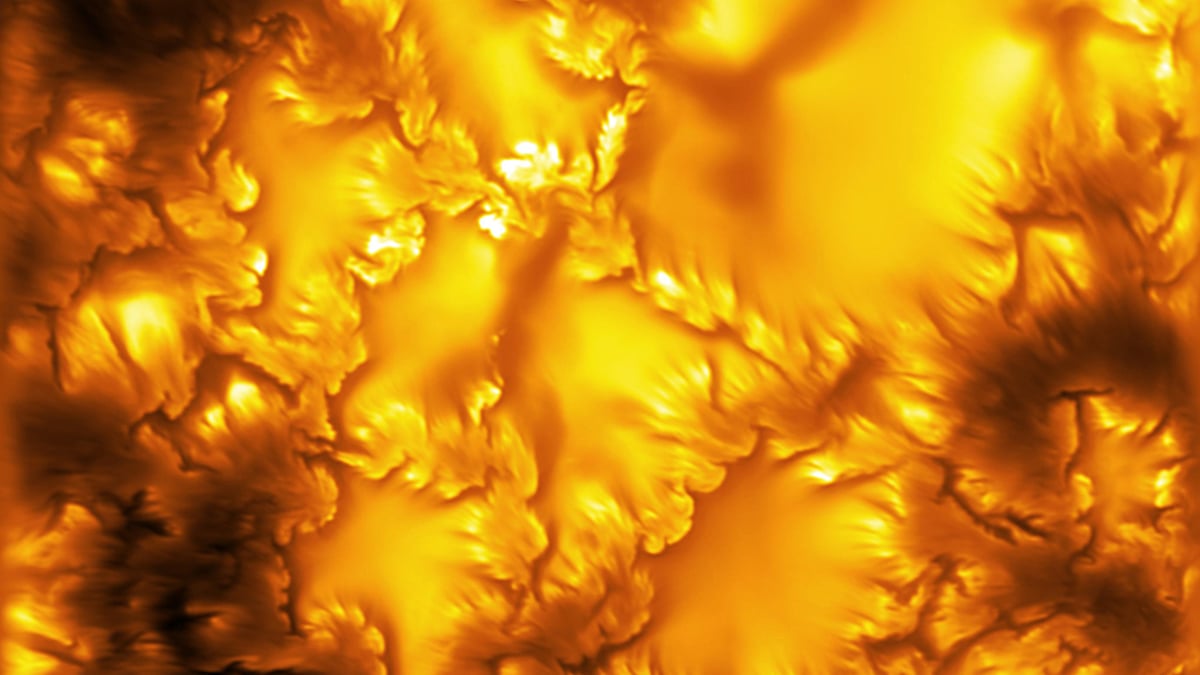
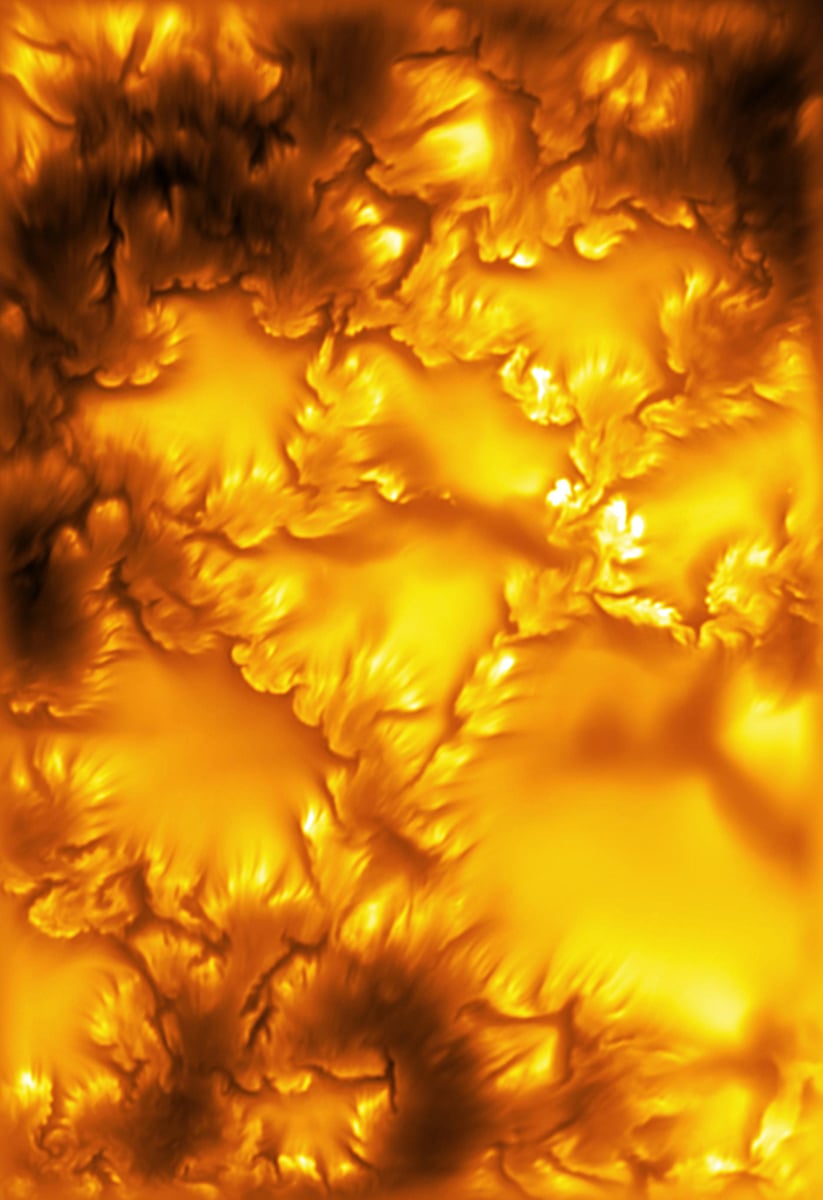
The latest observations from the National Science Foundation’s Daniel K. Inouye Solar Telescope (DKIST) have once again pushed the limits. The 4-metre telescope on Maui has captured the highest-resolution images yet of the Sun’s visible surface, resolving structures down to about 19 kilometers. These observations have also produced a major discovery. Researchers have identified the telltale signatures of Kelvin–Helmholtz instability in the solar photosphere.
Solar surface seen at extraordinary detail
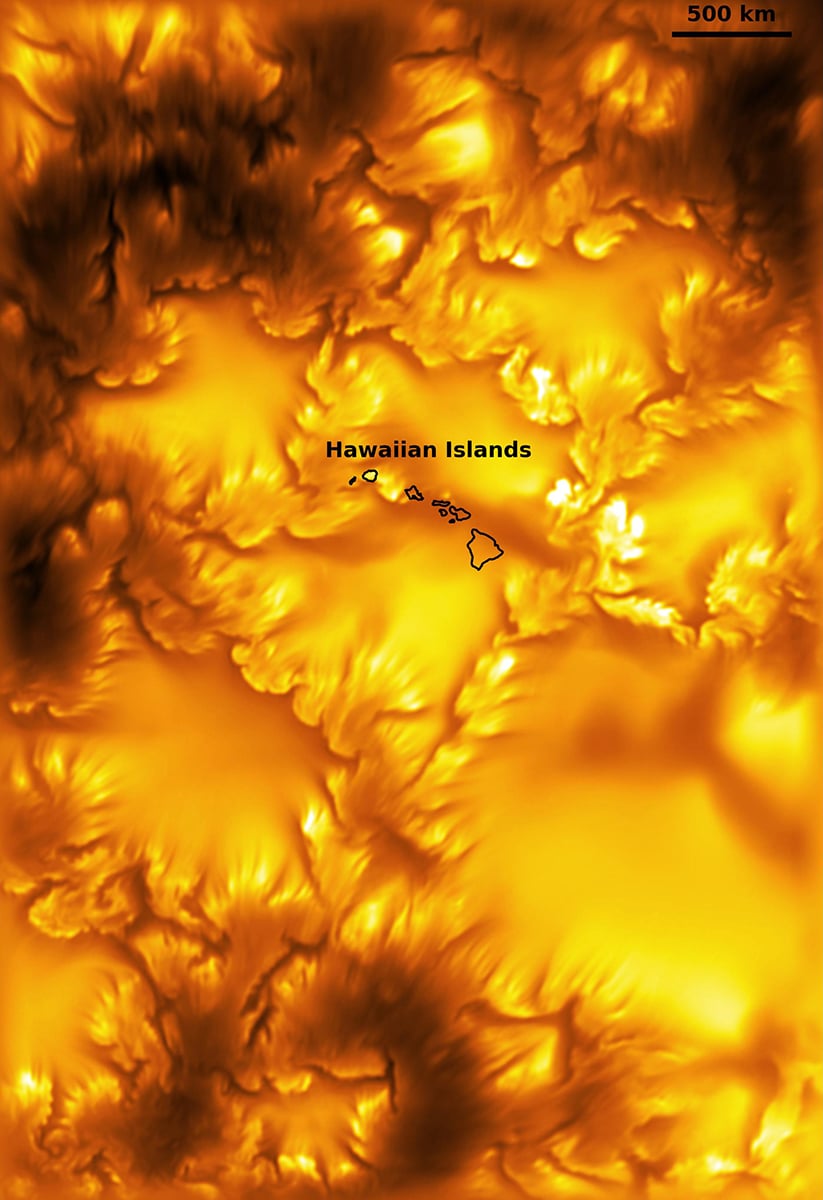
The photosphere is the layer we usually call the Sun’s surface. It is the source of most of the visible sunlight reaching Earth, but it is not a solid boundary. Hot plasma is constantly in motion. Convection carries energy from deeper layers towards the surface, producing the familiar pattern of bright granules separated by darker lanes. Those granules are enormous by human standards. Many stretch for hundreds or even thousands of kilometers.
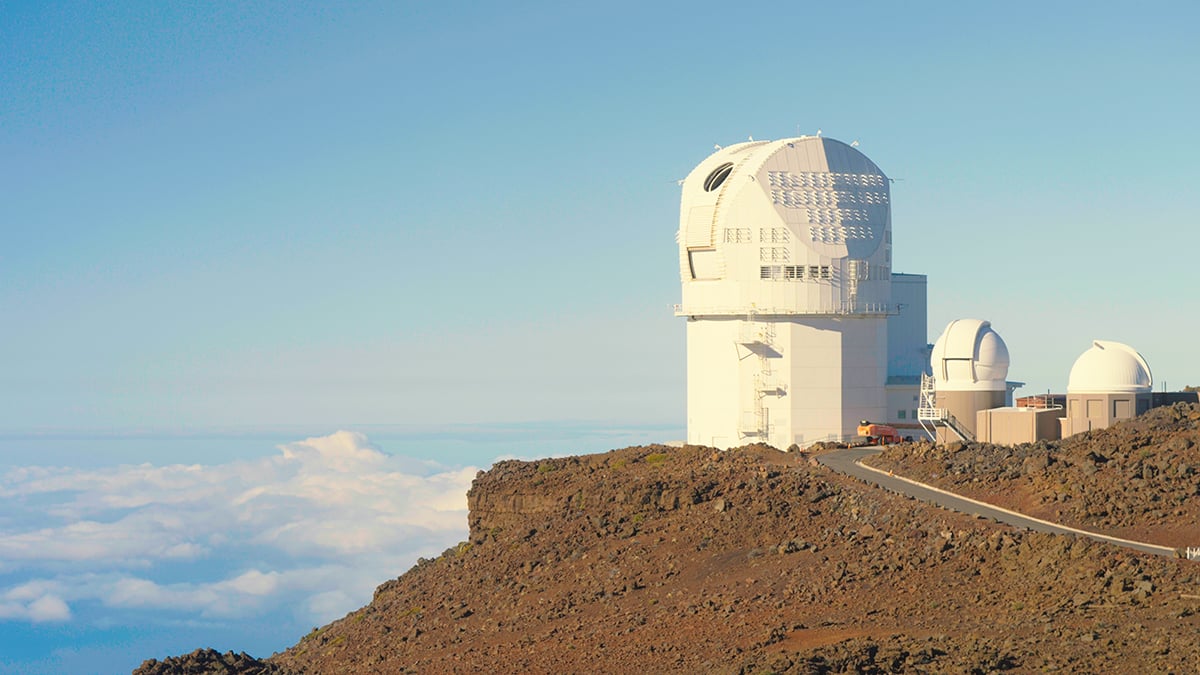
The DKIST was designed to resolve these structures. Its primary mirror is four meters across, making it the largest mirror on any solar telescope. It collects about seven times more sunlight than other solar telescopes, while its adaptive-optics system corrects for the blurring produced by Earth’s atmosphere. The telescope’s off-axis optical design also helps suppress scattered light, which is especially important when studying fine structures beside much brighter regions.
The improvement in resolution is substantial. The telescope’s first-light images in 2020 resolved features around 30 kilometers across. In 2025, observations reached about 20 kilometers and revealed extraordinarily narrow magnetic striations along the walls of solar granules. NSO described those observations as the sharpest view of the solar surface at the time. The latest observations reach roughly 19 kilometers.
The Sun’s surface is full of moving plasma
A conventional photograph of the Sun can give the impression of a relatively calm surface. In reality, the photosphere is governed by convection, where hot plasma rises, releases energy, and sinks again as it cools. Magnetic fields emerge through this moving plasma and become concentrated into small structures.
The interaction between these two components is one of the central problems in solar physics. Magnetic fields do not sit above the plasma. The plasma drags on them, bends them, and pushes them around. The fields, in turn, influence how the plasma moves. At small scales, this interaction becomes complicated very quickly.
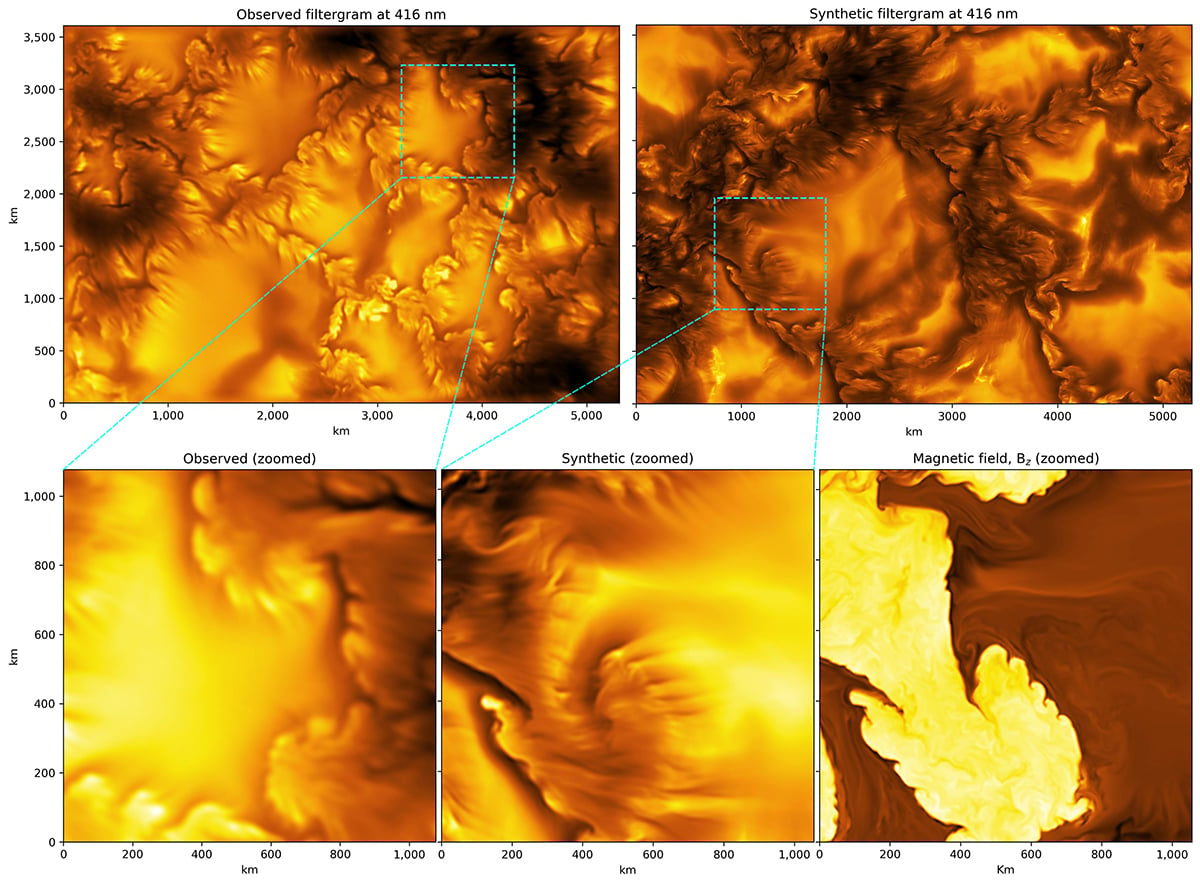
The new DKIST observations show just how complicated it can become. The researchers found small, curved structures developing around concentrated magnetic regions. In time-lapse observations, these structures evolve and form patterns resembling miniature vortices.
The researchers also found that the structures behaved as expected for Kelvin–Helmholtz instability. Computer simulations of the solar photosphere produced similar patterns, allowing the team to compare the observed structures with a model of the underlying physics.
Kelvin–Helmholtz instability
Kelvin–Helmholtz instability is a basic process in fluid dynamics. It appears when two adjacent flows move at different velocities. The difference creates a velocity shear at their interface. If the conditions are right, a small disturbance grows instead of disappearing. The boundary begins to ripple. These ripples become larger and eventually curl into vortices.
The same physics can produce distinctive cloud formations in Earth’s atmosphere. It can also occur in ocean currents and in many astrophysical plasmas. Solar physicists have previously found evidence of Kelvin–Helmholtz instability in parts of the Sun’s atmosphere, including jets and other dynamic structures.
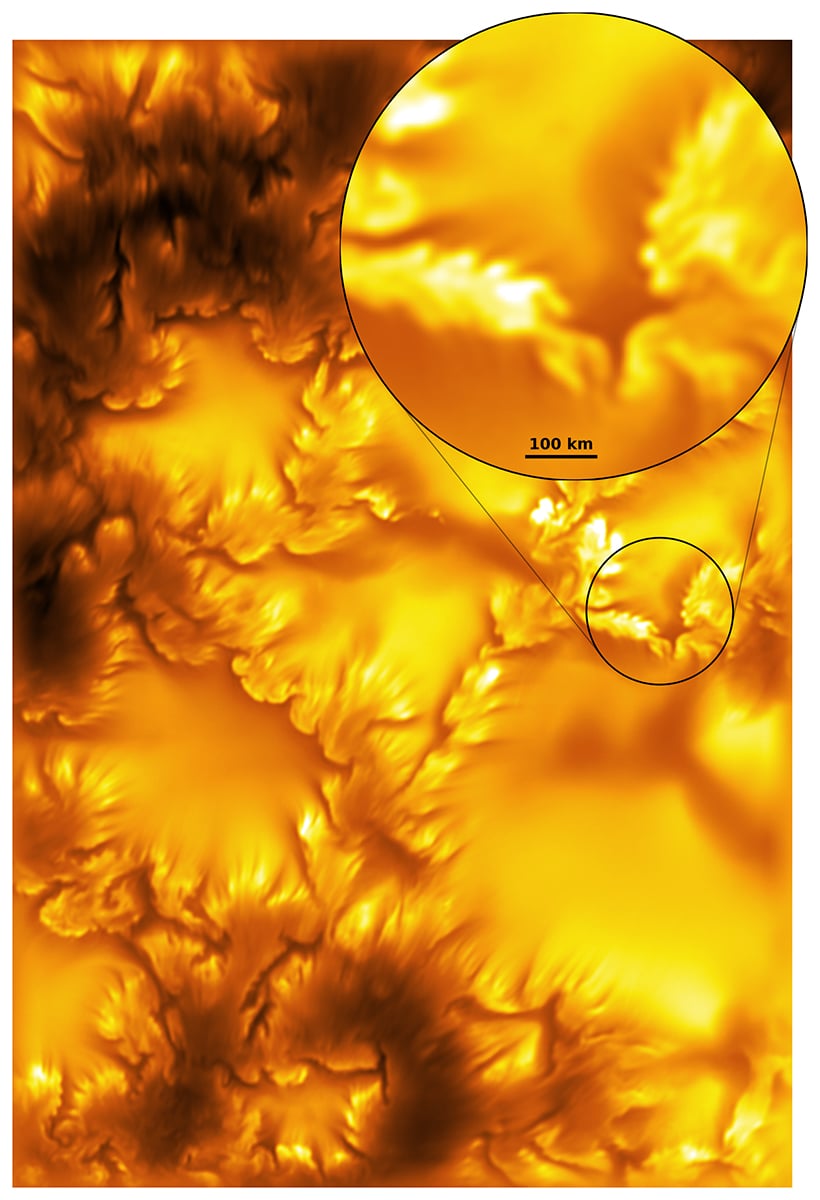
The new observation catches the instability operating in the photosphere itself. The photosphere sits at the bottom of the Sun’s visible atmosphere, where turbulent convection and magnetic fields interact. It is also the region where magnetic structures emerge from the solar interior and begin their journey into the higher atmosphere.
The Inouye observations show that velocity shear can produce a cascade of small vortices around these magnetic concentrations. The vortices mark the movement of plasma and magnetic fields at scales that previous observations could not resolve.
Clear skies!
See more from DIYPhotography.net on Google
Add DIYPhotography.net as a trusted source. This makes
our stories more likely to appear in your Google Search results.
 Add as a preferred source on Google

Soumyadeep Mukherjee
Soumyadeep Mukherjee is an award-winning astrophotographer from India. He has a doctorate degree in Linguistics. His work extends to the sub-genres of nightscape, deep sky, solar, lunar and optical phenomenon photography. He is also a photography educator and has conducted numerous workshops. His works have appeared in over 40 books & magazines including Astronomy, BBC Sky at Night, Sky & Telescope among others, and in various websites including National Geographic, NASA, Forbes. He was the first Indian to win “Astronomy Photographer of the Year” award in a major category.




Join the Discussion
DIYP Comment Policy
Be nice, be on-topic, no personal information or flames.