



















ESA’s Solar Orbiter Snaps Powerful Coronal Mass Ejection
Sep 2, 2025
Soumyadeep Mukherjee
Soumyadeep Mukherjee is an award-winning astrophotographer from India. He has a doctorate degree in Linguistics. His work extends to the sub-genres of nightscape, deep sky, solar, lunar and optical phenomenon photography. He is also a photography educator and has conducted numerous workshops. His works have appeared in over 40 books & magazines including Astronomy, BBC Sky at Night, Sky & Telescope among others, and in various websites including National Geographic, NASA, Forbes. He was the first Indian to win “Astronomy Photographer of the Year” award in a major category.
Share:

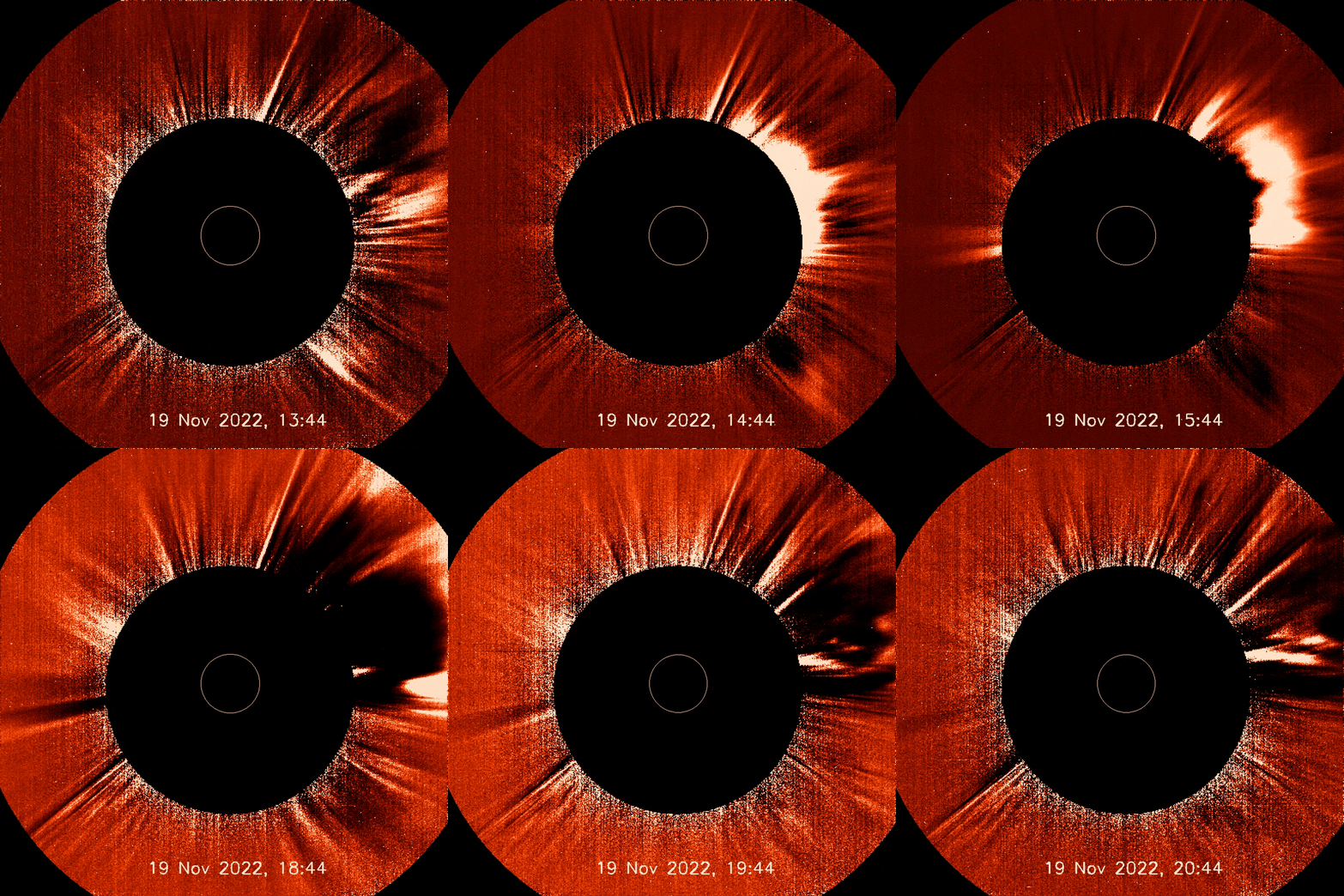
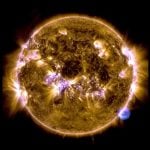
In September 2025, the European Space Agency released a remarkable image from its Solar Orbiter mission. The picture shows a coronal mass ejection (CME) captured by Metis, a coronagraph onboard the spacecraft. It was taken in November 2022 and highlights the power of modern solar observation. CMEs are immense eruptions of plasma and magnetic field from the Sun’s corona. They can travel millions of kilometers into space and sometimes strike Earth. Such impacts disturb our planet’s magnetic field, leading to auroras but also potential risks for satellites, communications, and power systems. Understanding how CMEs form and evolve is therefore critical.
The role of Solar Orbiter and Metis
Solar Orbiter was launched in February 2020 as a joint mission between ESA and NASA. Its goal is to study the Sun up close and from unique angles. The spacecraft carries ten scientific instruments, divided between remote sensing imagers and in situ detectors. Together, they examine the solar atmosphere, the solar wind, and the magnetic environment of space.
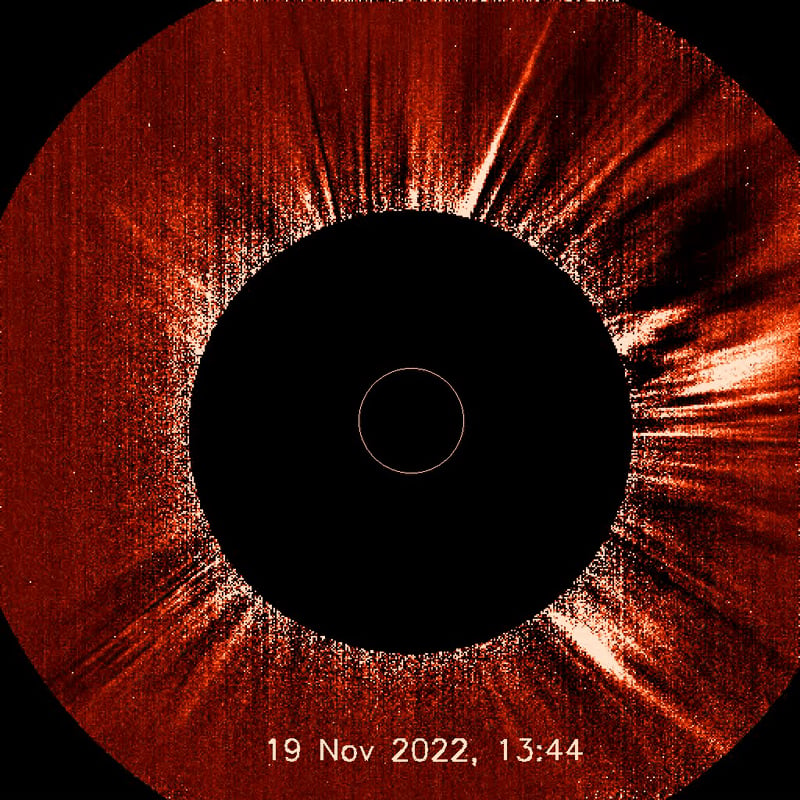
Metis is one of the key imagers. It is a coronagraph, meaning it blocks the bright solar disk so that the faint outer corona becomes visible. This method is similar to what happens during a natural solar eclipse. But unlike eclipses, Metis can observe continuously. What makes Metis unique is its ability to record the corona simultaneously in visible light and ultraviolet light. This dual view allows scientists to study both the density and temperature of coronal plasma.
When the CME erupted in November 2022, Metis had the perfect vantage point. It imaged the expanding plasma cloud as it burst from the Sun’s atmosphere. At the same time, Solar Orbiter’s particle detectors measured energetic electrons associated with the eruption. This combination provided strong evidence that the electrons originated in the same solar event captured by Metis.
Understanding coronal mass ejections
CMEs are among the most powerful solar phenomena. They carry billions of tons of plasma into space at speeds often exceeding a million kilometers per hour. These clouds are threaded with magnetic fields, which makes them particularly influential when they interact with Earth’s own magnetic system.
Previous missions such as SOHO and STEREO have provided long-term views of CMEs. They have shown their large-scale shapes and propagation through space. But Solar Orbiter, with its closer approach and advanced instruments, adds a new level of detail. Metis observes the inner corona where CMEs originate, while in situ detectors confirm their particle signatures.
In the November 2022 case, the synergy between imaging and particle data was especially valuable. The spacecraft detected bursts of solar energetic electrons at the same time that Metis observed the CME. This direct link helped confirm theories about how electrons escape the Sun during eruptions.
Scientific advances from Metis
Metis has already delivered several important findings since Solar Orbiter’s launch. One achievement has been its detailed study of solar streamers and the origin of the slow solar wind. Streamers are large structures in the corona that release plasma into space. By observing them in both visible and ultraviolet light, Metis helped characterize their density and temperature. With CMEs, Metis provides equally valuable contributions. Its field of view covers the region from 1.7 to 3.1 solar radii, exactly where eruptions begin to accelerate. Few instruments have observed this zone so clearly. Metis can track the early development of CMEs, including their fine structure and dynamics.
As Solar Orbiter continues its mission, more such observations will follow. Each one will add to our understanding of the Sun, its influence on the solar system, and its impact on Earth. The work of Metis is central to this effort, delivering clear and precise views of some of the most powerful events in the solar atmosphere.
Clear skies!
See more from DIYPhotography.net on Google
Add DIYPhotography.net as a trusted source. This makes
our stories more likely to appear in your Google Search results.
 Add as a preferred source on Google

Soumyadeep Mukherjee
Soumyadeep Mukherjee is an award-winning astrophotographer from India. He has a doctorate degree in Linguistics. His work extends to the sub-genres of nightscape, deep sky, solar, lunar and optical phenomenon photography. He is also a photography educator and has conducted numerous workshops. His works have appeared in over 40 books & magazines including Astronomy, BBC Sky at Night, Sky & Telescope among others, and in various websites including National Geographic, NASA, Forbes. He was the first Indian to win “Astronomy Photographer of the Year” award in a major category.


Join the Discussion
DIYP Comment Policy
Be nice, be on-topic, no personal information or flames.