
























Chandra’s Cosmic Collection: A Dazzling Tour of the High-Energy Universe
Aug 9, 2025
Soumyadeep Mukherjee
Soumyadeep Mukherjee is an award-winning astrophotographer from India. He has a doctorate degree in Linguistics. His work extends to the sub-genres of nightscape, deep sky, solar, lunar and optical phenomenon photography. He is also a photography educator and has conducted numerous workshops. His works have appeared in over 40 books & magazines including Astronomy, BBC Sky at Night, Sky & Telescope among others, and in various websites including National Geographic, NASA, Forbes. He was the first Indian to win “Astronomy Photographer of the Year” award in a major category.
Share:
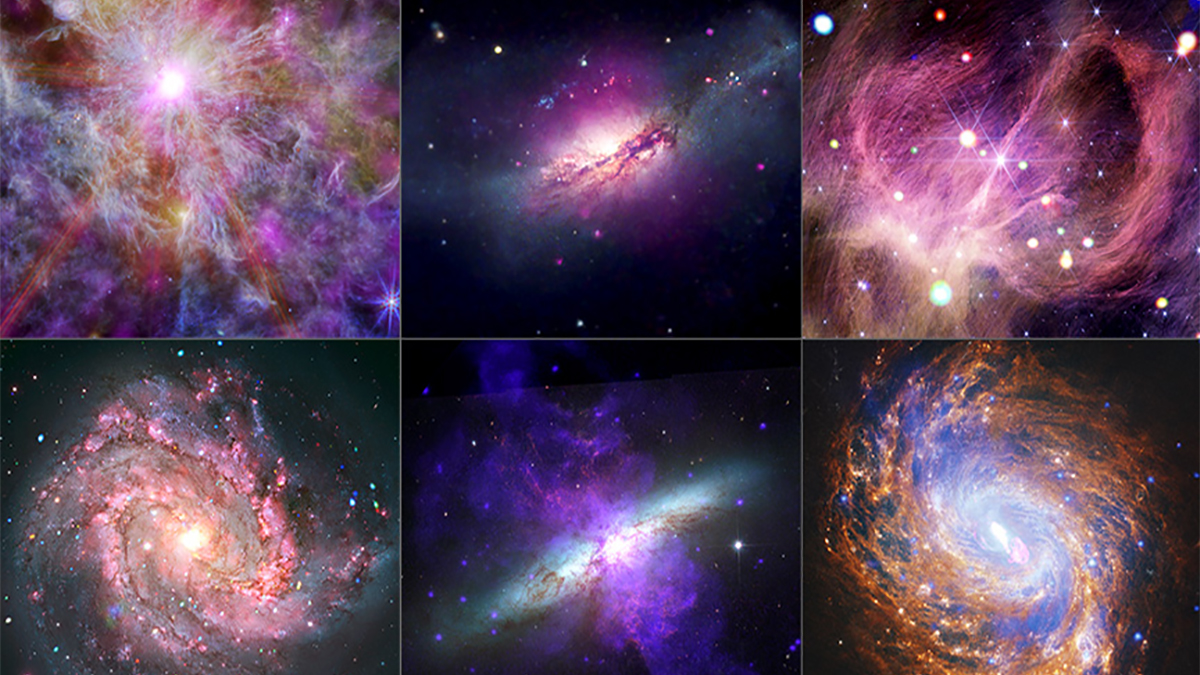
The Chandra X-ray Observatory has unveiled a breathtaking new set of images. Called the Cosmic collection, it brings together nine spectacular portraits of the universe. Each one blends Chandra’s X-ray vision with observations from other telescopes, including the James Webb Space Telescope, the Hubble Space Telescope, and powerful instruments on the ground. The result is a set of pictures that are not only beautiful but also packed with scientific insight. These images show some of the most energetic processes in the universe. X-rays reveal matter at millions of degrees. They expose the signatures of exploded stars, the glow of gas falling toward black holes, and the fierce winds from massive stars. When combined with data in optical, infrared, and radio light, they give a more complete view of how cosmic objects form, evolve, and interact.
A collaboration of light
Chandra’s role is unique. Since its launch in 1999, the observatory has been our sharpest eye on the high-energy universe. X-rays cannot pass through Earth’s atmosphere, so they must be observed from space. Chandra’s mirrors and detectors capture this rare form of light with unmatched precision. For the Cosmic collection, scientists layered Chandra’s data, often shown in purples, pinks, and blues, over imagery from other telescopes. The result is a tapestry where each wavelength adds a new thread. JWST’s infrared vision reveals cooler gas and hidden young stars. Hubble’s optical and ultraviolet data show familiar starlight and fine detail in dust lanes. Ground-based radio telescopes trace jets and clouds of charged particles. Together, they create an image far richer than any single telescope could provide.
The image collection
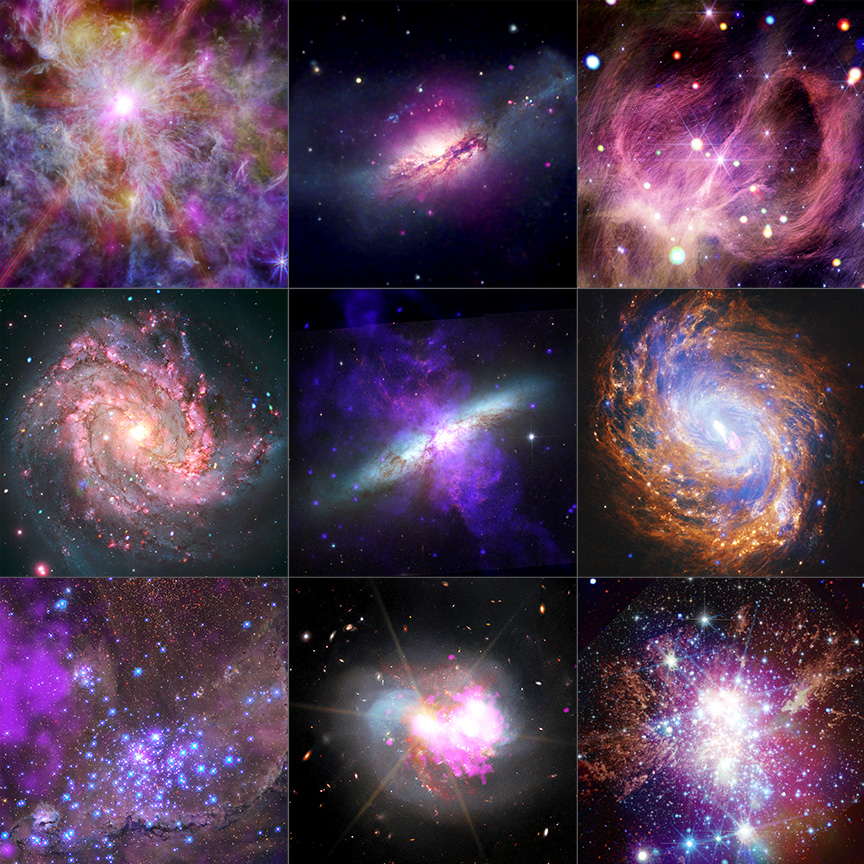
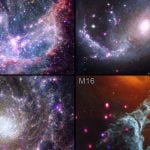
Here are some of the images from the “cosmic” collection:
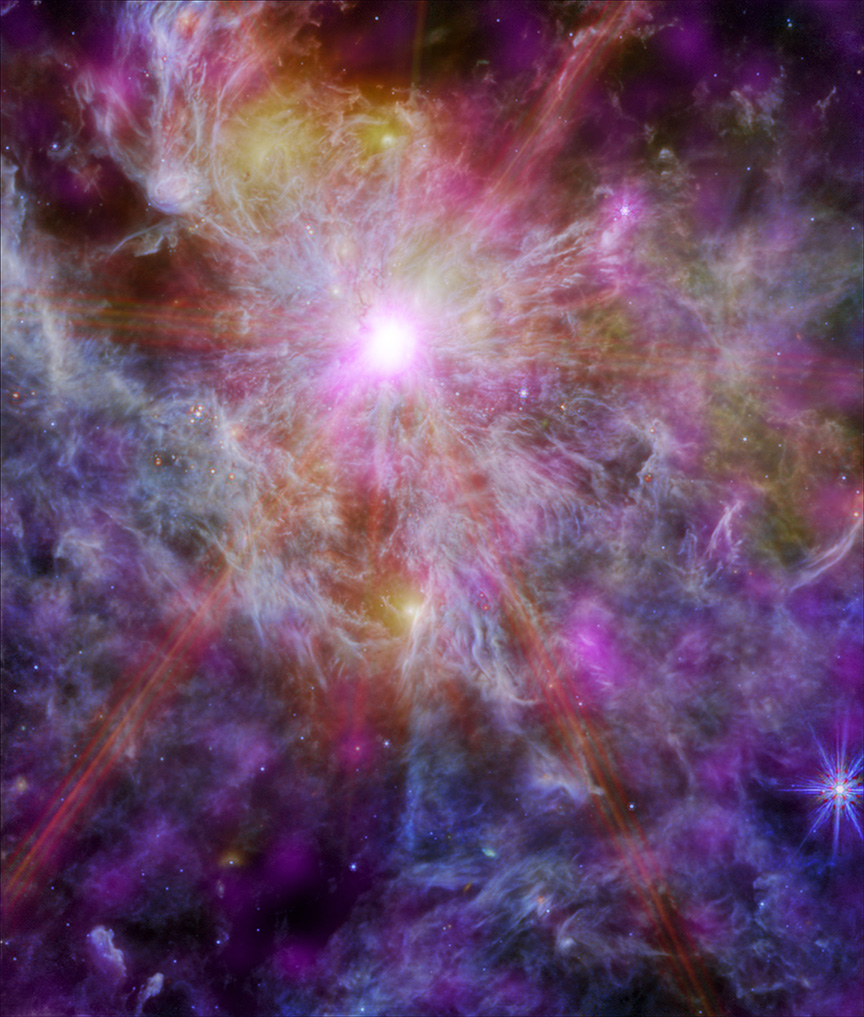
N79: A stellar nursery in the Large Magellanic Cloud
One of the collection’s gems is N79, a sprawling star-forming region in the Large Magellanic Cloud. This dwarf galaxy lies about 160,000 light-years away. In Webb’s infrared data, N79 glows with ribbons of dust and clusters of new stars. Chandra’s X-rays reveal a different story: hot, diffuse gas filling the spaces between stars. This is the aftereffect of stellar winds and explosions that have shaped the cloud over millions of years. The combination shows both the calm cradles of star birth and the violent forces that will one day disrupt them.
M82: The explosive starburst
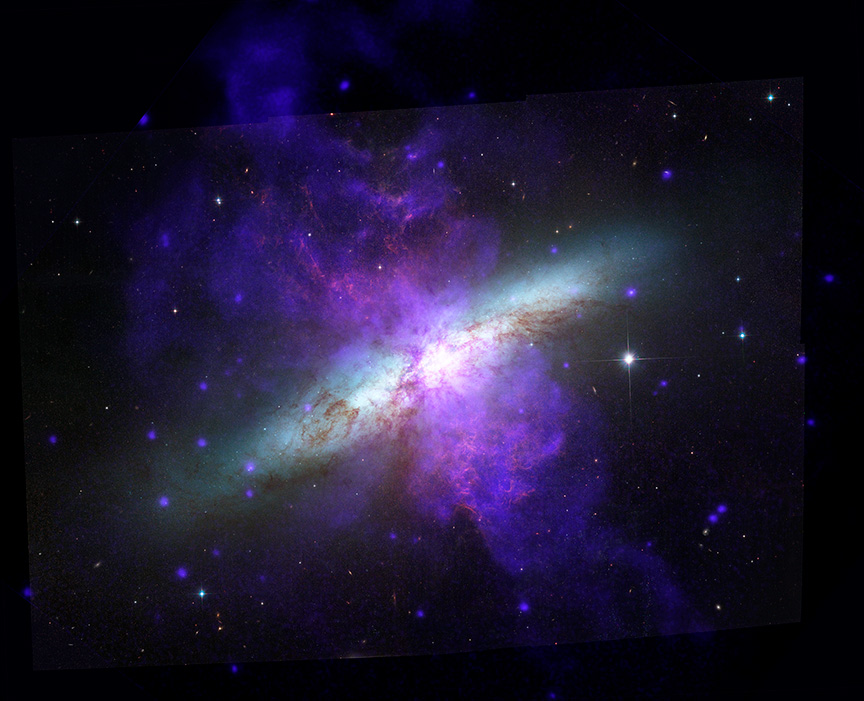
If N79 is a nursery, M82 is a factory in overdrive. This galaxy, located about 12 million light-years away, is undergoing a starburst. Stars are forming here at ten times the rate seen in our Milky Way. Supernova explosions and massive stellar winds pump energy into the galaxy’s core. Chandra captures gigantic bubbles of gas at millions of degrees, shooting out above and below the galaxy’s disk. These hot flows connect the life cycle of stars to the evolution of entire galaxies, pushing material into intergalactic space.
NGC 1068: A Black Hole’s Domain
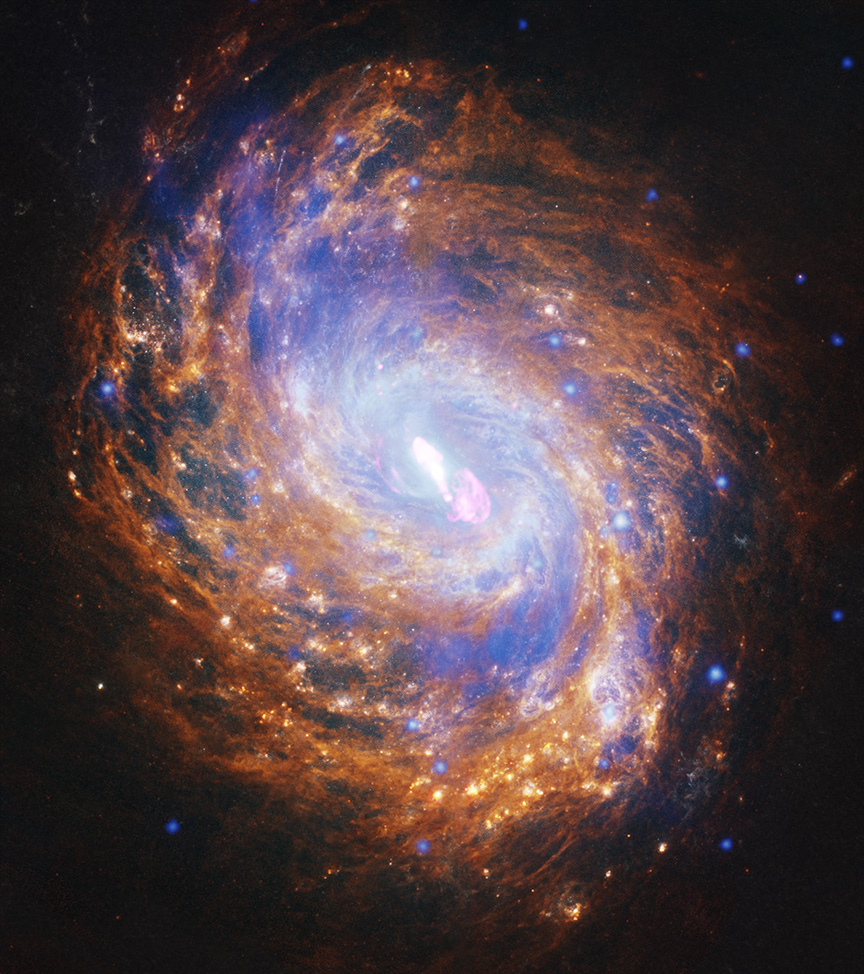
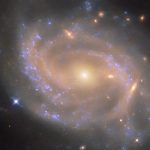
NGC 1068, also known as Messier 77, is a spiral galaxy with a secret: a supermassive black hole at its heart. This black hole is not quiet; it powers an active galactic nucleus that spans the entire spectrum. Chandra’s X-rays pinpoint the regions where gas heats to extreme temperatures as it spirals inward. The data also reveal high-speed winds driven by the black hole’s energy. Combined with optical and infrared views, the image shows how the central engine shapes the entire galaxy.
Westerlund 1: A cluster of giants
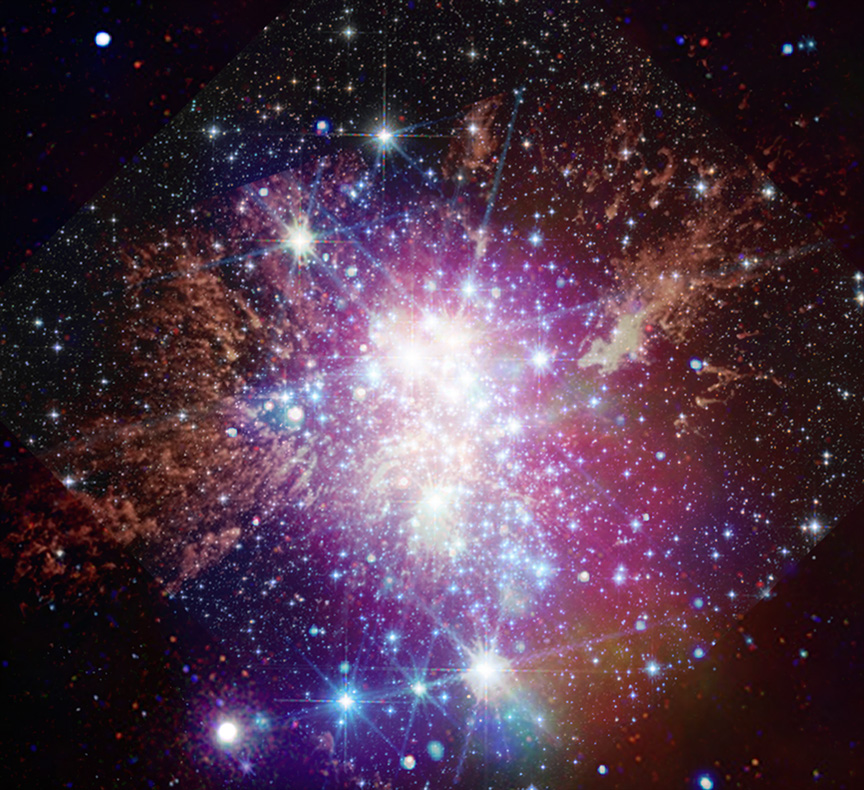
Closer to home, Westerlund 1 is one of the most massive star clusters in our galaxy. It contains hundreds of huge, short-lived stars that will end their lives as supernovae. Chandra’s sharp vision enables the separation of individual X-ray sources within the crowded cluster. Many of these are binary star systems where matter from one star falls onto another, heating to millions of degrees in the process. The cluster’s combined winds and explosions help stir and enrich the Milky Way’s interstellar medium.
Other highlights
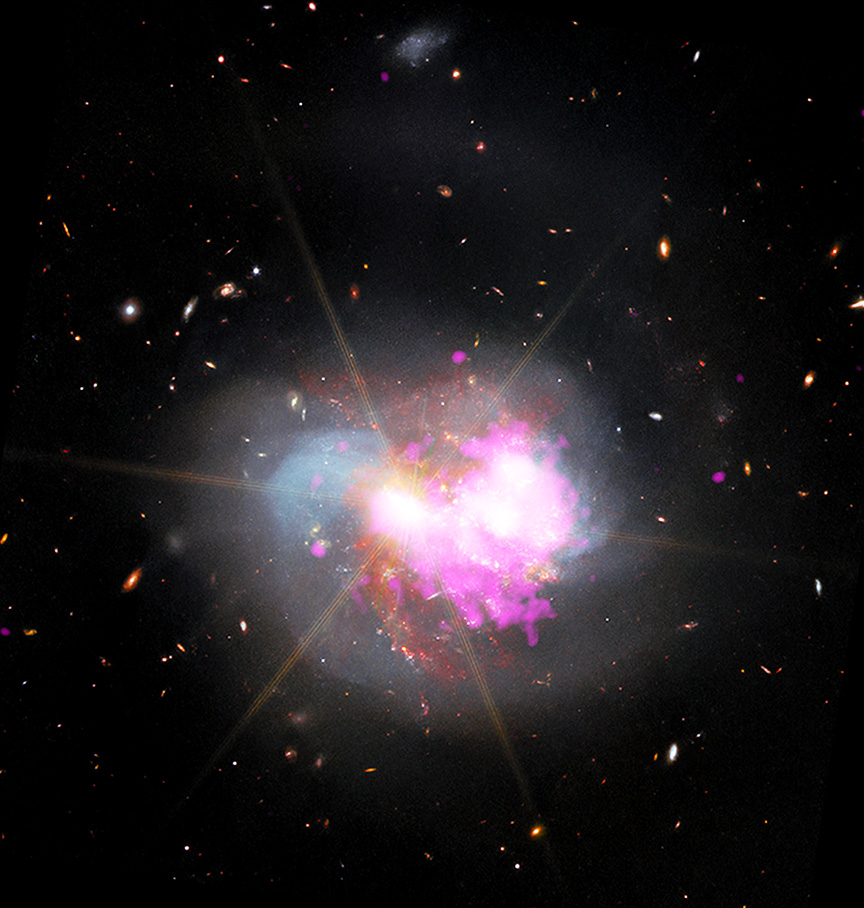
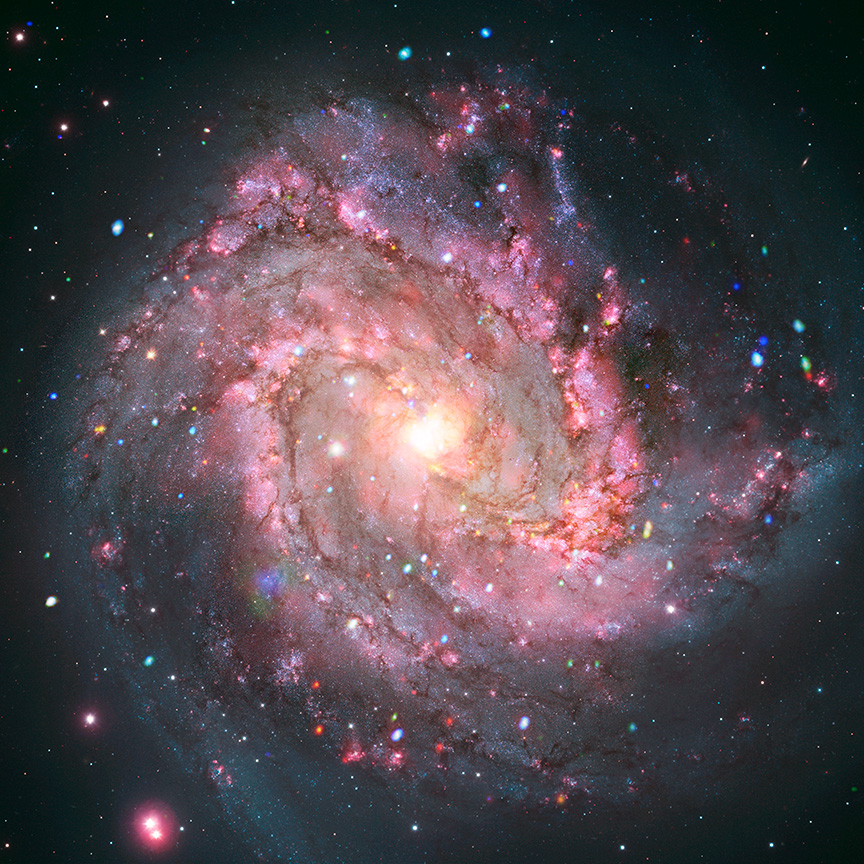
The Cosmic collection also includes NGC 2146, a galaxy distorted by past interactions; IC 348, a young star cluster in the Perseus molecular cloud; M83, a grand spiral galaxy with a busy population of X-ray binaries and supernova remnants; NGC 346, another vibrant star-forming region in the Small Magellanic Cloud; and IC 1623, a pair of galaxies in the process of merging. Each one demonstrates how Chandra’s high-energy data adds new layers of understanding.
The art and science of composite images
Making these images is as much art as it is science. X-ray light has no color that the human eye can see, so scientists assign colors based on energy levels and intensity. Lower-energy X-rays might be shown in red, while higher-energy ones appear in blue or purple. Optical and infrared layers are added using natural or representative colors. The goal is not to create a “true color” picture but to visualize physical conditions and processes.
Researchers use these composites to study the details of shock fronts in supernova remnants, to map the distribution of hot gas in galaxies, and to locate binary systems with neutron stars or black holes. In merging galaxies, X-rays reveal the heated gas stirred up by gravitational interactions. In star-forming regions, they expose the influence of massive stars on their surroundings.
Chandra’s legacy
Chandra has been in orbit for more than 25 years, yet it continues to deliver groundbreaking science. Over its lifetime, Chandra has studied objects as close as comets in our solar system and as far as quasars billions of light-years away. The Cosmic collection is a celebration of that legacy, showing how X-ray vision changes the way we see the universe.

Clear skies!
See more from DIYPhotography.net on Google
Add DIYPhotography.net as a trusted source. This makes
our stories more likely to appear in your Google Search results.
 Add as a preferred source on Google

Soumyadeep Mukherjee
Soumyadeep Mukherjee is an award-winning astrophotographer from India. He has a doctorate degree in Linguistics. His work extends to the sub-genres of nightscape, deep sky, solar, lunar and optical phenomenon photography. He is also a photography educator and has conducted numerous workshops. His works have appeared in over 40 books & magazines including Astronomy, BBC Sky at Night, Sky & Telescope among others, and in various websites including National Geographic, NASA, Forbes. He was the first Indian to win “Astronomy Photographer of the Year” award in a major category.


Join the Discussion
DIYP Comment Policy
Be nice, be on-topic, no personal information or flames.