





















Hubble’s Glorious View of NGC 1309: A Spiral Galaxy Full of Surprises
Jul 31, 2025
Soumyadeep Mukherjee
Soumyadeep Mukherjee is an award-winning astrophotographer from India. He has a doctorate degree in Linguistics. His work extends to the sub-genres of nightscape, deep sky, solar, lunar and optical phenomenon photography. He is also a photography educator and has conducted numerous workshops. His works have appeared in over 40 books & magazines including Astronomy, BBC Sky at Night, Sky & Telescope among others, and in various websites including National Geographic, NASA, Forbes. He was the first Indian to win “Astronomy Photographer of the Year” award in a major category.
Share:

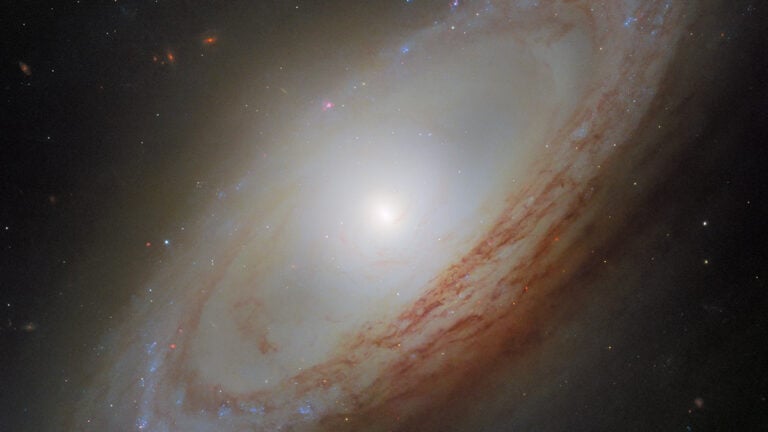
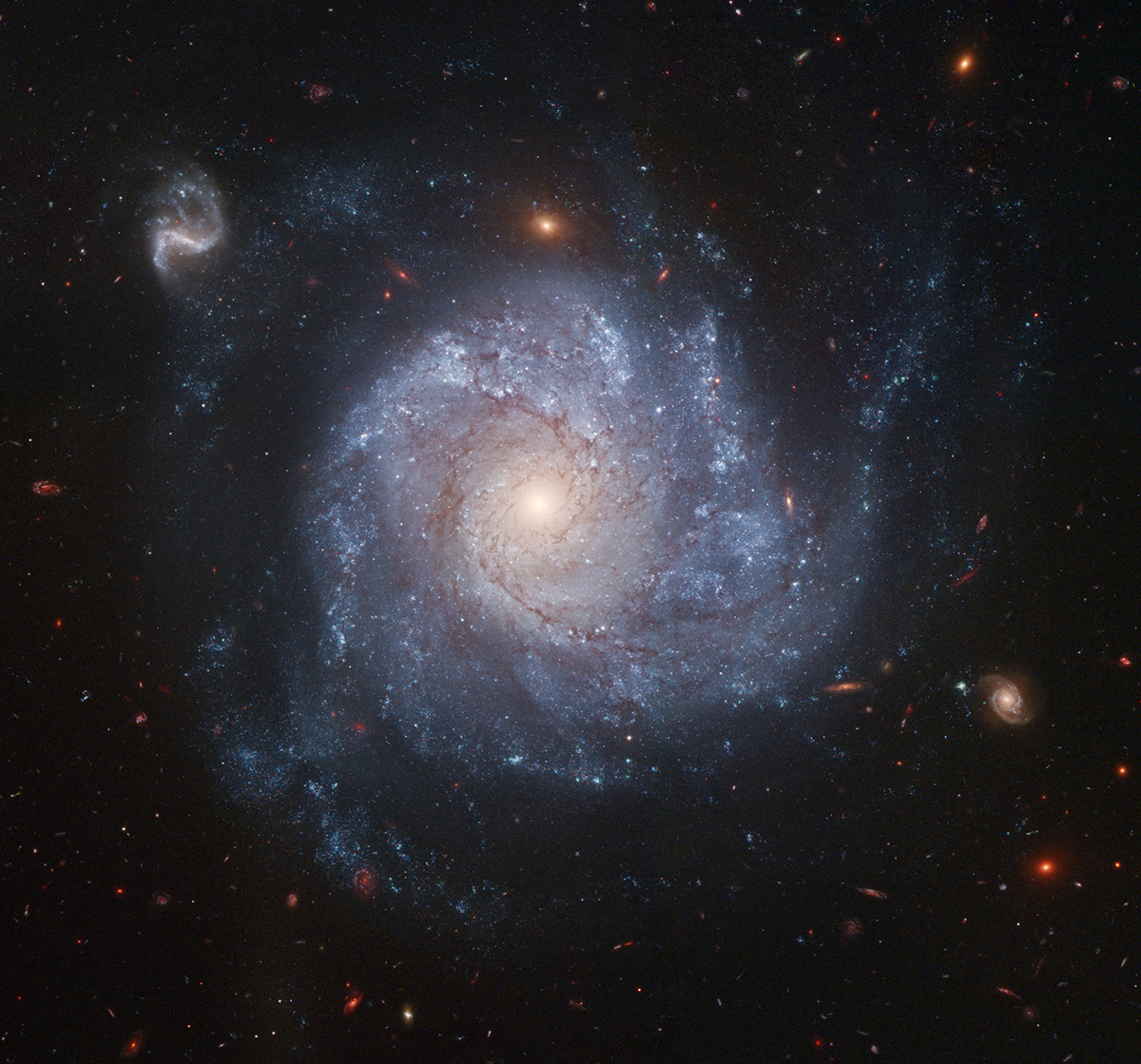
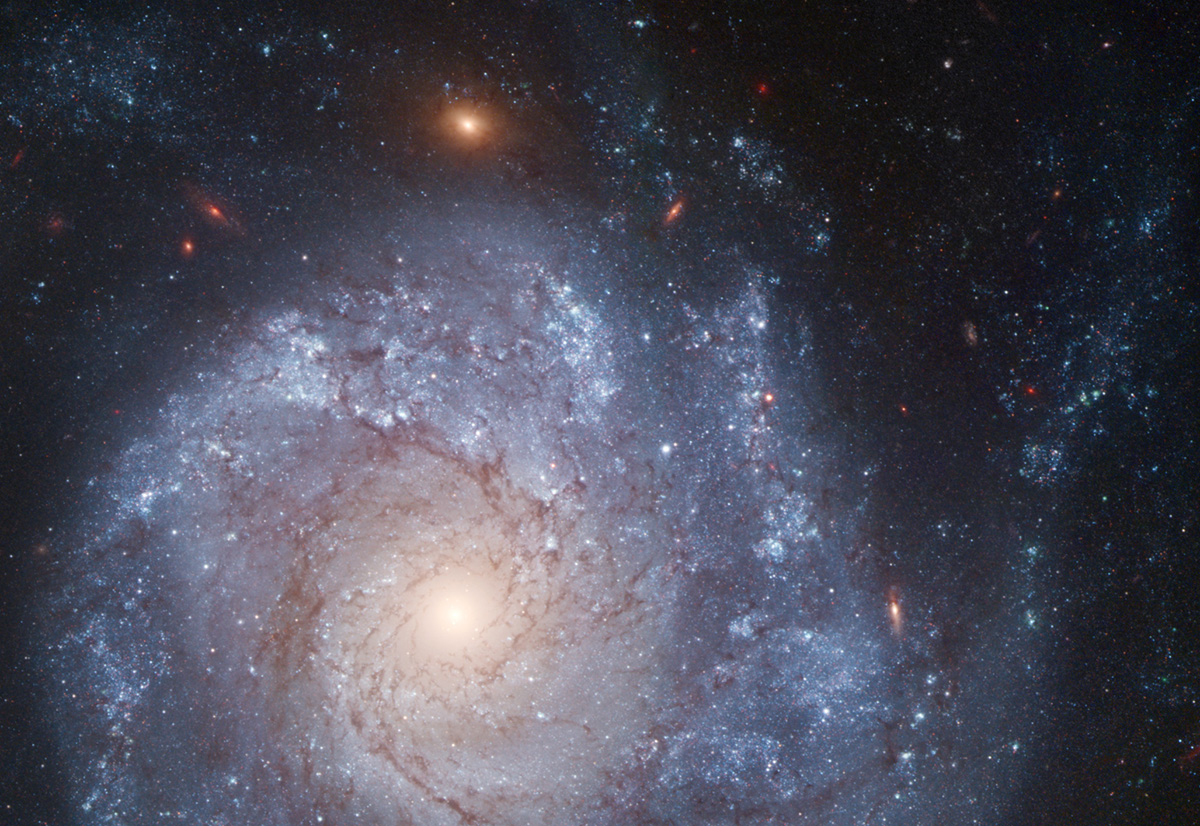
European Space Agency (ESA) and NASA have released a stunning new image from the Hubble Space Telescope. It features the spiral galaxy NGC 1309 in remarkable detail. This cosmic beauty lies around 100 million light-years away from Earth in the constellation Eridanus. The new image is not just eye candy. It also tells a rich story of star birth, stellar death, and cosmic evolution.
A face-on spiral galaxy
NGC 1309 is a face-on spiral galaxy, meaning we see it directly from above. This orientation gives us a clear view of its structure. We can see its spiral arms wrapping gracefully around a bright, dense core. Its arms are full of young blue stars, dark dust lanes, and glowing regions of gas. The Hubble image reveals extraordinary textures and colors. The core shines with a soft white light. This glow comes from older stars packed tightly together. The spiral arms, on the other hand, show a cooler blue hue. These areas are rich in hot, young stars. Dark streaks of interstellar dust cut across the arms, adding contrast and depth. What makes this image even more breathtaking is the surrounding environment of the galaxy. Behind NGC 1309, countless tiny smudges of light fill the sky. Each one is a distant galaxy. They lie billions of light-years away. These background galaxies make the scene feel vast and infinite.
Supernovae in NGC 1309
NGC 1309 is famous for more than just its beauty. It has hosted two known supernovae in the last two decades. These stellar explosions have given astronomers key insights into how stars end their lives.
SN 2002fk
In 2002, astronomers detected a Type Ia supernova in NGC 1309. This type of supernova occurs when a white dwarf star explodes in a binary system. Type Ia supernovae are very useful in astronomy. They all reach similar peak brightness. This makes them excellent “standard candles” for measuring cosmic distances. By studying SN 2002fk, astronomers were able to fine-tune their distance measurements to NGC 1309. This also helps improve the accuracy of the Hubble constant, which indicates the rate at which the universe is expanding.
SN 2012Z
Ten years later, in 2012, another supernova appeared in NGC 1309. This one was different. It was a Type Iax supernova, named SN 2012Z. Type Iax events are much rarer and less powerful than Type Ia explosions. They are sometimes called “failed supernovae.” Here’s why SN 2012Z was special. Astronomers found pre-explosion images of the exact location in archival Hubble data. This was a breakthrough. They were able to identify the likely progenitor of the explosion, a rare find. Even more surprising, follow-up observations revealed something incredible. The star that exploded may have survived. It wasn’t completely destroyed. This was the first time a “zombie” white dwarf had been spotted. It challenged existing theories about how stars explode.
A background of galaxies
One of the most impressive features of this image isn’t just NGC 1309. It’s the universe beyond it. Every dot, smudge, or faint streak in the background is a galaxy. Some of them are billions of light-years away. They existed when the universe was still very young. These background galaxies come in all shapes and colors. Some are tiny and red, others are large and blue. Their shapes include elliptical blobs, edge-on spirals, and irregular forms. The field is a visual record of the cosmic web. It’s a snapshot of the structure of the universe on the largest scales. This also highlights the power of the Hubble Space Telescope. While targeting one galaxy, it captures a deep field full of distant objects. Every Hubble image becomes a multi-purpose dataset.
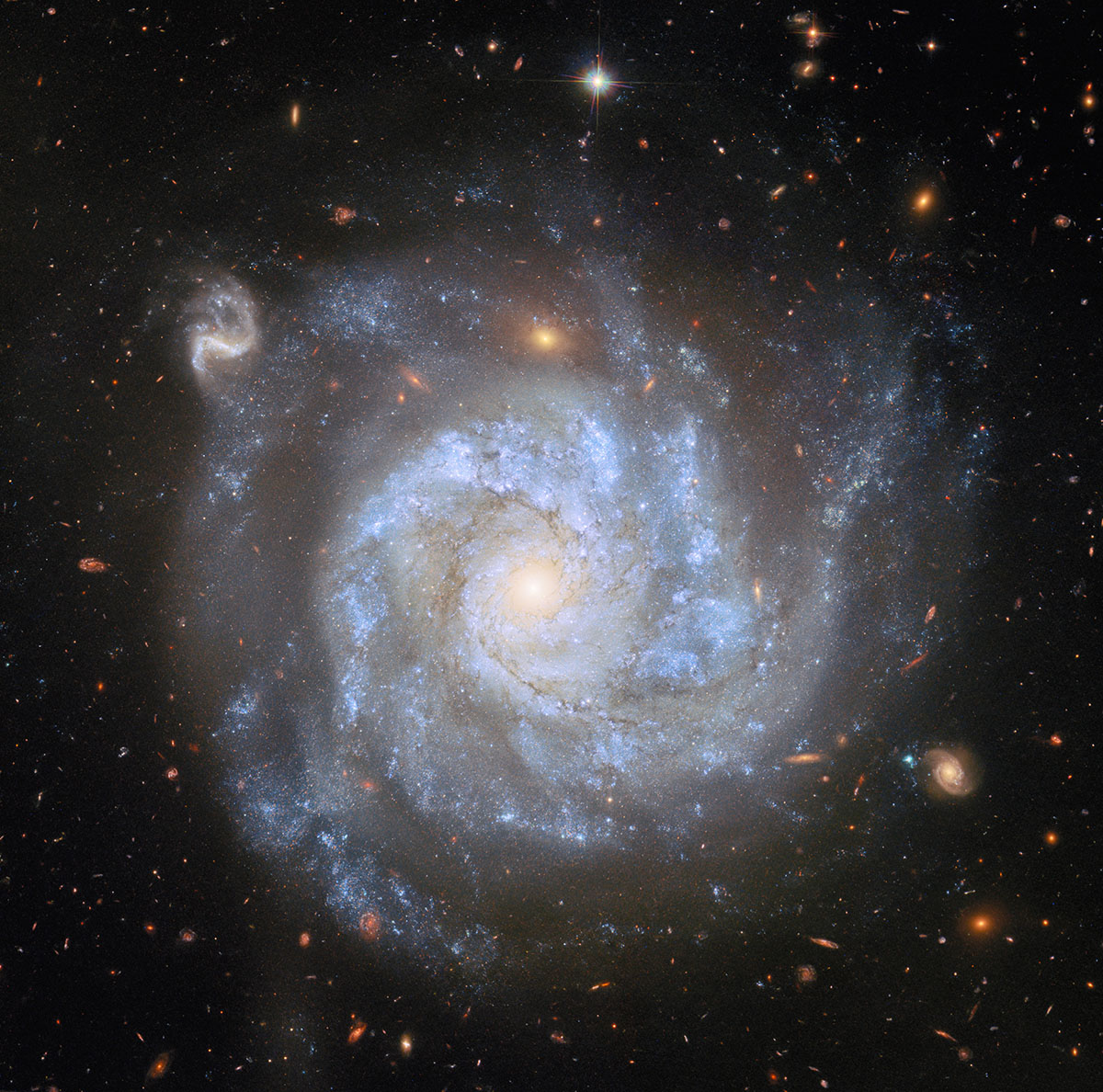
The new image of NGC 1309 is a cosmic document. It captures the structure of a galaxy, the history of stellar explosions, and the depth of the universe behind it. It showcases the power of long-term observation. And it proves that even a single galaxy can unlock the secrets of space and time.
Clear skies!
See more from DIYPhotography.net on Google
Add DIYPhotography.net as a trusted source. This makes
our stories more likely to appear in your Google Search results.
 Add as a preferred source on Google

Soumyadeep Mukherjee
Soumyadeep Mukherjee is an award-winning astrophotographer from India. He has a doctorate degree in Linguistics. His work extends to the sub-genres of nightscape, deep sky, solar, lunar and optical phenomenon photography. He is also a photography educator and has conducted numerous workshops. His works have appeared in over 40 books & magazines including Astronomy, BBC Sky at Night, Sky & Telescope among others, and in various websites including National Geographic, NASA, Forbes. He was the first Indian to win “Astronomy Photographer of the Year” award in a major category.

Join the Discussion
DIYP Comment Policy
Be nice, be on-topic, no personal information or flames.
One response to “Hubble’s Glorious View of NGC 1309: A Spiral Galaxy Full of Surprises”
It should be noted in all of these types of posts that the photographs of distant galaxies, solar systems, etc., are already obsolete, in as much as the light being photographed has travelled so far from its origin points to us that the entire structure may no longer exist at all. Unless or until there is some sort of “hyper-drive” enabling travel at exponential light speeds, photographs of the interstellar neighborhoods will be “scrap book”, or a “blast from the past”.