





















Hubble Photographs a “Small but mighty” starburst galaxy
Jun 18, 2025
Soumyadeep Mukherjee
Soumyadeep Mukherjee is an award-winning astrophotographer from India. He has a doctorate degree in Linguistics. His work extends to the sub-genres of nightscape, deep sky, solar, lunar and optical phenomenon photography. He is also a photography educator and has conducted numerous workshops. His works have appeared in over 40 books & magazines including Astronomy, BBC Sky at Night, Sky & Telescope among others, and in various websites including National Geographic, NASA, Forbes. He was the first Indian to win “Astronomy Photographer of the Year” award in a major category.
Share:

The Hubble Space Telescope has done it again. In its latest image, it showcases a small but powerful galaxy. Named NGC 4449, this galaxy bursts with star-forming activity. The new image is part of ESA/Hubble’s “Picture of the Week” series. But it’s more than just beautiful. It reveals how galaxies grow and evolve through cosmic interactions.
What is NGC 4449?
NGC 4449 is a dwarf irregular galaxy. It lies about 12.5 million light-years away from Earth. You can find it in the small constellation Canes Venatici, which means “hunting dogs” in Latin. Despite its small size, NGC 4449 is making a big impact. It is a starburst galaxy, which means it’s producing new stars at an incredibly high rate. Unlike most dwarf galaxies that show limited star formation, this one is buzzing with activity. This isn’t new. Scientists have known for years that NGC 4449 is active. But Hubble’s new image shows this activity in richer detail than ever before.
What makes this image special?
This new image is not the first time Hubble has photographed NGC 4449. Back in 2007, Hubble released a well-known image of the galaxy. That version focused on visible light. The new image goes much further. It combines observations in ultraviolet (UV) and optical light. This helps astronomers study both young, hot stars and older, cooler ones. The result is a multi-wavelength portrait of a galaxy in full bloom.
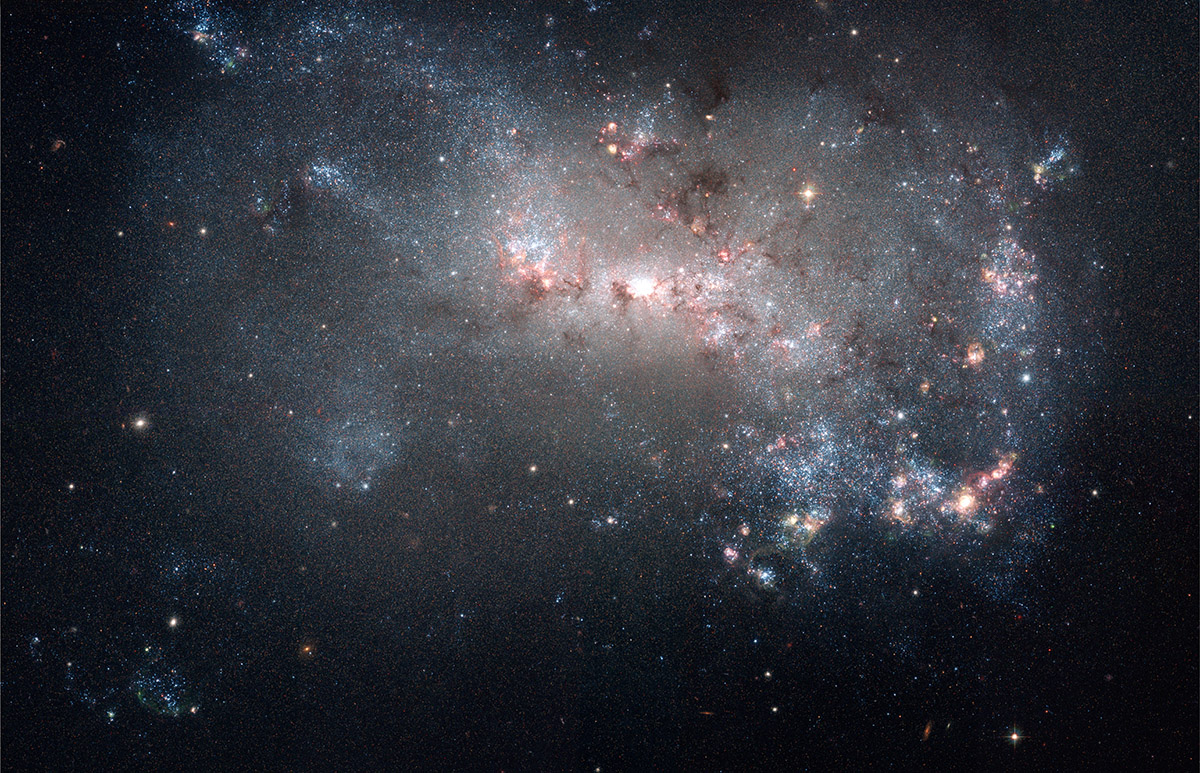
You can see pink-white star-forming regions scattered throughout the galaxy. These areas glow brightly due to hot hydrogen gas. Young, massive stars heat the gas, making it light up in visible and ultraviolet wavelengths. The image also reveals dark lanes of dust, filaments of gas, and glowing clusters. Every part of the galaxy seems to be alive.
What triggers the starburst?
Starbursts don’t happen randomly. In the case of NGC 4449, astronomers believe that gravitational interactions are the cause. Nearby galaxies have likely passed close to NGC 4449 in the past. These flybys can disturb the gas inside galaxies. When that happens, the gas clouds collapse and form stars. Think of it like shaking a soda bottle; pressure builds, and the contents explode. In NGC 4449, this “cosmic shaking” is happening on a large scale. It’s not limited to the core. Instead, star formation is occurring across the entire galaxy. That’s rare for dwarf galaxies. Some scientists even believe NGC 4449 may be merging with a smaller companion. This could explain its distorted shape and widespread star formation.
The role of Hubble
Hubble used its Advanced Camera for Surveys (ACS) and Wide Field Camera 3 (WFC3) to capture this image. These instruments are ideal for observing both ultraviolet and optical wavelengths.
- Ultraviolet light helps detect young, hot stars.
- Optical light reveals dust lanes, gas clouds, and older stars.

The data was processed by ESA/Hubble imaging teams. They combined multiple exposures to produce a color image. The final result shows the galaxy in striking detail.
How does this complement JWST?
The James Webb Space Telescope (JWST) has also observed galaxies like NGC 4449. While Hubble focuses on UV and optical light, JWST specializes in infrared light. This lets it see through dust and detect cooler structures. Together, Hubble and JWST give a complete picture of galaxies. Hubble maps the hot and young regions. JWST reveals the dusty and cold areas where stars are still forming. These joint observations are critical. They allow astronomers to trace a galaxy’s full star formation history.
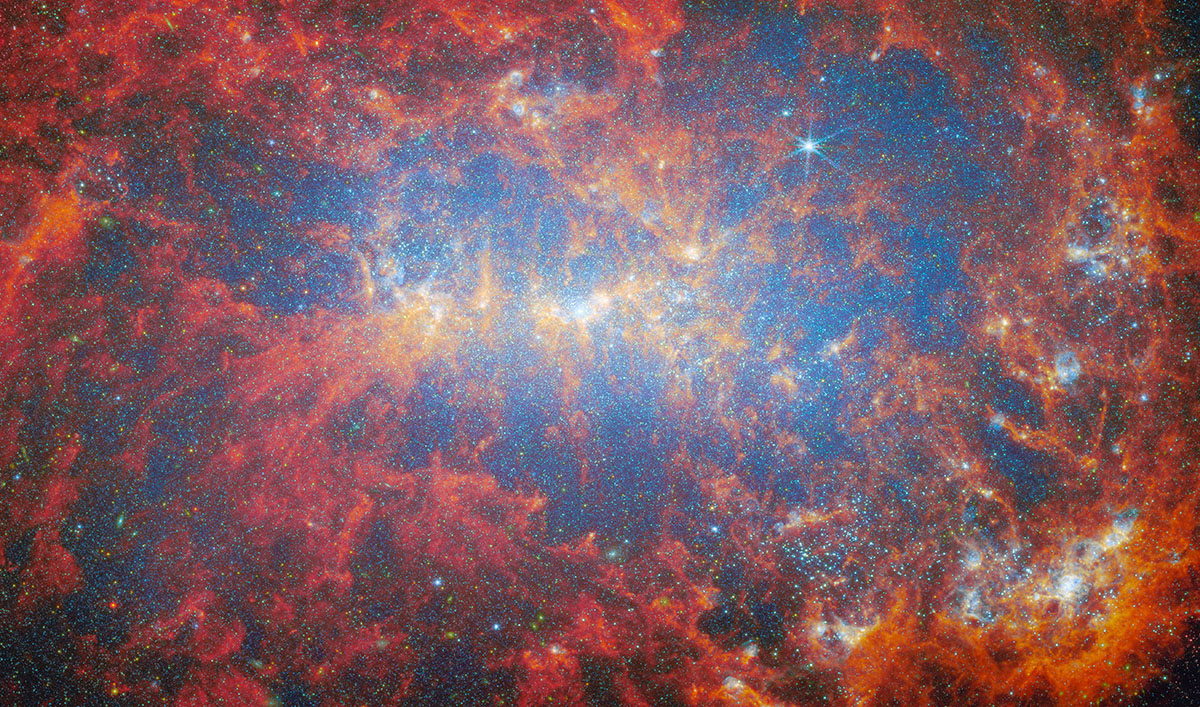
The new image of NGC 4449 tells a story. A story of growth, collisions, and the powerful forces that shape the universe. This dwarf galaxy may be small. But it’s a giant when it comes to understanding how stars and galaxies form. Hubble’s sharp eyes continue to reveal wonders. And NGC 4449 is a shining example of the magic happening just beyond our reach. We may be 12.5 million light-years away. But thanks to science, we’re right there, watching the fireworks unfold.
Clear skies!
See more from DIYPhotography.net on Google
Add DIYPhotography.net as a trusted source. This makes
our stories more likely to appear in your Google Search results.
 Add as a preferred source on Google

Soumyadeep Mukherjee
Soumyadeep Mukherjee is an award-winning astrophotographer from India. He has a doctorate degree in Linguistics. His work extends to the sub-genres of nightscape, deep sky, solar, lunar and optical phenomenon photography. He is also a photography educator and has conducted numerous workshops. His works have appeared in over 40 books & magazines including Astronomy, BBC Sky at Night, Sky & Telescope among others, and in various websites including National Geographic, NASA, Forbes. He was the first Indian to win “Astronomy Photographer of the Year” award in a major category.


Join the Discussion
DIYP Comment Policy
Be nice, be on-topic, no personal information or flames.