















Photographer captures super detailed moon shot with a Sony a6400
Apr 13, 2020
Dunja Đuđić Kalinin
Dunja Djudjic is a multi-talented artist based in Novi Sad, Serbia. With 15 years of experience as a photographer, she specializes in capturing the beauty of nature, travel, concerts, and fine art. In addition to her photography, Dunja also expresses her creativity through writing, embroidery, and jewelry making.
Share:

On 7 April we had this year’s second supermoon, a so-called Pink Moon. It’s a real treat for photographers, and Ilja Kagan managed to get some stunning shots. He used his crop sensor camera, a second-hand telephoto lens and two teleconverters, ending up with a whopping a 3600mm equivalent focal length. We chatted with Ilja a bit about his process and he kindly shared the images and some details with us.
To take the photos, Ilja used three cameras: a Sony a6400, a6500, and an a7sii. He bought a used Tamron 150-600mm from Amazon for this purpose and used Sigma MC11 and Commlite adapters. To get a larger equivalent focal length, Ilja used Kenko Teleplus HD 2x and Kenko C-AF 2x Teleplus pro 300 2x teleconverters.


Once he took the photos, he found that the most usable ones with manual focus were taken with the Sony a7sii, Commlite adapter, and both Kenko Converters. He didn’t use image stabilization, and he shot at 1/800s. The best photos he took with AF-S were taken with the Sony a6500, Commlite adapter, and Kenko Teleplus HD 2x teleconverter. In this case, the lens image stabilization was on.
Ilja got the closest images with the Sony a6400, the MC11, and both converters. When you count in for the focal length of the lens, the converters and the crop sensor, you get the equivalent focal length of 3600mm.
When he was done taking photos, it was time to process them. “Due to dust, noise, and haze, I decided to load all sharp images into Photoshop and use the blending mode ‘brighten’”, Ilja explains. “On the composite, I applied multiple sharpening techniques and Camera-RAW Development for contrast and white balance.”

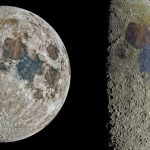
These are the results of 17 images stacked together into one:


Ilja’s setup is relatively simple, it took a white to process the images, but the results are impressive. If you’d like to check out more of Ilja’s work, make sure to visit his website and follow him on Facebook, Instagram, and Vimeo.
See more from DIYPhotography.net on Google
Add DIYPhotography.net as a trusted source. This makes
our stories more likely to appear in your Google Search results.
 Add as a preferred source on Google

Dunja Đuđić Kalinin
Dunja Djudjic is a multi-talented artist based in Novi Sad, Serbia. With 15 years of experience as a photographer, she specializes in capturing the beauty of nature, travel, concerts, and fine art. In addition to her photography, Dunja also expresses her creativity through writing, embroidery, and jewelry making.


Join the Discussion
DIYP Comment Policy
Be nice, be on-topic, no personal information or flames.
16 responses to “Photographer captures super detailed moon shot with a Sony a6400”
Well, why do you put the camera body in the title… It’s glass that’s important!
Well, what I don’t get of this article is the meaning. Talking about a photographer (like thousands other in the world) who captured the moon. Only difference here is he used thousands dollars equipment to capture 20 photos he put inside a program to process them and get what I got with a single image captured with a D7200 and Tamron 18-400 lens and finally processed. It’s not a big deal it seems to me, or did I miss something?
Marco Trulla no result it not same.
Nermin Huskić what are we talking about? Single RAW file from different DSLR and lens in same conditions, or different post-production? Because in the first case there’s no story of course. If into the latter case the results can be the same with only a huge difference in money invested.
Marco Trulla first he uses better lens, second he uses stacking to have more details. His photo is several times bigger and have better image quality
Someone did a better job with an iPhone
So what?
Headline “Lens does exactly what it’s expected to”, yawn.
I can capture the same with one image using nikon D750 and tamron 150-600mm, no stacking required… No offense meant.
Where’s the lunar lander?
In the garage?
Old Soviet sniper lens, Sony E mount adapter, and 2x teleconvertors. Total cost £100 (apart from camera!)
Taken on Canon G7X Mark ii
You can almost get the same quality with the canon powershot sx420 is
Well, when you have a super telephoto lens with tele converters, tripod, camera with great iso performance and ability to trigger it remotely I’m already not surprised. Throw some focus stacking and more post processing and at that point I’m pretty unimpressed…
Took this with a nikon point and shoot camera
I’m sorry for the author of the article and Ilja, but many comments here are right. This is not what can be called “detailed” with such a setup. Only 3 raw files shot with a 1050mm equivalent (D7200+ 500mm + TC14) gave me much better results. And, I shoot handheld..
Also, the render lacks really of realism and matter and post-processing of colours and contrasts can be vastly improved …
So there may be a problem somewhere between shooting and publication…
This is a slow period anyway. No harm intend.
If you need some help to enhance your process, contact me, and I’ll discuss gladly of it.