














On-Camera Flash on the Street: A Beginner’s Guide
Nov 17, 2025

Share:

On-camera flash in street photography is a polarizing tool—some see it as an aggressive intrusion, while others view it as a creative superpower. When used intentionally, this technique transcends simple illumination to create dramatic, stylized, and high-impact images that stand out from the scene. This guide focuses on getting started with on-camera flash and maximizing your keepers.
The On-Camera Flash Aesthetic

The direct, unfiltered light of an on-camera flash creates a signature look: harsh shadows, a distinct separation of the subject from the background due to the rapid fall-off of light (governed by the inverse square law), and a frozen, hyper-real quality that isolates a moment in time. This is not the subtle, soft lighting of a studio; it’s a bold, aggressive style that will draw attention.

So why should we use it? Shouldn’t street photographers blend into their surroundings? In busy, cluttered street scenes, flash immediately makes your subject the brightest, most prominent element, cutting through the ambient visual noise. In situations where the sun might not be lighting your subject dramatically or if you’re shooting at night, on-camera flash might be the only way to achieve that kind of separation.
If street portraiture is more your thing, walking the street with an on-camera flash can help you brightly light your subject, even when harshly backlit by the sun, casting them in a shadow
Flash Challenge: Understanding the Flash Exposure Triangle

Most street photographers already have a solid understanding of the exposure triangle. For the uninitiated, the exposure triangle refers to the three technical elements that are used to properly expose/light an image: ISO (light sensitivity of your film or camera sensor), Aperture (the amount of light your lens is letting in), and Shutter Speed (the amount of time your camera is allowing light to hit your film plane or camera sensor). When using a flash or other controlled light source, the triangle shifts depending on a variety of factors:
When using a flash or strobe, your shutter speed mainly controls the exposure of the background and any existing ambient light. A faster shutter speed darkens the background; a slower one brightens it. Crucially, you must stay at or below your camera’s flash sync speed (typically between 1/125th and 1/250th of a second) unless you have a High-Speed Sync-capable flash and are using it deliberately.
Meanwhile, the aperture will now control the exposure of the subject illuminated by the flash. A wider aperture (smaller f-number) allows more of the flash light to enter, making the subject appear brighter. Think of your aperture settings as the driver of how much of an effect your flash will have.
Typically, a flash or strobe uses an ISO rating of 100 as the basis for determining the amount of power it provides. For that reason, it’s best to start with the lowest native ISO of your camera (e.g., ISO 160 on my Fujifilm X-Pro 3) to minimize noise and control the overall sensitivity to both ambient and flash light. Only raise it if you need to boost both background and flash output simultaneously.
Photograph With Intentionality – Pre-Set Your Camera Settings

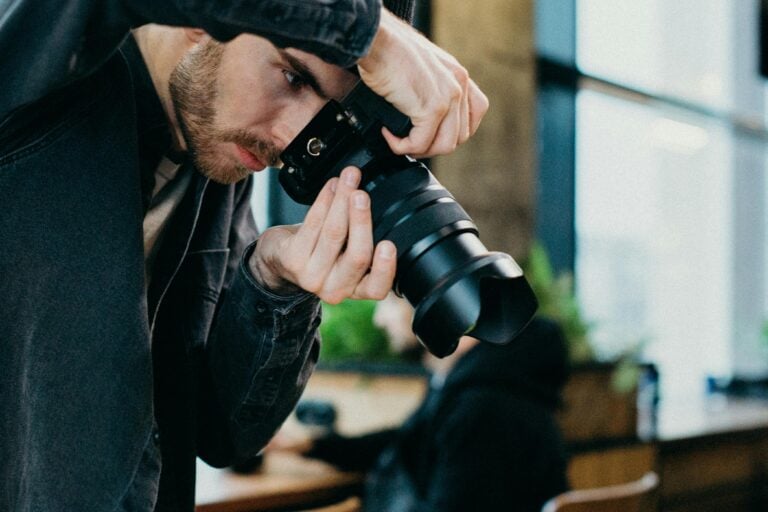
While scenes on the street can change very rapidly, planning ahead and locking in your settings before walking around will net the best results. Personally, I like to take a couple of test shots to get an idea of the flash’s power output relative to the distance of my potential subjects. In preparing this article, I used the Viltrox Spark Z3 with my X-Pro 3 – a relatively inexpensive flash that offers the added benefit of TTL (through-the-lens) metering for flash output. When starting out, learn to use your flash in Manual mode as it will give you more consistent results and help you to learn how to properly gauge your desired exposure settings.
Gear Used
- Fujifilm X-Pro 3
- Fujifilm XF 35mm F2 WR
- Viltrox Spark Z3-F (TTL for Fujifilm Cameras)
A very good friend of mine, and a professional photography instructor, once told me that the key to making great photographs on the street is to work a scene properly. That means, don’t leave a spot right away. Just because something isn’t happening as you get there doesn’t mean that it will remain uninteresting. Make time to try different angles, don’t be afraid to get lower to the ground or shoot from a top-down angle. And when using flash, don’t be afraid to get close to your subject – even if it is a person.


The Ethics of On-Camera Flash and Street Photography
The golden rule in life is to treat others as you’d like to be treated; allow me to introduce you to the platinum rule: Treat others as they want to be treated. Nowhere is that truer than in street photography. The very nature of street photography is in its humanity – people and their personhood lie at the core of the genre. While in the US, there is no expectation of privacy on public streets or public areas, that does not necessarily mean that they are comfortable or desire to be photographed.
There are generally two schools of thought on on-camera flash: those who are aggressive and unflinchingly get in their subject’s face (i.e., Bruce Gilden, Trevor Wisecup, et al) and those who instead avoid it altogether. It’s always important to understand that how you approach your subject will likely determine how successful you are how willing you will be to try again. Keep a good spirit about you, don’t slink and hide in the shadows like a creep. If someone asks what you’re doing, be courteous and let them know. If they still have an issue with you being there, move on. Lastly, never take images of the vulnerable. If your image isn’t changing their circumstance, don’t take advantage of them or their situation.
See more from DIYPhotography.net on Google
Add DIYPhotography.net as a trusted source. This makes
our stories more likely to appear in your Google Search results.
 Add as a preferred source on Google


Join the Discussion
DIYP Comment Policy
Be nice, be on-topic, no personal information or flames.