







The New York Times Bans Photoshop 2027: Has Adobe’s AI Gone Too Far?
Nov 26, 2026
Dunja Đuđić Kalinin
Dunja Djudjic is a multi-talented artist based in Novi Sad, Serbia. With 15 years of experience as a photographer, she specializes in capturing the beauty of nature, travel, concerts, and fine art. In addition to her photography, Dunja also expresses her creativity through writing, embroidery, and jewelry making.
Share:
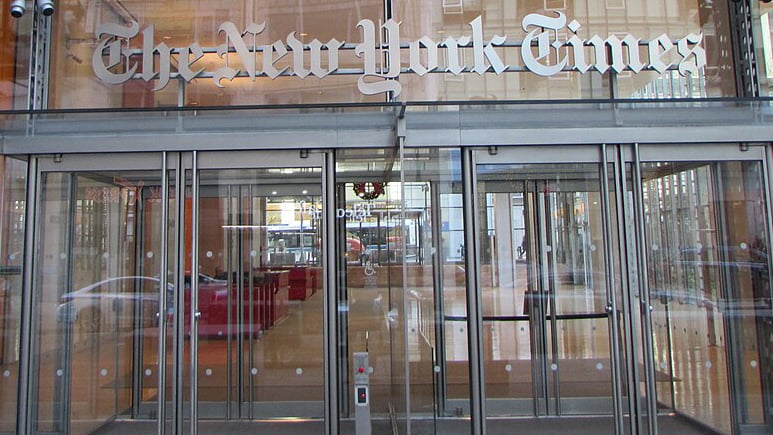
The New York Times has reportedly told its freelance photographers to stay away from the newest version of Photoshop. The reason behind the decision is that some of its features use generative AI behind the scenes, and that can label real photos as AI-generated.
The news broke through a leaked internal email that first popped up on social media and Reddit. The email reads that “certain functions in Adobe Photoshop 2027 (release 28.0.0) utilize generative AI in ways that may not be apparent to users.”
“Therefore, at this time we are requiring that all contributing photographers avoid using Adobe Photoshop 2027 (release 28.0.0 and subsequent updates) when working on assignment for The Times,” the email concludes.
Funnily enough, since we live in the AI era, the news could have easily be fabricated. However, the Times spokesperson Graham James reportedly confirmed to The Verge that this was a real requirement from the editors, and a real email.
The Times didn’t say which tools are the problem, but juding from a Reddit comment on the now-deleted post, backed by Adobe’s own website, these could trigger the AI label:
- Generate Similar
- Spot Healing Brush tool
- Generative Fill
- Generative Workspace (beta)
- Sky Replacement
- Curvature Pen tool
- Content-Aware Fill
- Smart Objects
- Match Font
- Neural Filters
- Smart Filters
- Preserve Details 2.0
I mean, no surprise for the tools like Sky Replacement, Generative Fill or Generate Similar, for example. But Spot Healing? Smart Objects? What?!
Has Adobe’s Fascination with AI Now Officially Gone Too Far?
After Adobe MAX, I finally sat down to play with the new AI-Assisted Editor in Photoshop. I used it for some basic cleanup: blemishes, small imperfections, contrast and white balance. Nothing was generated. And yet, my photos ended up flagged as AI content. Of course, you can use the Pro Editor (that’s the classic editing panel we all know and love). But it appears that, even there, generative AI tools are lurking to make your images flagged as “AI content.”

Now imagine you’re a photojournalist. Your entire career rests on readers trusting that what they see in your photos really happened. You, for example, remove a speck of dust, and suddenly your photo carries a label that says “AI.” It’s not ideal. The solution is to either switch back to an older version of Photoshop or use an entirely different editing tool. And if you’re used to using Photoshop throughout all these years… Again, not ideal.
And here’s the part that blows my mind. Adobe is the company behind the Content Authenticity Initiative. It championed Content Credentials, the very system that adds those AI labels. So, Adobe practically built the system, and then built tools that trigger the AI warning.
It’s Not Just Adobe
Let’s be honest, though: Adobe isn’t the only one doing this. AI has been force-fed to us by pretty much every tech company out there. It’s everywhere; in our search results, email, messaging apps, office software. Some laptops even have a dedicated AI key now, in case you forget it exists for five whole minutes. I can’t google a freaking nearest shoe store without AI anymore.
I felt this very strongly at Adobe MAX. I loved some of the tools I saw there, and I believe AI has its place in some bits of editing and design. But there’s a difference between offering a tool and putting AI in every corner until you get sick of it. The Times email shows where this leads: people stop trusting the software they pay for. In fact, they can’t even use it anymore for work, apparently.
Can Adobe Afford to Lose the Newsrooms?
This is the question I keep coming back to. The New York Times is not some random hobbyist photographer like you or me. It’s one of the most influential publications in the world, and newsrooms watch each other closely. If other outlets follow, Adobe might lose a huge chunk of their users. Very faithful, experienced, and devoted users, if I may add.
On the other hand, it may not end up being a problem for Adobe at all. At least not a major problem. Judging by MAX, Adobe seems to try to attract other types of audience. Not as much old-school photographers, designers, videographers and photo/video editors.
The company presented Firefly as a gateway to its tools for creators at every experience level and people of different crafts. In fact, they seem to be targeting more of marketers and social media creators than before. These new AI tools are for the people who want a quick result without learning the craft. They’re for the young, hip people who want to keep in check with every novelty out there. And maybe for those who want to do things faster, for whichever reason they may need to speed things up.
Maybe that’s a smart business move. There are a lot more people who want a cool image in two clicks than there are professional photojournalists. After all, Adobe now has one billion users, as they revealed at MAX, and it’s very likely not all of them are professional photojournalists.
Whether this is a smart move or not remains to be seen, and only time will tell. But there is another potential threat if Adobe is targeting different groups: subscriptions.
Subscription Fatigue Meets AI Fatigue
Adobe users were already tired. Not (just) of AI, but also of paying for Adobe every single month or year. And again, it’s not just Adobe, we’ll soon pay yearly subscription to air and water. Funnily enough, it will be precisely due to gen-AI’s impact on the environment.
Anyway, in a study by Secure Data Recovery, Adobe came in second as the most annoying subscription among 25 platforms, at 24.3%. Right after Microsoft 365, which I have many opinions about, and none of them are positive.
On Adobe’s own community forum, one user wrote a post complaining about paying full subscription fees for software they might only need once every three months. Another user explained being forced to cancel Creative Cloud because the cost is a barrier for entry-level designers who need the tools to build their skills and portfolios. The Creative Cloud Pro costs $69.99 a month, or $779.88 a year if you prepay, with access all the apps. This might be justifiable for a seasoned professional or a news outlet, but ridiculous for a hobbyist. There are cheaper plans, though, but still – the subscription model for everything is pretty annoying.
So, What Now?
If you shoot for news outlets (or any client who cares about AI labels), as I mentioned, you can roll back to Photoshop 27.0 through Creative Cloud. You should also disable auto-updates so you don’t get upgraded without noticing. Lightroom and Camera Raw aren’t covered by the Times’ restriction, at least there was no explicit word on it – for now.
As for the bigger picture, I don’t think AI tools are evil, and I don’t think Adobe is a cartoon villain. But I do think a company that has been around for more than 35 years should know its users well enough not to put them in this position.
All it takes is transparency but without the marketing fluff, if possible. It’s fine to add generative AI tools, but do tell us explicitly what each tool does, when it uses gen-AI, and if it will flag our work as AI. And also: leave us choice. It can’t be too complicated to keep the classic tools and the new, fancy AI-powered ones. Perhaps let users opt out of the AI tools altogether. I think that would be an ideal solution for both Adobe and its users, especially those who can’t risk having their content flagged with an AI label. But, as always, that’s just my two cents. Do share yours in the comments!
[Image credits: Pmk58, CC BY-SA 4.0, via Wikimedia Commons, cropped]
See more from DIYPhotography.net on Google
Add DIYPhotography.net as a trusted source. This makes
our stories more likely to appear in your Google Search results.
 Add as a preferred source on Google

Dunja Đuđić Kalinin
Dunja Djudjic is a multi-talented artist based in Novi Sad, Serbia. With 15 years of experience as a photographer, she specializes in capturing the beauty of nature, travel, concerts, and fine art. In addition to her photography, Dunja also expresses her creativity through writing, embroidery, and jewelry making.
Related Posts
 Has Photoshop gone too far with the one-click season change?
 Photographing the World’s Most Dangerous Church: How Far Is Too Far To “Get The Shot”?
 Fake Blood Left on a Family Grave: How Far Is Too Far for a Creative Shoot?
 The New York Times shares 2024 in photos: A year of chaos and contradictions
Join the Discussion
DIYP Comment Policy
Be nice, be on-topic, no personal information or flames.