





















Hubble Photographs a Noteworthy Nearby Spiral Galaxy: NGC 2835
Aug 18, 2025
Soumyadeep Mukherjee
Soumyadeep Mukherjee is an award-winning astrophotographer from India. He has a doctorate degree in Linguistics. His work extends to the sub-genres of nightscape, deep sky, solar, lunar and optical phenomenon photography. He is also a photography educator and has conducted numerous workshops. His works have appeared in over 40 books & magazines including Astronomy, BBC Sky at Night, Sky & Telescope among others, and in various websites including National Geographic, NASA, Forbes. He was the first Indian to win “Astronomy Photographer of the Year” award in a major category.
Share:
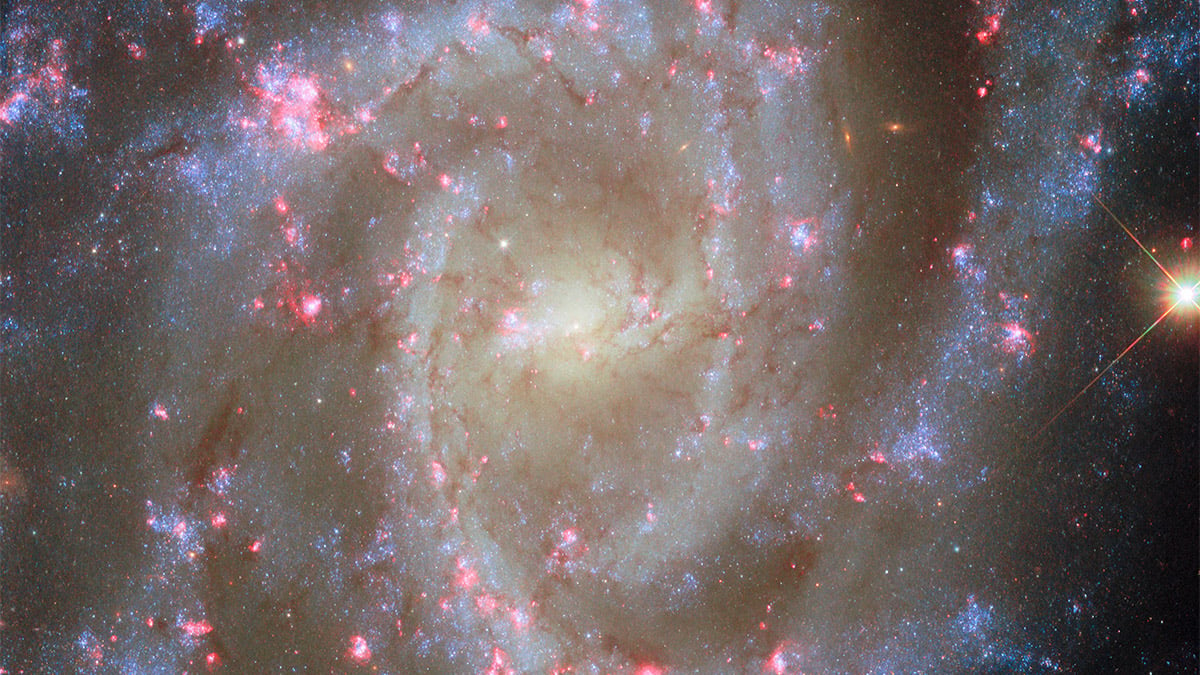
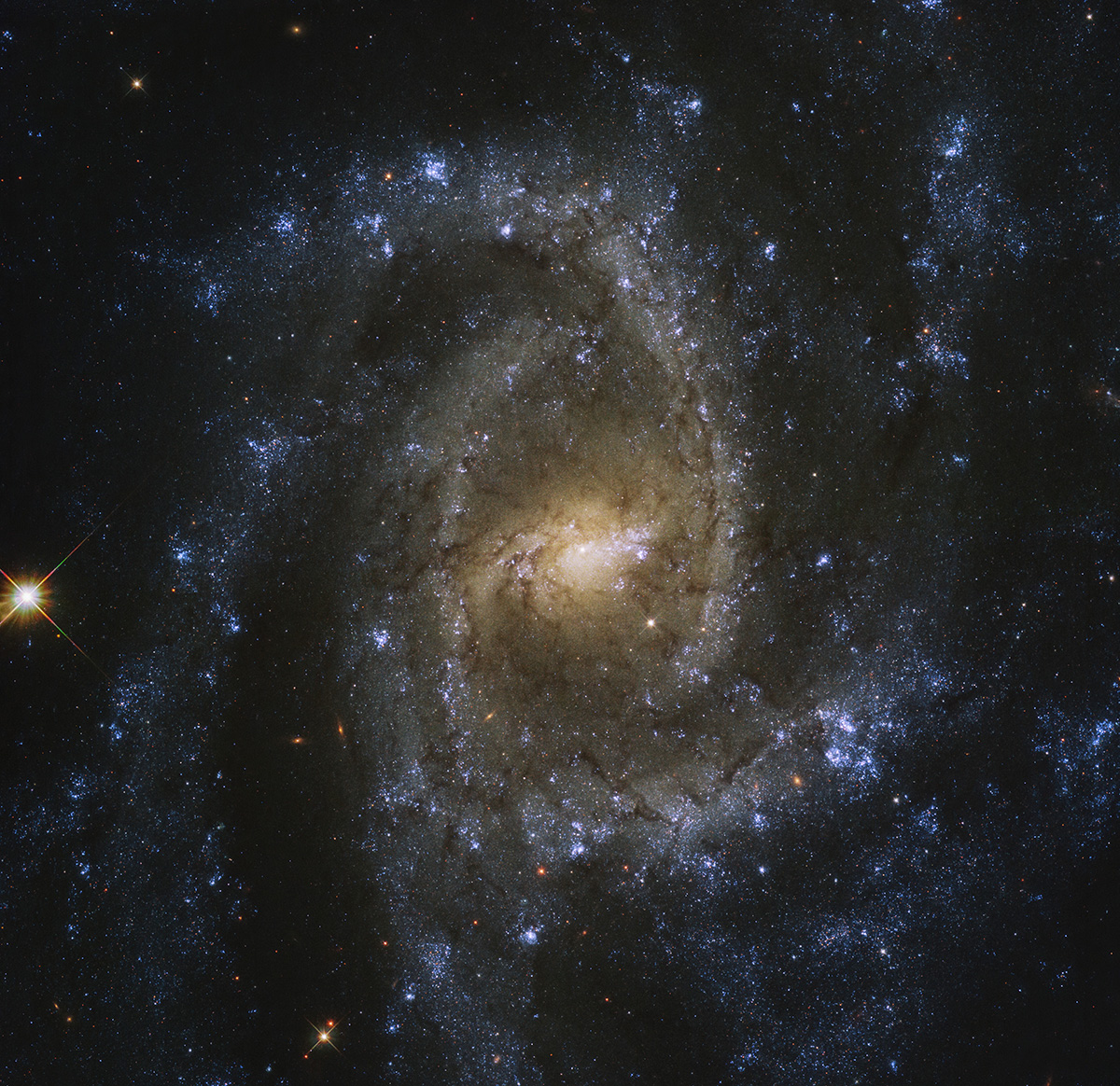
The latest picture from Hubble features NGC 2835, a face-on spiral galaxy about 35 million light-years away in Hydra. The image looks familiar at first glance. Blue clusters trace loose spiral arms around a bright central region. Look closer, and you notice something new. Hubble added a narrow slice of red light called H-alpha. That addition highlights dozens of nebulae along the arms. These are signposts of ongoing and recent star formation. The release pairs a beautiful view with fresh science motivation.
A nearby spiral in Hydra
NGC 2835 sits in the long southern constellation Hydra, the Water Snake. We view it nearly face-on, so the arms are easy to follow. The galaxy’s centre appears oval and smooth. That region is rich in older stars. The arms are clumpier and bluer. Young, massive stars live there in groups and associations. Dust lanes run along the arms as thin dark threads. The galaxy’s distance is about 35 million light-years. That makes it close enough for Hubble to resolve individual star-forming regions.

New additions from Hubble
This image includes new observations that isolate H-alpha emission. H-alpha sits around 656–657 nanometres. Hubble’s Wide Field Camera 3 recorded it with a narrow filter. The team combined that with five broadband filters from ultraviolet to near-infrared. Those include F275W, F336W, F438W, F555W, and F814W. Ultraviolet and blue filters emphasise hot, young stars. Redder filters map older populations and dust effects. The added H-alpha layer picks out compact ionised gas clouds. Together, these data reveal where stars recently formed and where they are forming now.
H-alpha and star formation
H-alpha light comes from ionised hydrogen. It forms when energetic ultraviolet radiation strikes surrounding gas. Newborn massive stars flood their birth clouds with that radiation. Their “H II regions” glow strongly in H-alpha and stand out as pink knots. H-alpha can also trace late stages of stellar evolution. Supernova remnants and some planetary nebulae emit at this wavelength as well. In NGC 2835, the H-alpha layer marks dozens of nebulae along the arms. The pattern shows where gas has turned into stars across the disk. By mapping H-alpha and starlight together, astronomers track the recent star-formation history. They also study how young stars heat, stir, and disperse the gas around them.
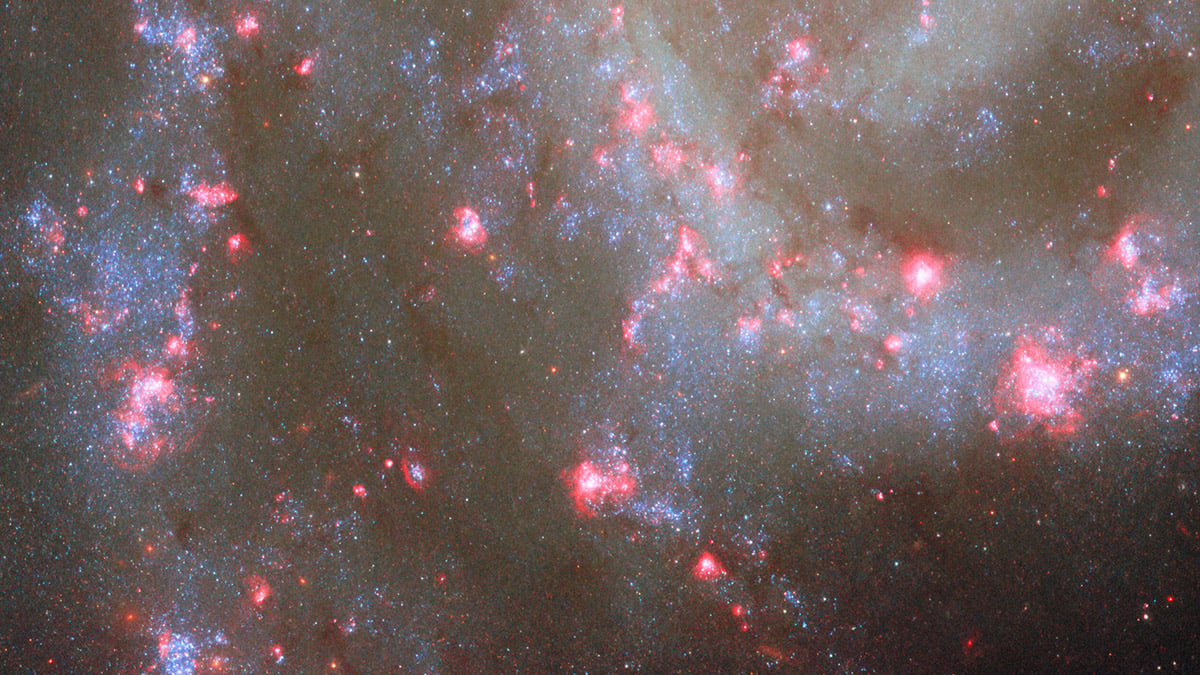
Inside the PHANGS-HST effort
The new data are part of a focused Hubble survey. Researchers are using H-alpha imaging to study 19 nearby galaxies. They aim to identify more than 50,000 nebulae across these systems. The project builds on a large, multi-observatory programme called PHANGS. PHANGS links stars, gas, and dust across many scales. Hubble’s role is to resolve star clusters and H II regions in detail. Other facilities add complementary views of cold gas and embedded stars. Together, they map the life cycle of star formation from cloud to cluster. NGC 2835 fits perfectly into this approach. Its face-on geometry and moderate distance allow fine measurements of feedback. That is how starlight and stellar winds shape the surrounding gas.
Hubble and JWST
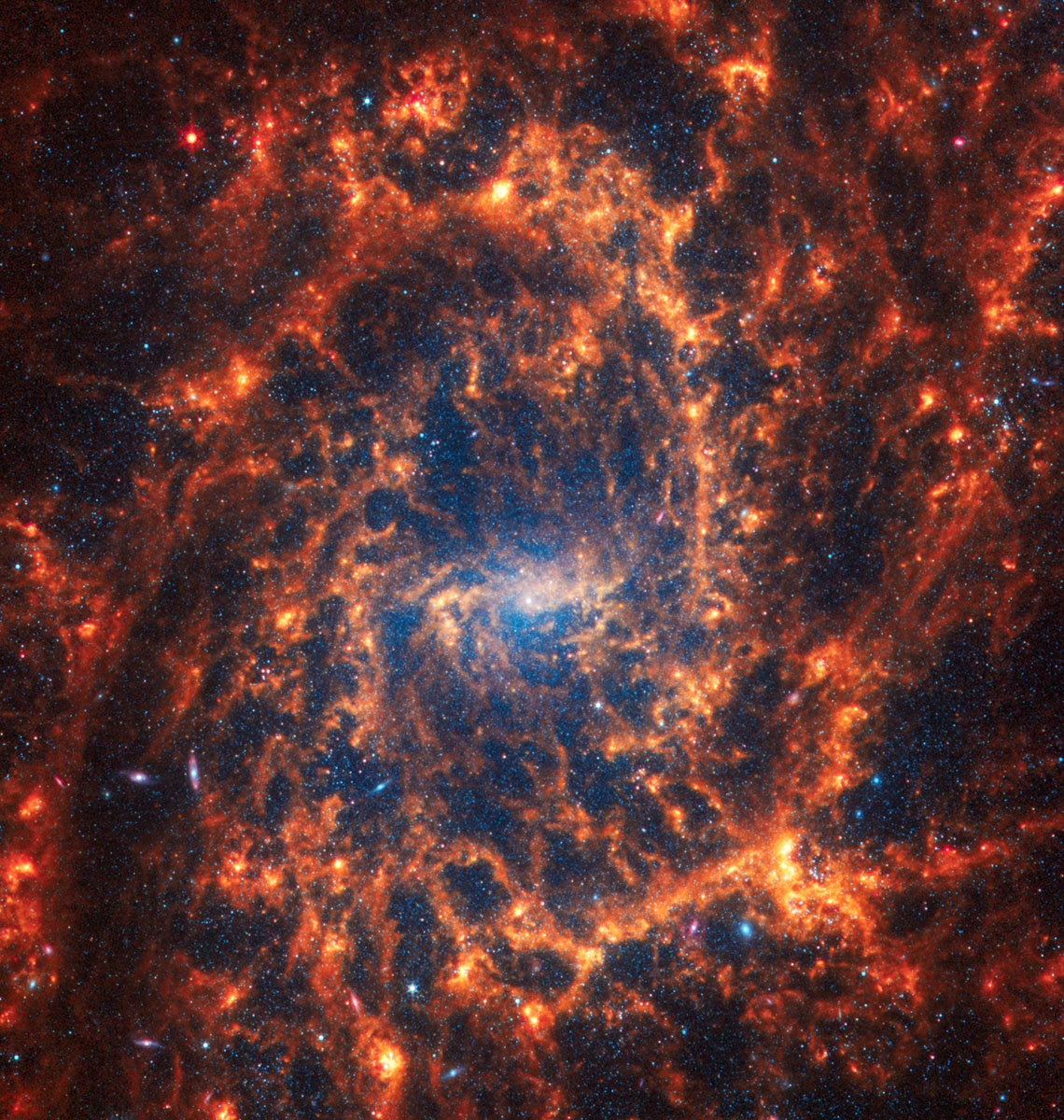
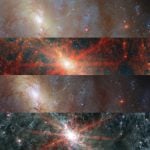
NGC 2835 has also been observed by the James Webb Space Telescope in recent years. JWST’s near- and mid-infrared data emphasise dust and deeply embedded stars. Hubble’s visible and ultraviolet view highlights young clusters and the older stellar disk. When you compare the two, you see complementary structure. Infrared light passes through dust and shows warm dust glowing. Optical light is absorbed by dust but captures hot, blue stars and H-alpha from ionised gas. The JWST and Hubble images together give a fuller picture of the galaxy. You see where stars are still forming inside dusty cocoons. You also see where young clusters have already cleared their surroundings. This combined approach is central to modern galaxy surveys.
Hubble first released a detailed image of NGC 2835 in 2020. That view already showed vigorous star formation along the arms. The 2025 release adds targeted H-alpha information and survey context. This improvement reflects a wider trend with Hubble. The observatory continues to deliver new science with focused programmes. The same galaxy, seen with a slightly different filter set, can answer fresh questions. That is especially true when tied to coordinated work with Webb and ground-based arrays. The long-term value comes from carefully matched datasets. Each new layer, like H-alpha here, unlocks a new set of measurements. We can then connect stars to gas across many environments and timescales. That is how we turn a striking picture into a robust test of galaxy evolution.
Clear skies!
See more from DIYPhotography.net on Google
Add DIYPhotography.net as a trusted source. This makes
our stories more likely to appear in your Google Search results.
 Add as a preferred source on Google

Soumyadeep Mukherjee
Soumyadeep Mukherjee is an award-winning astrophotographer from India. He has a doctorate degree in Linguistics. His work extends to the sub-genres of nightscape, deep sky, solar, lunar and optical phenomenon photography. He is also a photography educator and has conducted numerous workshops. His works have appeared in over 40 books & magazines including Astronomy, BBC Sky at Night, Sky & Telescope among others, and in various websites including National Geographic, NASA, Forbes. He was the first Indian to win “Astronomy Photographer of the Year” award in a major category.


Join the Discussion
DIYP Comment Policy
Be nice, be on-topic, no personal information or flames.