


















Fighting Dragons in Space: DECam’s detailed view of NGC 6188
Aug 15, 2025
Soumyadeep Mukherjee
Soumyadeep Mukherjee is an award-winning astrophotographer from India. He has a doctorate degree in Linguistics. His work extends to the sub-genres of nightscape, deep sky, solar, lunar and optical phenomenon photography. He is also a photography educator and has conducted numerous workshops. His works have appeared in over 40 books & magazines including Astronomy, BBC Sky at Night, Sky & Telescope among others, and in various websites including National Geographic, NASA, Forbes. He was the first Indian to win “Astronomy Photographer of the Year” award in a major category.
Share:
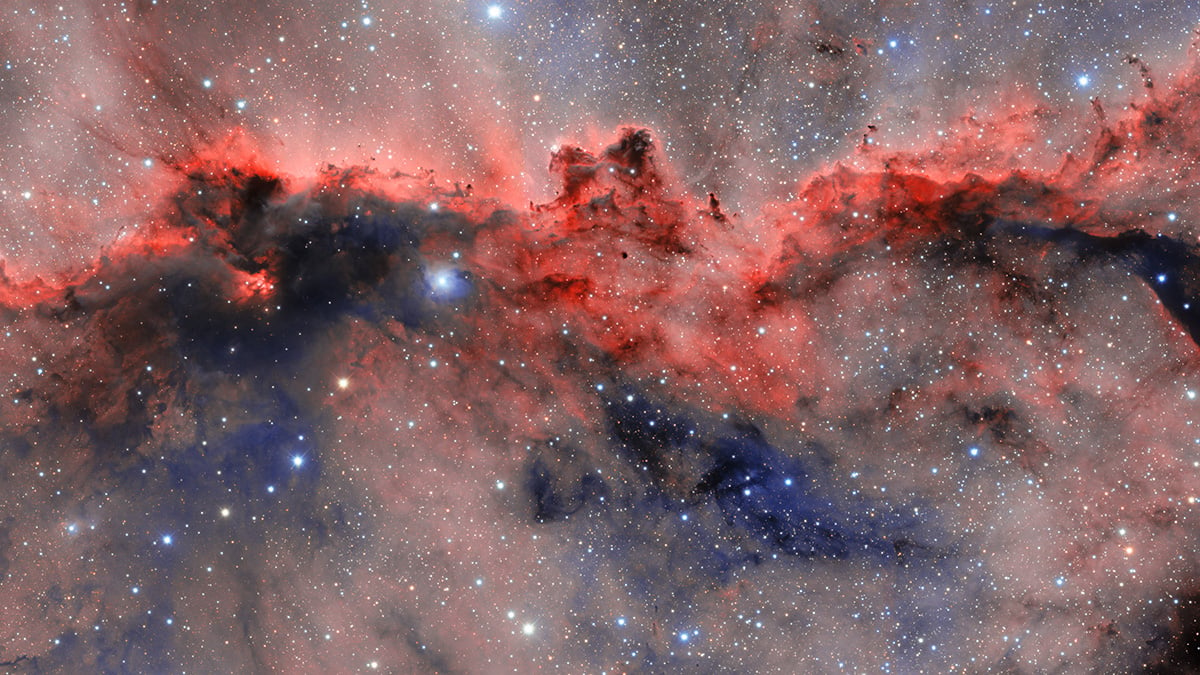
One of the latest images from NOIRLab turns a familiar southern target into a data-rich scene. The frame centers on NGC 6188, an emission nebula in Ara, and the nearby open cluster NGC 6193. The image comes from the Dark Energy Camera (DECam) on the Víctor M. Blanco 4-meter Telescope at Cerro Tololo Inter-American Observatory in Chile. The picture earns its informal title, “Dueling Dust Dragons,” from two dark, sculpted ridges. They run across the center like opposing profiles. The view is striking, but it is also informative. It captures how young massive stars carve a cloud and light the gas around them.
The nebula and its neighborhood
NGC 6188 sits about 4,000 light-years away, near the edge of a large molecular cloud in Ara. Molecular clouds are the raw material for new stars. Their cold gas collapses under gravity, forming dense cores and then stellar embryos. In this region, that process is active and ongoing. The nebula’s bright arcs mark the places where energetic radiation meets dust and gas. The red glow along the ridges comes mainly from ionized hydrogen. Young, hot stars emit intense ultraviolet light that strips electrons from hydrogen atoms. When the electrons recombine, the gas emits visible light. That emission dominates the familiar H-alpha line and produces the red cast in many star-forming regions. In NGC 6188, you can see that glow tracing the boundaries of the denser structures.
Young stars that set the shape
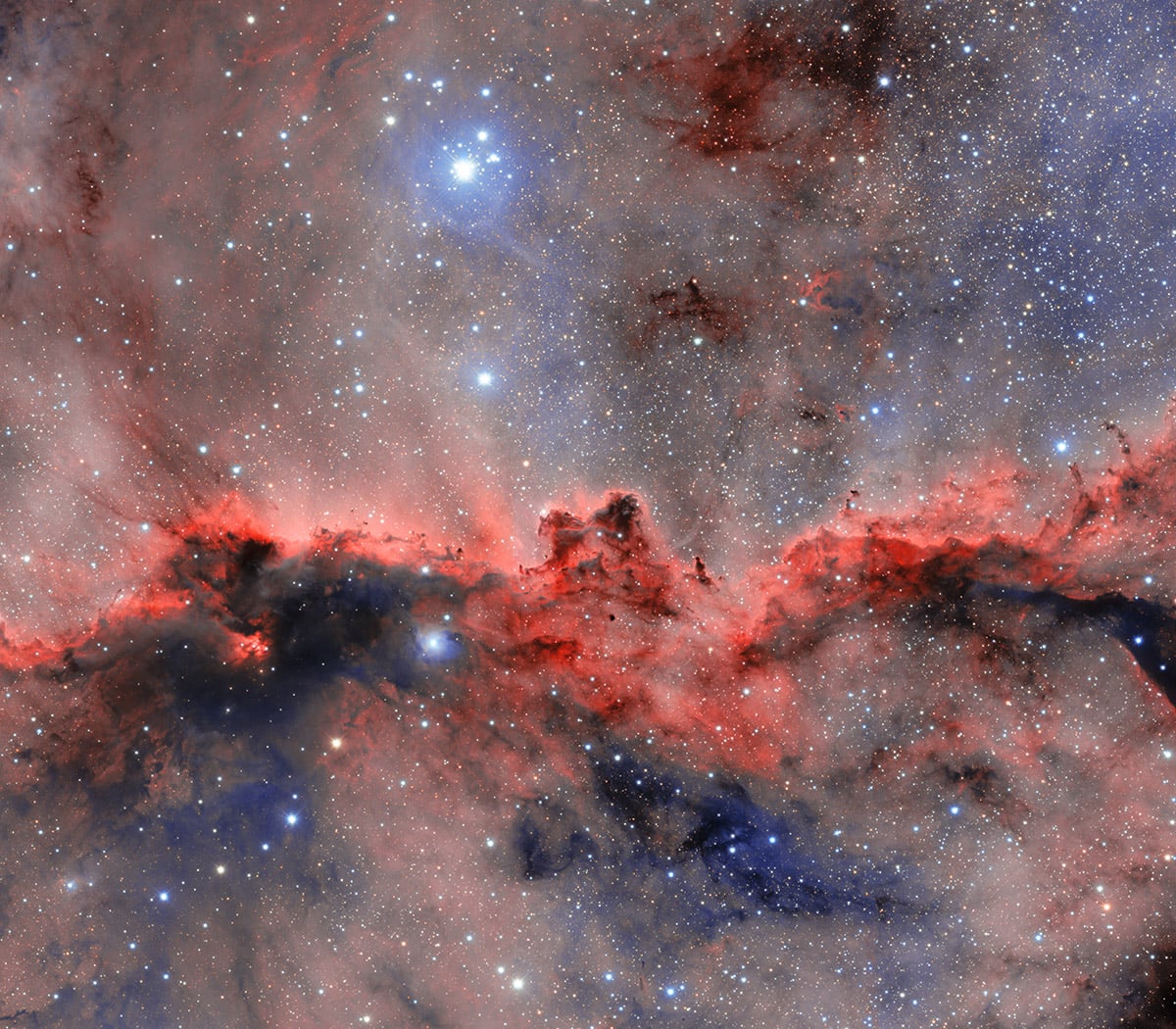
The structures in NGC 6188 are not static. They are being sculpted by newborn stars embedded in the cloud. These stars are only a few million years old. They flood their surroundings with radiation and strong winds. That output erodes nearby gas, compresses denser pockets, and drives new rounds of collapse. Over time, this “feedback” process both triggers and regulates star formation. The open cluster NGC 6193 is the most prominent local group of these young stars. It contains 27 bright members in the upper-left part of the image. Their light and winds help illuminate and shape the adjacent nebulosity. Observers use this cluster as a signpost when framing the nebula. It also serves as a laboratory for studying early stellar evolution in a nearby environment.
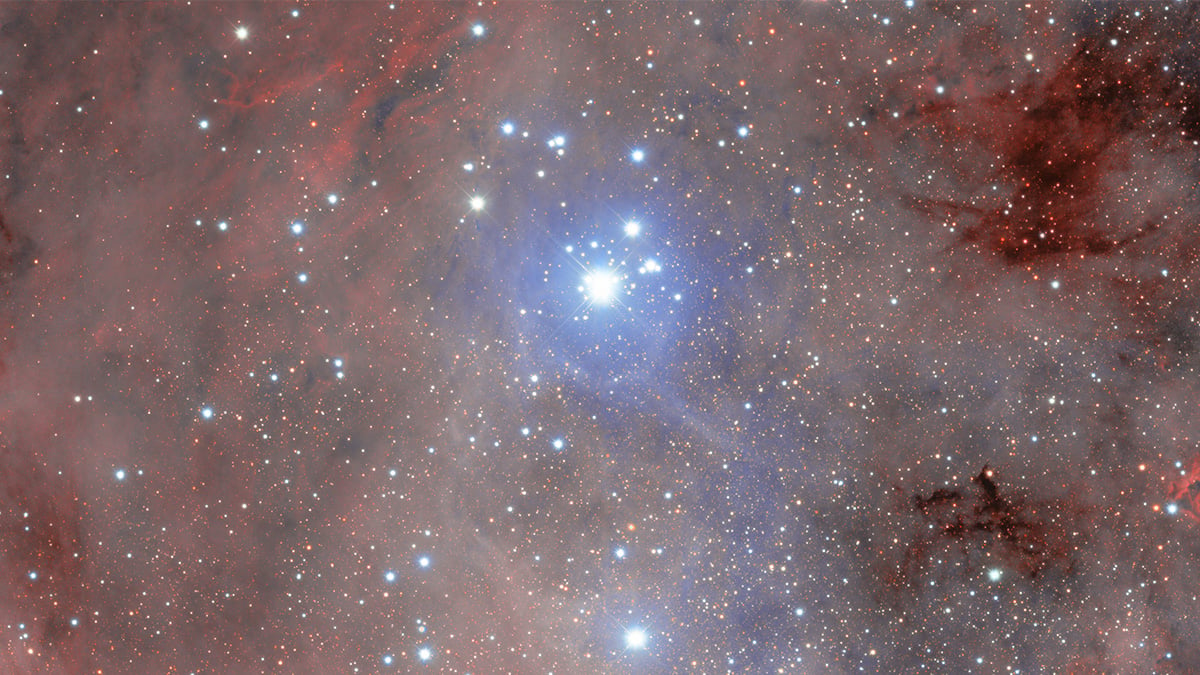
How DECam and the Blanco Telescope captured it
DECam is a wide-field optical imager built for precise, deep surveys. It uses 62 science CCDs for a total of about 520 megapixels. Each pixel samples 0.263 arcseconds on the sky. The camera covers roughly 3 square degrees in a single exposure, with a field about 2.2 degrees wide. That combination delivers both detail and area, ideal for large nebulae like NGC 6188. The camera sits at the prime focus of the 4-meter Blanco Telescope. The Blanco mirror and support structure are designed for stability and a wide field. That allows DECam to gather sharp, uniform data across its large focal plane. The instrument was developed for the Dark Energy Survey and installed at CTIO, which is now part of NSF’s NOIRLab. DECam’s origins also reflect a broader partnership that includes the U.S. Department of Energy.
Reading the colors and structures
Interpreting the scene starts with the red emission. As noted, hydrogen dominates that channel, especially along irradiated edges. The darker bands are dust lanes that block background light. Between them lie knots and scalloped rims where gas erodes at different rates. These variations reflect density differences in the cloud and the angle of the radiation field. The relationship between NGC 6193 and NGC 6188 is particularly clear. The cluster’s young, massive stars supply the radiation that lights the nebula. Their winds carve cavities and drive shocks into the surrounding gas. Those shocks can compress the gas and seed new stars, continuing the cycle.
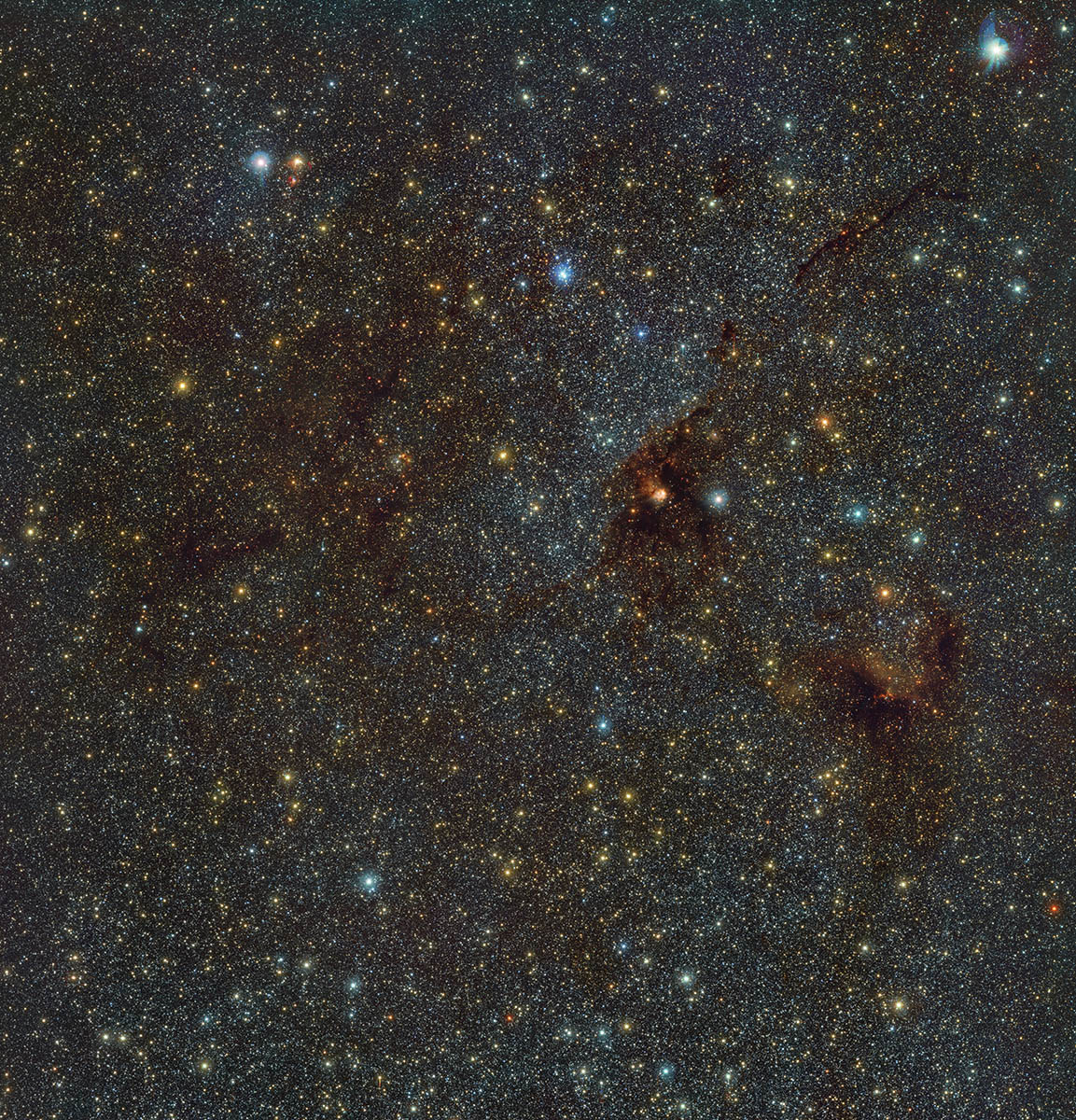
Images like this document how star formation proceeds in nearby complexes. By mapping ionization fronts and dust structures, astronomers track where gas is being removed and where it is being compressed. Knowing which parts of a cloud are eroding and which are collapsing shows how feedback shapes the next generation of stars. “Dueling Dust Dragons” points to a real physical boundary where young stars shape their birth cloud. The DECam view shows the boundary with both breadth and detail. You see the open cluster, the carved ridges, and the glowing gas in one frame. You also see how radiation and winds drive the appearance and evolution of the region.
Clear skies!
See more from DIYPhotography.net on Google
Add DIYPhotography.net as a trusted source. This makes
our stories more likely to appear in your Google Search results.
 Add as a preferred source on Google

Soumyadeep Mukherjee
Soumyadeep Mukherjee is an award-winning astrophotographer from India. He has a doctorate degree in Linguistics. His work extends to the sub-genres of nightscape, deep sky, solar, lunar and optical phenomenon photography. He is also a photography educator and has conducted numerous workshops. His works have appeared in over 40 books & magazines including Astronomy, BBC Sky at Night, Sky & Telescope among others, and in various websites including National Geographic, NASA, Forbes. He was the first Indian to win “Astronomy Photographer of the Year” award in a major category.

Join the Discussion
DIYP Comment Policy
Be nice, be on-topic, no personal information or flames.