





















ALMA photographs Hidden Structures in the Universe’s First Galaxies
Jul 4, 2025
Soumyadeep Mukherjee
Soumyadeep Mukherjee is an award-winning astrophotographer from India. He has a doctorate degree in Linguistics. His work extends to the sub-genres of nightscape, deep sky, solar, lunar and optical phenomenon photography. He is also a photography educator and has conducted numerous workshops. His works have appeared in over 40 books & magazines including Astronomy, BBC Sky at Night, Sky & Telescope among others, and in various websites including National Geographic, NASA, Forbes. He was the first Indian to win “Astronomy Photographer of the Year” award in a major category.
Share:
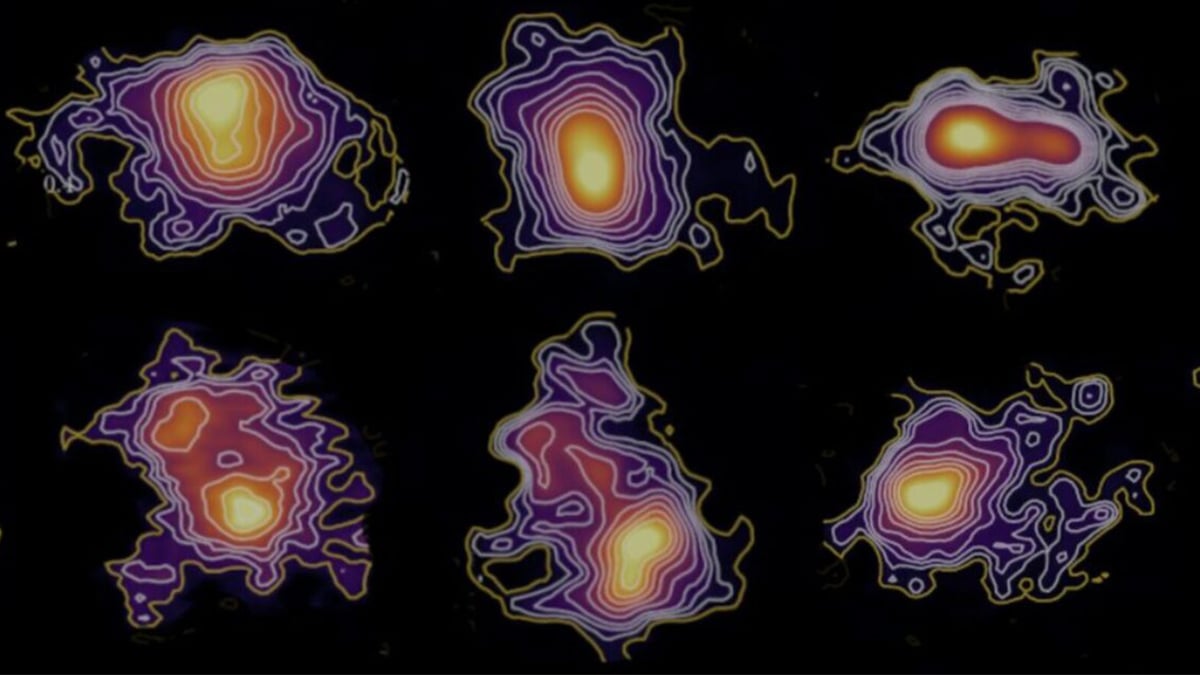
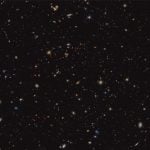
The Atacama Large Millimeter/submillimeter Array (ALMA) has peered into the early Universe to uncover something remarkable. For the first time ever, astronomers have mapped the detailed internal structure of galaxies that existed over 12 billion years ago. This discovery comes from a new ALMA project called CRISTAL. It stands for “[C II] Resolved ISM in STar-forming galaxies with ALMA.” These results are not about rare or massive galaxies. Instead, they focus on ordinary galaxies. The kind that are thought to evolve into galaxies like our Milky Way. The team observed 39 such galaxies. These galaxies existed just one billion years after the Big Bang. They live in what astronomers call the “cosmic dawn.”
What did ALMA do?
ALMA observed the galaxies in a special kind of light. Not visible light. Not infrared either. Instead, ALMA detected emission from a specific form of carbon. This is called singly ionized carbon, or [C II]. This type of emission comes from cold gas and dust. These are the raw materials for forming stars. This cold gas is usually invisible to regular telescopes. Even the powerful Hubble Space Telescope or the James Webb Space Telescope (JWST) cannot detect it easily. ALMA, on the other hand, specializes in this kind of work. It operates in the millimeter and submillimeter range. This lets it see things hidden behind dust clouds. By mapping the [C II] emissions, ALMA provided a new kind of image. It showed the actual structure of galaxies at a time when the Universe was still young. These are the earliest building blocks of cosmic architecture.
![A family portrait of galaxies from the CRISTAL survey. Red shows cold gas traced by ALMA’s [CII] observations. Blue and green represent starlight captured by the Hubble and James Webb Space Telescopes. Credit: ALMA (ESO/NAOJ/NRAO) / HST / JWST / R. Herrera-Camus](https://www.diyphotography.net/wp-content/uploads/2025/07/cristal-3.jpg)
Findings
The galaxies did not look like smooth blobs. Instead, they had internal structures. Some had multiple bright clumps of [C II] emission. These clumps are thousands of light-years across. They mark regions where stars are forming. Some galaxies showed signs of rotation. This means they were already forming disk-like structures. That is important. Disk galaxies are very common in the modern Universe. Our Milky Way is one. Finding early disks suggests galaxy evolution began earlier than we thought.
One galaxy, CRISTAL‑13, was invisible in starlight. But it glowed brightly in [C II]. That means it is full of dust. The dust blocks light from stars but lets [C II] through. Another galaxy, CRISTAL‑10, had very low [C II] for the amount of starlight it produced. This hints at unusual physical conditions. Maybe extreme radiation. Or different chemical makeup. These kinds of findings are only possible with ALMA. It reveals the parts of galaxies that are otherwise hidden.
![A family portrait of galaxies from the CRISTAL survey. The image shows the gas traced by ALMA’s [CII] observations. Blue and green represent starlight captured by the Hubble and James Webb Space Telescopes. Credit: ALMA (ESO/NAOJ/NRAO) / HST / JWST / R. Herrera-Camus](https://www.diyphotography.net/wp-content/uploads/2025/07/cristal-1.jpg)
What makes CRISTAL special
Most earlier studies looked at extreme galaxies. Very bright. Very active. Not typical. The CRISTAL survey, by contrast, selected normal galaxies. These are more common. But also harder to study. They are fainter. That is why they were not examined in detail before. Now, thanks to ALMA’s sensitivity and resolution, we can see their internal structure. And not just for one or two. The CRISTAL survey includes 39 galaxies. That’s enough to draw broader conclusions. We can begin to see patterns. We can compare different kinds of galaxies. This is the first time we have such a complete view of early galaxy structure.
Tools used
The CRISTAL survey was led by a large international team. The principal investigator is Dr. Annalisa Pillepich of the Max Planck Institute for Astronomy. The project involved more than 100 scientists from multiple countries. The team combined ALMA data with images from Hubble and JWST. These telescopes show the stars. ALMA shows the gas. Put together, they tell the full story. The galaxies came from earlier surveys like COSMOS and CANDELS. These areas of the sky have deep observations. That makes them ideal for detailed study.

The CRISTAL survey provides the clearest view yet of galaxy formation at cosmic dawn. It shows us that even ordinary galaxies were complex and dynamic. ALMA continues to be one of the most powerful tools in astronomy. Its ability to see the invisible opens new windows into the past. And with each new survey, we move closer to understanding how the universe came to be.
Clear skies!
See more from DIYPhotography.net on Google
Add DIYPhotography.net as a trusted source. This makes
our stories more likely to appear in your Google Search results.
 Add as a preferred source on Google

Soumyadeep Mukherjee
Soumyadeep Mukherjee is an award-winning astrophotographer from India. He has a doctorate degree in Linguistics. His work extends to the sub-genres of nightscape, deep sky, solar, lunar and optical phenomenon photography. He is also a photography educator and has conducted numerous workshops. His works have appeared in over 40 books & magazines including Astronomy, BBC Sky at Night, Sky & Telescope among others, and in various websites including National Geographic, NASA, Forbes. He was the first Indian to win “Astronomy Photographer of the Year” award in a major category.



Join the Discussion
DIYP Comment Policy
Be nice, be on-topic, no personal information or flames.