















The Inverse Square Law Experiment Done Right – Myth unBusted
Sep 30, 2009
Udi Tirosh
Udi Tirosh is an entrepreneur, photography inventor, journalist, educator, and writer based in Israel. With over 25 years of experience in the photo-video industry, Udi has built and sold several photography-related brands. Udi has a double degree in mass media communications and computer science.
Share:
 Yesterday I posted a cheat sheet that tried to question the applicability of the Inverse Square Law (ISL) on the way we use portable flashes I called this post The Inverse Square Law Cheat Sheet – Myth Busted.
The post stirred up a great conversation from which I learned about Light, some physics and some in camera processing facts. But mostly I learned that it is great fun to experiment and to share your findings. It definitely helped me get my knowledge to a higher level (at the small price of throwing a way my totally wrong fringy and conventions breaking experiment.
Firstly, The Inverse Square Law Experiment Done Right
Indecently Tim Rogan conducted the very same experiment just a few weeks ago.

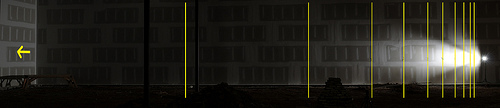
Images by Tim Rogan
Tim took a bit of a different approach to measuring light fall off. Surprisingly, his results were almost dead on with the ISL:
Measured the light with a light meter from a flash on manual mode.
Lines are whole stops. Even when it looks totally dark on the wall you
are still getting light. Light was measured by holding a light meter
flash head high about a foot away from the wall.Using the flash I put a piece of tape at every whole stop
This Make Me Wonder What Was Wrong In The First Experiment
Thanks for every one that cheeped in the discussion – I will bring the main points here, however, I encourage everyone to go to the original post, read the great comments, and join the discussion.
Location Of Measurement (Joshua Targownik)
Light has to be measured on Axis constantly. Measuring light off axis contributes to part of the falloff.
Reflected Light and Incident Angle (Joshua Targownik)
The light measured on the original experiment is reflected from the wall (which in itself is not ideal), but further more – the light is reflected in different angles depending on the distance from the flash. The deviation in the incident angle changes the amount of reflected light.
Surface Across The Wall Is Not Even (Anon)
This one is an obvious one – The wall has dents, planes in different angles, and color is not similar across concrete and block – all of which play a part when measuring reflected light.
Blown Highlights (Sean Phillips)
Any measurement that falls on the 255mark is inaccurate. basically the sensor got over exposed, so we don’t know what the exact value of exposure would have been if the light was within the limits.
In Camera Curves (Matti Rintala)
Camera has built in curves that are meant to enhance mid tone, hence post-shutter-click pixel data cannot be used for light measurements.
Even So, There Are Things To Learn From This Exercise
We Still Get To See The Light Patterns (Roger Barnes)
While we cannot deduce about the light intensity, we can see in what shape the light travels with each of the modifiers.
Reflection on the ISL (olli Rinne, Max)
This is a good opportunity for reflection, how can it be that the light behaves the same when it is directed by a small reflector/ lens inside the flash. What factor is missed. Of course, as Olli indicated, light is not a Laser. However, “simple” flashlight, where the light goes through a lens does not obey the ISL. This is a point to think about.
On the other hand, Max came up with a nice metaphor – think about the flash as a collection of point light sources
Additional Resources (Matti Rintala, Ian Mitchell)
“Light: Science & Magic” by Fil Hunter, Steven Biver, and Paul Fuqua is a great place to learn about the physical qualities of light.
Zack Arias provides a great explanation on ISL.

Udi Tirosh
Udi Tirosh is an entrepreneur, photography inventor, journalist, educator, and writer based in Israel. With over 25 years of experience in the photo-video industry, Udi has built and sold several photography-related brands. Udi has a double degree in mass media communications and computer science.


Join the Discussion
DIYP Comment Policy
Be nice, be on-topic, no personal information or flames.
One response to “The Inverse Square Law Experiment Done Right – Myth unBusted”
‘However, “simple” flashlight, where the light goes through a lens does not obey the ISL’ Obviously you learned nothing from this debacle.