























This Flat, Lensless Camera Could Push the Boundaries of Computational Imaging
Nov 24, 2015
Gannon Burgett
Gannon Burgett is a communications professional with over a decade of experience in content strategy, editing, marketing, multimedia content creation. He’s photographed and written content seen across hundreds of millions of pageviews. In addition to his communications work for various entities and publications, Gannon also runs his multimedia marketing agency, Ekleptik Media, where he brings his expertise as a full-stack creator to help develop and execute data-driven content strategies. His writing, photos, and videos have appeared in USA Today, Car and Driver, Road & Track, Autoweek, Popular Mechanics, TechCrunch, Gizmodo, Digital Trends, DPReview, PetaPixel, Imaging Resource, Lifewire, Yahoo News, Detroit Free Press, Lansing State Journal, and more.
Share:
 Researchers at Rice University have created FlatCam, a revolutionary lensless camera that measures in at only a few millimeters thick.
The key to this camera is the lack of lens. Rather than relying on comparatively bulky optics to focus an image, FlatCam uses a sensor beneath an incredibly thin mask of quartz and patterned chrome.
This mask works to separate the light hitting the sensor in such a way that software-based algorithms on a desktop computer can be used to extract an image – a method of photo capture known as computational imaging.
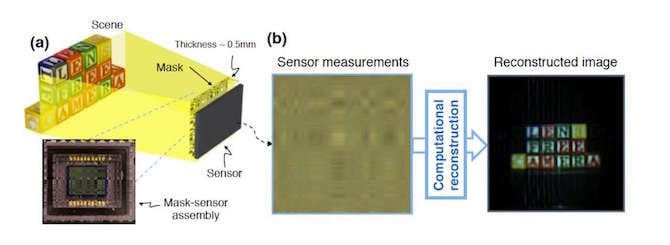 Considering FlatCam is still in its infancy, it’s no surprise the resulting images aren’t incredibly sharp or high resolution. As it stands, current FlatCam prototypes are capable of outputting a very blurry 512 x 512 pixel image as an output.
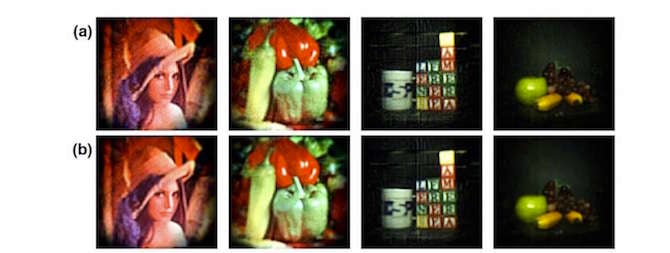 But as development continues, the research team is hopeful both sharpness and resolution will increase over time. Additionally, the team believes real-time previews will be able to be rendered on smartphone devices, rather than relying on a desktop computer.
Rice University Researchers Richard Baraniuk and Ashok Veeraraghavan acknowledge that FlatCam is never meant to replace traditional camera systems. Instead, they hope that its small size and flexibility are key components to making it a more viable solution in particular industrial and medical fields, where traditional camera designs aren’t as effective.
You can keep up with further developments of FlatCam on Rice University’s news page.
Image credits: Photos via Rice University

Gannon Burgett
Gannon Burgett is a communications professional with over a decade of experience in content strategy, editing, marketing, multimedia content creation. He’s photographed and written content seen across hundreds of millions of pageviews. In addition to his communications work for various entities and publications, Gannon also runs his multimedia marketing agency, Ekleptik Media, where he brings his expertise as a full-stack creator to help develop and execute data-driven content strategies. His writing, photos, and videos have appeared in USA Today, Car and Driver, Road & Track, Autoweek, Popular Mechanics, TechCrunch, Gizmodo, Digital Trends, DPReview, PetaPixel, Imaging Resource, Lifewire, Yahoo News, Detroit Free Press, Lansing State Journal, and more.


Join the Discussion
DIYP Comment Policy
Be nice, be on-topic, no personal information or flames.